You are here: Home » Blog » What is a cooling tower motor
What is a cooling tower motor
Views: 0 Author: Site Editor Publish Time: 2025-11-26 Origin: Site
What is a cooling tower motor
——Full analysis of structure, principle, type, and application
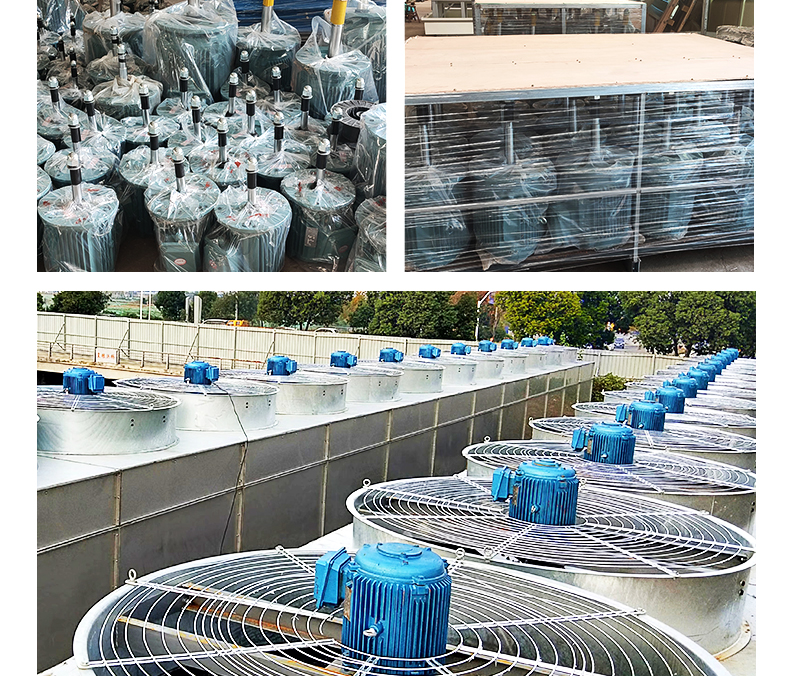
Cooling towers play an important role in dissipating waste heat in industrial, commercial air conditioning, and energy production systems. Among the many core components of the cooling tower, the most critical power source is the Cooling Tower Motor. It is responsible for driving the fan to operate, allowing sufficient heat exchange between air and circulating water, thereby achieving cooling. Below, a comprehensive introduction will be given to the cooling tower motor from the aspects of structural characteristics, working principles, types, and application scenarios.
Definition of Cooling Tower Motor
Cooling tower motor is a specialized electric motor designed specifically for the environment and operational needs of cooling towers, usually driven directly or through a reduction device to rotate fan blades. Its design needs to meet the requirements of high humidity, high temperature, and continuous operation, so it has stronger corrosion resistance, humidity resistance, and reliability compared to ordinary motors.
Working principle of cooling tower motor
The cooling tower reduces temperature by evaporating and dissipating heat between air and circulating water. When the cooling tower motor drives the fan to rotate, air is drawn into the interior of the tower, comes into contact with hot water, and carries away heat.
The fan speed, impeller structure, and motor power directly affect the efficiency of the cooling tower, while the stability of the motor determines whether the entire system can operate reliably for a long time.
Main characteristics of cooling tower motor
1. Waterproof and moisture-proof design
The humidity inside the cooling tower is extremely high, so the motor usually adopts a fully enclosed structure (such as TEFC) and is equipped with waterproof end caps and special coatings.
2. Strong corrosion resistance
The cooling tower water contains minerals or chemical treatment agents, and the motor casing needs to have corrosion resistance, such as using stainless steel, epoxy coating, etc.
3. Continuous long-term operation
Cooling towers often require 24/7 uninterrupted operation, so motors need to have high durability and low failure rates.
4. High efficiency and energy-saving control
When used in conjunction with a frequency converter (VFD), the speed can be automatically adjusted according to the actual cooling load to reduce energy consumption.
Types of cooling tower motors
According to different cooling tower structures and application scenarios, cooling tower motors can be divided into:
1. Direct Drive Motor
1)The motor is directly connected to the fan
2)Simple structure and low maintenance
3)Low noise
4)Suitable for small or medium-sized cooling towers
2. Belt or Gear Motor
1)Increasing torque through a reducer
2)More suitable for large fans
3)Easy to adjust fan speed
4)High maintenance volume
3. Explosion proof cooling tower motor
1)Used in situations that require strict safety standards, such as petrochemical plants
2)High explosion-proof rating, more sealed structure
Typical application areas of cooling tower motors
Cooling towers and their motors are widely used in:
1)Central air conditioning system (such as large commercial complexes, hospitals, airports)