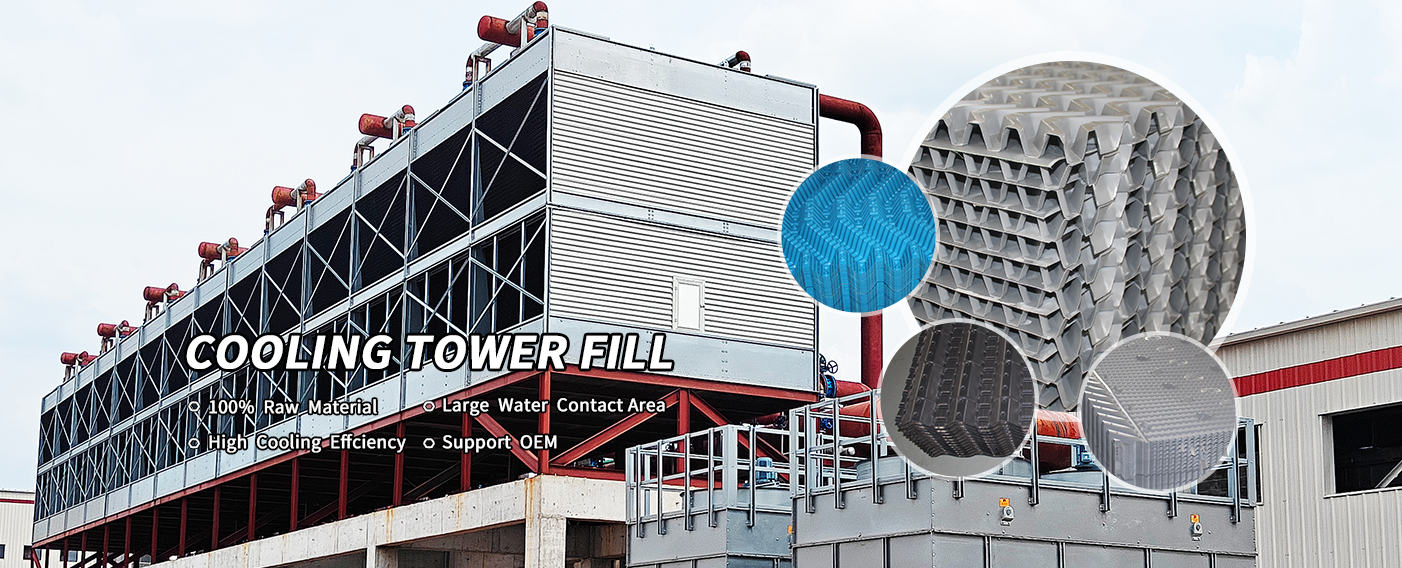
Choosing the right PVC cooling tower fill manufacturer can have a surprisingly large impact on cooling tower performance. Although cooling tower fill may look like a simple plastic component, it is actually one of the most important heat-transfer elements inside a wet cooling tower.
When fill becomes clogged, damaged, incorrectly sized, or poorly matched to operating conditions, even a powerful fan and efficient water distribution system may fail to deliver the expected cooling performance.
So, who should you consider when sourcing PVC cooling tower fill?
In this guide, we compare five well-known manufacturers and suppliers with different strengths: Power Tower Cooling Technology (Shaoxing) Co., Ltd., Brentwood Industries, SPX Cooling Technologies/Marley, Baltimore Aircoil Company (BAC), and EVAPCO.
Rather than simply ranking companies by popularity, we will look at their product capabilities, PVC fill technology, replacement solutions, customization potential, and application suitability.
What Is PVC Cooling Tower Fill?
PVC cooling tower fill is a structured heat-transfer medium installed inside a wet cooling tower. Its basic purpose is simple: increase the contact area between water and air.
Hot circulating water enters the cooling tower's distribution system and flows over the fill. At the same time, air moves through the fill. The structured PVC surface spreads the water into thin films, creating a much larger contact area for heat and mass transfer.
As part of the evaporative cooling process, a small portion of the circulating water evaporates. The evaporation removes heat from the remaining water, which then returns to the industrial process or HVAC system at a lower temperature.
In simple terms, the cooling tower fill is where much of the actual cooling action happens.
The better the water distribution, airflow, fill geometry, and material match the application, the more effectively the tower can reject heat.
How PVC Fill Works in a Cooling Tower
Imagine a cooling tower without fill. Water would simply fall through the tower while air moves around it. The two streams would still interact, but the available contact area would be relatively limited.
Now add structured film fill.
The PVC sheets create thousands of channels and surfaces over which water can spread. Air passes through these passages while water flows over the fill surface. This creates a much larger area for heat and moisture transfer.
Different fill designs use different flute patterns, sheet spacing, heights, and configurations.
In a counterflow cooling tower, air generally travels upward while water flows downward. In a crossflow cooling tower, air moves horizontally across water falling through the fill.
That difference matters.
A fill product designed for one tower configuration may not be the best choice for another. This is why experienced suppliers do more than quote a price. They first look at the tower design and operating conditions.
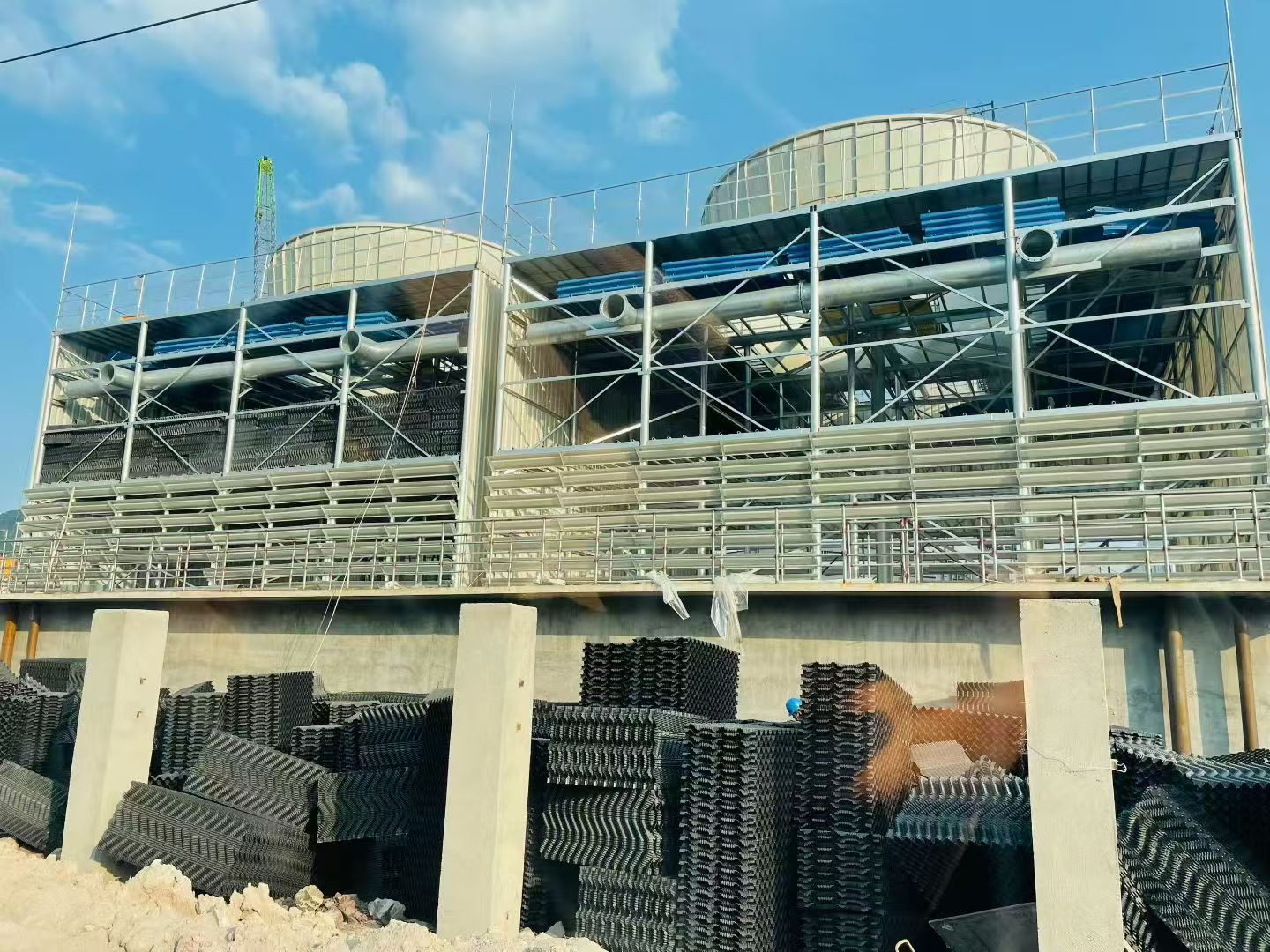
Why PVC Is Widely Used for Cooling Tower Fill
PVC remains one of the most popular materials for cooling tower fill because it offers a practical balance between:
PVC can be thermoformed into complex flute patterns and assembled into compact fill packs.
It is also widely available, which makes replacement sourcing easier for cooling tower operators around the world.
For many conventional HVAC and industrial cooling applications, properly designed PVC film fill provides an effective combination of heat-transfer performance and cost efficiency.
However, PVC is not automatically the right choice for every application.
High-temperature processes, aggressive chemical environments, severe fouling, or unusual water conditions may require alternative materials or specially designed fill.
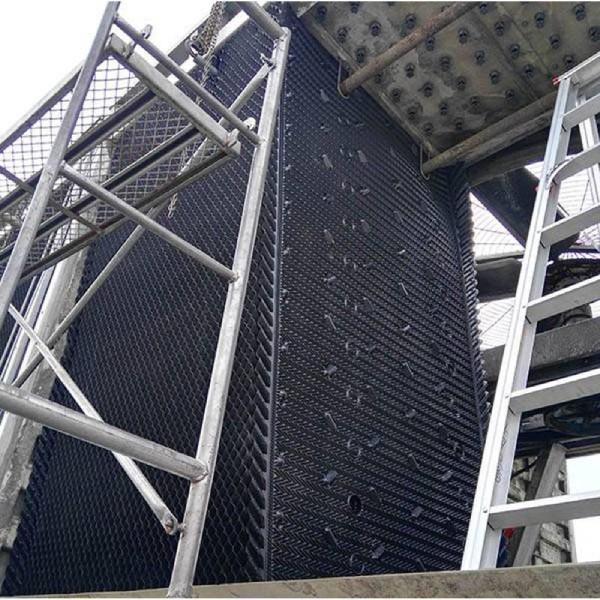
What Makes a Good PVC Cooling Tower Fill Manufacturer?
Not every company selling PVC fill should automatically be considered a qualified cooling tower fill manufacturer.
The important question is whether the supplier understands the relationship between material, geometry, water loading, airflow, temperature, fouling, and tower design.
A good manufacturer should be able to discuss more than price per square meter.
The supplier should understand how its product will perform inside the actual cooling tower.
Material Quality
Material quality is the foundation of reliable cooling tower fill.
PVC fill is continuously exposed to water, airflow, temperature changes, chemicals, biological growth, and mechanical stress. The material therefore needs to maintain suitable physical properties throughout its service life.
When evaluating a supplier, ask for information about:
For demanding applications, you should also ask whether PVC is the best material or whether PP or another high-temperature material would be more appropriate.
Fill Geometry and Thermal Performance
PVC is only part of the equation.
The geometry of the fill can have a major influence on heat transfer, airflow resistance, water distribution, and fouling.
Common designs include:
Cross-fluted film fill
Offset-fluted fill
Vertical-fluted fill
Herringbone fill
Splash fill
Hybrid fill
A highly compact film-fill design can provide excellent heat-transfer performance, but narrow passages may be more vulnerable to clogging when circulating water contains high levels of suspended solids.
On the other hand, a more open design may provide better fouling resistance while requiring a larger volume to achieve the same thermal duty.
That is why “higher efficiency” does not always mean “better for every cooling tower.”
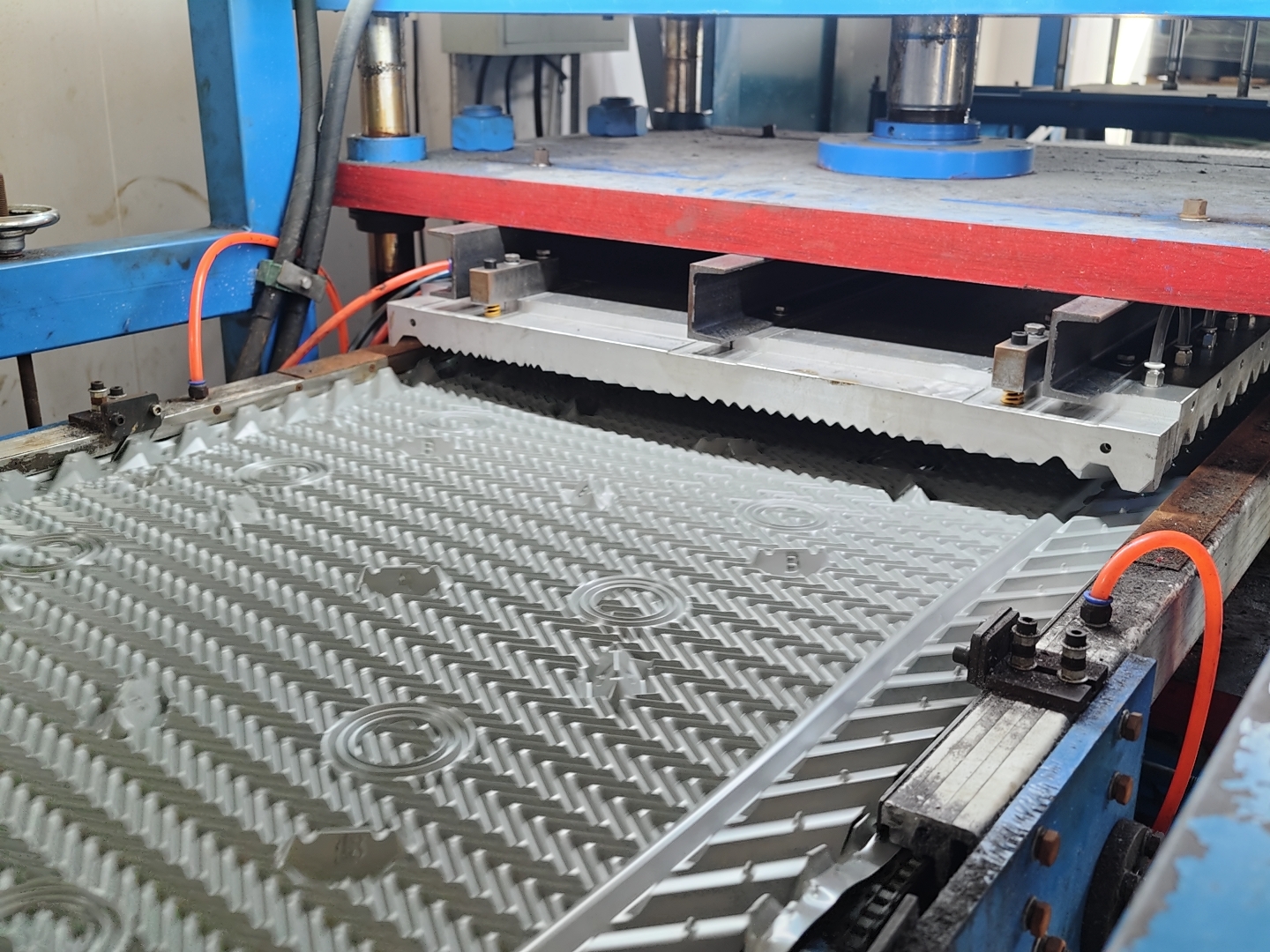
Manufacturing and Customization Capability
Replacement projects are often more complicated than new cooling tower projects.
An existing tower may have:
Non-standard fill dimensions
Older support structures
Modified water distribution systems
Unusual fill heights
Different sheet thicknesses
Limited installation space
A supplier capable of manufacturing customized fill can therefore be much more useful than a company that only sells standard products.
Before ordering replacement fill, provide the supplier with the tower model, existing fill dimensions, fill height, operating temperatures, water flow, and photographs if possible.
Replacement and Technical Support
A good supplier should think beyond the shipment.
Installation guidance, packaging, replacement quantities, support configuration, technical communication, and after-sales support all matter.
Cooling tower fill is not an ordinary plastic commodity. If the fill does not fit correctly, installation can quickly become expensive.
Top 5 PVC Cooling Tower Fill Manufacturers and Suppliers Worldwide
The following five companies are worth considering when researching PVC cooling tower fill manufacturers and suppliers worldwide.
Each company has a different market position, product portfolio, manufacturing capability, and approach to OEM or replacement fill.
1. Power Tower Cooling Technology (Shaoxing) Co., Ltd.

Power Tower Cooling Technology (Shaoxing) Co., Ltd. is a China-based manufacturer and supplier specializing in cooling tower components and replacement products.
The company operates CoolingTowerPart.com, offering cooling tower fill and related components for international customers.
Its product range includes cooling tower fill, PVC film fill, PP fill, splash fill, drift eliminators, cooling tower nozzles, and other replacement components.
For buyers looking specifically for PVC cooling tower fill, Power Tower can be an attractive option because its business is focused on cooling tower components rather than general plastic products.
The company can support different cooling tower configurations and replacement requirements.

PVC Fill Products and Custom Solutions
Cooling tower replacement projects rarely follow a one-size-fits-all model.
Power Tower can work with project information such as:
Fill dimensions
Fill height
Material requirements
Sheet thickness
Flute configuration
Cooling tower type
Water temperature
Water quality
Operating conditions
Replacement requirements
This information helps determine whether a particular PVC fill configuration is appropriate.
The company also offers PP cooling tower fill for applications where polypropylene may provide advantages over conventional PVC.
Why Choose Power Tower for Replacement Projects?
Think about an older cooling tower.
If the tower structure, fan, motor, pump, and water distribution system are still in reasonable condition, replacing damaged or heavily fouled fill may be much more practical than replacing the entire tower.
In that situation, replacement fill can act like a major performance upgrade without requiring a complete cooling tower replacement.
For international buyers, factory-direct sourcing can also provide advantages in terms of product customization, communication, and project coordination.
For more information about PVC cooling tower fill and related components, visit CoolingTowerPart.com.
2. Brentwood Industries
Brentwood Industries is an established manufacturer of cooling tower film fill and other water and wastewater treatment products.
The company offers several film-fill designs developed for different operating conditions and performance requirements.
Its cooling tower fill portfolio includes cross-fluted, herringbone, offset-fluted, vertical-fluted, and other configurations.
One of Brentwood's notable strengths is its focus on balancing thermal performance and fouling resistance.
This is especially important for industrial cooling tower operators.
A fill product can provide excellent heat transfer when it is clean. But what happens six months later when scale, biological material, and suspended solids begin accumulating?
That is where fill geometry becomes extremely important.
PVC Film Fill and Fouling-Resistant Designs
Different Brentwood fill designs address different operational challenges.
Cross-fluted designs can provide high thermal performance and promote lateral water distribution.
Vertical-fluted designs use larger openings and higher water-film velocities, which can be useful in applications where fouling is a concern.
This demonstrates an important purchasing lesson:
The most efficient fill on paper is not necessarily the best fill for your actual water conditions.
The right choice must balance heat transfer, airflow, fouling resistance, cleaning requirements, and operating cost.
3. SPX Cooling Technologies / Marley

SPX Cooling Technologies, including its Marley brand, is one of the best-known names in the global cooling tower industry.
Marley cooling towers have been used in industrial, power generation, HVAC, and other applications for decades.
For owners operating Marley equipment, Marley OEM fill is naturally an important option when evaluating replacement components.
Marley PVC Film Fill Solutions
Marley offers multiple cooling tower fill technologies.
One example is MVC20 counterflow film fill, which uses rigid PVC thermoformed sheets and is designed to provide efficient heat transfer while maintaining suitable airflow and fouling resistance.
OEM compatibility can be a significant advantage.
When a cooling tower owner already knows the tower model and original fill configuration, using a manufacturer-specific replacement product can simplify the engineering process.
SPX also has manufacturing capabilities for cooling tower plastics and components.
For Marley tower owners who prioritize OEM compatibility, established engineering support, and documented product performance, SPX Cooling Technologies remains an important supplier to consider.
4. Baltimore Aircoil Company (BAC)

Baltimore Aircoil Company (BAC) is another major global manufacturer of evaporative cooling and heat-rejection equipment.
BAC provides cooling towers, evaporative condensers, closed-circuit cooling towers, and replacement components.
BAC offers several replacement-fill solutions, including products such as BACount, BACross, VersaCross, QuickCross, and BAC Pak systems.
Its replacement fill products can be supplied in standard PVC as well as alternative materials for certain applications.
BAC PVC Replacement Fill
BAC's replacement approach is particularly useful for maintenance teams because replacement products can be designed around specific BAC cooling tower equipment.
When a tower has been operating for many years, finding a replacement product that fits correctly can be more important than simply finding the cheapest available fill.
BAC's factory-specific replacement solutions can help simplify this process for owners of BAC equipment.
The company also provides higher-temperature fill options for applications where standard PVC may not be sufficient.
5. EVAPCO
EVAPCO is another major manufacturer in the evaporative cooling industry and is well known for its cooling towers and related heat-transfer equipment.
One of its notable fill products is EVAPAK® fill, a PVC-based cooling tower fill designed for evaporative cooling equipment.
EVAPAK PVC Fill
EVAPCO describes EVAPAK as a cross-fluted counterflow fill designed to promote effective air-water mixing and heat transfer.
PVC provides the material characteristics needed for many conventional cooling tower applications.
One interesting aspect of EVAPCO's replacement approach is that replacement fill can also be considered for equipment manufactured by other cooling tower companies.
For buyers evaluating OEM and aftermarket replacement options, EVAPCO is therefore another manufacturer worth considering.
PVC Film Fill vs. Splash Fill
Which is better: PVC film fill or splash fill?
There is no universal answer.
The right choice depends on the cooling tower, water quality, thermal requirements, and operating environment.
PVC Film Fill
Film fill creates a large surface area for water and air contact.
Its major advantages include:
High heat-transfer efficiency
Compact design
Large effective surface area
Lower required fill volume in many applications
Suitable for many HVAC and industrial systems
However, film fill can be sensitive to fouling when water quality is poor.
Splash Fill
Splash fill breaks falling water into droplets as it moves through the tower.
It can be a good option for applications where water contains significant suspended solids or where fouling resistance is particularly important.
The trade-off is that splash fill may require more volume to achieve comparable thermal performance.
Some cooling tower designs combine film and splash technologies to achieve a balance between thermal performance and fouling resistance.
PVC vs. PP Cooling Tower Fill
PVC and PP are two common materials used for cooling tower fill.
So, which one should you choose?
The answer depends on the operating environment.
PVC offers an excellent balance of price, availability, formability, and thermal performance for many conventional cooling towers.
PP, or polypropylene, can be attractive in applications where higher temperature capability or particular chemical-resistance characteristics are required.
But PP is not automatically better than PVC.
If a cooling tower operates within the suitable temperature and water-quality range for PVC, there may be little reason to pay more for a different material.
The best approach is to select the material according to actual operating conditions.
How to Choose the Right PVC Cooling Tower Fill
Selecting cooling tower fill should be treated as an engineering decision rather than simply a purchasing decision.
Start with the cooling tower and work backward.
Check the Cooling Tower Type
First determine whether the tower is:
Counterflow
Crossflow
Induced draft
Forced draft
Open circuit
Closed circuit
The fill geometry needs to match the airflow and water-flow arrangement.
Do not assume that one PVC fill product can replace every type of cooling tower fill.
Evaluate Water Quality
Water quality is one of the biggest factors affecting fill selection.
Suspended solids, biological growth, scale, oil, and other contaminants can gradually block narrow passages.
If the circulating water is relatively clean and well treated, high-performance film fill may be an excellent choice.
If fouling is severe, a more open fill geometry may be preferable.
Check Operating Temperature
Temperature is another important consideration.
Not every PVC fill product has the same temperature capability.
Before ordering, ask the supplier to confirm the recommended operating temperature range.
For high-temperature applications, alternative materials such as PP or specially designed high-temperature plastics may need to be considered.
Confirm Fill Dimensions
Never order replacement fill based only on a photograph.
Confirm:
Length
Width
Height
Sheet thickness
Flute pattern
Module configuration
Support arrangement
A fill pack that is slightly different in size may not fit properly into the existing tower.
This is especially important for older cooling towers.
Consider Fouling and Maintenance
A highly efficient fill can lose its advantage if it becomes heavily clogged.
Ask yourself:
How easy will this fill be to inspect, clean, and maintain?
The ideal product is not necessarily the fill with the highest theoretical thermal efficiency.
It is the fill that provides an appropriate balance between:
Heat transfer + airflow + fouling resistance + maintenance + service life.

When Should You Replace PVC Cooling Tower Fill?
There is no universal replacement interval for cooling tower fill.
Service life depends on:
Water quality
Air quality
Operating temperature
Biological control
Scaling
Fouling
Cleaning practices
Chemical treatment
Mechanical damage
Some cooling towers operate for many years before requiring major fill replacement, while heavily contaminated industrial systems may need replacement much sooner.
Common warning signs include:
Cracked or Brittle Fill
PVC sheets can become damaged over time. Cracking, brittleness, or physical deformation can reduce the effectiveness of the fill.
Heavy Scaling
Scale deposits reduce the available heat-transfer surface and can restrict airflow.
Biological Growth
Algae, slime, and biological deposits can block fill channels and reduce cooling performance.
Collapsed Fill Packs
If fill packs deform or collapse, water distribution and airflow can change significantly.
Declining Cooling Performance
If the tower suddenly struggles to achieve its normal cold-water temperature, the fill should be inspected along with the fan, nozzles, water distribution, and other components.
Questions to Ask a PVC Cooling Tower Fill Supplier
Before placing an order, ask the supplier several practical questions.
What type of PVC material is used?
What is the sheet thickness?
What fill geometry do you recommend?
Is the product designed for counterflow or crossflow cooling towers?
What operating temperature is recommended?
How does the fill handle fouling?
Can you manufacture custom dimensions?
Can you provide product drawings?
Can you supply samples?
Can you recommend a replacement based on existing fill dimensions?
These questions can quickly distinguish a technical cooling tower manufacturer from a company that simply resells generic plastic products.
Why Factory-Direct PVC Cooling Tower Fill Can Be Worth Considering
For large cooling tower projects, sourcing directly from a manufacturer can provide several advantages.
First, communication is usually more direct.
Instead of passing technical questions through several trading companies, buyers can communicate directly with the manufacturer about dimensions, materials, production, packaging, and customization.
Second, factory-direct purchasing may provide more flexibility for customized products.
Third, buyers can potentially source multiple cooling tower components from the same supplier.
For example, a replacement project may require:
Working with a specialized cooling tower component manufacturer can make procurement easier.
Final Buying Advice
Choosing the right PVC cooling tower fill manufacturer and supplier is about much more than finding the lowest price.
The real value comes from matching the:
Fill material + geometry + dimensions + thermal requirements + water quality + cooling tower configuration.
Brentwood Industries is worth considering for buyers looking for a broad range of film-fill geometries and fouling-focused designs.
SPX Cooling Technologies and Marley are particularly relevant for Marley cooling tower owners who prioritize OEM compatibility and established engineering support.
Baltimore Aircoil Company offers a wide range of replacement fill solutions for BAC equipment, while EVAPCO provides its own PVC EVAPAK technology and replacement options.
For buyers looking for a China-based PVC cooling tower fill manufacturer and supplier, Power Tower Cooling Technology (Shaoxing) Co., Ltd. is an option worth evaluating.
Its focus on cooling tower components, PVC and PP fill, replacement products, and customized solutions makes it suitable for international buyers looking for factory-direct cooling tower fill.
The smartest approach is simple:
Match the fill to the tower. Match the material to the operating conditions. Match the supplier to the project.
When these three factors come together, PVC cooling tower fill becomes much more than a plastic replacement component. It becomes an important part of maintaining reliable heat rejection, efficient operation, and long-term cooling tower performance.
For more information about PVC cooling tower fills, cooling tower replacement fill, PVC film fill, PP fill, and other cooling tower components, visit CoolingTowerPart.com.


