Film Fill Cooling Tower: Types, Benefits and Applications
A film fill cooling tower uses specially designed fill media to spread water into thin films while air moves through the fill. This design dramatically increases the contact area between water and air, helping the tower remove heat efficiently through evaporation.
Film fill has become a popular solution for HVAC systems, industrial process cooling, power plants, chemical facilities, food processing, and many other applications. Compared with traditional splash fill, film fill can provide a larger effective heat-transfer surface within a relatively compact volume.
However, choosing the right film fill is not simply about selecting a high-surface-area product. Material, flute design, water quality, operating temperature, airflow, fouling conditions, and tower configuration all influence actual performance.
This guide explains the different types of film fill for cooling towers, their benefits, applications, limitations, maintenance requirements, and replacement considerations.
What Is Film Fill in a Cooling Tower?
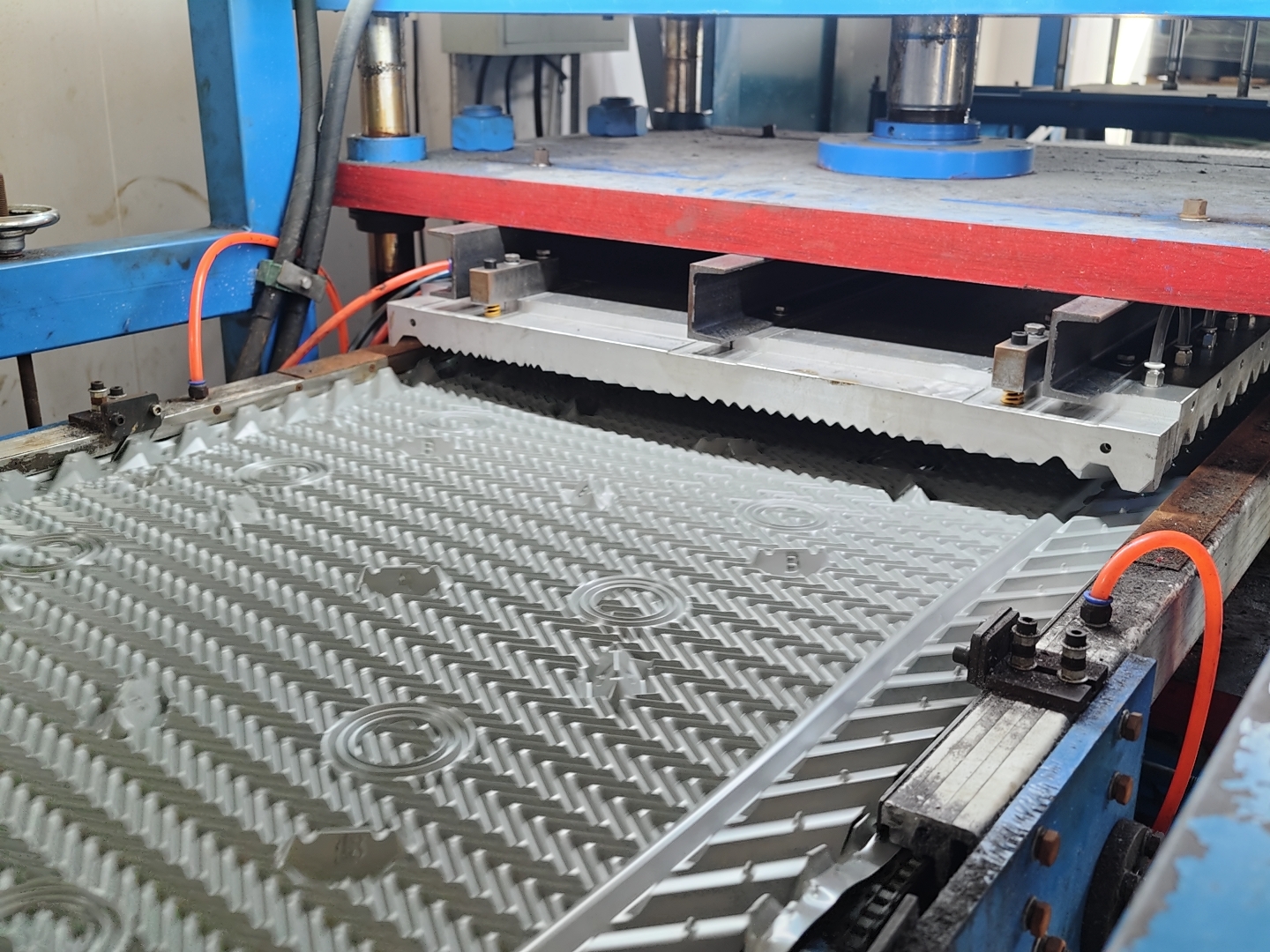
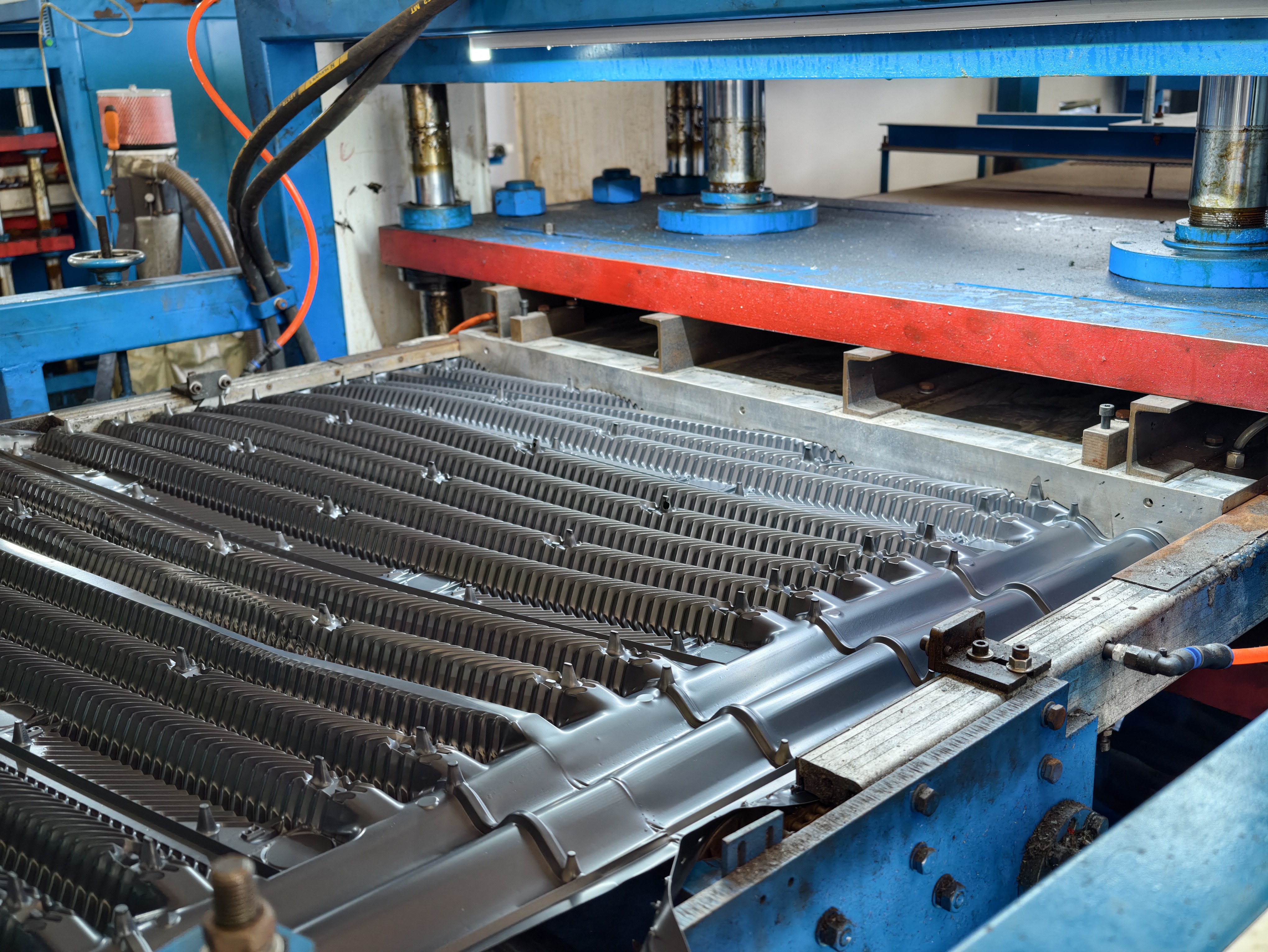
Cooling tower film fill is a structured heat-transfer media installed inside a wet cooling tower. Its surface is designed to distribute water into thin layers as it flows downward through the fill.
At the same time, air passes across or counter to the falling water.
How Does Film Fill Work?
The basic process can be divided into several stages:
Hot water enters the cooling tower.
The water distribution system spreads water over the fill.
Water flows across the structured fill surfaces.
Air passes through the fill.
A portion of the water evaporates.
Heat is transferred from the water to the air.
Cooled water collects in the basin.
Why Does a Thin Water Film Matter?
A thin water film provides a much greater effective contact area than a simple stream of water.
The greater contact area helps promote:
Evaporation
Heat transfer
Air-water interaction
Cooling efficiency
The Key Principle
The objective is not simply to make water move through the tower.
The objective is to create maximum useful air-water contact with acceptable airflow resistance and minimum fouling.
How Is Film Fill Different From Splash Fill?
Film fill and splash fill use different approaches to improve heat transfer.
Film Fill
Film fill spreads water across the surfaces of structured sheets.
Its main characteristics include:
Large effective surface area
Compact design
High heat-transfer potential
Structured airflow passages
Relatively low fill volume requirements
Splash Fill
Splash fill breaks water into droplets as it moves through the tower.
It is often preferred when water contains high concentrations of suspended solids or when resistance to blockage is a major concern.
Film Fill vs Splash Fill
| Feature | Film Fill | Splash Fill |
| Heat-transfer area | High | Moderate |
| Compactness | Excellent | Good |
| Fouling resistance | Moderate | Generally higher |
| Water quality requirement | More demanding | More forgiving |
| Typical material | PVC/PP | PP/PVC/wood/grid |
| Common application | HVAC/industrial | Industrial/dirty water |
Neither design is universally better. The correct choice depends on the operating environment.
What Are the Main Types of Film Fill Cooling Towers?
Film fill can be categorized according to material, geometry, tower configuration, and operating conditions.
PVC Film Fill
PVC film fill is one of the most widely used options for conventional cooling towers.
PVC offers a useful combination of:
Where Is PVC Film Fill Used?
PVC film fill is commonly found in:
PVC Film Fill Considerations
PVC is not suitable for every high-temperature application.
Before ordering, buyers should verify:
Entering-water temperature
Chemical exposure
Water treatment conditions
Fill manufacturer's temperature rating
Fire-retardant requirements
PP Film Fill
PP cooling tower fill is another important option, particularly where operating conditions require different material characteristics.
Polypropylene can provide advantages in applications involving higher temperatures or particular chemical environments.
Why Choose PP Film Fill?
Potential benefits include:
When Should PP Be Considered?
PP film fill can be worth considering when:
Water temperature is relatively high
The process involves aggressive chemicals
The existing PVC fill has temperature-related deformation
The tower manufacturer specifies PP
The exact operating temperature should always be confirmed with the manufacturer.
High-Temperature Film Fill
Some industrial cooling systems operate at temperatures beyond the preferred range of standard PVC film fill.
What Makes High-Temperature Fill Different?
High-temperature fill uses materials or formulations designed to maintain structural stability under more demanding conditions.
Applications can include:
Material Selection Comes First
A high-temperature application should not be solved simply by increasing sheet thickness.
Material selection, flute geometry, support structure, and water distribution must all be considered together.
Crossflow Film Fill
Crossflow cooling towers move air horizontally through the fill while water flows downward.
Characteristics of Crossflow Film Fill
Crossflow film fill can provide:
Where Is It Commonly Used?
Crossflow towers are widely used in:
Large HVAC systems
Commercial buildings
Industrial facilities
Manufacturing plants
Counterflow Film Fill
In a counterflow tower, air moves upward while water flows downward.
Advantages of Counterflow Film Fill
Counterflow film fill is often selected because it can provide:
What Makes Counterflow Fill Special?
The opposing movement of air and water allows the tower to maintain a strong thermal driving force through much of the fill section.
What Are the Main Benefits of Film Fill?
Film fill is popular because it combines high heat-transfer potential with a compact structure.
1. Large Effective Surface Area
The structured surface provides extensive contact between water and air.
Why Does Surface Area Matter?
The more effectively water can interact with air, the greater the opportunity for evaporation and heat transfer.
However, more surface area does not automatically mean better performance.
A fill with extremely fine passages can become inefficient if:
2. High Cooling Efficiency
Film fill can provide strong cooling performance in a relatively small volume.
Compact Cooling Tower Design
High-performance fill allows engineers to achieve the required thermal duty without making the tower unnecessarily large.
This can be especially valuable when installation space is limited.
3. Lower Fill Volume
Because film fill provides a large effective contact area, the required fill volume can be relatively compact compared with some splash-fill configurations.
Why Does This Matter?
A smaller fill volume can contribute to:
Compact tower dimensions
Lower structural requirements
Reduced material consumption
More flexible equipment design
4. Good Heat-Transfer Performance
Film fill continuously renews the water film as water flows over the structured surfaces.
The Heat-Transfer Mechanism
Heat removal involves both:
The evaporation process is particularly important in wet cooling towers.
5. Flexible Design Options
Film fill can be manufactured in different:
Materials
Sheet thicknesses
Flute patterns
Pitches
Block sizes
Surface structures
This allows manufacturers to optimize the fill for different applications.
What Factors Affect Film Fill Performance?
The performance of a film-fill cooling tower depends on much more than the fill itself.
Water Distribution
A high-quality fill cannot compensate for poor water distribution.
Why Is Distribution Important?
If some areas receive too much water while others receive too little:
Heat transfer becomes uneven
Some fill surfaces remain dry
Other areas may become overloaded
Tower capacity can decline
A Good Distribution System Should Provide
Airflow
Airflow is another critical factor.
Too Little Air
Insufficient airflow can reduce evaporation and heat transfer.
Too Much Air
Excessive airflow can increase:
Fan power
Pressure drop
Operating costs
Drift potential
The Goal
The best design balances airflow, water loading, heat transfer, and energy consumption.
Water Quality
Water quality can determine whether a particular film fill remains effective over time.
Common Contaminants
Cooling tower water may contain:
Suspended solids
Calcium deposits
Magnesium deposits
Organic matter
Algae
Corrosion products
Why Is This a Problem?
Small fill passages can become restricted by deposits.
As blockage increases:
Airflow decreases.
Water distribution becomes uneven.
Pressure drop increases.
Heat transfer declines.
Fan energy may increase.
Operating Temperature
Temperature is particularly important when selecting plastic film fill.
PVC vs PP
Standard PVC film fill may be appropriate for many conventional applications.
PP film fill may be considered where higher operating temperatures require a different material.
Always Check the Manufacturer's Specification
Do not assume that every PVC or PP product has the same temperature capability.
Material formulation, thickness, structure, and operating conditions can all influence service life.
What Are the Applications of Film Fill Cooling Towers?
Film-fill towers are used across a wide range of industries.
HVAC Cooling
Large air-conditioning systems frequently use cooling towers to reject heat from water-cooled chillers.
Typical Buildings
Applications include:
Office buildings
Shopping centers
Hotels
Hospitals
Airports
Data centers
Why Film Fill Is Suitable
HVAC systems often prioritize:
High efficiency
Compact equipment
Stable performance
Low operating cost
Industrial Process Cooling
Industrial facilities often require continuous heat rejection.
Typical Industries
Film-fill cooling towers can be used in:
Power Generation
Cooling towers are important in power-generation facilities where large quantities of heat must be rejected.
Film Fill Requirements
Power applications may require:
Chemical Industry
Chemical plants can have demanding cooling-water conditions.
Key Selection Factors
Engineers should consider:
Chemical compatibility
Water temperature
Fouling potential
Material resistance
Maintenance requirements
Why Material Matters
A plastic fill material that performs well in standard HVAC water may not be appropriate for a chemically aggressive process.
Food and Beverage Processing
Cooling towers can support refrigeration and process cooling in:
Breweries
Dairy plants
Beverage factories
Food-processing plants
Hygiene and Water Management
These applications require careful water-treatment and maintenance practices to prevent biological growth and excessive fouling.
How to Choose the Right Film Fill Cooling Tower?
Selecting film fill should start with the operating conditions rather than the product name.
Step 1: Determine the Tower Type
Identify whether the tower is:
Crossflow
Counterflow
Open circuit
Closed circuit
Why Does Tower Type Matter?
The airflow direction and water distribution arrangement determine which fill geometry is appropriate.
Step 2: Calculate the Thermal Requirement
Important parameters include:
Cooling Range
Cooling range is the difference between entering and leaving water temperature.
A basic relationship is:
Cooling Range = Hot Water Temperature − Cold Water Temperature
This is one of the key parameters used to evaluate tower duty.
Step 3: Evaluate Water Quality
Determine whether the water has:
Clean Water vs Dirty Water
Fine-pitch film fill can offer excellent heat transfer with relatively clean water.
For heavily contaminated water, a more open fill design may be safer.
Step 4: Select the Material
Choose between:
PVC
Best suited to many standard cooling applications.
PP
Worth considering for more demanding temperature or chemical conditions.
Step 5: Check Fill Dimensions
For replacement projects, measure the existing fill carefully.
Required Measurements
Record:
Length
Width
Height
Thickness
Flute pitch
Block arrangement
Don't Forget the Support Structure
The new fill must fit the existing support grid and tower geometry.
Film Fill Cooling Tower Maintenance
Even high-quality fill requires proper maintenance.
Regular Inspection
Inspect the fill periodically for:
Scaling
Biological growth
Mud
Cracks
Deformation
Blockage
What Should Operators Look For?
Early Warning Signs
Watch for:
Early detection can prevent larger maintenance problems.
Cleaning Cooling Tower Film Fill
Cleaning methods depend on the fill material and contamination.
Low-Pressure Cleaning
Low-pressure water cleaning can help remove loose deposits without excessively damaging the fill.
Chemical Cleaning
Chemical cleaning may be necessary for certain scale or biological deposits.
Chemical Compatibility
Before using cleaning chemicals, confirm compatibility with:
PVC
PP
Adhesives
Support structures
Other tower components
Cooling Tower Fill Replacement
Film fill eventually requires replacement when cleaning can no longer restore performance.
When Should Film Fill Be Replaced?
Consider replacement when the fill shows:
Replacement Process
1. Remove the Old Fill
Carefully remove damaged or fouled fill blocks.
2. Inspect the Tower
Check:
Supports
Water distribution
Nozzles
Drift eliminators
Louvers
3. Install New Fill
Ensure the new blocks are correctly aligned and securely supported.
4. Check Water Distribution
Verify that water reaches the fill evenly.
5. Test Cooling Performance
Compare operating temperatures and water flow after commissioning.
What Makes a Good Film Fill Manufacturer?
A reliable manufacturer should offer more than an attractive price.
Manufacturing Quality
Look for consistent:
Sheet thickness
Flute geometry
Bonding
Block dimensions
Material formulation
Why Is Consistency Important?
Even small dimensional differences can affect how water spreads across the fill.
Technical Support
A good manufacturer should be able to help with:
Fill selection
Thermal requirements
Replacement dimensions
Material selection
Installation
Customization Capability
For replacement projects, standard sizes may not always fit.
A manufacturer capable of producing customized blocks can be particularly valuable.
Quality Documentation
Ask suppliers for:
Technical datasheets
Material specifications
Drawings
Product photos
Test information
Packing specifications
How to Buy Film Fill From a Manufacturer?
International buyers should prepare detailed information before requesting a quotation.
Information to Include in an RFQ
| Parameter | Required Information |
| Tower type | Crossflow / Counterflow |
| Fill type | Film fill |
| Material | PVC / PP |
| Fill size | L × W × H |
| Sheet thickness | mm |
| Water flow | m³/h |
| Hot-water temperature | °C |
| Cold-water temperature | °C |
| Quantity | Sheets / blocks |
| Application | HVAC / Industrial |
| Destination | Port / Country |
What Should the Supplier Quote?
Ask for:
Common Mistakes When Buying Film Fill
Several mistakes can reduce the success of a replacement project.
Mistake 1: Choosing Only by Price
A cheaper product may not provide the same:
Material quality
Thermal performance
Mechanical strength
Service life
Mistake 2: Ignoring Water Quality
High-performance fine-pitch fill may perform poorly in heavily contaminated water.
Mistake 3: Using the Wrong Dimensions
Even a high-quality product is useless if it does not fit the tower.
Mistake 4: Ignoring Temperature
Plastic deformation can occur if the fill operates outside its recommended temperature range.
Mistake 5: Replacing Fill Without Checking Distribution
Poor nozzles or blocked distribution pipes can continue to cause poor cooling after new fill is installed.
Future Trends in Film Fill Cooling Towers
The development of cooling tower fill is increasingly focused on achieving higher thermal performance without excessive energy consumption.
Higher-Efficiency Geometry
Manufacturers continue to develop flute patterns that improve water distribution and air-water contact.
The Design Challenge
The goal is to increase effective surface area without creating excessive airflow resistance.
Better Fouling Resistance
Industrial customers increasingly require fill that can maintain performance under less-than-ideal water conditions.
More Open Designs
Some applications may favor wider passages and improved cleanability over maximum theoretical surface area.
Recyclable and Sustainable Materials
Environmental considerations are becoming increasingly important.
Manufacturers are exploring:
Smarter Cooling Tower Operation
Modern cooling towers can combine improved fill design with:
The Result
The future of cooling-tower efficiency will depend not only on better fill, but on the optimization of the entire cooling system.
FAQ
Is film fill better than splash fill?
Film fill can provide higher heat-transfer efficiency and a compact design, but splash fill may be more suitable for water containing large amounts of suspended solids. The right choice depends on water quality and operating conditions.
What is the most common material for film fill?
PVC is widely used for conventional film-fill cooling towers. PP is also commonly considered for applications requiring different temperature or chemical-resistance characteristics.
Can film fill be used in both crossflow and counterflow towers?
Yes, but the fill geometry and installation configuration must match the specific tower design.
How often should cooling tower film fill be replaced?
There is no universal replacement interval. Service life depends on water quality, temperature, maintenance, chemical treatment, UV exposure, and mechanical conditions.
Can damaged film fill be repaired?
Minor problems may sometimes be addressed during maintenance, but severely cracked, deformed, or blocked fill is generally better replaced.
How do I select PVC or PP film fill?
Compare operating temperature, chemical conditions, water quality, tower configuration, and the manufacturer's recommended operating range.
Does thicker film fill always last longer?
Not necessarily. Thickness is only one factor. Material formulation, operating temperature, water chemistry, mechanical support, and maintenance also influence service life.
Conclusion
Film fill cooling towers provide an efficient way to maximize air-water contact inside a wet cooling tower. By spreading water into thin films over structured surfaces, film fill can achieve strong heat-transfer performance while keeping the tower relatively compact.
PVC film fill remains a practical choice for many conventional HVAC and industrial applications, while PP and specialized high-temperature materials can be considered for more demanding environments.
The most important point is that the highest-surface-area film is not automatically the best film. Successful selection requires a balance between thermal performance, airflow resistance, water quality, operating temperature, fouling resistance, material compatibility, and service life.
For a new cooling tower or cooling tower fill replacement project, buyers should provide detailed operating data and existing fill dimensions to a qualified manufacturer. This allows the supplier to recommend the appropriate film fill media, material, geometry, and block configuration for the specific cooling application.