Top 5 Cooling Tower Film Fill Suppliers in Japan
Japan has a mature industrial cooling market supported by manufacturing, petrochemicals, power generation, steel, food processing, commercial HVAC, and data-center infrastructure. In these applications, cooling tower film fill plays an important role in increasing the contact area between circulating water and air, improving evaporative heat transfer while helping cooling towers operate efficiently.
For buyers looking for cooling tower film fill suppliers in Japan, supplier selection should go beyond price. Fill geometry, PVC or PP material, operating temperature, water quality, fouling resistance, flame-retardant requirements, dimensions, and compatibility with the existing cooling tower all affect service life and thermal performance.
This guide introduces five notable companies and supplier categories relevant to cooling tower film fill procurement in Japan, while explaining product specifications, applications, purchasing considerations, and alternatives for international buyers.
Buyer note: Product availability and exact film-fill models can vary by project and manufacturer. Buyers should confirm current specifications, material grades, dimensions, and export availability directly with each supplier before ordering.
1. What Is Cooling Tower Film Fill?
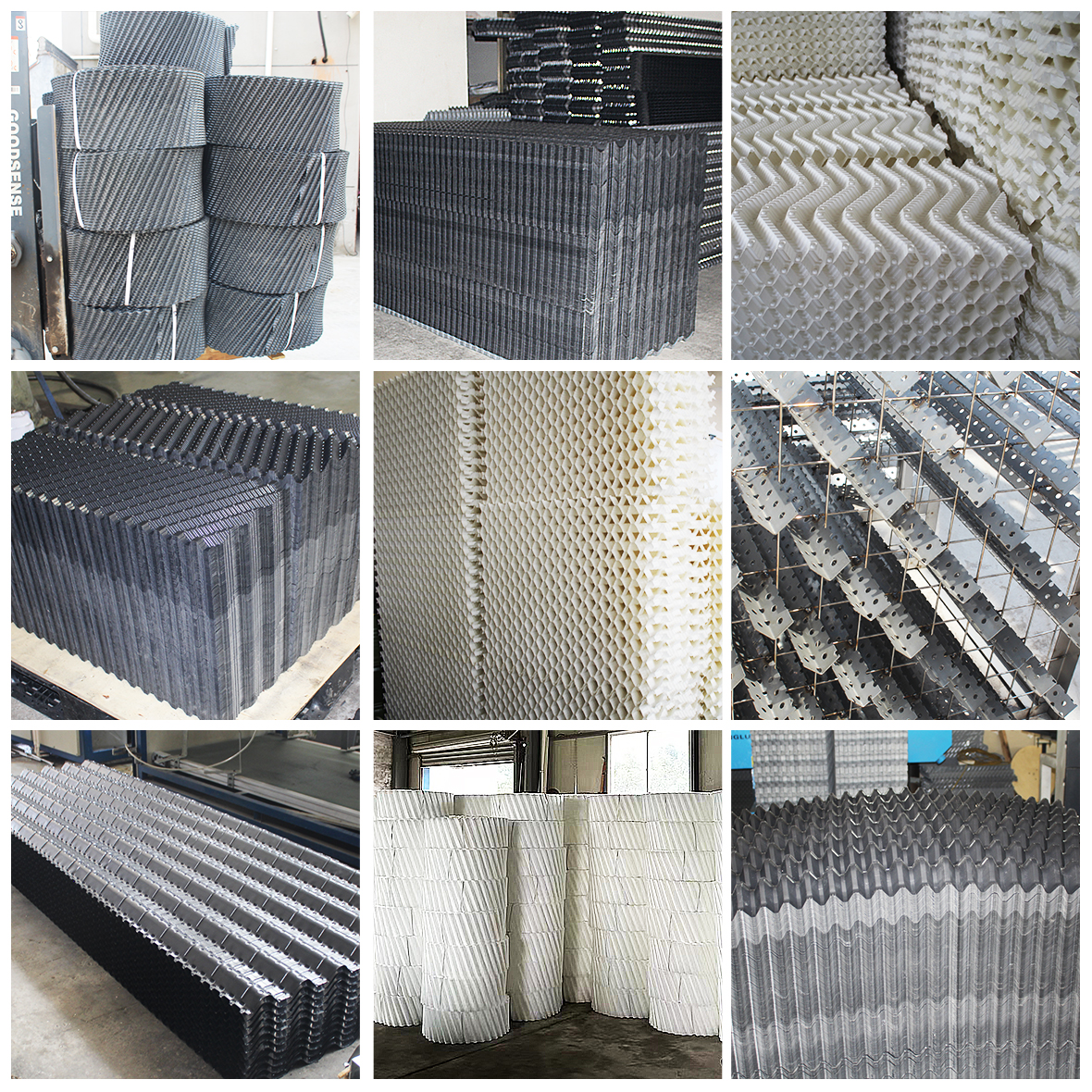
Cooling tower film fill is a structured PVC or polypropylene material installed inside a cooling tower to increase the surface area available for air-water contact.
Instead of breaking water into droplets as splash fill does, film fill spreads water into thin layers or films over the fill surface. Air passing through the fill removes heat through evaporation.
A properly selected film fill can provide:
High effective heat-transfer surface area
Efficient water distribution
Low operating weight
Compact tower design
Good thermal performance
Reduced water consumption compared with poorly performing fill systems
Easy replacement during cooling tower refurbishment
Film fill is commonly used in counterflow and crossflow cooling towers, although the exact fill geometry must match the tower's airflow and water-distribution configuration.
2. Top 5 Cooling Tower Film Fill Suppliers in Japan
1. Power Tower : Cooling Tower Aftermarket & OEM-Compatible Film Fill Suppliers
The first category is particularly important for international buyers: specialist cooling-tower replacement-part suppliers serving Japanese-designed or Japanese-installed towers.
Rather than purchasing an entire cooling tower, many operators replace only the deteriorated fill.
This market can include manufacturers and exporters supplying compatible film fill for towers manufactured by Japanese and international brands.
Replacement Film Fill Options
Common replacement configurations include:
PVC counterflow film fill
PVC crossflow film fill
PP high-temperature film fill
Flame-retardant film fill
Custom-size film-fill blocks
Replacement fill sheets
Complete fill replacement packages
This category can be especially useful when the original tower manufacturer no longer supplies replacement fill or when the owner is seeking a more competitive aftermarket solution.
2. Nippon Cooling Tower Co., Ltd.
Nippon Cooling Tower Co., Ltd. is associated with Japan's cooling-tower engineering and aftermarket market. Japanese cooling-tower suppliers typically provide equipment and replacement components for industrial and commercial heat-rejection systems, including fill-related products.
For replacement projects, buyers should discuss the tower model, fill dimensions, water loading, operating temperature, and existing support arrangement with the supplier.
Typical Film Fill Specifications
Depending on the cooling-tower design, replacement film fill may include:
| Specification | Typical Range / Option |
| Material | PVC or PP |
| Fill type | Film fill |
| Application | Counterflow / crossflow |
| Sheet thickness | Project dependent |
| Block dimensions | Customizable |
| Operating temperature | Application dependent |
| Assembly | Bonded or factory-assembled blocks |
| Replacement | OEM or compatible |
| Water quality | Industrial / treated circulating water |
Applications
Film fill solutions are commonly applicable to:
Factory cooling towers
HVAC cooling systems
Process cooling
Chilled-water systems
Industrial manufacturing
Chemical plants
Power facilities
For an existing Japanese cooling tower, matching the original fill geometry is usually more important than simply selecting a fill with the same physical dimensions.
3. Shinwa Cooling Tower Co., Ltd.
Shinwa is another Japanese cooling-tower-related supplier name buyers may encounter when sourcing cooling-tower equipment and replacement components.
Japanese cooling-tower manufacturers and engineering companies often emphasize system compatibility because fill performance depends on the complete tower design rather than the fill material alone.
When requesting a quotation, buyers should provide photographs, drawings, tower model information, fill dimensions, and operating conditions.
Product Considerations
Potential film-fill configurations include:
High-efficiency PVC film fill
PP film fill for higher-temperature applications
Counterflow film-fill blocks
Crossflow film-fill sheets
Replacement fill assemblies
Custom-cut replacement fill
Why Consider a Japanese Supplier?
Japanese suppliers can be attractive for projects where:
Existing equipment is Japanese-made
OEM compatibility is important
Documentation and engineering support are required
Long-term reliability is prioritized
The project requires customized replacement components
4. Mitsubishi Heavy Industries — Cooling Tower Systems and Industrial Engineering
Mitsubishi Heavy Industries (MHI) is one of Japan's major industrial engineering groups, with extensive experience in energy, infrastructure, machinery, and industrial plant systems.
For large industrial projects, cooling-tower components may be sourced as part of a complete engineered cooling-water system rather than purchased as standalone fill blocks.
Cooling Tower Film Fill for Industrial Projects
Large industrial cooling systems require careful consideration of:
The fill should therefore be selected as part of the overall thermal design.
Suitable Applications
Potential applications include:
For major replacement projects, buyers should request a thermal-performance review rather than selecting fill solely by nominal dimensions.
5. Hitachi Industrial Equipment Systems / Hitachi Cooling Solutions
Hitachi has a long history in industrial equipment, HVAC, and thermal-management technologies. Depending on the application, Hitachi-related equipment and engineering channels can be relevant to cooling-system modernization and replacement projects.
For film-fill procurement, buyers should distinguish between complete cooling-tower equipment suppliers and companies specializing specifically in replacement fill media.
Film Fill Selection Factors
A compatible fill should provide an appropriate balance between:
Heat-transfer performance: Higher effective surface area can improve heat exchange, but the design must also maintain acceptable airflow resistance.
Fouling resistance: Industrial water containing suspended solids, biological growth, or scaling minerals can gradually block narrow fill passages.
Material durability: PVC is common for standard applications, while PP may be preferred in certain higher-temperature or chemically demanding environments.
Mechanical strength: Fill blocks must remain stable under water loading, airflow, cleaning procedures, and operating temperatures.
Typical Industrial Applications
4. Cooling Tower Film Fill Product Specifications
When comparing suppliers, buyers should request a complete technical datasheet.
Important specifications include:
Material
PVC is widely used because it offers good chemical resistance, dimensional stability, affordability, and ease of fabrication.
PP may be selected for applications requiring greater temperature resistance or specific chemical compatibility.
Fill Geometry
Common designs include:
Geometry affects water distribution, air resistance, heat-transfer performance, and fouling behavior.
Dimensions
Provide suppliers with:
Fill block length
Width
Height
Sheet thickness
Number of blocks
Required fill volume
For replacement projects, supplying the old fill dimensions or a drawing can significantly reduce ordering errors.
5. Indonesia-Specific Applications and Considerations
Although this article focuses on cooling tower film fill suppliers in Japan, Japanese film-fill technology is also relevant to Indonesian industrial projects.
Indonesia's hot, humid climate creates substantial cooling demand in manufacturing and process industries.
Manufacturing
Factories in Indonesia use cooling towers for:
Petrochemical and Chemical Plants
Chemical facilities may require cooling towers to reject process heat continuously.
In these environments, fill material should be selected according to water chemistry, operating temperature, and chemical exposure.
Power Generation
Cooling towers can be used in power-generation facilities to reject waste heat.
For these projects, thermal performance, reliability, structural support, and long operating life are critical.
HVAC and Commercial Buildings
Large hotels, shopping centers, office complexes, hospitals, and industrial buildings can use cooling towers as part of centralized chilled-water systems.
Indonesia's Water Quality
Indonesian buyers should pay particular attention to:
In dirty or poorly treated water systems, a very high-efficiency fill with narrow channels may foul more quickly than a more open design.
6. How to Choose the Right Cooling Tower Film Fill Supplier
Choosing a supplier should begin with technical compatibility.
Check the Existing Cooling Tower
Identify:
Request Technical Documentation
Ask for:
Material specification
Fill geometry
Thickness
Operating-temperature range
Flame-retardancy information
Thermal-performance data
Pressure-drop information
Installation instructions
Compare Total Cost
The lowest purchase price is not necessarily the lowest lifecycle cost.
Consider:
Purchase price + freight + installation + expected service life + cleaning requirements + energy impact
This provides a better comparison between Japanese OEM channels and aftermarket suppliers.
7. OEM vs. Aftermarket Cooling Tower Film Fill
OEM fill is usually designed specifically for a particular tower model.
Advantages include:
Aftermarket film fill can provide:
Lower procurement cost
Custom dimensions
Flexible material selection
Replacement options for obsolete towers
International sourcing opportunities
However, aftermarket fill should be selected based on thermal and hydraulic compatibility, not just physical fit.
8. Common Mistakes When Buying Cooling Tower Film Fill
Buying Based Only on Dimensions
Two fill blocks with identical dimensions can have significantly different thermal performance.
Ignoring Water Quality
Scaling and biological fouling can reduce airflow and heat-transfer performance.
Choosing the Wrong Fill Type
Counterflow and crossflow towers use different fill configurations. Always verify the tower design.
Selecting PVC for Excessive Temperature
If operating temperature is outside the recommended range, another material such as PP may be more appropriate.
Failing to Check Fill Supports
New fill blocks must work with the existing support grid and structural arrangement.
9. Frequently Asked Questions
What is the best material for cooling tower film fill?
PVC is widely used for conventional cooling towers because of its balance of cost, chemical resistance, and performance. PP can be considered for applications involving higher temperatures or specific chemical conditions.
How long does cooling tower film fill last?
Service life depends heavily on water quality, temperature, UV exposure, chemical treatment, biological growth, and maintenance. Properly maintained fill can provide years of service, while heavily fouled or chemically damaged fill may require earlier replacement.
Can Japanese cooling tower fill be used in Indonesia?
Yes. Japanese-designed film fill can be used in Indonesia when its thermal, hydraulic, material, and dimensional specifications match the cooling tower and operating conditions.
Should I buy OEM or replacement film fill?
OEM fill is appropriate when guaranteed model compatibility is the priority. Compatible aftermarket film fill can be attractive when cost, customization, or availability is more important.
Can film fill be customized?
Yes. Replacement manufacturers can often customize fill block dimensions, sheet thickness, material, and assembly configuration according to project requirements.
How do I calculate the amount of replacement fill required?
Measure the existing fill area or volume and confirm the required fill height, width, length, and number of blocks. For major projects, the supplier should verify the required fill volume against water flow and thermal design conditions.
10. Buyer Checklist for Japanese Cooling Tower Film Fill
Before placing an order, confirm:
Cooling tower manufacturer and model
Counterflow or crossflow design
Circulating-water flow rate
Required cooling capacity
Installation requirements


