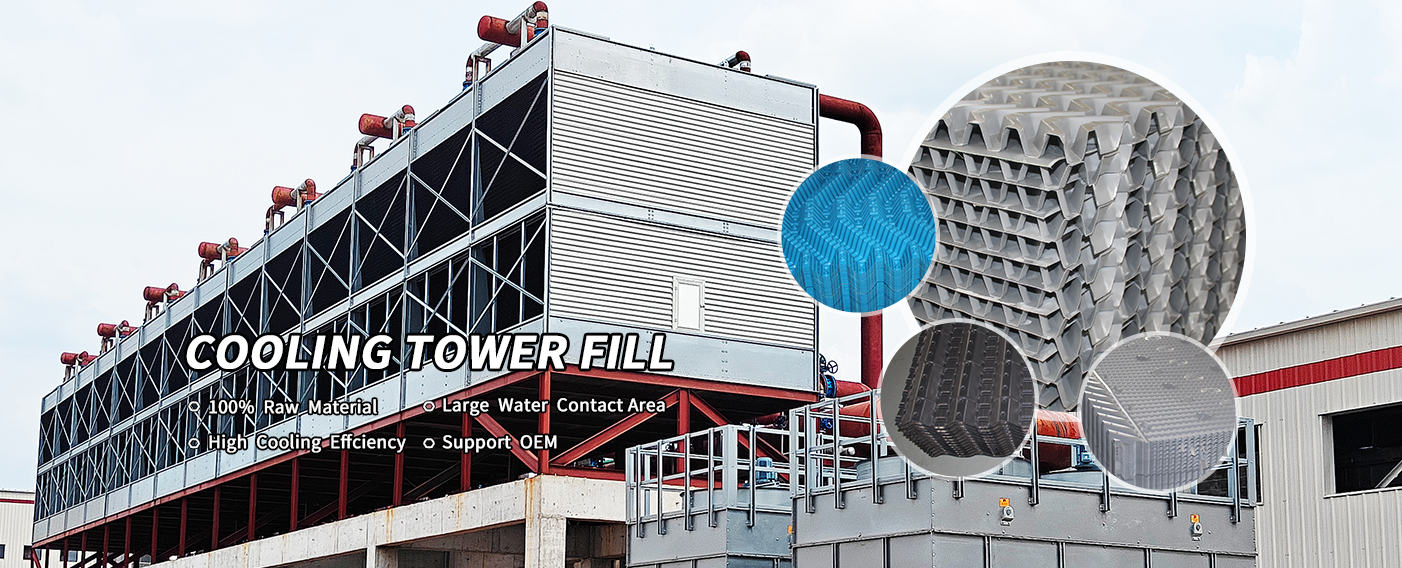
Top 5 Cooling Tower Fill & Fill Replacement Suppliers
Cooling tower fill is a critical heat-transfer component used in wet cooling towers. It increases the contact area between hot circulating water and air, allowing evaporation and sensible heat transfer to occur more efficiently. When fill becomes cracked, clogged, scaled, deformed, or structurally deteriorated, cooling tower fill replacement can be one of the most effective ways to restore thermal performance without replacing the entire cooling tower.
For industrial plants, HVAC facilities, power stations, chemical plants, data centers, and process-cooling systems, choosing a reliable cooling tower fill supplier is essential. The supplier needs to provide the correct fill type, dimensions, material, thermal characteristics, and compatibility with the existing tower.
This guide introduces five cooling tower fill and fill replacement suppliers that buyers can consider when sourcing replacement cooling tower fill. The list is not intended as a definitive ranking. The best supplier depends on the cooling tower manufacturer, tower configuration, water quality, operating temperature, thermal duty, location, and replacement requirements.
Quick Comparison of Top Cooling Tower Fill Suppliers
| Supplier | Main Strength | Fill / Replacement Focus | Suitable For |
| Power Tower Cooling Technology | Specialized cooling tower replacement parts | PVC/PP film fill, replacement and custom-size fill | Industrial aftermarket and replacement projects |
| Brentwood Industries | Engineered fill and water-management solutions | Film and splash fill solutions | Industrial and utility cooling towers |
| SPX Cooling Technologies / Marley | Major cooling tower OEM | Marley-compatible thermal components and fill | Marley tower owners and OEM replacement |
| Baltimore Aircoil Company (BAC) | Integrated cooling equipment | Tower-specific thermal media and replacement components | BAC cooling tower applications |
| EVAPCO | Evaporative cooling technology | Equipment-specific fill and replacement components | EVAPCO towers and industrial applications |
Note: Product availability, specifications, model compatibility, and regional service can change. Always confirm current technical information directly with the supplier before purchasing.
What Is Cooling Tower Fill?
Cooling tower fill is a heat-transfer medium installed inside a wet cooling tower.
Its primary function is to increase the effective contact area between circulating water and air.
Hot water enters the cooling tower through a water distribution system. The water is spread over the fill and flows through its structured surfaces. Air simultaneously moves through the fill.
The fill causes the water to form thin films or smaller droplets, depending on the design. This increases water-air interaction and promotes evaporation.
A simplified cooling process is:
Hot Water → Water Distribution → Cooling Tower Fill → Air-Water Contact → Evaporation → Cooled Water
Because fill creates a large effective heat-transfer area inside a relatively compact volume, it is one of the most important components affecting wet cooling tower performance.
Why Is Cooling Tower Fill Important?
A cooling tower without an effective fill system would have much less water-air contact within the available tower volume.
Properly selected fill can:
Increase effective heat-transfer area
Improve water-air contact
Promote evaporation
Improve thermal performance
Support lower cold-water temperatures
Make better use of tower volume
Improve cooling efficiency
Help maintain design cooling capacity
However, fill performance depends on the entire cooling tower system. Water distribution, airflow, water quality, fan performance, operating temperature, and maintenance also influence results.
What Is Cooling Tower Fill Replacement?
Cooling tower fill replacement involves removing deteriorated or unsuitable fill from an existing cooling tower and installing new heat-transfer media.
Fill replacement is commonly performed during cooling tower refurbishment or major maintenance.
Replacement may be necessary when the existing fill has:
Replacing the fill can often extend the useful life of the cooling tower without requiring complete tower replacement.
When Should Cooling Tower Fill Be Replaced?
There is no universal replacement interval because fill life depends on operating conditions.
Factors affecting service life include:
Water chemistry
Water temperature
Suspended solids
Biological growth
Cleaning frequency
Chemical treatment
UV exposure
Mechanical loading
Fill material
Operating conditions
A visual inspection should be combined with thermal-performance monitoring.
If cold-water temperatures are consistently higher than expected, fill degradation may be one potential cause. Other factors, including fan performance, water flow, spray-nozzle condition, fouling, and ambient wet-bulb temperature, should also be investigated.
Top 5 Cooling Tower Fill & Fill Replacement Suppliers
1. Power Tower Cooling Technology (Shaoxing) Co.,Ltd
CoolingTowerPart.com specializes in cooling tower parts and replacement components for industrial and commercial cooling tower applications.
For customers looking for cooling tower fill replacement, a specialized aftermarket supplier can be useful when the original tower is older, the original fill is discontinued, or custom dimensions are required.
Cooling Tower Fill Products
Potential fill requirements include:
PVC film fill
PP film fill
Counterflow cooling tower fill
Crossflow cooling tower fill
Replacement fill blocks
Custom-size cooling tower fill
OEM-compatible cooling tower fill
Industrial cooling tower replacement media
Why Consider Power Tower Cooling Technology?
A specialized cooling tower parts supplier may be particularly useful for:
Cooling tower refurbishment
Replacement projects
Older cooling tower models
Non-standard fill dimensions
OEM-compatible aftermarket sourcing
Projects requiring multiple cooling tower components
When requesting a quotation, customers should provide the cooling tower model, existing fill dimensions, photographs, operating temperatures, water flow, and fill configuration.
2. Brentwood Industries
Brentwood Industries is an established manufacturer of engineered plastic products and cooling tower fill solutions.
The company provides fill and water-management products for industrial and utility cooling applications.
Its products can be considered for both new cooling tower projects and refurbishment applications.
Cooling Tower Fill Applications
Typical applications include:
Why Consider Brentwood?
Brentwood may be suitable for buyers looking for:
Engineered fill solutions
Industrial cooling tower media
Replacement fill
Thermal performance considerations
Technical product support
When comparing Brentwood products with alternatives, buyers should evaluate fill dimensions, material, surface characteristics, water loading, temperature capability, and airflow resistance.
3. SPX Cooling Technologies / Marley
SPX Cooling Technologies, through its Marley brand, is one of the most recognized names in the cooling tower industry.
Marley has a broad installed base of industrial and commercial cooling towers, making Marley-related replacement components an important consideration for cooling tower owners.
Marley Cooling Tower Fill Replacement
Marley tower owners may require replacement fill during:
Depending on the tower model, fill may be designed specifically around the tower's water distribution and airflow configuration.
Why Consider Marley?
Marley is worth considering when:
The existing tower is a Marley model
OEM compatibility is important
Original engineering information is available
The customer wants manufacturer-specific replacement support
For aftermarket projects, however, buyers should compare OEM and compatible replacement options according to actual technical specifications.
4. Baltimore Aircoil Company (BAC)
Baltimore Aircoil Company (BAC) is a major manufacturer of evaporative cooling and heat-transfer equipment.
BAC cooling towers are widely used in industrial, HVAC, commercial, and process applications.
For BAC equipment owners, replacement fill should be selected according to the specific tower model and thermal requirements.
BAC Cooling Tower Fill Replacement
Fill-related requirements may include:
Why Consider BAC?
BAC is a potential choice for:
BAC cooling tower replacement projects
Industrial process cooling
HVAC condenser-water systems
Tower refurbishment
OEM-specific maintenance
Before ordering, buyers should confirm the exact BAC tower model and existing fill configuration.
5. EVAPCO
EVAPCO is a global manufacturer of evaporative cooling and heat-transfer equipment.
The company supplies cooling towers and related equipment for industrial, commercial, HVAC, refrigeration, and process applications.
For EVAPCO cooling tower owners, OEM replacement fill may be available for specific equipment models.
EVAPCO Cooling Tower Fill Replacement
Potential requirements include:
Why Consider EVAPCO?
EVAPCO can be considered when buyers require:
OEM-compatible components
Equipment-specific fill
Industrial cooling solutions
Technical product information
Replacement support
As with all cooling tower fill purchases, compatibility should be confirmed against the existing tower design.
Types of Cooling Tower Fill for Replacement
Selecting the right replacement fill begins with identifying the existing fill type.
The two main categories are film fill and splash fill.
Film Fill
Film fill consists of structured sheets, commonly manufactured from PVC or PP.
Water spreads across the sheet surfaces and forms thin films.
Film fill is widely used because it can provide high heat-transfer performance in a relatively compact volume.
Advantages
Applications
Splash Fill
Splash fill uses bars, grids, or molded components to break falling water into droplets.
It can be suitable for applications where water contains suspended solids or where narrow film-fill passages may become blocked.
Advantages
More open structure
Good water redistribution
Can tolerate certain fouling conditions
Suitable for some industrial applications
The correct splash-fill configuration depends on tower design and thermal requirements.
PVC Cooling Tower Fill
PVC cooling tower fill is one of the most widely used options for wet cooling tower applications.
PVC provides a practical balance between:
Cost
Weight
Mechanical properties
Water resistance
Manufacturability
Thermal performance
PVC film fill is available in various flute patterns, thicknesses, and block configurations.
The specific temperature capability must be verified for the selected product.
PP Cooling Tower Fill
Polypropylene cooling tower fill can be selected for applications where its material characteristics provide advantages over PVC.
PP is commonly considered for certain higher-temperature or chemically demanding applications.
As with PVC, the actual suitability depends on the operating environment.
Important parameters include:
Operating temperature
Water chemistry
Fill geometry
Water loading
Airflow
Thermal duty
Counterflow Cooling Tower Fill Replacement
In a counterflow tower, water flows downward while air moves upward.
Counterflow fill must provide suitable water distribution and airflow characteristics while maintaining effective heat transfer.
When replacing counterflow fill, measure:
The replacement fill should also be checked against the tower's operating water flow and airflow.
Crossflow Cooling Tower Fill Replacement
In a crossflow cooling tower, water flows vertically downward while air moves horizontally through the fill.
Crossflow towers often use gravity water distribution basins located above the fill.
Replacement fill should therefore be compatible with the existing basin and airflow configuration.
Important considerations include:
Fill dimensions
Flute orientation
Water distribution
Airflow
Water loading
Operating temperature
Fouling potential
How to Select a Cooling Tower Fill Replacement Supplier
The best supplier is not necessarily the largest company.
The supplier should be able to provide a fill that is technically appropriate for the actual tower.
Consider the following factors.
1. Experience With Cooling Tower Fill
Look for suppliers with specific experience in cooling tower thermal media rather than general plastic products.
2. Material Options
The supplier should be able to provide suitable PVC, PP, or other fill materials according to the application.
3. Custom Dimensions
Older towers may require non-standard fill sizes.
Custom manufacturing or modular assembly can be valuable.
4. Technical Data
A reliable supplier should provide specifications related to:
Material
Thickness
Fill dimensions
Operating temperature
Water loading
Thermal performance
Pressure drop
5. Tower Compatibility
The fill must match the existing tower's:
Airflow
Water distribution
Support system
Fill volume
Tower configuration
6. Replacement Support
A supplier familiar with refurbishment projects can help identify suitable replacement media based on measurements and photographs.
What Information Do You Need to Order Cooling Tower Fill Replacement?
Before contacting a supplier, prepare the following information.
Cooling Tower Information
Manufacturer
Model
Tower type
Cooling capacity
Number of cells
Fill Information
Existing fill type
Material
Fill height
Length
Width
Thickness
Flute configuration
Number of blocks
Operating Conditions
Photos
Photos can be extremely useful.
Recommended photographs include:
Cooling Tower Fill Replacement Process
A typical fill replacement project involves several stages.
Step 1: Inspect the Existing Fill
Determine whether the existing fill is damaged, blocked, scaled, or deformed.
Step 2: Measure the Fill
Record dimensions and configuration.
Step 3: Inspect the Support Structure
Check for corrosion, damage, and deformation.
Step 4: Inspect Water Distribution
Check nozzles, pipes, troughs, and basins.
Step 5: Select Replacement Fill
Choose material and geometry based on the operating conditions.
Step 6: Remove Existing Fill
Remove deteriorated fill while protecting the tower structure.
Step 7: Clean the Tower
Remove accumulated debris, scale, and biological deposits.
Step 8: Install New Fill
Install the new fill according to the specified configuration.
Step 9: Verify Distribution
Confirm that water is distributed evenly across the fill.
Step 10: Test the Tower
Monitor water temperature, flow, airflow, and overall thermal performance.
Cooling Tower Fill and Water Distribution
Fill cannot perform effectively without proper water distribution.
The distribution system may include:
Poor distribution can result in dry areas and overloaded sections of fill.
This reduces the effective heat-transfer area.
Therefore, cooling tower fill replacement should normally include an inspection of the water distribution system.
Cooling Tower Fill and Airflow
Airflow is another critical factor.
The cooling tower fan must move sufficient air through the fill.
Excessive fill resistance can increase fan power requirements.
Insufficient airflow can reduce heat-transfer performance.
When replacing fill, compare the airflow characteristics of the new fill with the original design.
Cooling Tower Fill Fouling and Clogging
Fouling is one of the most common causes of cooling tower fill performance deterioration.
Possible contaminants include:
Scale
Sediment
Dirt
Algae
Biofilm
Corrosion products
Process contaminants
As passages become blocked, airflow and water distribution can be affected.
Potential symptoms include:
Higher cold-water temperature
Reduced cooling capacity
Increased fan pressure
Uneven water distribution
Increased maintenance requirements
Effective water treatment can help control these problems.
Benefits of Replacing Old Cooling Tower Fill
Replacing deteriorated fill can provide several potential benefits.
Improved Heat Transfer
New fill restores the designed water-air contact surface.
Better Water Distribution
Newly installed fill can improve the effective use of distributed water when paired with a properly functioning distribution system.
Reduced Fouling
New media provides clean heat-transfer passages.
Improved Cooling Performance
Restoring the heat-transfer section can help the tower approach its intended thermal performance.
Extended Equipment Life
A properly maintained fill system can help extend the useful life of the overall cooling tower.
Potential Energy Benefits
Improved thermal performance may reduce the need to operate fans or other equipment at unnecessarily high levels, depending on the system.
Common Mistakes When Replacing Cooling Tower Fill
Buying by Dimensions Alone
Two fill blocks with similar dimensions can have different flute geometries and thermal characteristics.
Ignoring Water Temperature
Material suitability must be checked against actual operating temperatures.
Ignoring Water Quality
Dirty water may require a different fill configuration.
Failing to Inspect Nozzles
New fill cannot compensate for severely blocked or poorly performing distribution nozzles.
Ignoring Fill Support
Damaged support structures can compromise new fill installation.
Choosing Only by Price
Initial purchase price should be evaluated together with thermal performance, service life, installation cost, and maintenance.
OEM vs. Aftermarket Cooling Tower Fill Replacement
Both OEM and aftermarket fill can be appropriate depending on the project.
OEM Fill
Advantages may include:
Original equipment compatibility
Manufacturer-specific engineering
Established tower documentation
Equipment-specific support
Aftermarket Fill
Advantages may include:
The important factor is whether the replacement fill meets the required technical specifications.
How to Compare Cooling Tower Fill Suppliers
A supplier comparison should include more than product price.
| Evaluation Factor | Questions to Ask |
| Product | What type of fill is offered? |
| Material | PVC, PP, or another material? |
| Dimensions | Can the fill match the existing tower? |
| Temperature | Is it suitable for the operating temperature? |
| Water quality | Is it suitable for the application? |
| Thermal performance | What design data is available? |
| Airflow | What is the pressure drop? |
| Customization | Can non-standard sizes be supplied? |
| Technical support | Can the supplier help identify replacement fill? |
| Delivery | What is the expected production and shipping time? |
| Documentation | Are drawings and specifications available? |
Applications of Cooling Tower Fill Replacement
Cooling tower fill replacement is commonly required in:
Power Generation
For condenser cooling and auxiliary cooling systems.
Chemical Processing
For process heat exchangers and chemical production equipment.
Petrochemical Plants
For process cooling, condensers, compressors, and heat exchangers.
Steel Manufacturing
For equipment cooling and process-water systems.
HVAC
For commercial and industrial chiller systems.
Plastic Manufacturing
For injection molding and extrusion process cooling.
Food and Beverage
For refrigeration and process cooling systems.
Data Centers
For cooling systems using evaporative or water-cooled equipment.
Frequently Asked Questions
What is cooling tower fill?
Cooling tower fill is a heat-transfer medium installed inside a wet cooling tower to increase water-air contact and improve evaporative cooling.
What is cooling tower fill replacement?
Cooling tower fill replacement is the process of removing deteriorated fill and installing new heat-transfer media inside an existing tower.
How often should cooling tower fill be replaced?
There is no universal replacement interval. Service life depends on water quality, operating temperature, maintenance, chemical treatment, and mechanical condition.
What is the best material for cooling tower fill?
PVC and PP are widely used. The best material depends on temperature, water chemistry, thermal requirements, and fouling conditions.
Is PVC cooling tower fill suitable for industrial cooling towers?
Yes. PVC film fill is widely used in many industrial cooling tower applications where its temperature and chemical characteristics are suitable.
Can cooling tower fill be customized?
Yes. Many suppliers can provide custom dimensions, fill heights, sheet thicknesses, flute configurations, and module arrangements.
How do I know if my cooling tower fill needs replacement?
Signs include severe scaling, blocked passages, cracking, deformation, collapse, biological fouling, and declining thermal performance.
Can I replace cooling tower fill without replacing the cooling tower?
In many cases, yes. The existing tower structure, fill supports, water distribution, and other components should be inspected before replacement.
What is the difference between cooling tower fill and drift eliminators?
Fill promotes heat transfer between water and air. Drift eliminators reduce the amount of water droplets carried out of the tower with exhaust air.
How do I find the right cooling tower fill supplier?
Compare suppliers based on technical experience, material options, dimensions, thermal specifications, custom manufacturing capability, tower compatibility, documentation, and replacement support.
Conclusion
Selecting a reliable cooling tower fill and fill replacement supplier is essential for maintaining the thermal performance and operating reliability of a wet cooling tower.
The five suppliers discussed in this guide—CoolingTowerPart.com, Brentwood Industries, SPX Cooling Technologies/Marley, Baltimore Aircoil Company (BAC), and EVAPCO—offer different sourcing options for cooling tower fill and related thermal components.
For OEM projects, working directly with the original cooling tower manufacturer can provide equipment-specific compatibility. For older towers, retrofit projects, or non-standard requirements, a specialized aftermarket cooling tower fill supplier may offer greater flexibility in dimensions, materials, and replacement configurations.
Before purchasing, always evaluate the complete application:
Tower type + fill dimensions + water flow + water temperature + water quality + airflow + thermal duty + support structure
The right replacement fill should not simply fit inside the tower. It should also provide appropriate thermal performance, airflow characteristics, water distribution, temperature capability, and long-term durability.
For this reason, supplying the tower model, existing fill measurements, operating data, and photographs to the supplier is one of the best ways to obtain the correct PVC cooling tower fill, PP cooling tower fill, film fill, or splash fill replacement.


