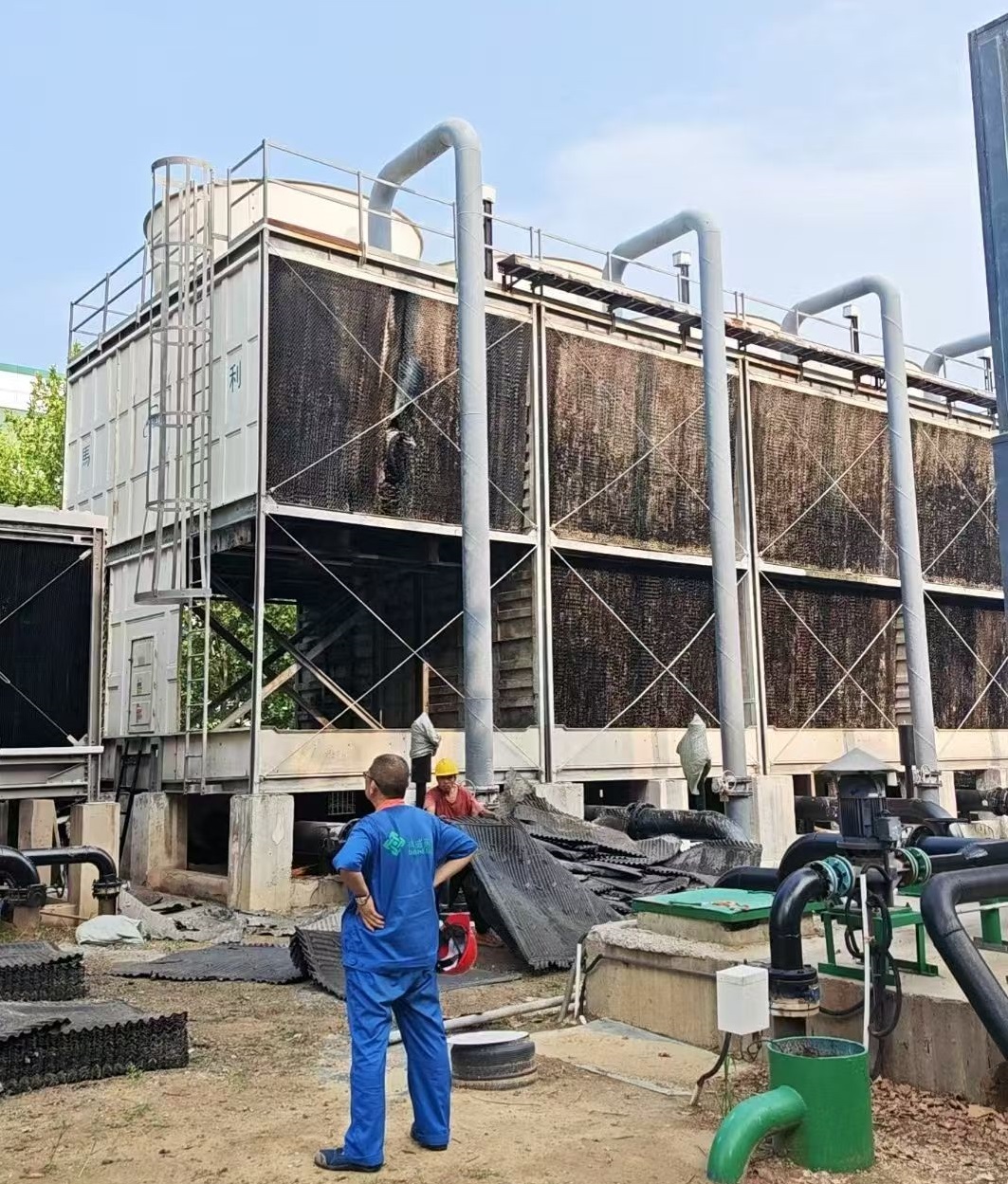
Marley cooling tower fill media is a key component in cooling towers used for industrial process cooling, commercial HVAC systems, and power generation. By increasing the contact area between water and air, fill media improves heat transfer and helps cooling towers maintain the required operating temperatures.
Over time, fill media can accumulate scale, sediment, algae, and other deposits. Physical damage and material deterioration can also reduce cooling performance. Selecting the right replacement and maintaining it correctly can help control operating costs, minimize downtime, and extend equipment service life.
This guide covers the main cooling tower fill media types, performance considerations, maintenance practices, and replacement options for Marley cooling towers.
What Is Marley Cooling Tower Fill Media?
Cooling tower fill media, also known as cooling tower packing or fill packs, is installed inside a cooling tower to increase the surface area available for heat exchange.
Hot water flows over the fill while air passes through its channels. Heat transfers from the water to the air, and evaporation removes additional heat from the circulating water.
The fill design influences heat-transfer efficiency, airflow resistance, water distribution, and the tower's overall cooling capacity.
Marley cooling towers use fill configurations suited to specific tower models and operating conditions. When replacing existing fill, buyers should verify the original specifications instead of assuming that all compatible products have the same dimensions or performance.
Main Types of Cooling Tower Fill Media
1. Film Fill
Film fill uses closely spaced sheets, commonly manufactured from PVC or polypropylene, to spread water into a thin film across a large surface area.
Benefits:
High water-air contact area.
Efficient heat transfer in a compact space.
Lightweight construction for easier handling.
Suitable for many commercial and industrial cooling applications.
Limitations: Narrow passages can collect scale, biological growth, and suspended solids. Film fill is generally most suitable for systems with relatively clean, properly treated circulating water.
2. Splash Fill
Splash fill uses bars, grids, or specially shaped components to break falling water into droplets. This increases water-air contact and supports heat transfer.
Benefits:
Can offer better tolerance of suspended solids than many fine-passage film-fill designs.
Suitable for selected industrial applications with greater fouling risks.
Provides an alternative where water quality limits conventional film fill.
Limitations: Splash fill may require a different packing arrangement and volume. Its performance depends on the specific design, airflow, water distribution, and tower configuration.
3. Hybrid Fill
Hybrid fill combines features of film and splash fill to balance heat-transfer performance with fouling tolerance.
It may be considered where conventional film fill experiences frequent blockage but efficient heat transfer remains important.
A hybrid fill retrofit requires careful assessment of the existing tower's dimensions, support structure, airflow, and operating conditions.
Marley Cooling Tower Fill Media Specifications
Exact specifications vary by tower model and fill design. Before ordering replacement media, review these important parameters.
| Specification | Importance |
| Material | Determines chemical compatibility and temperature tolerance |
| Fill type | Influences heat transfer and fouling resistance |
| Pack dimensions | Ensures correct fit within the fill section |
| Sheet thickness | Affects strength and material requirements |
| Channel geometry | Influences water distribution and airflow |
| Thermal performance | Determines whether cooling requirements can be met |
| Airflow pressure drop | Affects fan performance and operating conditions |
| Installation arrangement | Ensures proper support, alignment, and spacing |
PVC is widely used in cooling tower film fill, while polypropylene may suit selected applications. Material selection should consider operating temperature, water chemistry, chemical exposure, and fire-performance requirements.
These are general selection criteria rather than verified specifications for every Marley fill model. Always request product drawings and applicable technical data.
Factors That Affect Cooling Tower Fill Performance
Water Quality
Suspended solids, mineral deposits, and biological growth can accumulate on fill surfaces. Blocked passages reduce effective contact area and disrupt airflow and water distribution.
A suitable water-treatment program helps control scaling, corrosion, and biological fouling.
Fill Design and Geometry
Sheet spacing, corrugation patterns, channel geometry, and packing density affect heat transfer and airflow resistance. A replacement with different geometry may perform differently even when its overall dimensions match the original fill.
Airflow and Water Distribution
Cooling tower fill requires adequate airflow and reasonably uniform water distribution. Blocked nozzles, damaged headers, fan problems, or incorrect water flow can reduce cooling performance.
Consequently, replacing fill alone may not solve problems caused by other components.
Operating Temperature and Chemical Exposure
High temperatures and incompatible chemicals can accelerate material deterioration. Verify that the selected PVC or PP grade is suitable for the tower's actual operating environment.
Maintenance Practices
Regular inspection and proper cleaning help prevent deposits from accumulating. Poor maintenance can lead to persistent blockage, reduced cooling capacity, and premature fill replacement.
Marley Cooling Tower Fill Media Maintenance Guide
A consistent maintenance program helps preserve cooling performance and identify problems early.
1. Inspect Fill Packs Regularly
Check for cracks, deformation, collapsed sections, excessive deposits, and uneven water distribution. Inspection frequency should reflect operating hours, water quality, and site conditions.
2. Control Scale and Biological Growth
Maintain suitable water chemistry and follow the site's water-treatment program. Control algae, biofilm, and mineral deposits before they significantly restrict water or airflow.
3. Clean Fill Using Approved Methods
Use cleaning methods compatible with the fill material and cooling tower design. Excessive pressure or unsuitable chemicals may damage fill sheets.
Follow manufacturer recommendations and applicable safety procedures.
4. Check Water Distribution Components
Inspect spray nozzles, headers, and distribution pipes for blockage or damage. Uneven water distribution can reduce the effective use of the fill and create localized fouling.
5. Inspect Fill Supports and Drift Eliminators
Check supports for corrosion, deformation, or damage. Confirm that fill packs remain stable and properly positioned. Inspect drift eliminators to help control water droplet carryover.
6. Monitor Cooling Performance
Track entering and leaving water temperatures, water flow, fan operation, and other relevant operating parameters. Comparing performance over time can help identify deterioration and distinguish fill problems from other system issues.
When Should Marley Cooling Tower Fill Be Replaced?
Cooling tower fill does not have one universal replacement interval. Service life depends on water quality, operating temperature, chemical exposure, maintenance, and mechanical stress.
Consider replacing fill when:
Sheets are cracked, brittle, warped, or collapsed.
Persistent deposits cannot be removed through appropriate cleaning.
Fill passages remain blocked and restrict airflow or water flow.
Cooling performance declines and fill deterioration is identified as a contributing factor.
Fill supports or pack geometry no longer provide a secure installation.
Before replacement, inspect fans, nozzles, water distribution, and airflow paths to confirm that fill deterioration is a significant cause of poor performance.
How to Select Marley-Compatible Cooling Tower Fill Media
Choosing replacement fill requires dimensional checks and performance verification.
Step 1: Identify the tower model. Record the manufacturer, model number, serial number, and existing fill identification.
Step 2: Confirm dimensions. Measure the fill packs and document their height, width, length, sheet arrangement, and orientation.
Step 3: Select the appropriate material. Review operating temperature, water chemistry, suspended solids, and chemical exposure.
Step 4: Verify performance. Request relevant thermal performance information and airflow pressure-drop data.
Step 5: Review supplier documentation. Ask for technical drawings, material specifications, quality records, and installation guidance.
Step 6: Compare total project costs. Consider product price, freight, installation, downtime, and expected maintenance requirements.
Original replacement products and aftermarket Marley-compatible fill may both be suitable options. However, compatibility should be established through technical review rather than appearance or dimensions alone.
Original Marley Fill vs. Aftermarket Replacement Fill
Original replacement fill can simplify product identification when the exact component is available. Aftermarket Marley-compatible fill may offer alternative pricing, customized dimensions, or different lead times.
When comparing products, evaluate:
Material quality and operating-temperature limits.
Fill-pack dimensions and installation compatibility.
Heat-transfer performance and airflow resistance.
Manufacturing quality control.
Technical support and delivery schedules.
Warranty terms and documentation.
A lower purchase price does not necessarily mean a lower total cost. A poorly matched product can lead to installation problems, reduced cooling performance, or additional downtime.
Applications of Marley Cooling Tower Fill Media
Marley-compatible cooling tower fill may be used in appropriately designed systems serving:
Industrial manufacturing: Process water and equipment cooling.
Commercial HVAC: Chiller condenser-water systems in offices, hospitals, hotels, and commercial buildings.
Power generation: Cooling systems for power plants and auxiliary equipment.
Chemical processing: Heat rejection, subject to material compatibility.
General process cooling: Industrial operations that rely on recirculating cooling water.
The correct fill type depends on the tower design, water quality, cooling load, and operating conditions.
Find a Marley-Compatible Cooling Tower Fill Supplier
Working with a specialized cooling tower supplier can help buyers verify dimensions, select suitable materials, and evaluate replacement requirements.
When requesting a quotation, provide the tower model, existing fill dimensions, preferred material, operating temperature, water-quality conditions, required quantity, and delivery destination. Photographs and drawings can help suppliers identify the required configuration.
CoolingTowerPart.com can be considered as a sourcing channel for cooling tower fill and replacement components. Confirm current product availability, technical specifications, and compatibility before purchasing.
Frequently Asked Questions
What is Marley cooling tower fill media used for?
It increases the contact area between water and air, supporting heat transfer and evaporative cooling inside the tower.
What is the difference between film fill and splash fill?
Film fill spreads water over sheets to create a large wetted surface. Splash fill breaks falling water into droplets and may offer better fouling tolerance in selected applications.
Can aftermarket fill replace original Marley fill?
Potentially. The replacement must meet dimensional, material, thermal, and hydraulic requirements for the specific cooling tower. Technical verification is recommended.
How often should cooling tower fill be cleaned?
Cleaning frequency depends on water quality, operating conditions, and deposit formation. Regular inspections help determine when cleaning is needed.
Does replacing cooling tower fill improve efficiency?
Replacement may restore performance when existing fill is damaged or fouled. Actual results also depend on water distribution, airflow, fan operation, and overall system conditions.
Conclusion
Marley cooling tower fill media is essential for effective heat transfer and reliable cooling tower operation. Understanding film, splash, and hybrid fill options helps buyers select products suited to different operating conditions.
Regular maintenance, effective water treatment, and timely replacement can reduce avoidable downtime and support long-term performance. For replacement projects, verify dimensions, material compatibility, thermal performance, and airflow resistance before purchasing Marley-compatible fill.
Looking for cooling tower fill replacement? Prepare your tower model and existing fill specifications to request a technical assessment and quotation for your industrial cooling tower project.
Recommended internal links for CoolingTowerPart.com:


