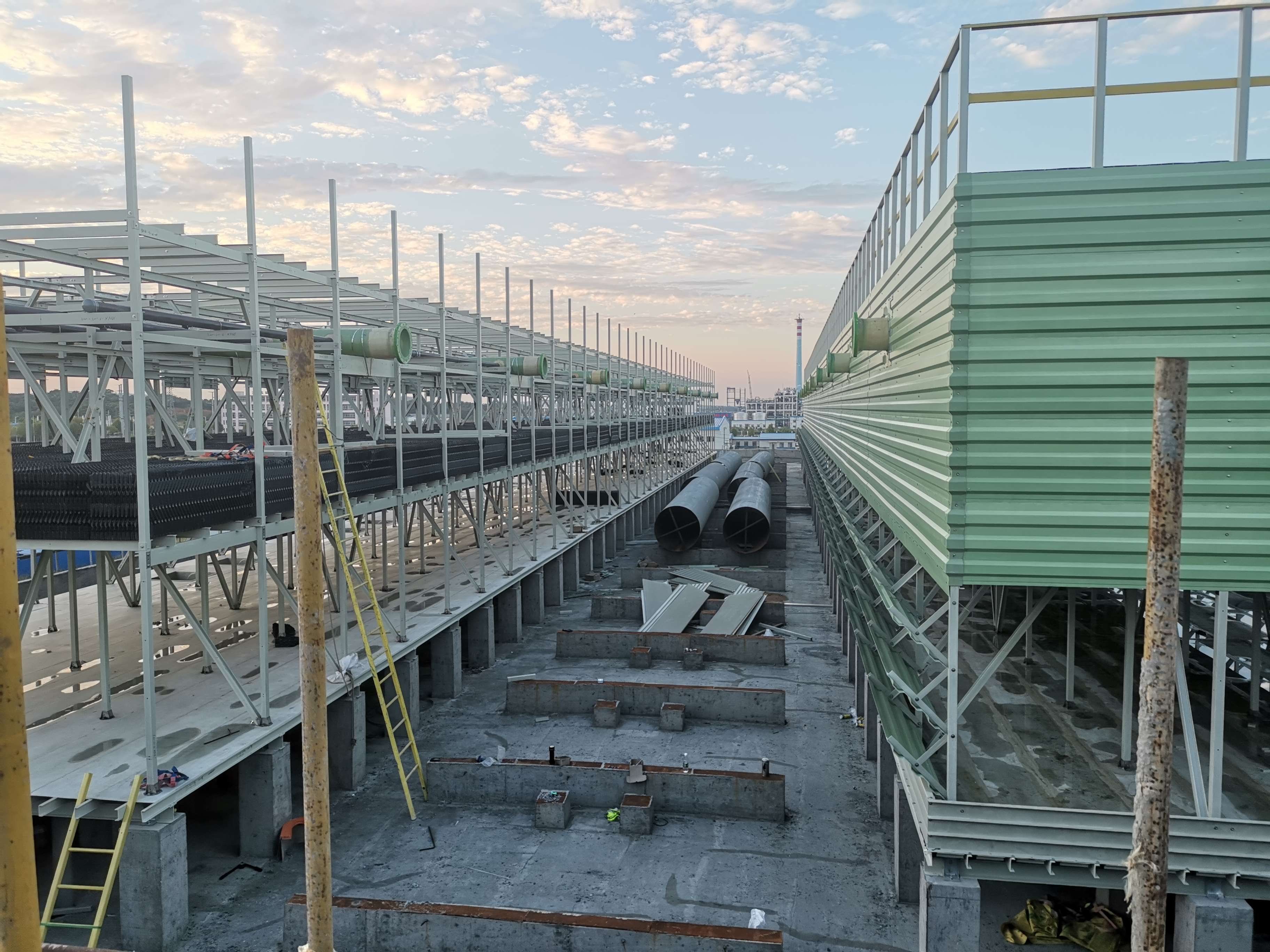
Choosing the right industrial cooling tower fill is essential for maintaining efficient heat transfer, stable cooling performance, and reliable tower operation. The fill media provides a large contact area where hot process water meets moving air, allowing heat to transfer from the water to the atmosphere.
However, not every cooling tower fill works for every application. Water quality, operating temperature, tower design, airflow, chemical conditions, and maintenance requirements all affect product selection.
This guide explains the main types of cooling tower fill, important material options, and the key factors industrial buyers should consider before purchasing replacement or new fill media.
What Is Industrial Cooling Tower Fill?
Industrial cooling tower fill is the internal media installed inside a cooling tower to increase the contact area between water and air.
Without fill, water would fall through the tower in relatively large streams or droplets, resulting in limited air-water contact. Fill breaks the water into thin films or droplets and distributes it across a larger surface area. This improves evaporation and heat transfer.
Depending on the tower design, cooling tower fill can be manufactured from PVC, PP, or other materials and supplied in film, splash, or hybrid configurations.
Why Cooling Tower Fill Is Important
The fill is one of the most important performance components inside an industrial cooling tower.
A properly selected fill can provide:
Greater air-water contact area
Better heat transfer
Improved cooling efficiency
Lower required tower footprint
Stable water distribution
Reliable operation under continuous industrial conditions
Longer service life when properly maintained
When fill becomes damaged, clogged, scaled, or deformed, cooling performance can decline. In some cases, replacing old fill is a more practical solution than replacing the entire cooling tower.
Main Types of Industrial Cooling Tower Fill
1. Film Fill
Film fill for cooling towers uses closely spaced sheets with formed surfaces. Water spreads across the sheets as a thin film while air passes through the fill.
The large surface area makes film fill highly effective for heat transfer.
Typical advantages include:
Film fill is commonly used where the circulating water is relatively clean.
However, narrow passages can become blocked by dirt, biological growth, suspended solids, or scale. Water quality should therefore be considered carefully before selecting a high-density film fill.
2. Splash Fill
Splash cooling tower fill works differently. Instead of creating a continuous water film, the fill repeatedly breaks falling water into droplets.
Common splash-fill designs include grid, tube, bar, and modular splash configurations.
Splash fill is often preferred for applications with:
Although splash fill may require more volume than film fill for comparable thermal performance, its open structure can provide better resistance to blockage.
3. Hybrid Fill
Hybrid cooling tower fill combines characteristics of film and splash designs.
It can be considered when an application requires a balance between heat-transfer performance and resistance to fouling. The exact performance depends on the fill geometry, material, water quality, and tower operating conditions.
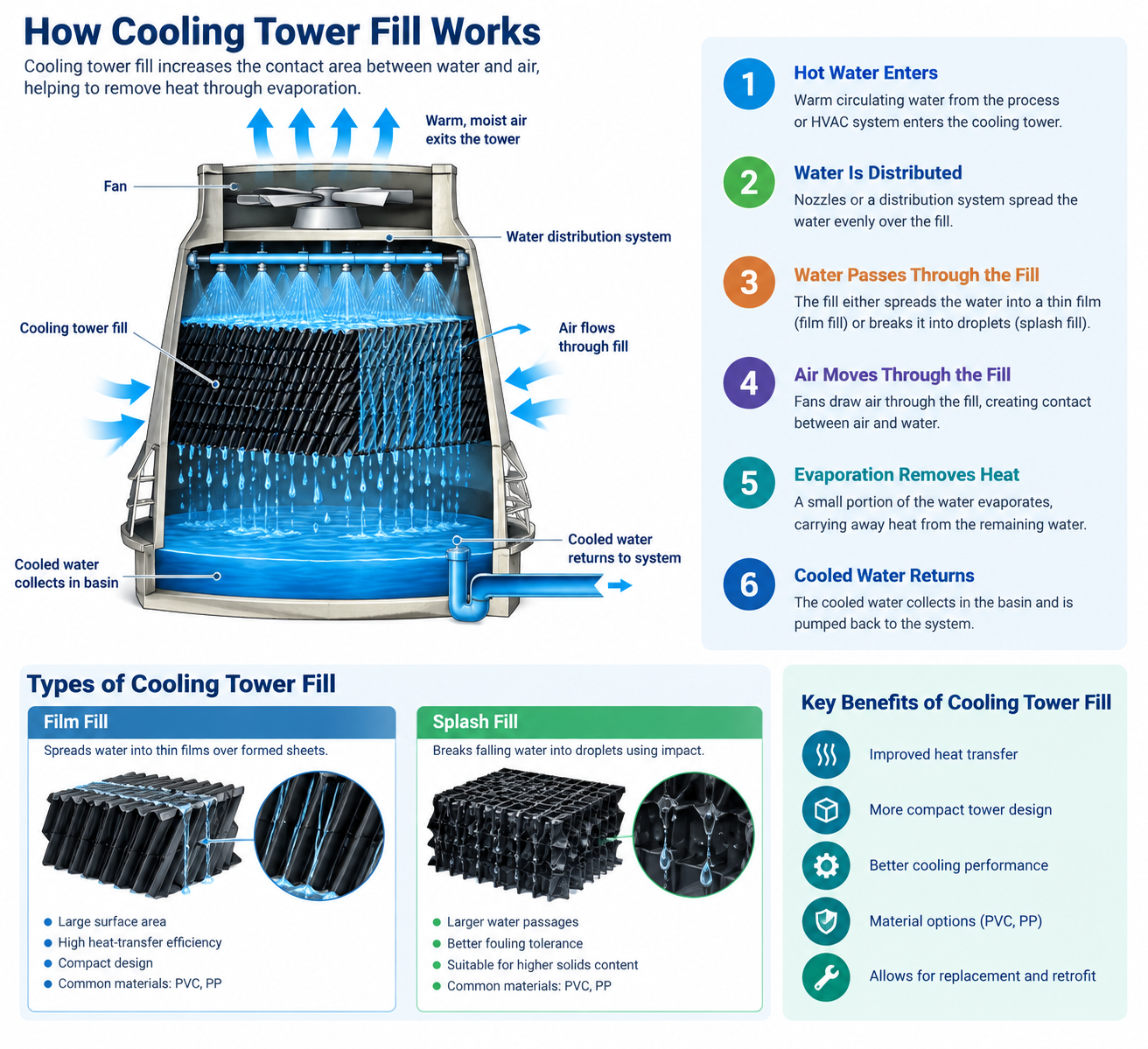
Choose the Right Fill Material
Material selection is another major consideration when purchasing industrial cooling tower fill.
PVC Cooling Tower Fill
PVC cooling tower fill is widely used because it offers a practical combination of cost, rigidity, chemical resistance, and thermal performance.
PVC film fill is suitable for many standard industrial and commercial cooling tower applications.
It is particularly attractive when the circulating water chemistry and operating temperature fall within the material's recommended limits.
PP Cooling Tower Fill
PP cooling tower fill is often selected for applications requiring higher temperature capability or improved resistance to certain chemicals.
Polypropylene can be especially useful in industrial environments where PVC may not provide the desired temperature or chemical resistance.
Before choosing PP, buyers should still verify the actual operating temperature and chemical conditions with the fill manufacturer.
Other Materials
Special applications may require alternative plastics or materials. The correct choice depends on temperature, water chemistry, fire requirements, mechanical conditions, and tower construction.
Do not select fill material based only on price. A low-cost material that fails prematurely can create significantly higher replacement and maintenance costs.
Key Factors for Selecting Industrial Cooling Tower Fill
1. Water Quality
Water quality is one of the most important selection factors.
Check for:
Suspended solids
Hardness
Scaling tendency
Biological growth
Oil contamination
Corrosive chemicals
Organic matter
If the water contains high levels of solids or contaminants, an open-structure splash fill may be more suitable than a closely spaced film fill.
2. Operating Temperature
Always compare the fill material's recommended temperature range with the actual operating conditions.
Hot process water can accelerate deformation or material degradation if the fill is not designed for the application.
For higher-temperature industrial processes, PP or another suitable material may provide a better solution than standard PVC.
3. Cooling Tower Design
The fill must match the tower configuration.
Consider whether the tower is:
Counterflow or crossflow
Induced draft or forced draft
Mechanical draft or natural draft
New construction or retrofit
The fill dimensions, support arrangement, airflow characteristics, and water distribution system must work together.
4. Water Loading and Airflow
Thermal performance depends on the relationship between water flow and air flow.
When selecting replacement fill, consider the tower's:
Water circulation rate
Airflow rate
Design heat load
Inlet water temperature
Outlet water temperature
Approach temperature
Fill height
A fill product should be evaluated according to actual operating conditions rather than catalog specifications alone.
5. Fouling and Maintenance
Industrial cooling towers can operate in challenging environments. Dust, algae, scale, and suspended solids may accumulate inside the fill.
If maintenance access is limited, consider a fill design that is easier to inspect and clean.
For heavily contaminated water, splash fill may offer an advantage because its larger passages are less prone to plugging.
6. Replacement Dimensions
For a cooling tower fill replacement, accurate measurements are critical.
Check:
Fill block length
Width
Height
Sheet thickness
Flute or corrugation design
Hanging or support method
Fill support dimensions
Water distribution arrangement
A replacement fill should fit the existing tower structure without creating excessive gaps or airflow restrictions.
Industrial Cooling Tower Fill Replacement
Replacing damaged or aging fill can improve cooling performance without rebuilding the complete tower.
Common signs that fill may need replacement include:
Reduced cooling capacity
Increased approach temperature
Visible fill deformation
Cracked or brittle sheets
Severe scaling
Biological fouling
Blocked air passages
Excessive pressure drop
Uneven water distribution
Before replacement, inspect the fill and identify the actual cause of performance loss. In some cases, cleaning may restore performance. Severely damaged or deteriorated fill, however, usually requires replacement.
How to Compare Cooling Tower Fill Suppliers
When purchasing industrial cooling tower fill, compare suppliers based on more than unit price.
Look for:
Technical specifications – Confirm dimensions, material, thickness, and thermal characteristics.
Application experience – Choose a supplier familiar with industrial cooling tower conditions.
Customization – Replacement projects may require specific dimensions or configurations.
Material quality – Verify that the supplied PVC or PP meets the required operating conditions.
Quality control – Consistent sheet thickness and forming quality can affect installation and performance.
Replacement support – Technical assistance can help avoid incorrect fill selection.
Production capacity – For large industrial projects, confirm the supplier can provide the required quantity and delivery schedule.
Industrial Cooling Tower Fill Buying Checklist
Before placing an order, confirm the following:
| Selection Factor | What to Check |
| Fill type | Film, splash, or hybrid |
| Material | PVC, PP, or other suitable material |
| Tower design | Counterflow or crossflow |
| Water quality | Solids, scale, algae, chemicals |
| Operating temperature | Actual process conditions |
| Water flow | Circulation rate |
| Airflow | Tower design airflow |
| Fill dimensions | Length, width, height |
| Thermal requirements | Heat load and approach |
| Maintenance | Cleaning and inspection requirements |
| Compatibility | Existing supports and distribution system |
Final Thoughts
Selecting the right industrial cooling tower fill requires more than choosing the cheapest product. The best fill depends on water quality, operating temperature, tower configuration, thermal requirements, and maintenance conditions.
Film fill is an excellent choice for many clean-water applications because of its high heat-transfer efficiency. Splash fill is often better suited to dirty or heavily fouling water. PVC provides a cost-effective solution for many standard applications, while PP cooling tower fill can be advantageous in higher-temperature or chemically demanding environments.
For replacement projects, always verify the existing fill dimensions and tower operating conditions before ordering. A properly selected fill can improve cooling performance, reduce operating problems, and extend the useful life of an industrial cooling tower.
Frequently Asked Questions
What is the best fill for an industrial cooling tower?
There is no single best product for every application. Film fill is often preferred for clean water and high heat-transfer efficiency, while splash fill can be better for applications with high fouling or suspended solids.
Is PVC or PP better for cooling tower fill?
PVC is widely used for standard cooling tower applications because of its cost and performance. PP may be preferred for higher-temperature or specific chemical conditions. The actual operating environment should determine the choice.
When should industrial cooling tower fill be replaced?
Fill should be considered for replacement when it is cracked, deformed, severely scaled, clogged, brittle, or no longer provides the required cooling performance.
Can cooling tower fill be customized?
Yes. Many industrial cooling tower fill suppliers can provide different dimensions, materials, sheet thicknesses, and configurations for new towers and replacement projects.
Can film fill be used with dirty cooling water?
It can be used in some applications, but high levels of suspended solids, scale, or biological contamination can cause blockage. Splash fill may be a better choice when fouling is a major concern.
Internal Links for Other CoolingTowerParts
Cooling Tower Nozzles
Cooling Tower Drift Eliminators
Cooling Tower Louvers
Cooling Tower Fan Blades
Cooling Tower Motors


