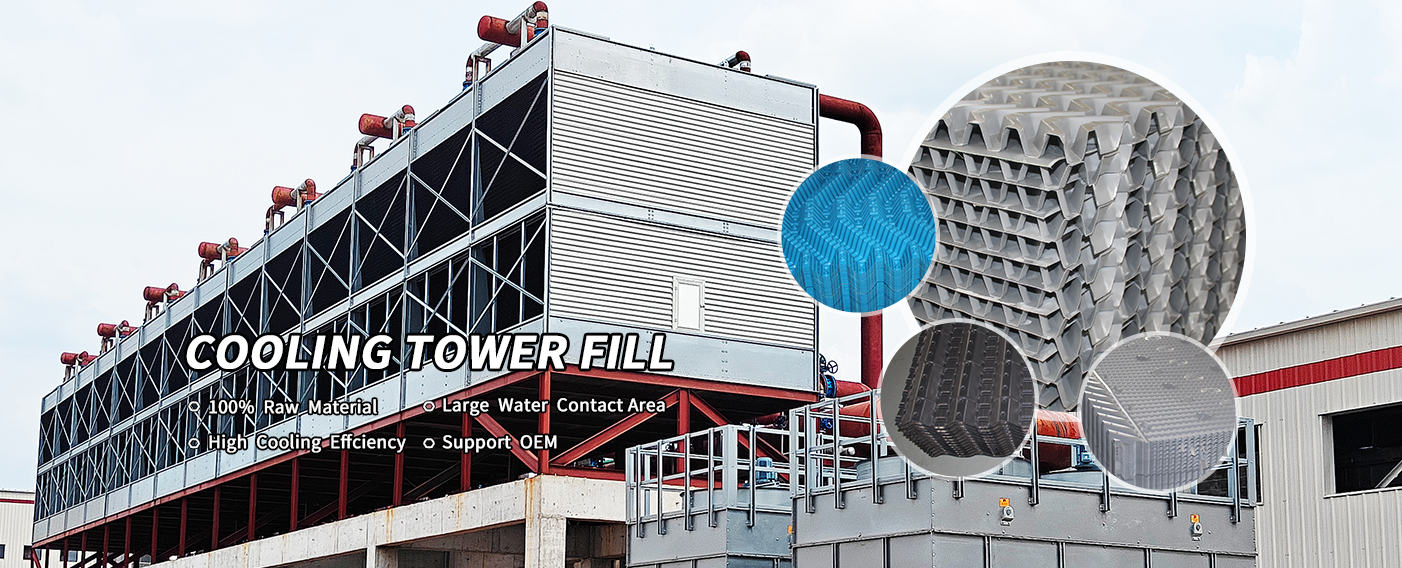
How to Clean Cooling Tower Fill: Complete Cleaning & Maintenance Guide
Cooling tower fill cleaning is an important part of cooling tower maintenance. Over time, scale, suspended solids, biological growth, slime, algae, and other deposits can accumulate inside cooling tower fill. These deposits reduce the effective contact between water and air, restrict airflow and water flow, increase operating problems, and can eventually damage or deform the fill.
Modern high-efficiency PVC cooling tower film fill provides a large surface area for heat transfer, but its narrow and often tortuous passages can also make it susceptible to fouling. Once deposits become severe, cleaning becomes increasingly difficult and cooling tower fill replacement may be required.
This guide explains how cooling tower fill becomes fouled, how to identify different types of deposits, which cleaning methods can be considered, and how to prevent serious fill deterioration.
Safety note: Chemical cleaning of cooling tower fill should be planned and performed by qualified personnel. Chemical compatibility, tower materials, discharge requirements, worker protection, and the manufacturer's recommendations must be evaluated before any treatment is started.
What Is Cooling Tower Fill?
Cooling tower fill is the heat-transfer media installed inside a wet cooling tower to increase contact between circulating water and air.
Hot return water enters the tower and is distributed over the fill. As water flows through the fill, it spreads over the available surfaces while air passes through the same area.
This increases water-air contact and promotes evaporative cooling.
Modern cooling towers commonly use film fill, while splash fill is also used for applications where a more open structure is desirable.
The source article emphasizes that cooling tower performance depends heavily on effective contact between hot return water and cooling air, with fill designed to maximize this contact.
Why Does Cooling Tower Fill Need Cleaning?
Even a well-managed cooling tower can eventually develop deposits.
The source material notes that scale and microbiological deposits can accumulate even when chemical treatment and monitoring are being used. These deposits can interfere with heat transfer and, in severe cases, contribute to physical deterioration of the fill.
Common causes include:
Mineral scale
Calcium carbonate deposits
Silica and silicate deposits
Suspended solids
Mud and silt
Microbiological growth
Biofilm
Algae
Organic deposits
Airborne contaminants
Process contamination
Inadequate water treatment
As deposits accumulate, the fill can begin to function like a filter, trapping additional solids inside its passages. This progressively restricts water and air movement.
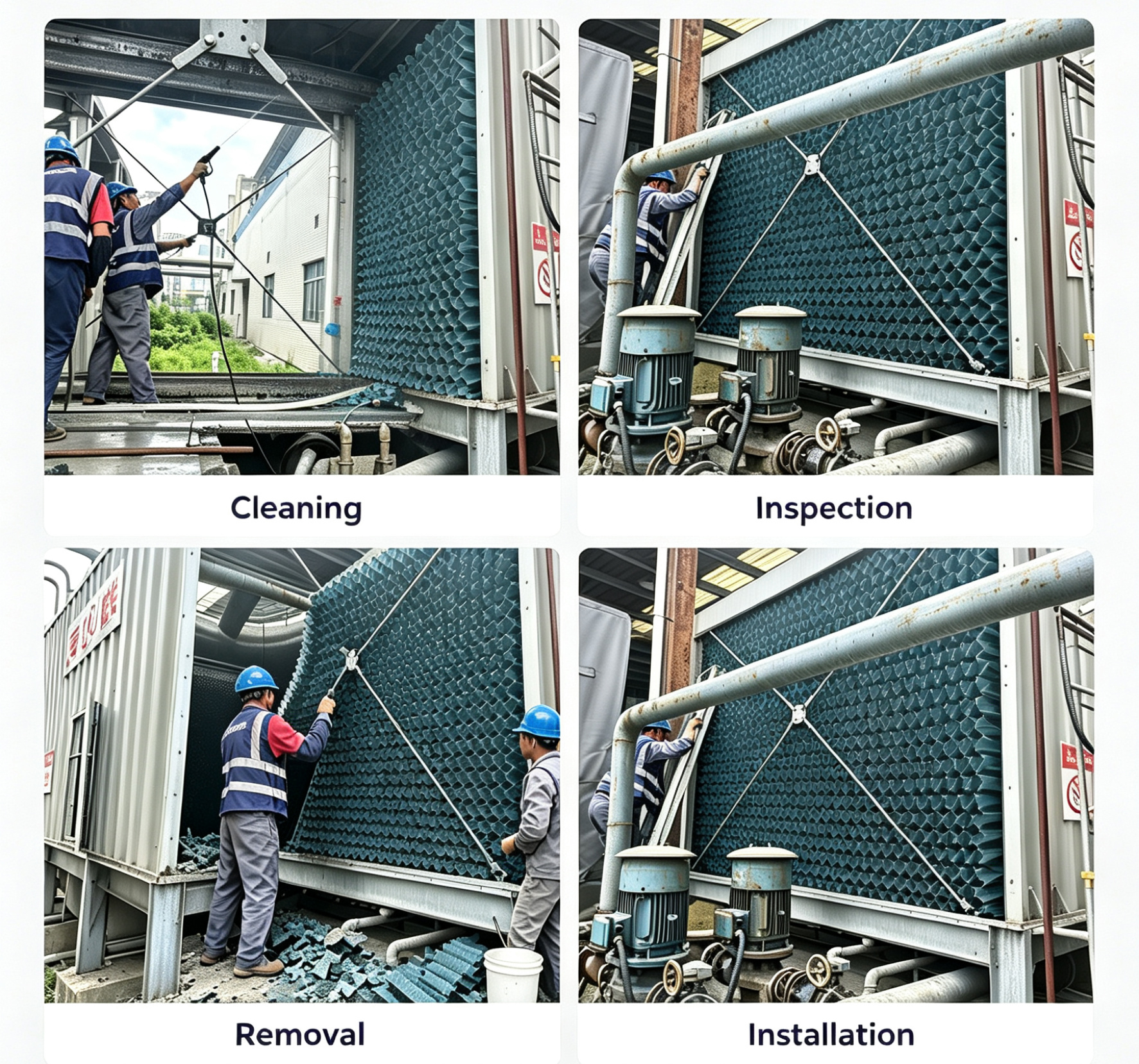
How Fouled Cooling Tower Fill Affects Performance
Dirty cooling tower fill can affect both thermal performance and mechanical reliability.
Reduced Heat Transfer
Deposits cover portions of the fill surface and reduce effective water-air contact.
Restricted Airflow
Blocked fill passages increase resistance to air moving through the tower.
Restricted Water Flow
Scale and sludge can interfere with water distribution and drainage through the fill.
Increased Fill Weight
Heavy deposits add substantial weight to plastic fill.
The source article reports that severely fouled high-efficiency fill can gain approximately 10 times its original weight, eventually contributing to deformation and collapse.
Fill Deformation or Collapse
Advanced fouling can place additional mechanical loads on fill supports and cause the fill to deform or collapse into the cold-water basin.
At that stage, cleaning may no longer be a practical solution and fill replacement may be necessary.
Common Types of Cooling Tower Fill Fouling
Before selecting a cleaning method, identify what is actually accumulating inside the fill.
Different deposits require different approaches.
The major categories are:
Mineral scale
Microbiological deposits
Organic deposits
Suspended solids
Mixed fouling deposits
Mineral Scale in Cooling Tower Fill
Mineral scale is one of the most common forms of cooling tower fouling.
Two important examples are:
The location of deposits can provide clues about the underlying problem.
Calcium Carbonate Scale
Calcium carbonate can occur throughout the fill and may be particularly significant in areas where evaporation concentrates dissolved minerals.
As water moves through the tower, evaporation increases the concentration of dissolved substances, while changes in temperature and pH can influence mineral deposition.
Silica and Silicate Deposits
Silica-related deposits can be particularly difficult to remove.
The source material notes that silica deposits often occur toward the lower portion of counterflow fill, where temperature, concentration, and local water/air distribution conditions can favor deposition.
Because silica scale can be difficult to dissolve, prevention and early intervention are particularly important.
Microbiological Fouling in Cooling Tower Fill
Microbiological fouling can include:
Biofilm
Slime
Algae
Microbial growth
Organic matrices
These deposits can be more difficult to detect visually than mineral scale.
The source article explains that microbiological deposits often accumulate in the middle portion of the fill, rather than being concentrated only at the top or bottom.
This is important because inspecting only the visible upper surface of the fill may not reveal the full extent of internal fouling.
Why Biological Fouling Is Difficult to Detect
Water velocity immediately below spray nozzles can be relatively high, making microbial attachment less likely.
Farther into the fill, water velocity decreases and microorganisms can begin colonizing surfaces.
The developing biological layer can then trap suspended solids, creating a thicker deposit matrix.
As a result, the fill can become heavily fouled internally while looking relatively acceptable from the top.
This is one reason periodic inspection and monitoring are important.
How to Inspect Cooling Tower Fill
A good cleaning program begins with inspection.
Look for:
Inspection should not be limited to the top of the fill.
Where practical and safe, inspect representative sections from different depths and locations.
Should You Clean or Replace Cooling Tower Fill?
This is one of the most important decisions in a cooling tower maintenance program.
Cleaning may be appropriate when:
Fouling is relatively early-stage
Fill remains mechanically sound
Deposits can be removed without damaging the media
Water distribution remains functional
The fill has not significantly deformed
Replacement becomes more appropriate when:
Fill is cracked
Fill has become brittle
Structural deformation is significant
Fill has collapsed
Passages are permanently blocked
Severe fouling has compromised the structure
Cleaning would be more expensive or risky than replacement
The source emphasizes that the decision depends on fouling severity, foulant characteristics, fill type, and environmental considerations.
Cooling Tower Fill Cleaning Methods
There is no single cleaning method suitable for every cooling tower.
Potential approaches include:
Preventive chemical cleaning
Chemical descaling
pH adjustment
Acid cleaning
Foam cleaning
Oxidizing cleaning
Mechanical cleaning
Low-pressure water cleaning
Fill removal and off-line cleaning
The appropriate method depends on the deposit and the cooling tower's materials and operating conditions.
1. Chemical Cleaning of Cooling Tower Fill
Chemical cleaning can be effective when deposits are chemically removable.
Before applying any chemical cleaner, evaluate:
Fill material
Tower metallurgy
Existing water chemistry
Type of deposit
Chemical concentration
Contact time
Temperature
Discharge requirements
Worker safety
Chemical cleaning should never be based simply on the assumption that a stronger chemical will produce a better result.
Aggressive chemicals can damage tower components or create environmental and disposal problems.
2. Cleaning Calcium Carbonate Scale
For predominantly calcium carbonate fouling, the source article describes reducing operating pH and/or cycles of concentration so the water becomes undersaturated with respect to calcite.
Acid-based approaches may also be considered.
Potential acid choices can include:
Sulfuric acid
Organic acids
Inhibited sulfamic acid
However, the choice and concentration must be engineered for the specific cooling tower system.
Do not apply acid cleaning to PVC fill or other tower components without confirming material compatibility and an appropriate cleaning procedure.
3. Foam Acid Cleaning
For certain light calcium carbonate deposits, off-line foam cleaning can be considered.
Foam can be applied from above the fill so that the cleaning solution gradually contacts the deposit as it moves through the pack.
This method can reduce the volume of liquid cleaning solution compared with some conventional flooding approaches.
The source describes foam acid cleaning as an option used particularly on smaller towers for light calcium carbonate scaling.
4. Mechanical Cleaning
Mechanical cleaning can sometimes remove brittle mineral scale from plastic fill.
Because mineral scale can be more brittle than flexible PVC, carefully controlled mechanical action may loosen deposits.
However, excessive force can:
Mechanical cleaning should therefore be performed carefully.
The source identifies mechanical cleaning as a possible approach for mineral deposits, both in situ and after removal, depending on circumstances.
5. Hydrogen Peroxide for Biological Deposits
Hydrogen peroxide can be considered for certain microbiological and organic fouling conditions.
The source identifies hydrogen peroxide as a widely used cleaning approach for deposits with microbiological or organic binders and describes its oxidizing action and oxygen-bubble effect on organic deposits.
The article gives a typical range of 500–3,000 ppm active H₂O₂ for the cleaning approach it discusses.
That concentration should not be treated as a universal dosing instruction. Actual chemical cleaning must be designed for the specific system, deposit, materials, and discharge requirements.
6. Surfactants and Dispersants
Surfactants may help cleaning chemicals penetrate and loosen deposits.
Polymeric dispersants can also help keep released solids suspended until they can be removed through controlled blowdown or another solids-management process.
The source discusses both surfactants and polymeric dispersants as aids during cleaning.
Why Cleaning Can Increase Suspended Solids
One often-overlooked issue is what happens to the deposits after they are removed from the fill.
A severely fouled tower can contain a substantial quantity of accumulated solids.
When cleaning releases those deposits, the solids enter the circulating water.
This can produce:
High turbidity
Increased suspended solids
Plugged nozzles
Basin accumulation
Increased filtration demand
Blowdown-management problems
The source specifically warns that severely fouled systems may release enough material to create very high suspended-solids concentrations.
Therefore, solids handling should be part of the cleaning plan.
Cooling Tower Fill Cleaning Procedure
A general cleaning project can follow this sequence.
Step 1: Shut Down and Isolate the Tower
Follow the plant's lockout/tagout and confined-space procedures where applicable.
Step 2: Inspect the Fill
Determine:
Fill type
Deposit type
Fouling severity
Mechanical condition
Step 3: Inspect the Water Distribution System
Check:
Spray nozzles
Distribution pipes
Headers
Basins
Troughs
Cleaning fill while leaving blocked distribution components unresolved will not restore proper performance.
Step 4: Determine the Cleaning Method
Select the least aggressive method that is appropriate for the specific deposit.
Step 5: Protect Equipment
Confirm chemical compatibility with:
PVC or PP fill
Metal components
Sealants
Coatings
Pumps
Piping
Other tower materials
Step 6: Apply the Cleaning Treatment
Follow the engineered cleaning procedure and chemical supplier instructions.
Step 7: Remove Released Solids
Manage sludge, scale fragments, and suspended solids.
Step 8: Flush the System
Flush remaining chemicals and loosened deposits according to the approved procedure.
Step 9: Inspect the Fill Again
Check whether deposits remain and whether the fill has suffered damage.
Step 10: Restart and Monitor
Monitor:
Supply-water temperature
Return-water temperature
Water flow
Fan operation
Differential pressure
Water quality
Basin condition
Preventing Cooling Tower Fill Fouling
The best cooling tower fill cleaning strategy is to prevent severe fouling in the first place.
The source emphasizes that proper chemical treatment and monitoring are fundamental to maintaining cooling tower performance.
A preventive program should address:
Scale Control
Control mineral concentration and operating conditions that promote scale formation.
Microbiological Control
Maintain an appropriate biocide program.
Suspended Solids Control
Use filtration or sidestream solids removal where appropriate.
Water Treatment Monitoring
Regularly monitor the parameters that influence scaling, corrosion, and biological growth.
Fill Inspection
Inspect the fill before fouling becomes severe.
Cooling Tower Fill Cleaning Maintenance Schedule
A practical maintenance program can include:
| Frequency | Recommended Inspection |
| Daily/operational | Water temperature, flow and abnormal operating conditions |
| Weekly | Basin condition, water quality and visible fouling |
| Monthly | Spray nozzles, distribution and accessible fill areas |
| Quarterly | Detailed fouling and water-treatment review |
| Annually | Comprehensive fill inspection and preventive cleaning assessment |
| As required | Chemical or mechanical cleaning based on deposit condition |
The exact frequency should be adapted to the tower's water quality, operating environment, fouling history, and manufacturer's recommendations.
The source recommends proactive inspection and notes that periodic light preventive fill cleaning can help control gradual weight accumulation.
When Cleaning Is No Longer Enough
Cleaning is not a substitute for replacement when the fill has suffered serious structural deterioration.
Consider cooling tower fill replacement when the fill:
Has collapsed
Is severely deformed
Has become brittle
Has extensive cracking
Has permanently blocked passages
Cannot be adequately cleaned
Has lost its structural integrity
Once high-efficiency fill has become heavily loaded with deposits and physically deformed, attempting increasingly aggressive cleaning can create more risk than benefit.
Choosing Replacement Cooling Tower Fill
When replacement becomes necessary, select fill according to the complete cooling tower application.
Important factors include:
Tower Configuration
Counterflow
Crossflow
Mechanical draft
Natural draft
Fill Type
Material
Operating Temperature
Check both normal and maximum water temperature.
Water Quality
Consider:
Hardness
Silica
Suspended solids
Biological activity
Chemical treatment
Fill Dimensions
Verify:
Length
Width
Height
Thickness
Flute configuration
PVC Cooling Tower Fill Cleaning
PVC cooling tower fill is widely used in high-efficiency film-fill applications.
Its structured surfaces provide substantial water-air contact, but those same passages can trap deposits when water treatment and solids control are inadequate.
When cleaning PVC film fill:
Confirm chemical compatibility
Avoid damaging the thin plastic sheets
Control mechanical force
Monitor deposit removal
Manage released solids
Inspect the fill after cleaning
If PVC fill is cracked, brittle, collapsed, or severely deformed, replacement is generally more appropriate than repeated cleaning.
Film Fill vs. Splash Fill Maintenance
Film fill and splash fill have different fouling characteristics.
| Feature | Film Fill | Splash Fill |
| Heat-transfer surface | High | Generally more open |
| Passage size | Often relatively narrow | Generally more open |
| Fouling sensitivity | Can be significant | Often more tolerant of solids |
| Cleaning | Requires careful methods | May be easier in some applications |
| Typical application | High-efficiency cooling | Fouling-prone industrial water |
The choice should be based on water quality and thermal requirements rather than heat-transfer efficiency alone.
How to Improve Cooling Tower Fill Life
A good maintenance program combines water treatment, inspection, cleaning and timely replacement.
1. Maintain Proper Water Chemistry
Control scaling, corrosion, and biological growth.
2. Monitor Suspended Solids
Prevent the fill from becoming a filter for excessive sediment.
3. Inspect Fill Regularly
Look beyond the visible surface when possible.
4. Clean Before Fouling Becomes Severe
Early-stage deposits are generally easier to address.
5. Check Water Distribution
Blocked nozzles can create localized fouling and dry areas.
6. Monitor Thermal Performance
Unexpected increases in cold-water temperature can indicate fouling or other operating problems.
7. Replace Severely Damaged Fill
Do not continue cleaning structurally failed fill.
Cooling Tower Fill Cleaning Safety
Cooling tower cleaning can involve chemicals, elevated structures, wet surfaces, rotating equipment, contaminated water, and potentially hazardous biological exposure.
Before starting work:
Follow site safety procedures
Isolate rotating equipment
Use appropriate PPE
Follow chemical SDS requirements
Control chemical exposure
Confirm ventilation requirements
Follow confined-space procedures where applicable
Prevent uncontrolled chemical discharge
Verify chemical compatibility
Follow local environmental regulations
Chemical cleaning should be performed by qualified personnel with an appropriate risk assessment and treatment plan.
Frequently Asked Questions
How often should cooling tower fill be cleaned?
There is no universal interval. Cleaning frequency depends on water quality, fouling rate, chemical treatment, operating conditions, and the condition of the fill. Preventive inspection should determine when cleaning is appropriate.
What causes cooling tower fill to become dirty?
The most common causes include mineral scale, microbiological growth, suspended solids, mud, silt, organic deposits, airborne contaminants, and inadequate water treatment.
Can you pressure wash cooling tower fill?
Mechanical or water cleaning can be possible, but excessive pressure can damage plastic film fill. The cleaning method should be selected according to the fill material and condition.
What chemical is used to clean cooling tower fill?
The appropriate chemical depends on the deposit. Acidic treatments may be used for certain mineral scales, while oxidizing treatments can be considered for biological and organic deposits. Chemical compatibility and environmental requirements must be evaluated first.
Can hydrogen peroxide clean cooling tower fill?
Hydrogen peroxide can be used for certain microbiological and organic deposit conditions. The source article discusses peroxide cleaning as an effective approach for these types of deposits.
How do I remove calcium carbonate from cooling tower fill?
Approaches can include controlled chemical treatment designed to dissolve calcite, depending on the system and material compatibility. The source discusses pH/cycles-of-concentration control and acid-based approaches for calcite deposits.
Can silica scale be removed from cooling tower fill?
Silica deposits can be particularly difficult to remove. The appropriate strategy depends on the deposit chemistry and severity. Prevention and control of the conditions that promote silica deposition are especially important.
When should cooling tower fill be replaced instead of cleaned?
Replacement should be considered when fill is cracked, brittle, collapsed, severely deformed, structurally compromised, or so heavily fouled that cleaning is impractical.
Does cleaning cooling tower fill improve cooling performance?
It can. Removing deposits can restore water-air contact and reduce blockage, potentially improving thermal performance. However, overall tower performance also depends on airflow, water distribution, water flow, ambient conditions, and other components.
Conclusion
Cooling tower fill cleaning is an important part of maintaining the thermal performance and structural reliability of a wet cooling tower.
The most effective approach is not simply to wait until the fill becomes heavily fouled and then use the strongest available cleaning chemical. Instead, cooling tower operators should combine water treatment, suspended-solids control, microbiological control, regular inspection, preventive cleaning, and timely fill replacement.
Mineral scale, microbiological deposits, organic matrices, and suspended solids require different cleaning strategies. Early-stage fouling may sometimes be managed through relatively mild chemical or mechanical approaches, while heavily fouled or structurally damaged fill may need to be replaced.
For PVC cooling tower film fill, particular care is required because the high-efficiency structure that provides excellent heat transfer can also contain narrow passages that trap deposits.
The key principle is simple:
Prevent fouling where possible, identify deposits early, select the least aggressive effective cleaning method, and replace fill when its structural or thermal condition can no longer be restored.
For cooling tower refurbishment projects, CoolingTowerPart.com can position its cooling tower fill and fill-replacement products around this maintenance lifecycle—from preventive maintenance and replacement fill selection to complete cooling tower thermal-media replacement.


