Cooling Tower Water Consumption Calculation
Introduction
If you're involved in managing or operating a cooling tower, one of the most important factors to keep an eye on is **water consumption**. Cooling towers play a key role in heat dissipation for various industrial processes, including power plants, HVAC systems, and manufacturing. However, these towers consume a significant amount of water, and calculating that usage is crucial for efficiency, cost-saving, and sustainability.
In this guide, we’ll walk you through the basics of calculating cooling tower water consumption, why it matters, and how you can optimize water usage to ensure your system runs smoothly while conserving resources.
What is a Cooling Tower?
Definition and Purpose of Cooling Towers
A cooling tower is a heat rejection device that uses water to cool down a system or process by releasing excess heat into the atmosphere. The main purpose of a cooling tower is to facilitate heat transfer through evaporation—cooling water by turning a small portion of it into vapor and releasing it into the air.
These towers come in various types, from natural draft towers to forced-draft or induced-draft towers, each designed for different applications. What they all have in common is their significant water consumption, which is why it’s essential to monitor and optimize usage.
How Cooling Towers Use Water
Understanding how cooling towers use water is key to calculating and optimizing their consumption. There are three primary forms of water loss:
Evaporation
The process of evaporation is where most of the cooling tower’s water is lost. Water evaporates as it comes into contact with warm air, and this loss is directly proportional to the amount of heat being removed.
Drift
Drift is the small amount of water that is carried away with the air as it exits the cooling tower. Though drift loss is minimal compared to evaporation, it can still add up over time and contribute to significant water waste if not controlled.
Blowdown
Blowdown is the water that’s intentionally removed from the cooling tower to maintain water quality. The buildup of dissolved solids due to evaporation leads to the need for periodic blowdown to prevent scaling and corrosion.
Makeup Water
Makeup water is the fresh water added to the cooling tower to replace the water lost through evaporation, drift, and blowdown. Calculating the correct amount of makeup water is essential for efficient water usage.
Why Calculate Cooling Tower Water Consumption?
Understanding and calculating water consumption in cooling towers is important for several reasons:
Cost Efficiency
Water is a costly resource, especially in industrial settings where cooling towers are used extensively. Accurately calculating water consumption can help reduce unnecessary water use, leading to substantial savings.
Water Conservation
In many regions, water scarcity is becoming a critical issue. By calculating and minimizing water consumption, facilities can play a part in contributing to water conservation efforts.
Regulatory Compliance
Governments and local authorities often have regulations regarding water usage and discharge from cooling systems. Proper calculations ensure compliance with environmental standards and avoid costly fines.
Basic Principles Behind Water Consumption
To understand how to calculate cooling tower water consumption, it’s essential to familiarize yourself with a few key principles:
Evaporation Loss
The rate of evaporation loss depends on the amount of heat the cooling tower needs to reject. The greater the heat load, the more water will evaporate.
Drift Loss
Drift loss is typically quantified as a percentage of the total airflow. Though small in comparison to evaporation, controlling drift is still important for minimizing overall water consumption.
Blowdown and Makeup Water
Blowdown is necessary to maintain water quality by removing concentrated dissolved solids. The makeup water compensates for all losses, ensuring the system stays balanced.
Factors Affecting Cooling Tower Water Usage
Several environmental and operational factors influence how much water a cooling tower consumes. Understanding these factors will help in making accurate calculations.
Ambient Temperature
Hotter ambient temperatures increase the cooling demand and, therefore, increase evaporation. As a result, more water will be needed to cool the system.
Humidity
High humidity levels reduce the evaporation rate, as the air is already saturated with moisture. Conversely, low humidity increases evaporation, leading to more water loss.
Cooling Load
The cooling load—the amount of heat the system needs to reject—directly impacts the volume of water required. Higher cooling loads require more water for cooling.
Tower Efficiency
The efficiency of the cooling tower itself affects water consumption. Well-maintained and properly designed towers can minimize water use while still providing adequate cooling.
Evaporation Loss
How It Happens
Evaporation occurs when heat is transferred from the water in the tower to the surrounding air. As water is exposed to the hot air, a small portion turns into vapor and escapes. The more heat the system needs to dissipate, the more water will be lost through evaporation.
Impact on Water Consumption
Evaporation is the largest contributor to water loss in cooling towers. As it’s directly tied to the heat load, the more heat the tower needs to reject, the higher the evaporation rate.
Drift Loss
What Is Drift?
Drift refers to the water droplets that are carried away by the airflow as it exits the cooling tower. Although drift loss is generally low, it can still contribute to significant water waste over time.
How to Minimize Drift Loss
To reduce drift, ensure that drift eliminators are properly installed and maintained. These devices capture the small water droplets and return them to the system, reducing overall water loss.
Blowdown and Make-Up Water
Purpose of Blowdown
Blowdown is the process of removing a portion of water from the cooling tower to control the buildup of dissolved solids, which can cause scaling or corrosion. Blowdown helps maintain water quality and system efficiency.
Make-Up Water
Make-up water is added to the system to replace the water lost due to evaporation, drift, and blowdown. Calculating the correct amount of make-up water is critical to avoid excessive water use.
Cooling Tower Water Consumption Formula
To calculate the water consumption in a cooling tower, you can use the following formula:
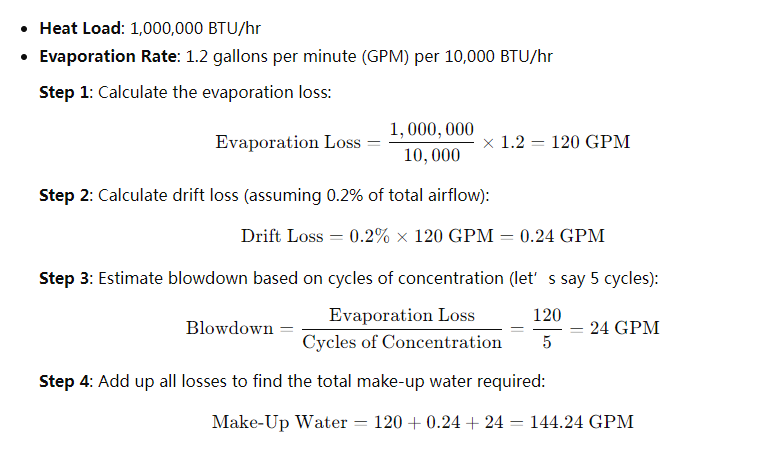
Make-Up Water= Evaporation Loss + Drift Loss + Blowdown
Where:
* Evaporation Loss is usually calculated based on the heat load of the system.
* Drift Loss can be estimated as a small percentage of the total airflow.
* Blowdown is calculated based on the concentration of dissolved solids in the water and the system's cycles of concentration.
Step-by-Step Guide to Calculating Water Usage
Let’s walk through a simple example. Suppose a cooling tower has the following values:
Adjusting for Variable Factors
Water consumption in cooling towers can vary depending on seasonal changes, ambient temperature fluctuations, and system load variations. Be sure to adjust your calculations accordingly based on these factors.
Ways to Reduce Water Consumption in Cooling Towers
Water-saving strategies can significantly reduce cooling tower consumption:
* Use of VSDs: Implementing variable speed drives on fans and pumps can reduce unnecessary water consumption during off-peak hours.
* Regular Maintenance: Keeping the tower clean and free of scale and debris can reduce water wastage.
* Water Recycling: Implementing water treatment systems that allow water to be reused can cut down on the need for fresh makeup water.
Water Recycling in Cooling Towers
Water recycling in cooling towers can reduce the need for external water sources. By installing water treatment systems such as reverse osmosis or filtration, cooling towers can reuse water within the system, saving both water and money.
Common Miscalculations in Water Consumption
There are several common mistakes people make when calculating cooling tower water consumption:
* Underestimating Drift Loss; Drift loss is often overlooked, but even small amounts can add up over time.
* Incorrect Blowdown Calculations: Failing to account for high cycles of concentration can lead to improper blowdown rates.
* Overlooking Seasonal Changes: Not adjusting calculations for seasonal temperature and humidity variations can lead to inaccurate results.
Monitoring and Optimizing Water Use
Using advanced monitoring tools, such as IoT-based sensors and automated control systems, can help you continuously monitor water usage and optimize cooling tower efficiency.
Real-World Examples of Water Consumption Calculations
In real-world scenarios, companies have successfully reduced water consumption by optimizing their cooling tower operations. For example, a large manufacturing facility used VSDs and improved maintenance protocols, which resulted in a 15% reduction in water usage over a year.
Conclusion
Accurately calculating and managing cooling tower water consumption is essential for improving efficiency, saving costs, and supporting sustainability efforts. By understanding the basic principles of water use, monitoring key factors, and adopting best practices, you can optimize your cooling tower’s performance and reduce environmental impact.