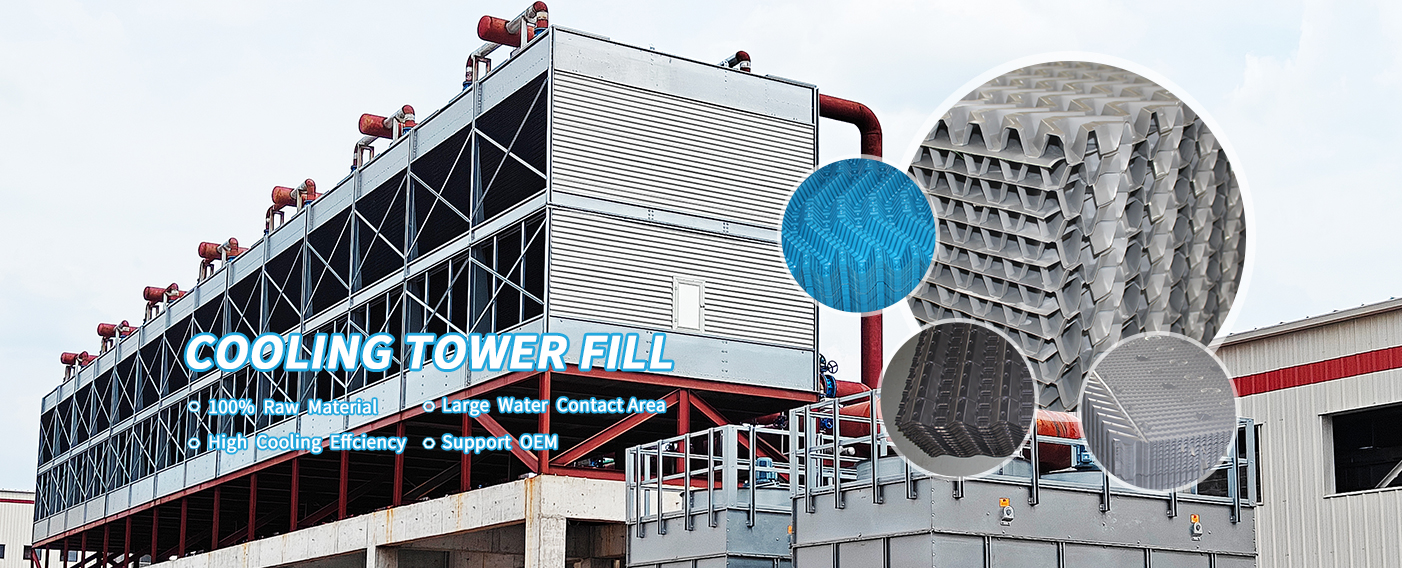
Cooling Tower Fills for Hot Water Distribution
Cooling tower fills are one of the most important heat-transfer components in a wet cooling tower. Installed beneath the hot water distribution system, cooling tower fill increases the contact area between hot circulating water and air, allowing heat to be transferred more efficiently through evaporation.
For industrial cooling towers, HVAC systems, power plants, chemical processing facilities, and process-cooling applications, selecting the right cooling tower fills for hot water distribution can have a significant impact on thermal performance, water distribution, pressure drop, maintenance requirements, and operating life.
This guide explains how cooling tower fill works, the different types and materials available, how to select the right fill, and what to consider when replacing existing cooling tower packing.
What Is Cooling Tower Fill?
Cooling tower fill, also called cooling tower packing or heat transfer fill, is a structured or splash-type material installed inside a wet cooling tower.
Its primary purpose is to increase the effective contact area between water and air.
Hot water from the process or condenser system enters the cooling tower through a distribution system. The water is distributed over the cooling tower fill, where it spreads into thin films or breaks into droplets. Air passes through the fill at the same time.
As the water and air interact, a portion of the water evaporates. This evaporation removes heat from the circulating water, reducing its temperature before the water returns to the process.
The fill therefore does not simply provide a surface for water to flow over. It is an engineered heat-transfer medium that helps maximize the efficiency of the cooling tower.
How Cooling Tower Fills Work With Hot Water Distribution
The relationship between the hot water distribution system and cooling tower fill is critical.
A typical wet cooling tower has several functional zones:
Hot water inlet
Water distribution system
Spray nozzles or distribution pipes
Cooling tower fill
Air inlet or louver section
Drift eliminators
Cold water basin
Fan and air-moving system
Hot water is first distributed across the upper section of the tower. Nozzles, pipes, troughs, or other distribution devices spread the water over the fill.
The fill then increases the water-air contact area.
In a counterflow cooling tower, water flows downward while air moves upward. In a crossflow cooling tower, water generally flows vertically downward while air travels horizontally through the fill.
The greater effective contact between water and air allows the tower to reject heat more efficiently.
Why Cooling Tower Fill Is Important
Without an effective fill system, water would fall through the tower too quickly and have relatively limited contact with moving air.
Cooling tower fill addresses this problem by slowing and spreading the water flow.
A properly designed fill can:
Increase heat-transfer surface area
Improve water-air contact
Increase evaporative cooling
Improve cooling tower thermal performance
Reduce the required tower footprint for a given duty
Support more uniform water distribution
Improve approach temperature performance
Help optimize cooling tower airflow
For this reason, cooling tower fill is often considered the primary heat-transfer medium in a mechanical-draft wet cooling tower.
Cooling Tower Fill and Hot Water Distribution
Hot water distribution determines how effectively water reaches the fill.
Even high-performance film fill cannot compensate for severely uneven water distribution. Areas receiving insufficient water may become underutilized, while areas receiving excessive water may experience flooding or increased pressure drop.
The ideal system provides relatively uniform water loading across the available fill surface.
Important distribution components can include:
The compatibility between the distribution system and fill design should therefore be considered during cooling tower upgrades or replacement projects.
Types of Cooling Tower Fill
Cooling tower fill can generally be divided into two major categories: film fill and splash fill.
Film Fill
Film fill consists of corrugated or specially formed sheets assembled into blocks or modules.
Water flows over the surfaces of the sheets and forms thin films. The large wetted surface area provides extensive contact between water and air.
Film fill is widely used in modern cooling towers because it can provide high thermal performance within a relatively compact volume.
Common applications include:
HVAC cooling towers
Industrial process cooling
Counterflow cooling towers
Crossflow cooling towers
Chiller condenser-water systems
Splash Fill
Splash fill uses a series of bars, grids, or molded elements that repeatedly break falling water into smaller droplets.
Rather than relying primarily on thin water films, splash fill promotes repeated splashing and redistribution.
Splash fill can be advantageous in applications where water contains suspended solids, biological material, or other contaminants that could quickly obstruct narrow film-fill passages.
Counterflow Cooling Tower Fill
Counterflow cooling tower fill is designed for towers where air and water move in opposite directions.
Water travels downward through the fill while air moves upward.
Counterflow film fill commonly consists of corrugated PVC or PP sheets assembled into blocks. The flute geometry promotes water spreading and creates an extended air-water interface.
Advantages can include:
High heat-transfer efficiency
Compact fill volume
Large effective surface area
Efficient use of tower space
Compatibility with many industrial applications
Counterflow fill selection must consider water temperature, water quality, air velocity, water loading, and the required thermal duty.
Crossflow Cooling Tower Fill
In a crossflow cooling tower, air passes horizontally through the fill while water flows downward.
Crossflow towers commonly use gravity-based water distribution systems located above the fill.
Crossflow fill can be configured to work with different water distribution basin designs and tower layouts.
The selection of crossflow fill should consider:
PVC Cooling Tower Fill
PVC cooling tower fill is one of the most widely used options for wet cooling towers.
Polyvinyl chloride provides a useful combination of mechanical strength, chemical resistance, manufacturability, and cost effectiveness.
PVC film fill is commonly used in HVAC and industrial cooling tower applications where operating conditions are suitable for the material.
Typical advantages include:
Good dimensional stability
Good resistance to water exposure
Lightweight construction
Easy modular installation
Suitable for mass production
Cost-effective replacement
The maximum allowable operating temperature should always be confirmed for the specific PVC fill design and application.
PP Cooling Tower Fill
Polypropylene cooling tower fill is another important option, particularly for applications requiring higher temperature capability or specific chemical resistance characteristics.
PP film fill can be manufactured in different corrugated patterns and thicknesses to achieve the required combination of heat-transfer performance and mechanical strength.
It is often considered for industrial applications where PVC may not be the preferred material.
High-Temperature Cooling Tower Fill
Some industrial cooling towers operate with higher hot-water temperatures than conventional HVAC systems.
For these applications, material selection becomes particularly important.
The fill material must maintain adequate mechanical stability and dimensional integrity at the operating temperature.
Potential choices include specialized PP or other engineered materials, depending on the application.
When selecting high-temperature fill, consider:
Hot water inlet temperature
Cold water outlet temperature
Continuous operating temperature
Peak operating temperature
Water chemistry
Cleaning procedure
Airflow
Fill loading
Temperature limits should be verified with the fill manufacturer rather than relying on generic material specifications.
Film Fill Flute Design
The flute or corrugation pattern is an important characteristic of film fill.
Different flute geometries influence:
A fill with very narrow passages may provide high surface area but could be more vulnerable to blockage when water contains suspended solids.
Conversely, larger passages may provide better fouling resistance but can offer different thermal performance characteristics.
The correct balance depends on the cooling tower's operating environment.
Cooling Tower Fill Surface Area
One of the fundamental functions of cooling tower fill is increasing the effective surface area available for water-air contact.
The water should spread over as much of the available fill surface as practical.
However, the nominal geometric surface area alone does not determine actual cooling performance.
Effective performance also depends on:
Water distribution
Airflow
Water loading
Fill geometry
Water temperature
Air conditions
Fouling
Scale accumulation
Fill condition
Therefore, selecting fill solely according to surface area can lead to an inappropriate design.
Cooling Tower Fill Water Loading
Water loading is an important design parameter for cooling tower fill.
It describes the amount of water flowing over a given fill area, commonly expressed in units such as m³/h per m².
The fill must be capable of handling the expected water loading while maintaining proper water distribution and airflow.
Too little water may result in underutilized fill surface.
Excessive water loading can contribute to flooding, increased pressure drop, poor air passage, or reduced thermal performance.
The manufacturer's recommended operating range should therefore be considered during fill selection.
Airflow and Cooling Tower Fill
Cooling tower fill performance depends on both water and air movement.
Mechanical-draft cooling towers use fans to move air through the tower. The fill must allow adequate airflow while providing sufficient water contact.
If the fill creates excessive air resistance, fan energy requirements can increase.
If the fill provides insufficient water-air contact, thermal performance may decline.
A properly selected fill therefore balances:
Heat transfer + airflow + pressure drop + water distribution
This balance is particularly important when replacing fill in an existing cooling tower because the original fan system may have been designed around a specific fill configuration.
Cooling Tower Fill Fouling and Clogging
Fouling is one of the most common challenges affecting cooling tower fill.
Depending on the application, deposits can include:
Scale
Dirt
Sediment
Biological growth
Algae
Corrosion products
Process contaminants
Film fill with small passages can be particularly sensitive to excessive fouling.
When passages become blocked, several problems can occur:
Reduced effective heat-transfer area
Poor water distribution
Increased airflow resistance
Higher fan energy consumption
Higher cold-water temperature
Reduced cooling capacity
For applications with poor water quality, splash fill or a more open film-fill design may be more appropriate.
Cooling Tower Fill Cleaning
Regular inspection and cleaning can help maintain cooling tower performance.
The appropriate cleaning method depends on the fill material and the type of deposits.
Common maintenance approaches include:
Low-pressure water cleaning
Mechanical removal of deposits
Chemical cleaning
Biological control
Water-treatment optimization
High-pressure cleaning should be used cautiously because excessive pressure can deform or damage fill sheets.
The cleaning procedure should follow the fill manufacturer's recommendations.
When Should Cooling Tower Fill Be Replaced?
Cooling tower fill does not necessarily need to be replaced on a fixed schedule.
Replacement should be considered when the fill shows significant:
Thermal performance should also be monitored.
If the tower is consistently producing warmer cold-water temperatures despite correct fan operation, water flow, and water distribution, degraded fill may be one possible cause.
Cooling Tower Fill Replacement
Replacing cooling tower fill can be an effective way to restore heat-transfer performance without replacing the entire tower.
A replacement project normally begins with an assessment of the existing installation.
Important information includes:
Cooling tower manufacturer
Tower model
Counterflow or crossflow configuration
Existing fill type
Fill dimensions
Fill height
Module width and length
Sheet thickness
Water temperature
Circulating water flow
Water quality
Existing distribution system
Photographs and drawings can also help identify the appropriate replacement configuration.
Custom Cooling Tower Fill
Cooling towers vary significantly in size and design, so standard fill dimensions may not always be suitable.
Custom cooling tower fill can be manufactured according to project requirements.
Customization may include:
Fill block dimensions
Fill height
Sheet thickness
Flute configuration
Material selection
Module arrangement
Support requirements
Custom replacement fill is particularly useful for older cooling towers where the original fill is obsolete or no longer readily available.
How to Select Cooling Tower Fill
Choosing the right cooling tower fill requires more than selecting PVC or PP.
Consider the following factors.
1. Cooling Tower Type
Determine whether the tower is counterflow or crossflow.
2. Hot Water Temperature
Check both normal and maximum water temperature.
3. Circulating Water Flow
The fill must accommodate the required water loading.
4. Water Quality
Evaluate suspended solids, hardness, biological activity, and other contaminants.
5. Airflow
Consider the existing fan capacity and fill pressure drop.
6. Fouling Potential
Applications with dirty water may require a more open fill design.
7. Fill Dimensions
Replacement fill must fit the existing fill support system and tower geometry.
8. Material
PVC and PP are common choices, but the final selection should match the operating conditions.
9. Thermal Requirements
The fill should be selected according to the required cooling range and approach temperature.
Cooling Tower Fill Installation
Proper installation is essential for achieving the expected performance.
Before installation, the existing fill should be removed and the fill support structure inspected.
The support system should be checked for:
Corrosion
Damage
Deformation
Loose components
Structural deterioration
New fill blocks should be installed securely and arranged according to the specified configuration.
Gaps should be minimized where required by the design, while allowing appropriate expansion and drainage.
The hot water distribution system should also be inspected before commissioning the new fill.
Cooling Tower Fill and Spray Nozzles
Fill and spray nozzles work together as part of the heat-transfer system.
The nozzle distributes water over the fill, while the fill provides the surface required for water-air contact.
Poor nozzle performance can reduce the effectiveness of otherwise high-quality fill.
During maintenance, inspect nozzles for:
Blockage
Wear
Damage
Uneven spray patterns
Incorrect installation
If water distribution is uneven, the cooling tower may not use its entire fill surface effectively.
Cooling Tower Fill and Drift Eliminators
Drift eliminators are installed above or downstream of the water distribution and fill section, depending on tower design.
Their purpose is to reduce the amount of circulating-water droplets carried out of the tower by the exhaust air.
While fill and drift eliminators perform different functions, both are important components of an efficient wet cooling tower.
Industrial Applications of Cooling Tower Fill
Cooling tower fill is used across many industries.
Power Plants
Cooling towers reject heat from condenser cooling-water systems and other plant processes.
Chemical Plants
Process cooling systems often require reliable heat rejection under demanding operating conditions.
Petrochemical Plants
Cooling towers support heat exchangers, condensers, compressors, and other process equipment.
Steel Plants
Industrial cooling towers are used for cooling process water and equipment.
HVAC Systems
Commercial buildings and industrial facilities use cooling towers to reject condenser heat from water-cooled chillers.
Plastic and Rubber Processing
Process cooling systems use cooling towers to control production temperatures.
Advantages of High-Quality Cooling Tower Fill
Choosing appropriate cooling tower fill can provide several operational benefits:
Improved heat-transfer performance
Better use of tower volume
More stable cooling-water temperatures
Improved water-air contact
Potentially lower operating costs
Better utilization of existing cooling tower capacity
Easier maintenance and replacement
The actual benefit depends on the complete cooling tower system and operating conditions.
Cooling Tower Fill Manufacturer and Supplier
When purchasing replacement cooling tower fill, it is important to work with a supplier capable of matching the fill to the existing tower.
A qualified cooling tower fill manufacturer should be able to provide information about:
For replacement projects, providing detailed operating information can significantly improve the accuracy of the fill selection.
Cooling Tower Fill for Hot Water Distribution: Key Considerations
The best fill is not necessarily the fill with the highest advertised surface area.
A successful cooling tower fill design must match the entire system.
The most important factors include:
Hot water distribution: Water must be distributed evenly across the fill.
Airflow: The fan must provide adequate airflow without excessive pressure loss.
Water quality: Fill geometry should match the fouling and scaling characteristics of the water.
Temperature: The fill material must withstand the operating temperature.
Thermal duty: The fill must provide sufficient heat-transfer capability.
Maintenance: The design should allow practical inspection and cleaning.
Dimensions: Replacement fill must fit the existing tower structure.
Frequently Asked Questions
What is the purpose of cooling tower fill?
The purpose of cooling tower fill is to increase the contact area between circulating water and air, improving evaporative heat transfer and reducing water temperature.
Where is cooling tower fill located?
Cooling tower fill is generally installed below the hot water distribution system in a wet cooling tower.
What is the difference between film fill and splash fill?
Film fill spreads water into thin films over structured surfaces, while splash fill repeatedly breaks falling water into droplets. Film fill generally provides high heat-transfer performance, while splash fill can be advantageous in applications with higher fouling potential.
Is PVC or PP better for cooling tower fill?
Neither material is universally better. PVC is widely used for conventional applications, while PP may be preferred for certain higher-temperature or chemically demanding applications. The correct choice depends on the operating conditions.
Can cooling tower fill be replaced without replacing the entire tower?
Yes. Cooling tower fill is a replaceable component, and properly designed replacement fill can often be installed within the existing tower structure.
How do I choose replacement cooling tower fill?
Start with the cooling tower type, existing fill dimensions, water flow, hot-water temperature, water quality, airflow, and required thermal performance. Manufacturer compatibility should also be verified.
Can cooling tower fill be customized?
Yes. Cooling tower fill can be supplied in customized module dimensions, fill heights, materials, thicknesses, and configurations to match specific cooling tower installations.
Does cooling tower fill improve cooling capacity?
Properly selected and maintained fill can improve the effectiveness of water-air contact and help the cooling tower achieve its intended thermal performance. However, total tower capacity also depends on airflow, water flow, weather conditions, distribution, and equipment condition.
Conclusion
Cooling tower fills for hot water distribution play a central role in the heat-transfer process of wet cooling towers. By spreading hot circulating water over a large effective surface area and promoting contact with moving air, cooling tower fill enables efficient evaporative cooling.
PVC and PP film fills are widely used in counterflow and crossflow cooling towers, while splash fill remains an important option for applications where fouling and suspended solids are major concerns.
When selecting or replacing cooling tower fill, consider the complete operating environment rather than focusing on one specification. Water temperature, water loading, air velocity, distribution system, water quality, fill geometry, material, pressure drop, and tower dimensions all affect the final result.
For industrial replacement projects, supplying the cooling tower model, existing fill dimensions, operating temperatures, water flow, and photographs can help a cooling tower fill manufacturer or supplier identify a suitable replacement.
With the right fill design and proper hot water distribution, a cooling tower can maintain effective heat transfer, reliable operation, and long-term thermal performance.


