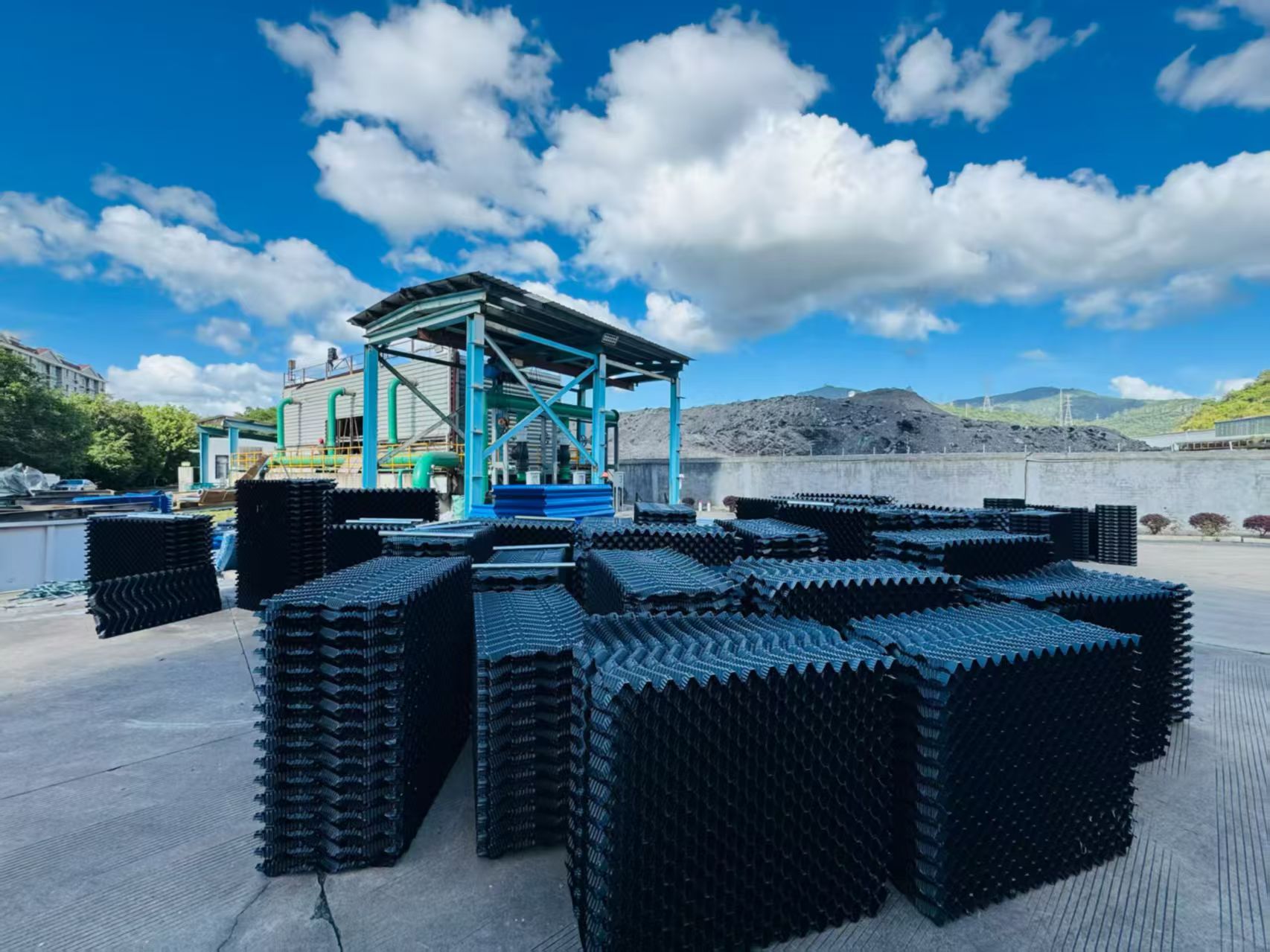
Cooling Tower Fill Materials: The Key to Efficiency & Performance
Cooling tower fill materials are one of the most important components in determining the efficiency, cooling capacity, and operating cost of a cooling tower. Although cooling tower fills may appear to be simple plastic sheets or splash bars, their design and material directly affect heat transfer, water distribution, pressure drop, maintenance requirements, and service life.
Choosing the right cooling tower fill material is therefore essential for industrial cooling towers, HVAC systems, power plants, manufacturing facilities, chemical processing plants, and other applications that rely on efficient heat rejection.
This guide explains the most common cooling tower fill materials, their advantages and disadvantages, applications, and the key factors buyers should consider when selecting replacement or new cooling tower fill.
What Is Cooling Tower Fill?
Cooling tower fill is the internal media installed inside a cooling tower to increase the contact area between circulating water and air.
Hot process water enters the tower and is distributed over the fill. As the water flows downward, air passes through or around the fill. The large surface area created by the fill allows heat and a small amount of water to evaporate, transferring heat from the circulating water to the atmosphere.
In simple terms, the primary purpose of cooling tower fill is to:
Increase water-to-air contact area
Improve heat transfer
Increase cooling tower efficiency
Reduce the required tower size
Support higher cooling capacity
Improve water distribution and air contact
The performance of a cooling tower depends heavily on the quality and design of its fill material.
Why Cooling Tower Fill Material Matters
Different materials provide different levels of chemical resistance, mechanical strength, temperature resistance, and service life.
A properly selected fill can improve tower performance while reducing maintenance and replacement costs. In contrast, unsuitable fill may deform, clog, break, or deteriorate prematurely.
Important performance characteristics include:
For this reason, cooling tower operators should evaluate both the fill material and the fill design before purchasing replacement media.
Common Cooling Tower Fill Materials
Several materials are commonly used in cooling tower fill manufacturing. The most widely used are PVC, polypropylene, and various materials used for splash-type fill.
PVC Cooling Tower Fill
PVC cooling tower fill is one of the most widely used options for HVAC and industrial cooling towers.
PVC film fill is manufactured from thin sheets formed into corrugated or cellular patterns. These surfaces spread water into thin films and maximize contact between water and air.
Key advantages include:
Excellent heat-transfer performance
Lightweight construction
Cost-effectiveness
Good corrosion resistance
Easy installation
Suitable for many commercial and industrial applications
PVC fill is particularly common in counterflow and crossflow cooling towers.
However, standard PVC has temperature limitations. If the entering water temperature is too high, the sheets may soften or deform. Therefore, operating temperature should always be checked before selecting PVC fill.
PP Cooling Tower Fill
Polypropylene (PP) cooling tower fill is another popular material, especially for applications requiring higher temperature resistance.
Compared with conventional PVC, polypropylene generally offers better resistance to elevated temperatures and certain aggressive chemical environments.
Advantages of PP fill include:
PP cooling tower fill is frequently considered for industrial applications where operating conditions are more demanding.
Splash Fill Materials
Splash fill works differently from film fill. Instead of creating a continuous thin water film, splash bars or grids repeatedly break falling water into smaller droplets.
Common splash-fill materials include polypropylene and other engineered plastics.
Splash fill is often preferred where water contains suspended solids, biological contaminants, or other substances that could quickly foul narrow film-fill passages.
Its major advantages include:
Better resistance to clogging
Suitable for dirty or contaminated water
Robust construction
Easier cleaning in many applications
Suitable for industrial cooling systems
The trade-off is that splash fill may require greater tower volume to achieve the same cooling performance as a highly efficient film-fill system.
Film Fill vs. Splash Fill
One of the most important decisions when selecting cooling tower fill is whether to use film fill or splash fill.
Film fill spreads water over a large surface area, producing highly efficient heat transfer in a relatively compact volume. It is often the preferred choice for clean-water applications.
Splash fill breaks water into droplets as it falls through the tower. It generally has larger passages and is less susceptible to plugging.
| Feature | Film Fill | Splash Fill |
| Heat-transfer efficiency | High | Moderate to high |
| Water quality requirement | Relatively clean | More tolerant of solids |
| Clogging risk | Higher | Lower |
| Tower volume | More compact | Generally larger |
| Typical applications | HVAC, industrial process | Industrial, wastewater, dirty water |
| Maintenance | Requires regular cleaning | Generally more tolerant |
The best choice depends on water quality, temperature, cooling duty, tower configuration, and operating conditions.
Cooling Tower Fill Shapes and Designs
Material is only one part of cooling tower fill performance. The geometry of the fill is equally important.
Common designs include:
The surface pattern determines how water spreads and how air moves through the fill.
A well-designed fill should provide high surface area while maintaining an acceptable pressure drop. Excessive air resistance can increase fan power consumption and operating costs.
Applications of Cooling Tower Fill Materials
Cooling tower fill is used in a wide range of industries.
HVAC and Commercial Buildings
Film fill is commonly installed in HVAC cooling towers serving:
Office buildings
Shopping centers
Hotels
Hospitals
Universities
Data centers
In these applications, energy efficiency and compact tower design are usually important priorities.
Industrial Manufacturing
Industrial cooling towers may use PVC, PP, or splash fill depending on water quality and temperature.
Typical industries include:
Steel manufacturing
Automotive manufacturing
Food processing
Plastics production
Cement production
Machinery manufacturing
Chemical and Petrochemical Plants
Chemical plants can expose cooling tower fill to elevated temperatures and aggressive chemicals. PP or specially selected industrial-grade materials may therefore be preferable for demanding applications.
Power Plants
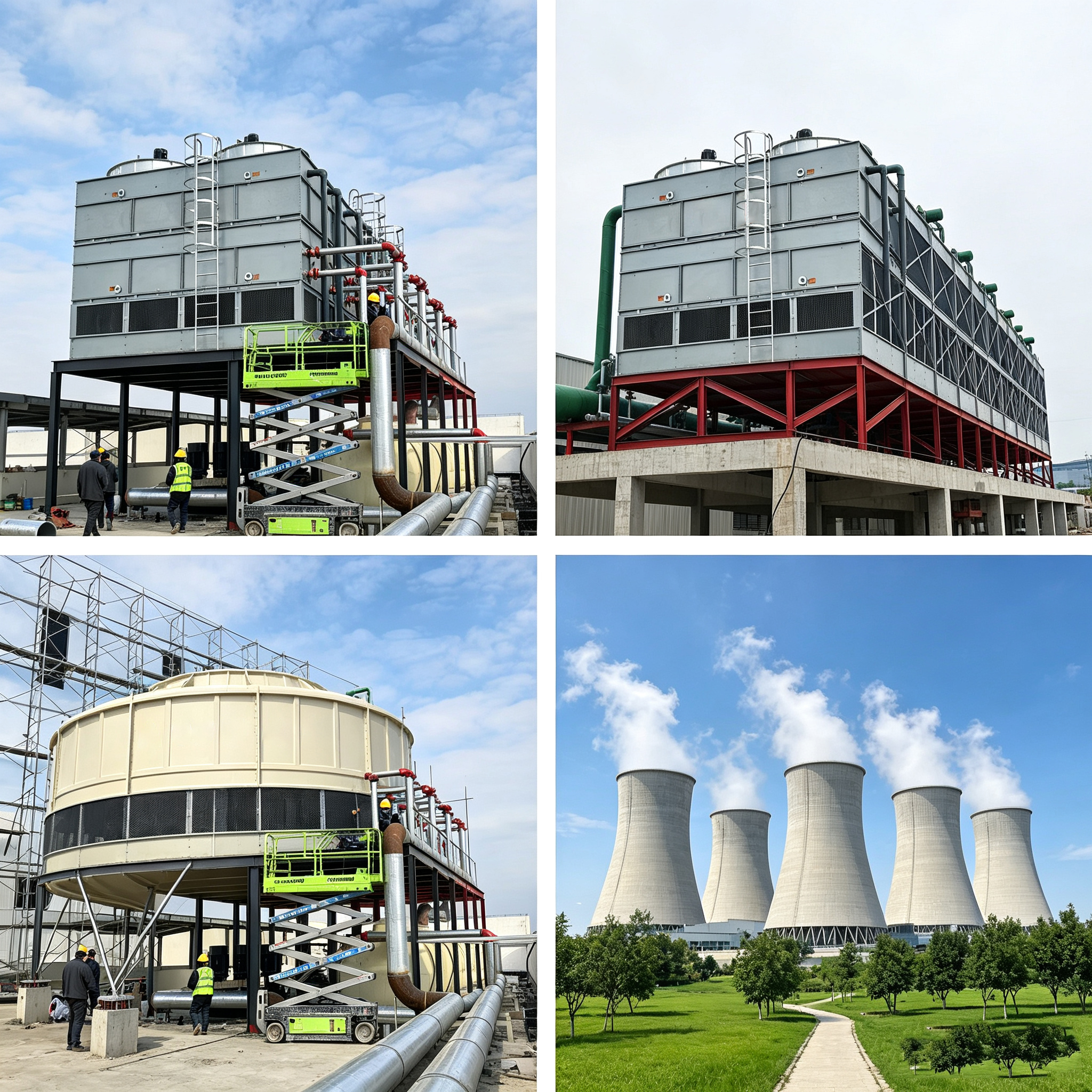
Large power-generation facilities require cooling towers capable of handling substantial heat loads. Fill selection must account for water chemistry, operating temperature, air velocity, maintenance requirements, and expected service life.
How to Choose the Right Cooling Tower Fill Material
Selecting cooling tower fill should begin with the operating conditions rather than simply choosing the lowest-cost product.
1. Check Operating Temperature
Determine the entering and leaving water temperatures. Higher-temperature applications may require PP or other heat-resistant materials instead of standard PVC.
2. Evaluate Water Quality
Water containing suspended solids, algae, scale, or biological growth can quickly foul film fill.
If water quality is poor, splash fill may be a more reliable option.
3. Consider Chemical Compatibility
Cooling tower water can contain treatment chemicals, dissolved minerals, acids, or other substances. Confirm that the selected fill material is compatible with the water chemistry.
4. Match the Existing Tower Design
Replacement fill should match the cooling tower's:
Dimensions
Fill height
Airflow direction
Water loading
Support structure
Nozzle arrangement
Design cooling capacity
A technically excellent fill may still perform poorly if it is incorrectly sized or installed.
5. Consider Pressure Drop
High-performance fill should not create excessive air resistance. Higher pressure drop can increase fan energy consumption and reduce overall system efficiency.
6. Consider Maintenance Requirements
Choose fill that can be inspected and cleaned according to the site's maintenance capabilities.
Regular inspection helps identify:
Scale deposits
Algae growth
Clogging
Cracking
Deformation
Material deterioration
When Should Cooling Tower Fill Be Replaced?
There is no single replacement interval that applies to every cooling tower.
Fill may require replacement when it shows significant:
A sudden increase in cold-water temperature can also indicate that the fill, water distribution system, airflow, or other tower components require inspection.
Replacing damaged fill can restore heat-transfer performance and help prevent additional operating problems.
How to Improve Cooling Tower Fill Performance
Even high-quality fill requires proper operation and maintenance.
Recommended practices include:
Maintain proper water treatment.
Inspect fill regularly.
Remove scale and biological deposits.
Keep spray nozzles free from blockage.
Maintain correct water distribution.
Check fan and airflow performance.
Monitor entering and leaving water temperatures.
Inspect fill supports for damage.
Avoid operating outside the manufacturer's recommended temperature range.
Replace heavily damaged fill promptly.
A clean and properly wetted fill surface is essential for effective heat transfer.
Cooling Tower Fill Manufacturer and Replacement Supplier
When purchasing cooling tower fill materials, buyers should consider more than price. A reliable manufacturer or supplier should be able to provide fill that matches the tower's design and operating requirements.
Important supplier qualifications include:
Experience in cooling tower fill manufacturing
Consistent material quality
Custom sizing capability
Technical support
Replacement compatibility
Quality control procedures
Packaging suitable for international shipping
For replacement projects, provide the supplier with the cooling tower model, existing fill dimensions, fill type, operating temperature, water quality, and required cooling capacity whenever possible.
Frequently Asked Questions About Cooling Tower Fill Materials
What is the best material for cooling tower fill?
There is no universal best material. PVC is widely used for efficient film fill applications, while PP is often preferred for higher-temperature or chemically demanding conditions. Splash-fill materials are suitable when clogging and suspended solids are major concerns.
How long does cooling tower fill last?
Service life depends on water chemistry, temperature, UV exposure, biological growth, mechanical conditions, and maintenance. Proper water treatment and regular cleaning can significantly extend fill life.
Is PVC cooling tower fill better than PP?
Not necessarily. PVC is economical and highly effective for many standard applications, while PP generally provides better temperature resistance. Selection should be based on actual operating conditions.
Can cooling tower fill be cleaned?
Yes. Depending on the material and condition, cooling tower fill can often be cleaned using controlled water washing and appropriate maintenance procedures. Aggressive cleaning methods should be avoided if they could damage the fill.
Can cooling tower fill be customized?
Yes. Many cooling tower fill manufacturers can supply custom dimensions, thicknesses, flute patterns, fill heights, and configurations to match existing tower structures.
Conclusion
Cooling tower fill materials play a critical role in heat-transfer efficiency, cooling capacity, energy consumption, and overall cooling tower reliability. PVC film fill, PP fill, and splash fill each offer different advantages, making proper material selection essential.
For clean-water HVAC systems, high-efficiency film fill is often an excellent choice. For high-temperature or chemically demanding industrial applications, PP may provide additional durability. Where water contains significant suspended solids or fouling contaminants, splash fill can offer greater reliability.
Ultimately, the right cooling tower fill should be selected based on water quality, operating temperature, tower design, cooling requirements, pressure drop, chemical compatibility, and maintenance conditions.
By choosing the appropriate fill material and maintaining it properly, cooling tower operators can improve heat-transfer performance, reduce energy costs, extend equipment life, and maintain reliable cooling performance.


