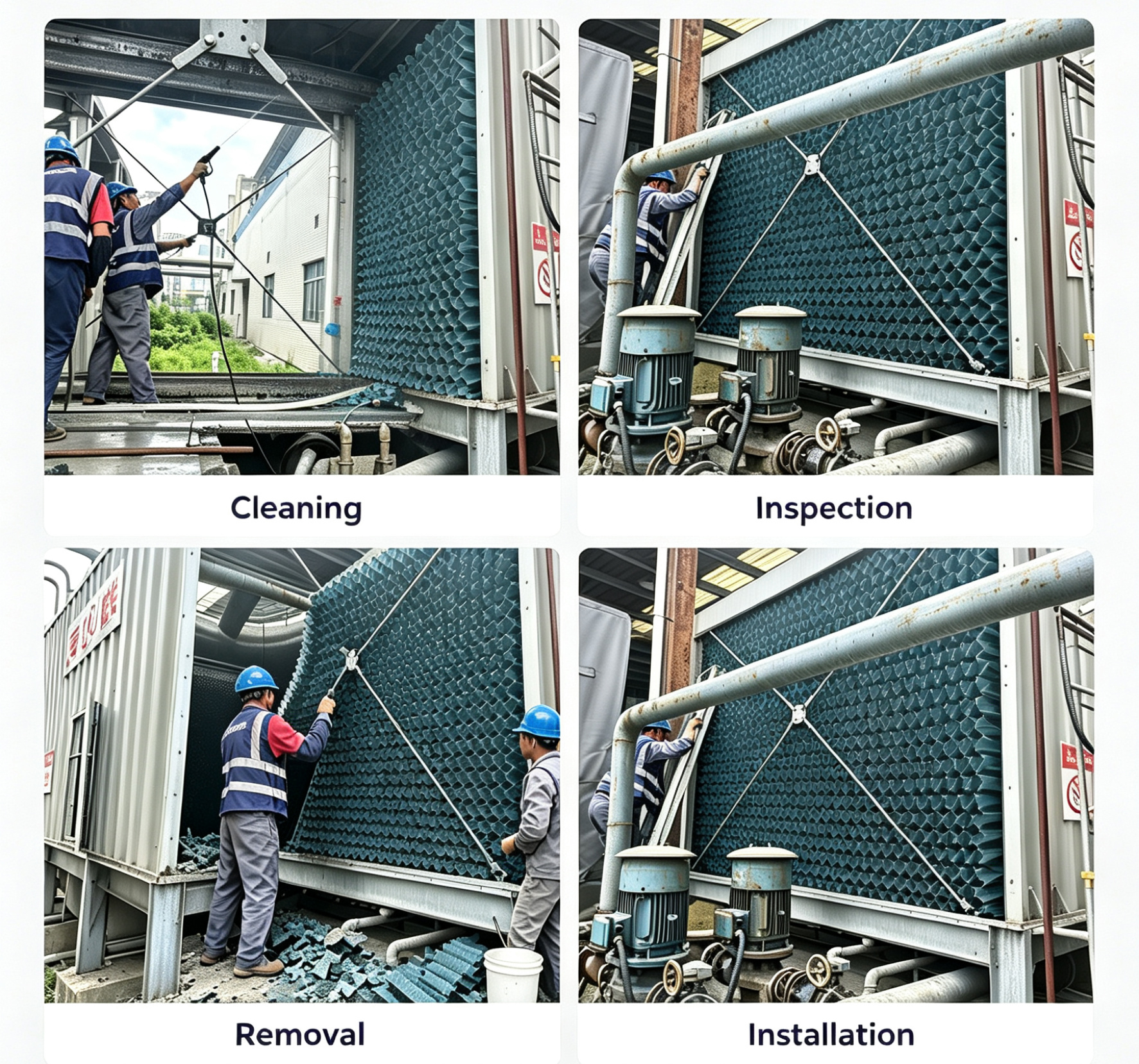
Cooling Tower Fill Material Cleaning Service in Malaysia
Cooling tower fill material is one of the most important components inside an evaporative cooling tower. Whether the tower uses PVC film fill, PP fill, splash fill, honeycomb fill, or other engineered packing, the fill provides the surface area required for efficient heat and mass transfer between circulating water and air.
Over time, cooling tower fill can accumulate scale, algae, sludge, biological deposits, dirt, corrosion products, and suspended solids. When these deposits restrict water and airflow, cooling tower performance can decline significantly.
A professional cooling tower fill material cleaning service in Malaysia can help industrial facilities restore heat-transfer performance, improve water distribution, reduce operating problems, and extend the service life of cooling tower packing.
Malaysia's hot and humid climate makes cooling tower maintenance particularly important. Facilities in industries such as manufacturing, petrochemicals, power generation, food processing, plastics, steel, chemical processing, and HVAC frequently operate cooling towers for long periods under demanding conditions.
This guide explains cooling tower fill cleaning methods, specifications, applications, supplier considerations, and how to determine whether cleaning or replacement is the better solution.
Why Cooling Tower Fill Needs Regular Cleaning
Cooling tower fill operates continuously in contact with circulating water and air. Even when a water treatment system is installed, deposits can gradually develop on the fill surface.
Common contaminants include:
Calcium carbonate scale
Magnesium deposits
Algae
Slime and biofilm
Mud and sediment
Dust and airborne debris
Organic matter
Corrosion products
Suspended solids
Microbiological deposits
A heavily contaminated fill can cause several problems.
Reduced Heat Transfer
Scale and biological deposits create an insulating layer over the fill surface. This reduces the effective contact between water and air and can increase the cooling-water outlet temperature.
Restricted Water Distribution
Blocked passages can prevent water from flowing evenly through the fill. This can create dry areas and overloaded sections inside the tower.
Increased Airflow Resistance
Debris and biological growth can obstruct air passages, increasing pressure drop and potentially reducing fan airflow.
Higher Energy Consumption
Poor heat transfer may require fans, pumps, or other equipment to operate longer or harder to achieve the required cooling temperature.
Premature Fill Replacement
If deposits are allowed to become severe, cleaning may no longer restore the original fill condition. Early maintenance can therefore reduce replacement frequency.
Cooling Tower Fill Cleaning Service Process
A professional service provider normally evaluates the tower before selecting a cleaning method.
1. Cooling Tower Inspection
The first step is a visual and operational inspection.
Technicians may check:
Water chemistry and operating history should also be reviewed where available.
2. Deposit Identification
Not all deposits should be treated in the same way.
For example, loose sediment may be removed mechanically, while mineral scale may require a carefully controlled chemical cleaning process.
Identifying the deposit helps determine whether the appropriate solution is:
Mechanical cleaning → Chemical cleaning → Biocidal treatment → Fill replacement
or a combination of these approaches.
3. Low-Pressure Water Cleaning
For PVC and polypropylene fill, controlled low-pressure washing is commonly preferred over aggressive high-pressure cleaning.
Excessive water pressure can deform, tear, or separate delicate film-fill sheets.
The objective is to remove loose dirt and deposits while preserving the fill structure.
4. Chemical Cleaning
Where mineral scale is present, a compatible cleaning chemical may be applied.
The chemical selection should consider:
PVC and PP fills can tolerate different chemical conditions, but the cleaning method should always be validated against the specific fill manufacturer's recommendations.
5. Biological Treatment
If algae, slime, or biofilm is present, an appropriate biocide program may be required.
Cleaning alone does not necessarily prevent biological growth from returning. A long-term cooling tower water-treatment program should address the underlying cause.
6. Rinsing and Inspection
After cleaning, the fill should be thoroughly rinsed to remove loosened deposits and chemical residues.
Technicians should then inspect the fill for:
Cracks
Warping
Brittleness
Broken sheets
Sagging
Blocked passages
Missing fill sections
Structural deterioration
Cooling Tower Fill Material Specifications
The correct cleaning procedure depends partly on the type and condition of the fill.
| Fill Type | Common Material | Typical Application | Cleaning Considerations |
| Film Fill | PVC | HVAC and industrial towers | Avoid excessive pressure and incompatible chemicals |
| Film Fill | PP | Industrial and higher-temperature applications | Check chemical and temperature compatibility |
| Honeycomb Fill | PVC/PP | Evaporative cooling systems | Clean passages carefully |
| Splash Fill | PP/PVC/wood alternatives | Dirty-water applications | Easier access for mechanical cleaning in some designs |
| Grid Splash Fill | PP/PVC | Industrial towers | Suitable for applications with higher solids loading |
Typical Film Fill Characteristics
Depending on the manufacturer and tower design, film fill may feature:
Corrugated or offset sheets
Cross-fluted geometry
Bonded or assembled modules
Different flute heights
Different sheet thicknesses
PVC or PP construction
Designed surface area for heat transfer
Specific water loading capabilities
A service company should identify the existing fill before starting cleaning rather than treating every cooling tower fill in the same way.
Cooling Tower Fill Cleaning Applications in Malaysia
Malaysia has extensive demand for industrial cooling systems because of its tropical climate and manufacturing base.
Professional fill cleaning services can be applied in:
Manufacturing Plants
Plastic, electronics, metalworking, automotive, and general manufacturing plants often use cooling towers for process cooling.
Chemical and Petrochemical Plants
Cooling towers used in chemical facilities can experience significant mineral and biological contamination, making water treatment and periodic fill inspection essential.
Power Generation
Power plants depend on reliable cooling-water systems. Fill blockage can affect cooling performance and operating efficiency.
Food and Beverage Facilities
Cooling towers supporting process refrigeration and HVAC systems require controlled cleaning programs to maintain hygienic and reliable operation.
Commercial HVAC Systems
Large shopping centers, hospitals, hotels, office buildings, and industrial buildings may use cooling towers for central chilled-water systems.
Data Centers
Cooling systems supporting data centers require high reliability. Fill fouling can contribute to reduced heat rejection and potentially compromise cooling capacity.
Cooling Tower Fill Cleaning vs. Fill Replacement
One of the most important purchasing decisions is determining whether the existing fill can be restored.
Cleaning Is Usually Appropriate When:
Fill sheets remain structurally sound
Deposits are removable
There is no major deformation
Water passages remain intact
The fill has adequate mechanical strength
Cleaning can restore acceptable airflow and water distribution
Replacement May Be Better When:
PVC has become brittle
Large sections are broken
Fill has collapsed or deformed
Passageways are permanently blocked
Chemical deterioration is severe
The fill has reached the end of its service life
A professional inspection can prevent unnecessary replacement while also avoiding the false economy of repeatedly cleaning severely damaged fill.
Supplier and Service Provider Profiles
When sourcing a cooling tower fill cleaning service in Malaysia, buyers should distinguish between cleaning contractors, cooling tower maintenance companies, fill manufacturers, and replacement-part suppliers.
1. Cooling Tower Maintenance Contractors
These companies provide on-site services such as:
Cooling tower inspection
Fill cleaning
Basin cleaning
Nozzle cleaning
Drift eliminator cleaning
Fan maintenance
Water distribution inspection
General preventive maintenance
They are generally the first choice when the customer needs a complete on-site cleaning project.
2. Cooling Tower Fill Suppliers
Fill suppliers can provide replacement PVC or PP modules when the existing packing is beyond economical cleaning.
A good supplier should be able to recommend compatible fill based on:
3. Cooling Tower Parts and Aftermarket Suppliers
Specialized cooling tower parts suppliers can provide fill as well as associated components such as nozzles, drift eliminators, louvers, fan blades, belts, bearings, and water-distribution components.
For international projects, these suppliers may also support export shipments to Malaysia and Indonesia.
4. OEM and Tower-Specific Suppliers
OEM-related suppliers can be useful when the tower has proprietary fill geometry or when maintaining an existing tower design is particularly important.
For older towers, however, an experienced aftermarket supplier may be able to provide compatible replacement packing at a competitive cost.
How to Choose a Cooling Tower Fill Cleaning Service in Malaysia
Before selecting a contractor, industrial buyers should evaluate several factors.
1. Experience
Ask how many cooling towers the contractor has serviced and whether they have experience with your tower type.
2. Fill Material Knowledge
The contractor should understand the differences between PVC, PP, film fill, and splash fill.
3. Cleaning Method
Ask whether the company uses controlled water pressure, compatible chemicals, mechanical cleaning, or a combination.
4. Safety Procedures
Cooling tower cleaning may involve confined spaces, chemicals, wet surfaces, rotating equipment, and elevated working areas. Proper safety procedures are essential.
5. Water Treatment Expertise
A good cleaning contractor should understand that cleaning is only part of long-term cooling tower maintenance.
6. Replacement Capability
If the existing fill cannot be economically restored, the supplier should be able to recommend replacement fill.
7. Inspection Report
Request before-and-after photographs and a written report identifying the fill condition and major sources of contamination.
Recommended Maintenance Frequency
There is no universal cleaning interval for every cooling tower.
The appropriate frequency depends on:
As a general maintenance strategy, operators should perform routine visual inspections throughout the operating year and schedule more detailed inspections during planned shutdowns.
Severe fouling, repeated high condenser-water temperatures, abnormal pressure drop, poor water distribution, or visible biological growth are reasons to investigate the fill sooner.
Signs Your Cooling Tower Fill Needs Cleaning
Watch for these warning signs:
Rising cooling-water outlet temperature
Visible algae or slime
Scale deposits on fill surfaces
Reduced cooling capacity
Uneven water distribution
Increased fan operating requirements
Excessive debris in the basin
Blocked fill passages
Increased system pressure drop
Repeated water-treatment problems
Early intervention is usually more economical than allowing contamination to become severe.
Cost Factors for Cooling Tower Fill Cleaning in Malaysia
The cost of a cooling tower fill cleaning service depends on the project rather than simply the tower size.
Important pricing factors include:
For an accurate quotation, buyers should provide tower dimensions, photographs, fill type, operating conditions, and the scope of cleaning required.
Frequently Asked Questions
What is cooling tower fill cleaning?
Cooling tower fill cleaning is the process of removing scale, dirt, algae, sludge, biofilm, and other deposits from cooling tower packing to restore water and airflow passages and improve heat-transfer performance.
How often should cooling tower fill be cleaned?
There is no fixed interval. Cleaning frequency depends on water quality, operating conditions, contamination, and water-treatment performance. Regular inspection is more useful than relying solely on a calendar-based schedule.
Can PVC cooling tower fill be pressure washed?
PVC fill can generally be cleaned using controlled water pressure, but excessive pressure can damage delicate film-fill sheets. The cleaning pressure should be appropriate for the specific fill construction.
Should cooling tower fill be cleaned or replaced?
If the fill remains structurally sound, cleaning may restore performance. If it is brittle, badly deformed, broken, or permanently blocked, replacement is usually more appropriate.
Can chemical cleaning damage cooling tower fill?
Yes. An incompatible chemical, excessive concentration, high temperature, or excessive contact time can damage certain fill materials. Chemical compatibility should be confirmed before cleaning.
Can the same service be used for Malaysia and Indonesia?
The fundamental cleaning principles are similar, but site conditions differ. Local water chemistry, climate, contamination, environmental regulations, and tower operating conditions should be considered for each project.
What information should I provide when requesting a cleaning quotation?
Provide the cooling tower manufacturer and model if available, tower dimensions, fill type, photographs, operating conditions, contamination type, and whether you require cleaning only or both cleaning and fill replacement.
Buyer Checklist for Malaysian Industrial Facilities
Before placing an order, buyers should confirm:
Conclusion
A professional cooling tower fill material cleaning service in Malaysia can play an important role in maintaining cooling performance, reducing fouling-related problems, and extending the usable life of cooling tower packing.
The best approach is not simply to wash the fill. A complete service should include inspection, contamination assessment, appropriate cleaning, rinsing, post-cleaning inspection, water-treatment recommendations, and replacement evaluation when necessary.
For Malaysian and Indonesian industrial facilities, tropical operating conditions make effective cooling tower maintenance especially important. Choosing the correct fill-cleaning method and maintaining suitable water chemistry can help keep heat-transfer surfaces open and cooling systems operating reliably.
For facilities with severely deteriorated packing, cleaning should be compared with the cost and performance benefits of installing new PVC or PP cooling tower fill material.


