English


Views: 0 Author: Cindy Publish Time: 2026-10-10 Origin: Site


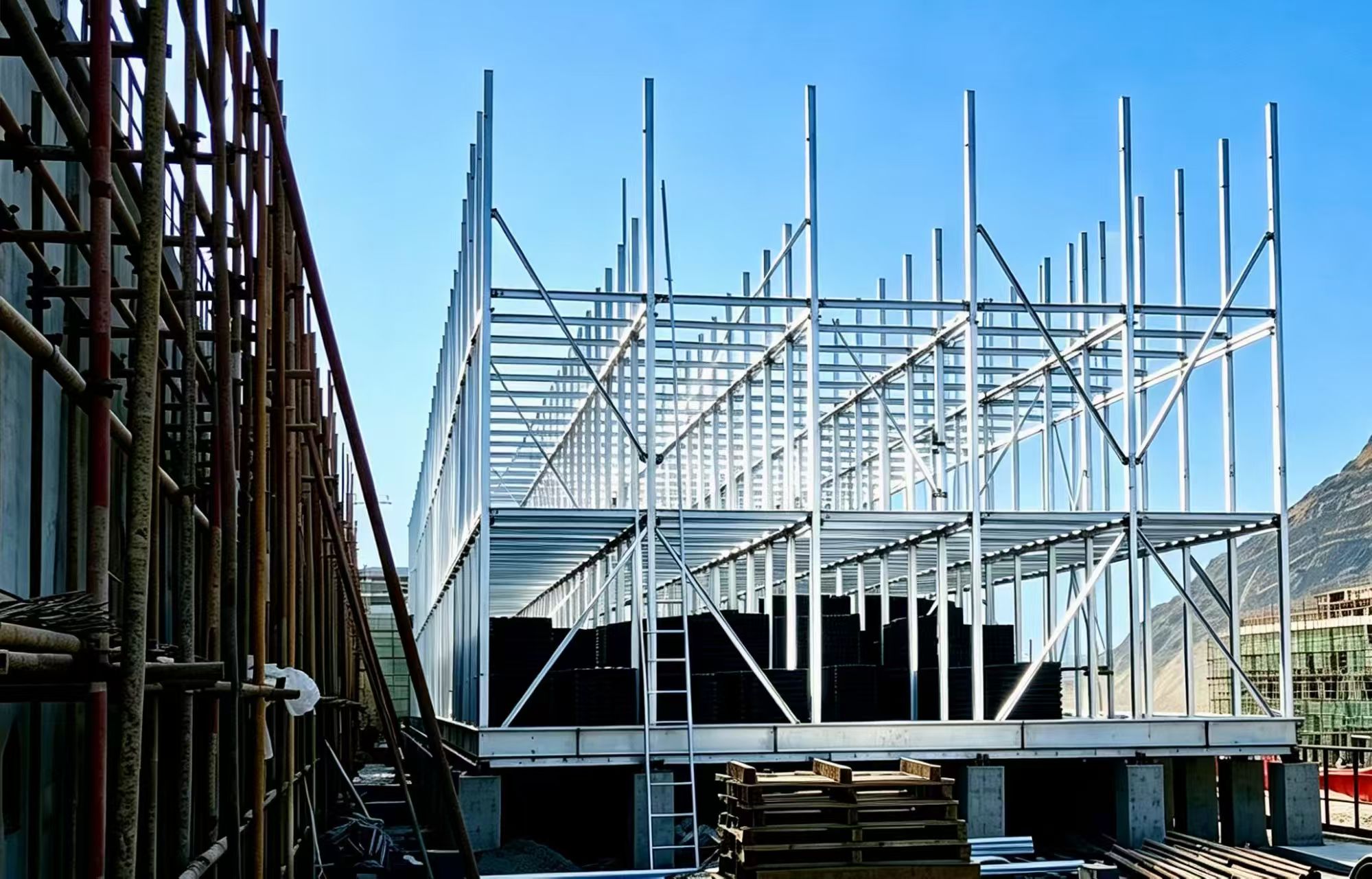
When sourcing cooling tower infill from China, choosing the right supplier is just as important as choosing the right product. High-quality infill helps cooling towers achieve reliable heat transfer, maintain stable airflow, and reduce unnecessary maintenance. However, differences in raw materials, manufacturing processes, product dimensions, and quality control can significantly affect performance and service life.
For industrial buyers, cooling tower manufacturers, distributors, and maintenance contractors, the challenge is knowing how to distinguish a reliable product from an inexpensive alternative that may create problems later.
So, what should you check before placing an order?
In this guide, we explain the key factors that influence China cooling tower infill quality, including material selection, heat resistance, structural strength, thermal performance, manufacturing consistency, and supplier reliability. We also introduce Power Tower Cooling Technology (Shaoxing) Co.,Ltd, whose cooling tower products can be explored at www.coolingtowerpart.com.
Cooling tower infill, also known as cooling tower fill or fill media, plays a central role in the heat rejection process. It increases the contact area between circulating water and air, helping heat transfer and evaporation take place more effectively.
When the infill is properly designed and manufactured, it helps the cooling tower achieve its intended thermal performance under suitable operating conditions.
Poor-quality infill can create several problems:
Uneven water distribution and reduced cooling performance.
Excessive airflow resistance and increased fan energy consumption.
Deformation caused by high temperatures or mechanical loading.
Premature deterioration due to unsuitable materials.
Increased clogging and cleaning requirements.
More frequent replacement and higher maintenance costs.
Consider two cooling tower fill products with similar prices. One maintains its shape and performs consistently for years, while the other develops blocked passages or weak bonding after a relatively short period. The initial savings on the second product may quickly disappear.
That is why buyers should evaluate the total cost of ownership rather than focusing only on the purchase price.
Cooling tower infill creates a larger effective contact area between water and air. As warm water flows over or through the fill, heat transfers to the air, and some water evaporates. This evaporation removes heat from the remaining water.
The design of the infill affects several operating characteristics, including:
Effective heat transfer area.
Water distribution and contact time.
Airflow resistance.
Susceptibility to scaling and blockage.
Cleaning requirements.
Compatibility with the cooling tower structure.
Selecting the wrong fill can limit cooling performance even when the product itself is manufactured to a high standard. Buyers must therefore consider both product quality and application suitability.
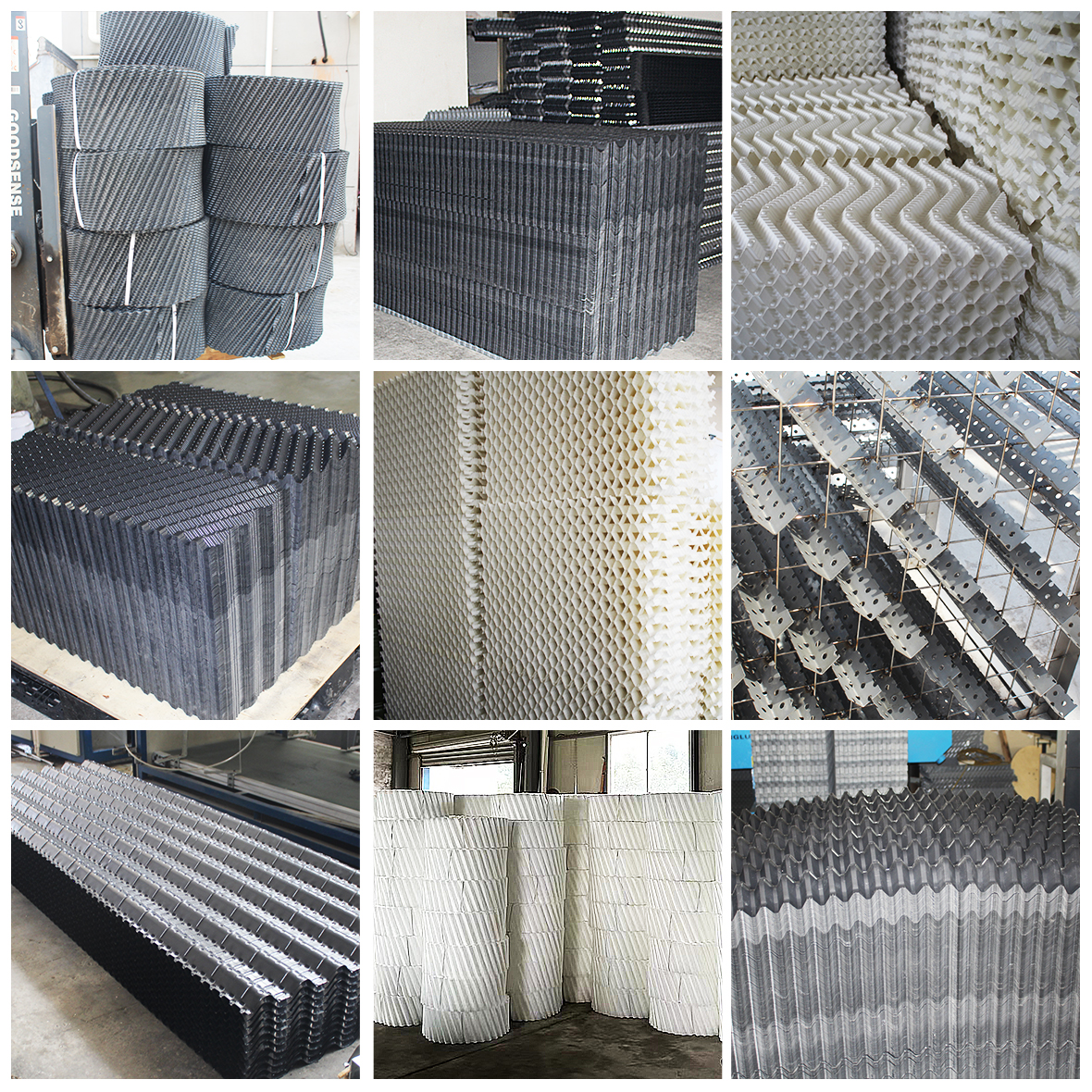
Film fill spreads water into thin layers across closely spaced plastic surfaces. This design offers a large effective contact area and can provide strong thermal performance in applications with relatively clean circulating water.
However, narrow channels may become blocked by suspended solids, mineral deposits, biological growth, or debris. Film fill therefore requires careful consideration of water quality and maintenance practices.
Splash fill works differently. It breaks falling water into droplets, increasing contact between water and air. Its relatively open structure can be advantageous in applications where suspended solids and clogging are major concerns.
Neither design is universally superior. Film fill may be appropriate for clean-water systems requiring high heat transfer performance, while splash fill may be worth considering for certain industrial applications with more challenging water conditions.
PVC and polypropylene (PP) are two commonly used materials for cooling tower infill.
PVC cooling tower fill is widely used in conventional cooling tower applications. It offers useful formability, availability, and thermal performance when the formulation and design are suitable for the operating environment.
PP cooling tower fill may be a better choice for some higher-temperature applications or environments requiring particular chemical resistance. Its suitability depends on the specific resin grade, formulation, and product construction.
Other materials may be used in specialized applications.
When comparing products, buyers should avoid assuming that all PVC or PP infill performs identically. Material grade, sheet thickness, operating temperature, chemical exposure, and manufacturing quality can make a significant difference.
China has a broad market for cooling tower components, giving international buyers access to different product designs, manufacturers, and price levels.
However, a competitive quotation does not automatically indicate a high-quality product. Buyers need clear technical criteria to evaluate what they are purchasing.
Raw material quality is one of the most important factors affecting cooling tower infill durability.
Inconsistent material formulations can affect strength, flexibility, heat resistance, and long-term dimensional stability. For plastic fill, buyers should understand the material grade and whether the manufacturer uses virgin resin, recycled material, or a controlled combination.
Recycled material is not automatically unsuitable. The key questions are whether its quality is controlled, whether it meets the required specifications, and whether the finished product performs reliably in the intended application.
When evaluating a China cooling tower infill manufacturer, ask for:
Material grade and relevant technical data.
Information about material consistency.
Applicable material test reports.
Confirmation that production follows the agreed specifications.
Traceability or batch identification where required.
A supplier that can explain its material specifications clearly gives buyers a stronger basis for evaluating product quality.
Cooling tower infill must withstand the temperatures encountered during normal operation and any foreseeable temperature variations.
If the plastic softens excessively or loses dimensional stability, sheets may sag, warp, or collapse. These changes can interfere with water distribution and airflow, reducing cooling performance.
PVC and PP have different thermal characteristics, but the performance of each depends on its formulation, design, thickness, and operating conditions.
Before ordering, provide the supplier with the expected hot-water inlet temperature, cold-water outlet temperature, normal operating range, and maximum anticipated temperature.
Ask the manufacturer to confirm the recommended continuous operating temperature and any short-term temperature limitations.
Do not rely on a generic maximum temperature without checking whether it applies to the specific material and finished product you intend to purchase.
Cooling tower water contains dissolved minerals, treatment chemicals, and sometimes suspended solids or contaminants from industrial processes.
These substances can influence infill selection and long-term performance. Some applications also expose fill to cleaning chemicals during maintenance.
Before selecting a product, consider:
Circulating-water chemistry.
Chemical treatment methods.
Potential process contamination.
Operating temperature.
Cleaning procedures and cleaning agents.
For example, a product suitable for a conventional commercial HVAC system may not be the best option for a chemical processing plant with more demanding operating conditions.
Ask the supplier to assess material compatibility based on the actual water conditions rather than simply recommending a standard product.
Cooling tower fill packs must maintain their shape under their own weight, water loading, airflow, and normal operating temperatures.
Structural weaknesses may cause deformation or separation between sheets. Incorrect dimensions can also create installation difficulties, gaps, or unwanted airflow restrictions.
When inspecting a sample, pay attention to:
Sheet thickness and consistency.
Pack length, width, and height.
Uniformity of the formed channels.
Bonding strength and joint consistency.
Edge quality and visible defects.
Compatibility with the existing support structure.
For replacement projects, accurate dimensions are especially important. Even a well-manufactured fill pack may cause problems if it does not match the cooling tower's original arrangement.
Ask the manufacturer to confirm the dimensions and acceptable tolerances in writing before production begins.
High-quality infill should provide the required heat transfer while maintaining acceptable airflow resistance.
Its performance depends on several interacting factors, including surface geometry, channel spacing, water loading, airflow, and water distribution.
A product with a large surface area does not automatically deliver the best overall result. If the channels are too restrictive, airflow resistance may increase, potentially raising fan energy consumption or limiting the airflow available to the tower.
Buyers should request technical performance information whenever it is available. Useful information may include thermal performance data, pressure-drop measurements, recommended operating conditions, and relevant test methods.
When comparing two products, make sure the performance claims use comparable test conditions.
Statements such as “high efficiency” and “energy saving” are not enough on their own. Reliable purchasing decisions should be based on measurable information and the requirements of the actual cooling tower.
Clogging is a common concern in cooling towers exposed to dust, debris, suspended solids, or water with a high tendency to form deposits.
As contaminants accumulate, they can restrict water passages, disrupt water distribution, and increase airflow resistance. Over time, these problems may reduce cooling performance and increase maintenance requirements.
Film fill can provide strong thermal performance, but its narrow passages may be vulnerable to blockage. Open splash fill may be more suitable for some applications with heavily contaminated water.
Before making a decision, evaluate the circulating-water quality, filtration system, basin cleaning practices, and biological control program.
Ask the supplier which fill designs are appropriate for your operating conditions and how the product should be inspected and cleaned.
Choosing clog-resistant fill is helpful, but it should form part of a broader water management and maintenance strategy.
Ultraviolet radiation can gradually degrade some plastics, particularly when components are exposed to direct sunlight over long periods.
If the infill will be exposed to sunlight during storage or operation, ask whether UV stabilization is necessary and available for the specific product.
Service life also depends on water chemistry, temperature, mechanical stress, biological growth, and maintenance practices.
For this reason, buyers should be cautious about suppliers promising a fixed service life without explaining the conditions behind the claim.
Instead, ask for realistic guidance based on your application, the material specifications, and the expected operating environment.

Good raw materials are only one part of cooling tower infill quality. The manufacturing process determines whether those materials become consistent, dimensionally accurate, and reliable finished products.
When assessing a Chinese manufacturer, ask how it controls production from the initial material stage to final inspection and packaging.
Many plastic cooling tower fill products begin with sheets produced through an extrusion process.
Inconsistent processing temperatures, material flow, or sheet thickness can create weak areas and variation between production batches.
Manufacturers should have appropriate procedures for monitoring sheet dimensions and visual quality. For repeat orders, they should also be able to maintain the agreed material specifications and product design.
This is especially important for distributors, contractors, and cooling tower operators who need replacement infill that matches previously supplied products.
After sheet production, the material is formed into the required geometry and assembled into fill packs.
Poor forming can create uneven channels, while weak bonding may allow sheets to separate during handling or operation.
Inspect samples for consistent surface patterns, uniform spacing, secure joints, and clean edges. For assembled packs, confirm that the finished dimensions match the approved drawings.
Packaging is another important consideration. Fill packs can be damaged during transport if they are inadequately supported or exposed to excessive compression.
A reliable supplier should be able to explain how it protects the product during storage and shipment.
A structured quality-control process may include incoming material checks, in-process inspections, and final product verification.
Depending on the product, inspection records may cover:
Material identification.
Sheet thickness and dimensions.
Surface appearance and forming quality.
Bonding or assembly consistency.
Relevant performance test results.
Packaging and shipment condition.
Ask for documentation related to the actual product and order. For large or critical projects, consider agreeing on pre-shipment inspection requirements and acceptance criteria before production starts.
The objective is straightforward: ensure that the delivered infill matches the specifications agreed upon during procurement.

Product specifications matter, but supplier capability also influences the success of a purchase.
A reliable supplier should understand the application, communicate technical information clearly, and provide consistent products across orders.
Start by asking about the supplier's product range, production capabilities, equipment, and experience with your type of cooling tower.
If you are purchasing replacement fill, experience with similar dimensions and tower configurations can be particularly useful.
It is also important to understand whether you are dealing directly with a manufacturer or through a trading company. Both business models can serve buyers, but the manufacturing arrangements and quality responsibilities should be clear.
Useful verification methods include reviewing factory information, requesting product samples, examining technical documentation, and arranging a factory audit when appropriate.
Do not judge a supplier solely by its website design or the number of products displayed in its catalog.
A product sample gives buyers an opportunity to examine physical quality before committing to a large order.
Check the material, dimensions, thickness, channel geometry, finish, and bonding. Compare the sample against the product specification rather than relying only on visual impressions.
Ask the supplier to provide drawings and technical information that identify the exact product being quoted.
For customized or replacement applications, provide the cooling tower model, available dimensions, operating temperature, and water conditions.
Good technical communication should involve more than confirming a price. The supplier should help establish whether the proposed fill is suitable for the application.
Some projects require quality management certificates, material declarations, inspection reports, or other compliance documentation.
Check that certificates are valid and relevant to the supplier, manufacturing site, and scope of work. Do not assume that a manufacturer holds a particular certification unless it can provide evidence.
For critical installations or recurring orders, batch identification and production records can help buyers trace products back to the relevant manufacturing and inspection information.
Clear documentation supports supplier qualification and makes future procurement more consistent.
Even the highest-quality fill may underperform if it is unsuitable for the tower's design or operating conditions.
Before requesting a quotation, prepare the technical information that the supplier needs to evaluate the application.
At minimum, try to provide:
Cooling tower type and model.
Existing fill dimensions and arrangement.
Required cooling duty.
Hot-water and cold-water temperatures.
Circulating-water quality.
Expected operating environment.
Maintenance and replacement requirements.
The more accurate the information, the easier it becomes to compare technically suitable products.
Crossflow cooling towers generally move air horizontally across descending water, while counterflow towers move air upward against the falling water.
These configurations can require different fill arrangements and dimensions. A product designed for one tower configuration may not fit correctly or deliver the expected performance in another.
For replacement projects, verify the original fill layout, support arrangement, airflow paths, and available installation space.
When possible, provide drawings, photographs, and measurements to the manufacturer. This helps reduce the risk of ordering a product that requires unexpected modifications during installation.
Industrial applications can present very different challenges.
An HVAC cooling tower may operate with relatively controlled circulating water, while a steel plant, chemical facility, or other industrial installation may experience higher temperatures, greater suspended-solid loads, or more demanding chemical exposure.
These differences influence both material selection and fill geometry.
For example, open splash fill may be worth evaluating where clogging is a persistent problem. Film fill may be appropriate where water quality is well controlled and strong heat transfer performance is required.
The right solution should be selected according to actual operating conditions, not simply the industry name or the lowest available quotation.
Before placing an order, watch for warning signs that may indicate inconsistent manufacturing or an unsuitable product.
Inconsistent sheet thickness: Variations may affect mechanical strength, forming quality, and product consistency.
Warped or uneven sheets: Deformation can indicate manufacturing issues or improper storage and handling.
Weak bonding: Poorly assembled fill packs may separate during transportation or operation.
Incorrect dimensions: Packs that do not match the approved drawings can create installation gaps or airflow restrictions.
Unclear material specifications: A supplier that cannot identify the material grade or recommended operating conditions makes it difficult to assess suitability.
Unsupported performance claims: Broad promises of exceptional efficiency without defined test conditions should be treated cautiously.
Insufficient quality documentation: Missing or irrelevant inspection records can make it harder to verify that the delivered product meets the agreed requirements.
An unusually low price is not proof of poor quality, but it should prompt a closer comparison of material grade, dimensions, thickness, performance data, and quality-control procedures.
When purchasing China cooling tower infill, the cheapest quotation is not always the most economical option.
A lower-priced product may reduce the initial budget but create additional expenses if it requires frequent cleaning, causes higher airflow resistance, or needs replacement sooner than expected.
At the same time, a more expensive product is not automatically better.
The best approach is to compare quotations using consistent specifications.
Comparison Factor |
What Buyers Should Check |
|---|---|
Material |
Grade, formulation, and application suitability |
Dimensions |
Pack size, sheet geometry, and agreed tolerances |
Thickness |
Specified thickness and manufacturing consistency |
Performance |
Relevant thermal data and airflow resistance |
Durability |
Temperature limits, chemical compatibility, and expected operating conditions |
Quality control |
Inspection procedures and applicable test reports |
Delivery |
Production lead time, packaging, and shipping arrangements |
After-sales support |
Warranty terms, technical assistance, and replacement arrangements |
Buyers should also consider installation costs, maintenance requirements, and expected replacement intervals.
For large projects, even a relatively small difference in operating performance or service life can affect the total cost of ownership.
Quality infill needs correct installation and appropriate maintenance to deliver its intended performance.
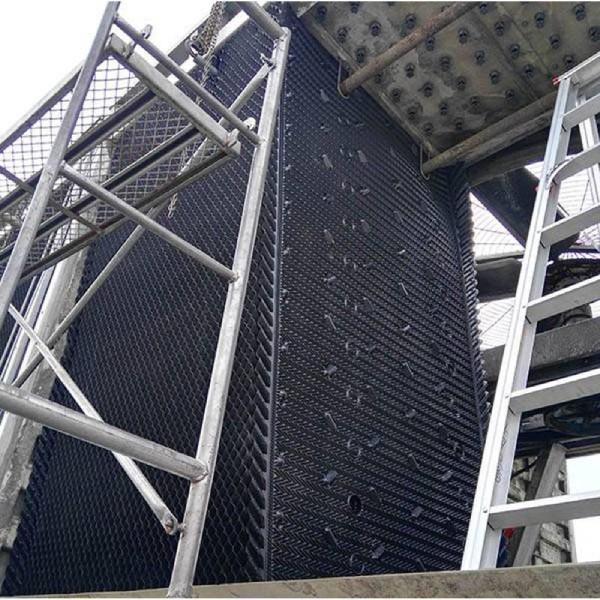
Before installation, inspect the cooling tower structure and fill supports for damage, corrosion, and accumulated debris. Confirm that the packs fit securely and that the installation does not obstruct the designed airflow paths or water distribution system.
After installation, monitor cooling performance and look for signs of uneven water distribution, deformation, unusual pressure-drop changes, or persistent blockage.
Regular maintenance should reflect actual water quality and operating conditions. Cleaning methods must be compatible with the material and product design. Excessive mechanical force or unsuitable chemicals can damage plastic fill.
Replace infill when deterioration, structural damage, or persistent fouling can no longer be managed effectively through maintenance.
A well-planned maintenance program helps protect the investment, but it cannot compensate for an unsuitable material or incorrectly selected fill design.

For buyers sourcing cooling tower components from China, Power Tower Cooling Technology (Shaoxing) Co.,Ltd is a supplier to consider when comparing cooling tower infill options.
Its website, www.coolingtowerpart.com, provides a starting point for exploring cooling tower fill products and discussing project requirements.
Before selecting a product, buyers should communicate their specific application needs, including:
Required infill type and material.
Cooling tower model and dimensions.
Operating temperatures and water conditions.
Replacement requirements or custom specifications.
Expected order quantity and delivery schedule.
Buyers should request the applicable technical specifications, product samples, inspection documentation, quotation, and delivery details before making a purchasing decision.
It is also advisable to confirm material compatibility, dimensional tolerances, quality acceptance criteria, and warranty conditions in writing.
By providing clear application information at the quotation stage, buyers can make a more informed comparison and reduce the risk of ordering unsuitable infill.
Visit Power Tower Cooling Technology (Shaoxing) Co.,Ltd to explore available cooling tower products and discuss your project requirements.
Use this practical checklist when comparing China cooling tower infill manufacturers and preparing a purchase order.
Confirm whether PVC, PP, or another material is suitable for the application.
Request material specifications and applicable test data.
Verify recommended operating temperatures and chemical compatibility.
Review available thermal performance and pressure-drop information.
Evaluate clogging risk against the actual circulating-water quality.
Request a representative product sample and approved drawings.
Check sheet thickness, dimensions, forming quality, and bonding.
Confirm the manufacturer's quality-control procedures.
Review relevant certificates and inspection records.
Verify production lead time, packaging, and shipping arrangements.
Specify the exact product type, material, dimensions, and tolerances.
Define inspection and acceptance criteria before production.
Confirm whether pre-shipment inspection is necessary.
Agree on warranty conditions and after-sales support.
Retain the approved sample and specifications for future reference.
A clear checklist makes supplier comparisons more objective and helps prevent misunderstandings between buyers and manufacturers.
Start by checking material specifications, sheet thickness, dimensions, forming quality, and bonding consistency. Request representative samples and applicable inspection reports. You should also verify that the product is suitable for the operating temperature, water chemistry, and cooling tower configuration.
Visual inspection is useful, but it cannot replace engineering evaluation or appropriate performance testing.
Neither material is universally better.
PVC is widely used in conventional cooling tower applications, while PP may be suitable for certain higher-temperature or chemically demanding environments. Actual performance depends on the material grade, formulation, product design, operating temperature, and water chemistry.
Ask the manufacturer to recommend a suitable material based on your specific operating conditions.
Cooling tower infill does not have one universal service life. Durability depends on material quality, temperature, water chemistry, UV exposure, mechanical loading, and maintenance.
Regular inspections can identify deformation, cracking, brittleness, severe scaling, or persistent blockage. Replacement should be considered when deterioration or reduced performance cannot be addressed effectively through maintenance.
Customization may be available for pack dimensions, configurations, sheet geometry, and replacement requirements, depending on the manufacturer and product design.
When requesting a quotation, provide drawings, measurements, photographs, and cooling tower model information. Confirm material specifications, dimensional tolerances, sample approval, and production lead time before placing an order.
Useful documents may include technical data sheets, product drawings, material specifications, relevant test reports, inspection records, and applicable certificates.
For large or critical projects, buyers may also require batch traceability, pre-shipment inspection, and written acceptance criteria. The specific documentation should match the project requirements and destination market.
Not necessarily. A low purchase price may be attractive, but differences in material quality, thickness, thermal performance, and service life can affect long-term costs.
Compare products using the same technical requirements and consider installation, maintenance, energy consumption, and replacement expenses when evaluating overall value.
Choosing high-quality China cooling tower infill requires more than comparing quotations. Buyers should evaluate material quality, temperature resistance, chemical compatibility, structural strength, thermal performance, clogging resistance, and manufacturing consistency.
Supplier capability is equally important. Technical documentation, representative samples, transparent quality-control procedures, and clear communication help buyers establish whether a product meets their requirements.
Most importantly, select infill according to the actual cooling tower design and operating conditions. A product that performs well in one application may not be suitable for another, particularly when water quality, temperature, or contamination levels differ.
For companies evaluating cooling tower infill suppliers in China, Power Tower Cooling Technology (Shaoxing) Co.,Ltd is an option to explore through https://www.coolingtowerpart.com.
By defining your technical requirements, checking product quality, and comparing suppliers against measurable criteria, you can make a more informed purchasing decision, reduce avoidable maintenance risks, and select cooling tower infill that supports reliable long-term operation.


