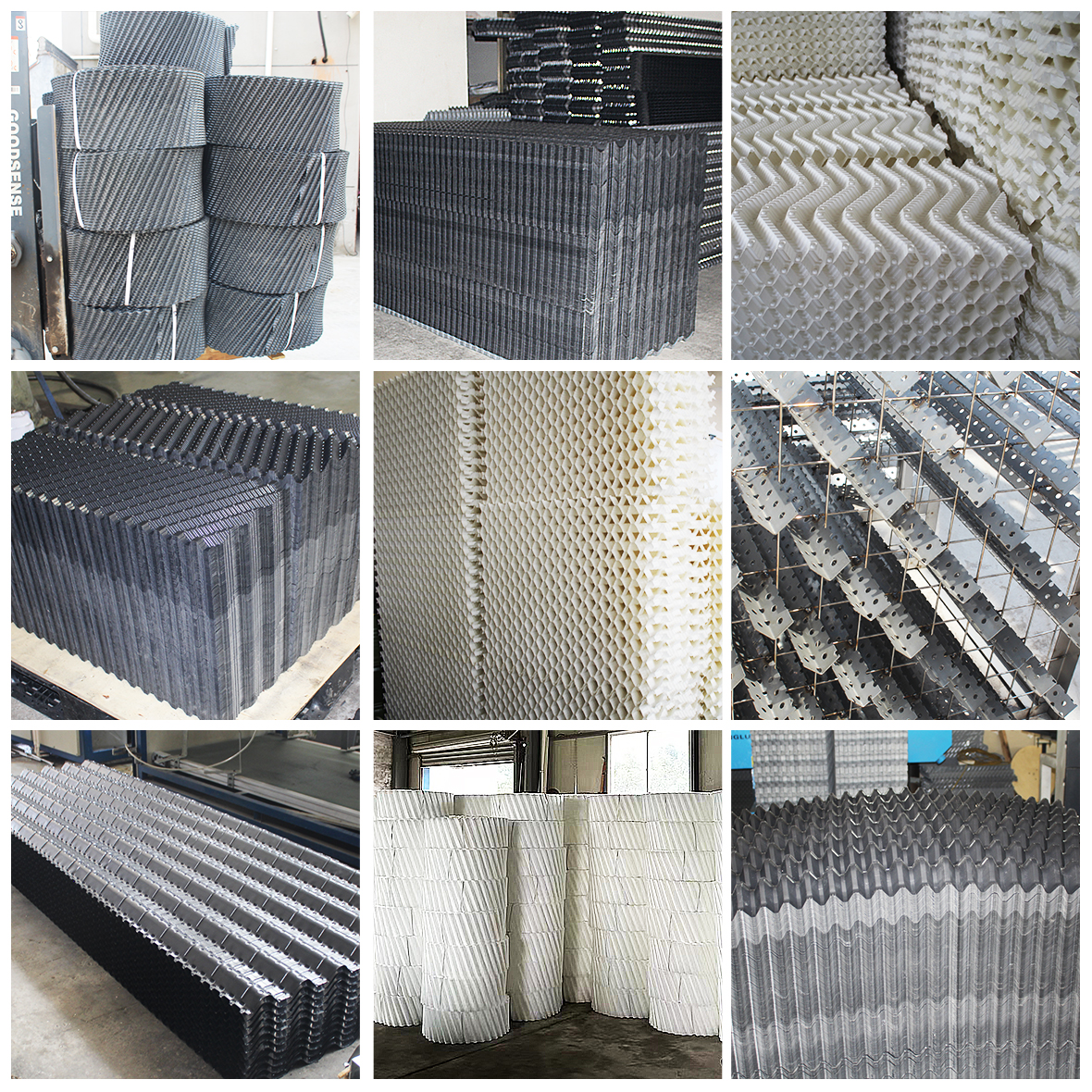
Cooling tower performance depends on several important components that work together to remove heat from circulating water. Among these components, cooling tower infills and drift eliminators play essential roles in heat transfer efficiency, water conservation, and stable system operation. Selecting the right products can help industrial facilities reduce operating costs, improve cooling performance, and extend equipment service life.
For industrial cooling systems, reliable cooling tower infills and drift eliminators should be designed to match the tower structure, water flow rate, air distribution, operating temperature, and water quality. Whether used in power plants, chemical processing facilities, manufacturing plants, or HVAC systems, high-quality components contribute to more efficient and dependable cooling operations.
As a supplier of cooling tower infills and drift eliminators, understanding material selection, product design, application requirements, and maintenance needs helps buyers make informed purchasing decisions.
What Are Cooling Tower Infills and Drift Eliminators?
Cooling tower infills and drift eliminators are two different components installed inside cooling towers. Although they work together to improve overall performance, each has a distinct function.
What Is a Cooling Tower Infill?
Cooling tower infill, also called cooling tower fill media or cooling tower filler, increases the contact area between hot circulating water and the air moving through the tower. This expanded contact area promotes heat and mass transfer, allowing water to cool more effectively.
Main Functions of Cooling Tower Infills
Cooling tower infills are designed to:
Increase the contact area between water and air.
Improve heat transfer efficiency.
Support uniform water distribution.
Promote effective evaporative cooling.
Help achieve the required cooling capacity within a limited tower space.
The correct fill design depends on the cooling tower type, water quality, air velocity, thermal load, and risk of fouling.
What Is a Cooling Tower Drift Eliminator?
A cooling tower drift eliminator is designed to capture and redirect water droplets carried by the exhaust air before they leave the tower. These droplets, known as drift, contain circulating water and may carry dissolved minerals or treatment chemicals.
Main Functions of Drift Eliminators
Drift eliminators help to:
Reduce circulating water loss.
Limit water droplets discharged into the surrounding environment.
Reduce the potential spread of water treatment chemicals.
Help maintain more efficient water management.
Support compliance with applicable environmental and operating requirements.
Drift eliminators do not eliminate normal evaporative water loss. Instead, they reduce mechanical water loss caused by droplets escaping with the exhaust air.
Why Are Cooling Tower Infills and Drift Eliminators Important for Industrial Applications?
Industrial cooling systems often operate continuously under demanding conditions. Inefficient heat transfer, excessive drift, and frequent maintenance can increase operating expenses and interrupt production.
Improving Heat Transfer Efficiency
Cooling tower infills create a large surface area for water-air contact. When the fill is properly selected and maintained, it supports effective heat exchange and helps the cooling tower achieve its design temperature range.
How Fill Design Influences Cooling Performance
Film fill spreads water into thin films over closely spaced surfaces, creating extensive contact between water and air. Splash fill breaks falling water into droplets, increasing contact through repeated splashing.
The most suitable design depends on the operating environment. Film fill can provide high heat transfer performance when water quality is appropriate, while splash fill may be preferred in applications where suspended solids and fouling are significant concerns.
Reducing Water Loss Through Drift Control
Drift eliminators capture droplets entrained in the airflow and direct the collected water back into the tower. This helps reduce unnecessary water consumption and minimizes wetting around the cooling tower.
Why Drift Control Matters in Industrial Facilities
Large cooling towers can circulate substantial volumes of water. Even a relatively small amount of drift can create avoidable water loss over extended operating periods.
Efficient drift eliminators are particularly valuable in water-intensive facilities, locations with strict environmental requirements, and installations near equipment or buildings that should be protected from water droplets.
Supporting Stable and Reliable Operation
Cooling tower infills and drift eliminators influence different aspects of tower performance. Fill media supports heat transfer, while drift eliminators support water retention.
When both components are correctly selected and installed, the cooling tower can operate more consistently, provided that the fan, water distribution system, basin, and other components are also functioning properly.
Types of Cooling Tower Infills for Industrial Applications
Choosing the right cooling tower infill is an important step in optimizing thermal performance. Different fill types provide different advantages depending on the cooling tower design and operating conditions.
Film Fill for High Heat Transfer Performance
Film fill is widely used in industrial and commercial cooling towers where effective heat transfer and compact installation are important.
Features of Film-Type Cooling Tower Fill
Film fill typically consists of formed plastic sheets with corrugated or patterned surfaces. Water spreads across these surfaces, forming thin films that contact the upward-moving or cross-flowing air.
Key advantages include:
High effective heat transfer area.
Efficient use of cooling tower space.
Potential for compact tower designs.
Suitable performance in applications with appropriately treated water.
However, narrow passages may be vulnerable to blockage from scale, sediment, biological growth, or other contaminants. Water quality should therefore be evaluated before selecting film fill.
Splash Fill for Challenging Water Conditions
Splash fill uses bars, grids, or other structures to break water into smaller droplets as it falls through the cooling tower.
Benefits of Splash Fill
Splash fill can be suitable for applications where circulating water contains suspended solids or where deposits are a recurring concern. Its open structure may make inspection and cleaning easier in certain installations.
Typical considerations include:
Resistance to blockage in suitable designs.
Compatibility with some industrial process-water applications.
Potentially easier access for cleaning.
Different thermal performance characteristics compared with film fill.
Splash fill is not automatically suitable for every contaminated-water application. Buyers should confirm the manufacturer's recommendations for solids concentration, operating temperature, and water chemistry.
PVC and PP Cooling Tower Infills
Plastic materials are commonly used in cooling tower fill manufacturing because they can be formed into complex surface patterns and modular sheet assemblies.
PVC Cooling Tower Fill
PVC cooling tower fill is widely used in many conventional cooling tower applications. It offers practical forming characteristics and can provide a suitable balance of thermal performance, durability, and cost when operating conditions fall within the material's rated limits.
PP Cooling Tower Fill
Polypropylene cooling tower fill may be preferred when operating conditions require particular chemical resistance or higher temperature capability than a standard PVC product can provide.
The actual temperature limit depends on the PP formulation, sheet thickness, loading, water chemistry, and product design. Buyers should request documented operating limits rather than assuming all polypropylene products have the same performance.
Types of Cooling Tower Drift Eliminators
Cooling tower drift eliminators are available in different profiles and configurations to match airflow conditions, tower geometry, and required drift control.
PVC Drift Eliminators
PVC drift eliminators are commonly used in cooling towers operating within the suitable temperature and chemical limits of the selected material.
Advantages of PVC Drift Eliminators
PVC drift eliminators can offer:
Lightweight construction.
Corrosion resistance in suitable environments.
Modular assembly for installation and replacement.
Practical manufacturing and maintenance costs.
The material grade and structural design should be checked for long-term exposure to moisture, sunlight where applicable, treatment chemicals, and operating temperatures.
PP Drift Eliminators
PP drift eliminators may be appropriate for applications that require additional chemical resistance or a different temperature operating range.
When Should Buyers Consider PP Drift Eliminators?
Buyers may consider polypropylene when the circulating water or process environment is not well suited to the proposed PVC grade. The decision should be based on verified chemical compatibility, mechanical strength, temperature limits, and expected service life.
Blade-Type and Multi-Pass Drift Eliminators
Drift eliminators may use blade profiles that force the air to change direction. As droplets follow the airflow, larger droplets impact the blade surfaces and drain back into the cooling tower.
How Multi-Pass Designs Capture Water Droplets
Multiple changes in airflow direction increase opportunities for droplets to separate from the air stream. Effective designs must balance droplet capture against air pressure drop.
A suitable drift eliminator should achieve the required drift performance without imposing excessive resistance that could adversely affect fan operation and airflow.
How to Select the Right Cooling Tower Infills and Drift Eliminators
Industrial buyers should assess the entire cooling system before ordering replacement components or specifying products for a new installation.
Evaluate Cooling Tower Type and Dimensions
The first step is to identify whether the tower is a crossflow or counterflow design and confirm the available installation space.
Information to Provide to a Supplier
To help ensure compatibility, buyers should provide:
Cooling tower manufacturer and model, if available.
Existing fill or drift eliminator dimensions.
Required sheet size, height, width, and thickness.
Module arrangement and support structure details.
Airflow direction and installation orientation.
Required quantity and delivery destination.
For replacement projects, photographs, drawings, or samples of the existing components can help the supplier verify the configuration.
Consider Water Quality and Fouling Risk
Water quality has a major influence on cooling tower fill selection and service life.
Important Water Quality Factors
Review suspended solids, hardness, scaling tendency, biological growth, oil contamination, and chemical treatment practices.
Where fouling is likely, a more open fill structure may be worth evaluating. For cleaner and well-controlled water, film fill may provide an effective solution for maximizing heat transfer.
The final choice should be based on the actual operating conditions rather than the fill type alone.
Check Operating Temperature and Chemical Compatibility
Material selection should account for both normal operating conditions and occasional temperature or chemical excursions.
PVC or PP: Which Material Is More Suitable?
PVC and PP each have applications where they can perform effectively. The best option depends on the required operating temperature, water chemistry, mechanical loading, fire-related requirements, and total lifecycle cost.
Suppliers should provide relevant technical specifications and clarify any limitations associated with the selected material.
Balance Thermal Performance and Airflow Resistance
High heat transfer performance is important, but it should not be considered independently of airflow resistance.
Why Pressure Drop Matters
Fill media and drift eliminators both influence airflow through the cooling tower. Excessive pressure drop can increase fan energy consumption or reduce airflow if the existing fan system cannot accommodate the additional resistance.
For replacement projects, buyers should consider thermal performance, airflow resistance, drift capture, and compatibility together.
What Should Buyers Look for in a Cooling Tower Infills and Drift Eliminators Supplier?
Choosing a reliable supplier involves more than comparing the lowest quotation. Product consistency, engineering support, quality control, and delivery reliability can directly affect project results.
Manufacturing Capability and Product Range
A qualified supplier should be able to explain its manufacturing process, available materials, product configurations, and customization options.
Can the Supplier Provide Customized Solutions?
Industrial cooling towers vary in dimensions, airflow arrangements, and operating requirements. A capable supplier should review drawings and technical specifications before confirming a custom order.
Useful customization options may include:
PVC or PP fill sheets.
Crossflow and counterflow fill configurations.
Different corrugation patterns and sheet thicknesses.
Custom module dimensions.
PVC or PP drift eliminators.
Replacement components for existing cooling tower systems.
Customization should be confirmed against manufacturing capability and the intended operating conditions.
Quality Control and Technical Documentation
Consistent product quality helps reduce installation problems and premature component failure.
Quality Checks to Discuss Before Ordering
Depending on the product, buyers should ask about:
Raw material specifications.
Sheet thickness and dimensional tolerances.
Forming and bonding quality.
Module strength and assembly consistency.
Material temperature and chemical limitations.
Product inspection and packaging procedures.
For technically demanding projects, request relevant test reports, drawings, or performance data where available.
Production Lead Time and Export Experience
International industrial projects often depend on coordinated delivery schedules. Delays in cooling tower infills or drift eliminators can affect maintenance shutdowns and commissioning plans.
How to Reduce Procurement Risks
Confirm production lead time, packaging method, shipment dimensions, delivery terms, and required export documentation before placing an order.
For large-volume orders, buyers should also review the packaging arrangement to minimize transportation damage and use container space efficiently.
Cooling Tower Infill and Drift Eliminator Replacement
Even durable cooling tower components eventually require inspection, cleaning, repair, or replacement. The timing depends on water quality, operating conditions, maintenance practices, and product material.
When Should Cooling Tower Infills Be Replaced?
Signs that fill replacement may be necessary include:
Persistent blockage that cannot be resolved through appropriate cleaning.
Broken, deformed, or collapsed fill sheets.
Severe scaling or biological fouling.
Uneven water distribution.
Reduced cooling performance despite other system checks.
Material deterioration that affects structural stability.
Why Early Inspection Matters
A cooling tower may experience reduced performance before obvious damage becomes visible. Periodic inspection can help identify blocked passages, uneven water flow, and deterioration before these issues cause more serious operational problems.
When Should Drift Eliminators Be Replaced?
Drift eliminators should be inspected for cracked blades, deformation, missing sections, loose connections, and incorrect installation.
How Damaged Drift Eliminators Affect Operation
Damaged or poorly fitted drift eliminators can allow excessive water droplets to escape with the exhaust air. Misalignment and gaps between modules may also reduce the effectiveness of the drift control system.
Replacing damaged sections and restoring proper installation can help recover the intended water-retention performance.
Cleaning Versus Replacement
Cleaning may be appropriate when deposits are removable and the component remains structurally sound. Replacement may be more economical when materials have deteriorated, passages remain blocked, or damage is extensive.
Safe Maintenance Practices
Before maintenance, follow the facility's isolation procedures and applicable occupational safety requirements. Cleaning methods should be compatible with the material and approved for the cooling tower system. Avoid aggressive chemicals, excessive pressure, or mechanical methods that could damage the fill or eliminator surfaces.
Industrial Applications of Cooling Tower Infills and Drift Eliminators
Cooling tower infills and drift eliminators are used across industries that depend on reliable heat rejection.
Power Generation Plants
Power generation facilities require effective cooling to support condensers, auxiliary equipment, and other heat-producing processes.
Key Requirements for Power Plants
Product selection should account for thermal duty, water quality, operating continuity, maintenance access, and the consequences of unplanned downtime.
Chemical and Petrochemical Industries
Chemical plants may operate cooling towers under demanding water chemistry and process conditions.
Material Compatibility and Operational Reliability
PVC or PP components should be selected according to documented temperature and chemical limits. Buyers should also consider fouling risk, maintenance access, and the availability of replacement modules.
Manufacturing and Metal Processing
Industrial manufacturing facilities use cooling towers to remove heat from production equipment, process water, hydraulic systems, and other industrial processes.
Improving Cooling System Availability
Appropriate fill media and efficient drift control can support stable heat rejection and reduce avoidable water loss. The exact product configuration should match the facility's cooling load and operating conditions.
Commercial HVAC and Large Buildings
Commercial HVAC cooling towers support chillers and central cooling systems in offices, hotels, hospitals, shopping centers, and other large buildings.
Energy Efficiency and Water Management
Well-maintained fill media helps the tower meet its cooling requirements, while drift eliminators reduce mechanical water loss. Together with proper fan control, water treatment, and maintenance, these components contribute to efficient system operation.
How to Request a Quotation for Cooling Tower Infills and Drift Eliminators
A clear technical inquiry helps suppliers prepare accurate quotations and reduces the risk of ordering incompatible components.
Prepare the Required Technical Information
Before requesting a quotation, organize the available specifications.
Essential Details for a Faster Quotation
Include the following information whenever possible:
Cooling tower manufacturer and model.
Application and operating conditions.
Fill type and drift eliminator configuration.
Material preference, such as PVC or PP.
Dimensions, sheet thickness, and required quantity.
Operating temperature and water quality information.
Delivery destination and required delivery date.
Drawings, photographs, or samples of existing components.
If some details are unavailable, provide the cooling tower nameplate information and photographs so the supplier can help identify the appropriate configuration.
Compare Quotations Beyond Unit Price
A low initial price does not necessarily represent the lowest total cost.
What Should a Commercial Quotation Include?
Compare material specifications, dimensions, technical compatibility, quality requirements, packaging, production lead time, shipping costs, warranty conditions, and after-sales support.
For international orders, confirm the agreed Incoterms and the responsibilities of each party for transportation, insurance, customs clearance, and delivery.
Frequently Asked Questions About Cooling Tower Infills and Drift Eliminators
Can Cooling Tower Infills and Drift Eliminators Be Supplied Together?
Yes. Many suppliers can provide both components for new cooling tower installations, maintenance projects, and replacement work. Ordering them together can simplify technical coordination and procurement, provided that each component is designed for the specific tower.
Are PVC Cooling Tower Infills Suitable for All Industrial Applications?
No. PVC fill is suitable for many conventional applications, but temperature, chemical exposure, water quality, and fire-related requirements must be evaluated. PP or another suitable material may be more appropriate under certain conditions.
Do Drift Eliminators Improve Cooling Tower Heat Transfer?
Drift eliminators primarily reduce water droplets escaping with exhaust air. They are not a substitute for cooling tower fill media. However, properly selected drift eliminators help control water loss while maintaining an appropriate balance between droplet capture and airflow resistance.
How Often Should Cooling Tower Fill Media Be Replaced?
There is no single replacement interval for every cooling tower. Service life depends on water treatment, operating temperature, contamination, maintenance, and material condition. Inspection results and actual performance should guide replacement decisions.
Can Cooling Tower Infills Be Customized?
Yes. Depending on the supplier's manufacturing capabilities, fill sheets and modules can be produced in different dimensions, thicknesses, materials, and configurations. Buyers should provide drawings or existing component measurements to confirm compatibility.
What Information Is Needed to Purchase Drift Eliminators?
The most useful information includes the cooling tower model, eliminator dimensions, blade profile, material, installation arrangement, airflow direction, and required quantity. Existing drawings and photographs can help verify the design.
Conclusion: Source Cooling Tower Infills and Drift Eliminators with Confidence
Supplying cooling tower infills and drift eliminators for industrial applications requires attention to thermal performance, material compatibility, airflow resistance, drift control, and long-term maintenance requirements.
Cooling tower infills improve water-air contact and support heat transfer, while drift eliminators reduce mechanical water loss by capturing droplets carried by exhaust air. Selecting compatible components can help industrial facilities maintain reliable cooling performance and manage operating costs.
For buyers seeking a dependable cooling tower infills and drift eliminators supplier, the most important steps are to define the operating conditions, verify product dimensions, compare technical specifications, and confirm manufacturing and delivery capabilities.
By working with an experienced supplier that understands industrial cooling requirements, buyers can source PVC or PP fill media and drift eliminators suited to new installations, system upgrades, and cooling tower replacement projects.