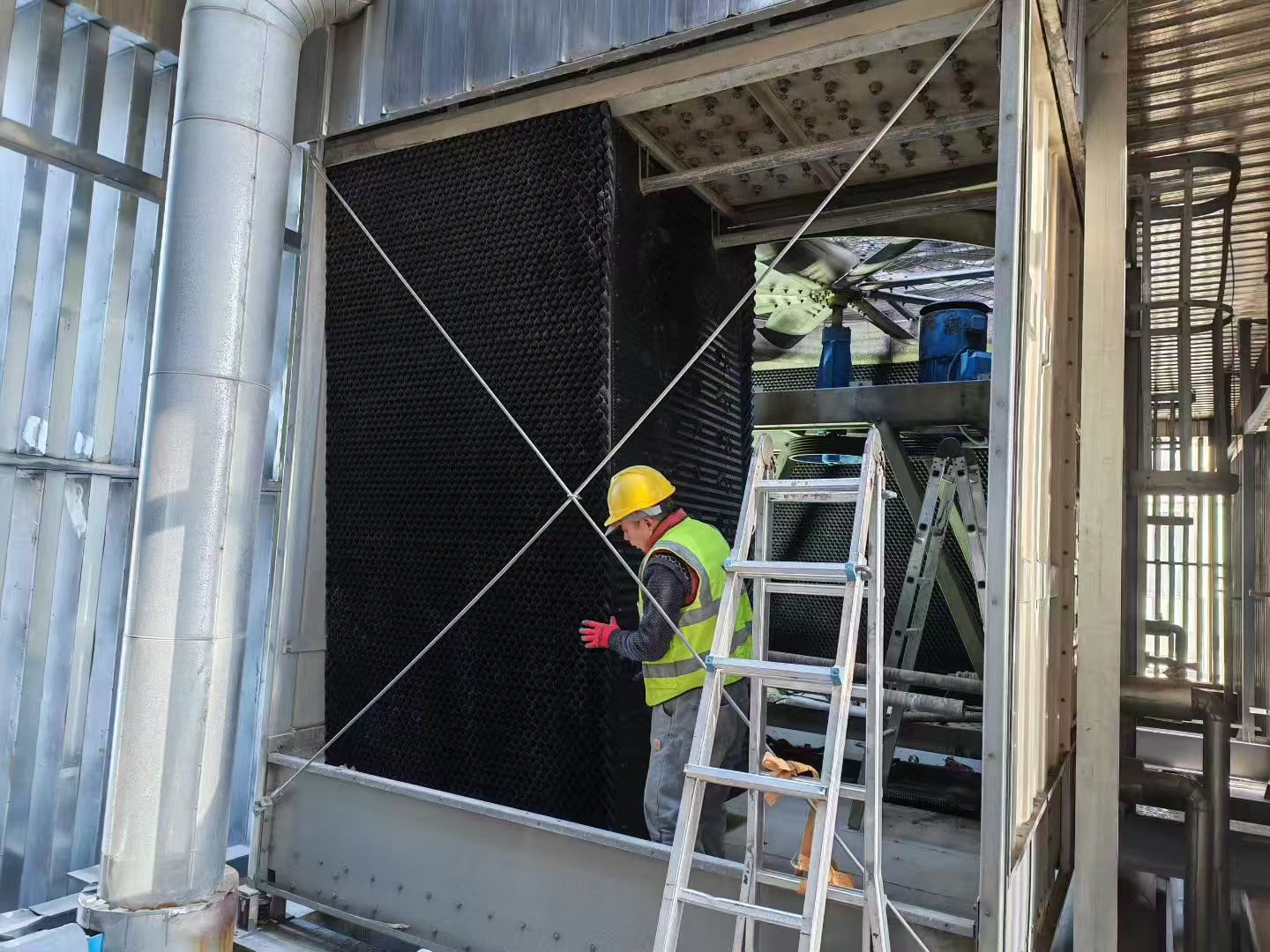
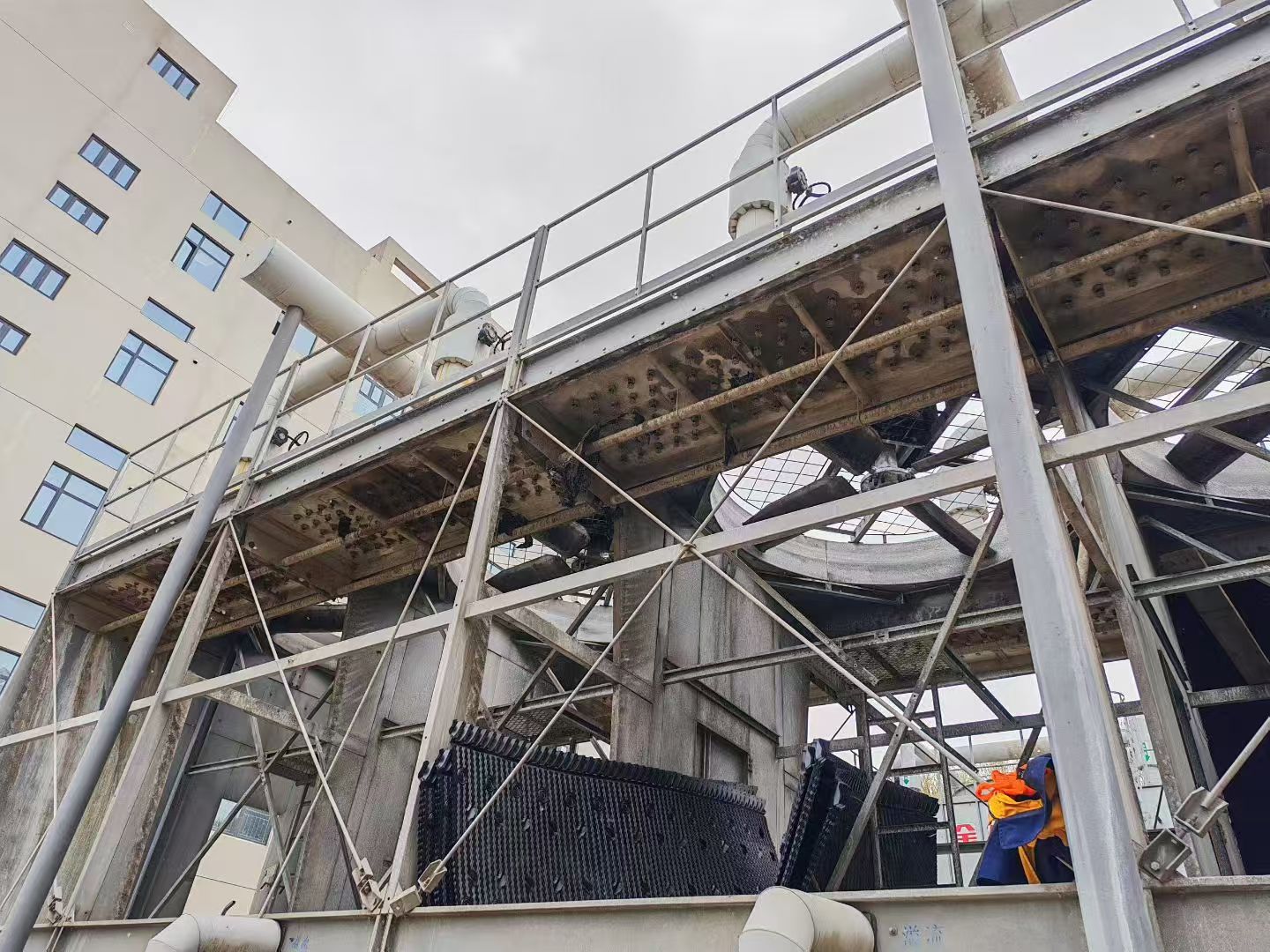
Why Is Cooling Tower Infill Replacement Important?
Cooling tower infill, also called cooling tower fill or fill media, is one of the most important components inside a cooling tower. It increases the contact area between hot process water and moving air, allowing heat to transfer more efficiently.
Over time, cooling tower infill can become clogged, cracked, deformed, brittle, or chemically damaged. When this happens, the tower may require more energy to achieve the same cooling effect, while water distribution and airflow can also become less stable.
Cooling tower infill replacement is therefore an important part of long-term cooling tower maintenance. Replacing damaged or inefficient fill media can restore heat transfer performance, improve water distribution, reduce operating problems, and extend the service life of the cooling tower.
What Is Cooling Tower Infill?
Cooling tower infill is the structured material installed inside a cooling tower to increase the contact area between air and water.
How Does Cooling Tower Infill Work?
Hot water enters the upper section of the tower and is distributed over the fill surface. As the water flows downward, air moves through the fill in either a crossflow or counterflow direction.
The fill creates a thin water film or repeated water-air contact points. This increases the effective surface area available for heat and mass transfer.
What Are the Main Types of Cooling Tower Infill?
Different cooling tower designs require different types of fill media.
Film Fill
Film fill creates a large surface area by spreading water into thin films across closely spaced sheets. It is widely used in modern industrial and HVAC cooling towers because of its high heat transfer efficiency.
Splash Fill
Splash fill breaks falling water into droplets as it passes through specially designed splash bars or modules. It is often selected for applications where water quality is poor or suspended solids are present.
Crossflow Fill
Crossflow cooling towers allow air to move horizontally through the fill while water flows downward. Crossflow fill is commonly used in large HVAC and industrial cooling tower systems.
Counterflow Fill
In counterflow towers, air moves upward while water flows downward. Counterflow cooling tower fill is designed to maximize air-water contact within a relatively compact tower structure.
When Should Cooling Tower Infill Be Replaced?
There is no universal replacement interval for every cooling tower. The actual service life depends on water quality, operating temperature, chemical exposure, UV exposure, airflow, maintenance practices, and fill material.
However, several warning signs indicate that cooling tower infill replacement should be considered.
1. Visible Cracks or Physical Damage
Inspect the fill during scheduled maintenance. Cracked, broken, warped, or collapsed sheets can reduce the effective contact area between air and water.
Severely damaged fill can also restrict airflow and create uneven water distribution.
2. Excessive Scaling
Mineral deposits can accumulate on cooling tower fill surfaces when water treatment is inadequate.
Why Does Scaling Matter?
Heavy scale reduces the available heat transfer surface and can increase the resistance to airflow and water flow.
If chemical cleaning cannot effectively restore the fill, replacement may be more economical.
3. Biological Fouling
Algae, bacteria, sludge, and other biological deposits can accumulate inside cooling tower fill.
Heavy biological fouling can block passages and reduce the effective fill area.
Regular water treatment and cleaning should be the first response, but severely contaminated or deteriorated fill may eventually need replacement.
4. Increased Cooling Water Temperature
A noticeable increase in cold-water temperature can indicate declining tower performance.
However, high outlet-water temperature does not automatically mean the fill needs replacement. Operators should also check:
If the fill is damaged or heavily fouled after these factors are checked, replacement may be necessary.
5. Increased Pressure Drop
Blocked or deformed cooling tower infill can restrict airflow and increase pressure drop across the fill section.
This may force fans to operate harder and can increase energy consumption.
6. Fill Becomes Brittle
Plastic fill materials such as PVC and PP can gradually deteriorate because of heat, chemicals, UV exposure, and long-term operation.
Brittle sheets can break during cleaning or normal operation, making replacement a better long-term solution.
What Causes Cooling Tower Infill to Fail?
Understanding the causes of fill failure can help operators determine whether replacement is necessary.
Poor Water Quality
High concentrations of suspended solids, hardness minerals, oil, and biological contaminants can accelerate fill fouling.
Incorrect Chemical Treatment
Improper chemical dosing may lead to scaling, corrosion, microbiological growth, or material degradation.
High Operating Temperature
Some standard PVC cooling tower fill products have temperature limitations. Applications involving elevated water temperatures may require specially formulated PVC or PP materials.
Mechanical Damage
Improper installation, maintenance activities, excessive water pressure, or structural problems can physically damage the fill.
Long-Term Material Aging
Even properly maintained cooling tower fill eventually experiences material aging. Long-term exposure to heat, water, chemicals, and airflow can gradually reduce mechanical strength.
How to Choose the Right Cooling Tower Infill Replacement?
Selecting replacement fill should not be based only on dimensions. The new fill must match the tower's thermal, hydraulic, mechanical, and operating requirements.
Check the Existing Fill Dimensions
Measure the existing fill carefully, including:
Length
Width
Height
Sheet thickness
Cell spacing
Module configuration
Support requirements
Accurate measurements help ensure that the replacement cooling tower infill fits the existing structure.
Select the Correct Material
PVC and PP are two common materials used for cooling tower fill.
PVC Cooling Tower Fill
PVC is widely used because it offers a good balance of cost, chemical resistance, rigidity, and heat transfer performance.
PVC fill is commonly selected for conventional HVAC and industrial cooling applications.
PP Cooling Tower Fill
PP cooling tower fill can provide advantages in applications requiring higher temperature resistance or specific chemical resistance.
The actual suitability depends on the operating temperature, water chemistry, and cooling tower design.
Match the Fill Design to the Tower
Replacement fill should be compatible with the tower's airflow and water distribution pattern.
A fill designed for a counterflow cooling tower should not automatically be substituted into a crossflow system without checking the engineering requirements.
How to Replace Cooling Tower Infill?
A proper replacement process helps prevent installation problems and protects the performance of the new fill.
Step 1: Shut Down and Isolate the Cooling Tower
Before replacement, shut down the relevant equipment and follow the site's safety procedures.
Drain or isolate water where necessary and make sure workers can safely access the fill section.
Step 2: Inspect the Existing Fill
Before removing the old fill, inspect its condition.
Record the following information:
This information can help determine the correct replacement specification.
Step 3: Remove the Old Fill
Carefully remove damaged fill modules from the tower.
Avoid unnecessary damage to support beams, structural components, pipes, and nozzles during removal.
Step 4: Clean the Fill Area
Before installing new cooling tower fill, clean the surrounding area.
Remove:
Sludge
Scale
Broken plastic pieces
Algae
Debris
Sediment
A clean installation environment helps prevent immediate fouling of the new fill.
Step 5: Inspect Water Distribution
New fill cannot compensate for poor water distribution.
Check spray nozzles, distribution pipes, headers, and other water distribution components before installing the replacement fill.
Why Is Water Distribution Important?
Uneven water distribution creates dry areas and overloaded areas within the fill.
This reduces the effective heat transfer area and may cause localized scaling or biological growth.
Step 6: Install the New Cooling Tower Infill
Install the replacement fill according to the manufacturer's recommended arrangement.
Make sure the modules are properly supported and aligned.
Do not compress or deform the fill during installation.
Step 7: Check Airflow and Water Flow
After installation, inspect airflow and water distribution.
The fill should provide adequate contact between air and water without creating unnecessary airflow resistance.
Step 8: Restart and Monitor Performance
After the tower is restarted, monitor:
Cold-water temperature
Hot-water temperature
Approach temperature
Water flow
Fan operation
Pressure drop
Vibration
Water distribution
Comparing these parameters with historical operating data can help verify whether the replacement has improved tower performance.
What Are the Benefits of Cooling Tower Infill Replacement?
Replacing deteriorated fill can provide several operational benefits.
Improved Heat Transfer
New fill provides a clean and properly structured surface for air-water contact.
This can help restore the tower's heat transfer capacity.
Better Cooling Tower Efficiency
When the fill is properly selected and installed, the cooling tower can operate closer to its original design performance.
Reduced Airflow Resistance
Removing collapsed or heavily fouled fill can improve airflow through the tower.
This may also help reduce unnecessary fan loading.
More Stable Water Distribution
New fill can provide more consistent water flow through the fill section when combined with a properly functioning distribution system.
Longer Equipment Service Life
Replacing fill before severe deterioration spreads to other components can help protect the cooling tower and reduce the risk of unexpected downtime.
How Much Does Cooling Tower Infill Replacement Cost?
The cost of cooling tower fill replacement varies significantly from one project to another.
Several factors affect the total cost.
Fill Material
PVC cooling tower fill is often selected for its cost-effectiveness, while PP may be preferred for specific temperature or chemical conditions.
Fill Quantity
Larger towers require more replacement fill, increasing material and installation costs.
Fill Design
Different cell sizes, sheet thicknesses, configurations, and thermal performance requirements can affect the price.
Transportation and Packaging
Cooling tower fill is lightweight but bulky. Packaging, pallet dimensions, shipping method, and destination can have a significant impact on international purchasing costs.
Installation Requirements
Projects involving difficult access, extensive cleaning, structural repairs, or shutdown coordination may have higher installation costs.
How to Extend the Life of New Cooling Tower Infill?
Replacement should not be treated as the end of the maintenance process.
Maintain Good Water Treatment
Proper water treatment is one of the most effective ways to protect cooling tower fill.
Control scale, biological growth, suspended solids, and other contaminants according to the cooling tower's operating requirements.
Perform Regular Inspections
Inspect the fill periodically for:
Scaling
Fouling
Cracking
Deformation
Biological growth
Blocked passages
Early detection can prevent small problems from becoming major replacement projects.
Keep Spray Nozzles Clean
Blocked or damaged nozzles can create uneven water distribution.
Maintaining the distribution system helps the fill operate across its intended surface area.
Avoid Aggressive Cleaning Methods
Some cleaning methods can damage plastic fill.
Cleaning procedures should be compatible with the fill material and manufacturer recommendations.
How Can Buyers Choose a Reliable Cooling Tower Infill Replacement Supplier?
For industrial replacement projects, choosing the right supplier is just as important as selecting the correct fill design.
Check Manufacturing Capability
A reliable supplier should be able to provide consistent production quality and stable dimensions.
Request Technical Specifications
Ask for information such as:
Ask About Customization
Cooling towers often have different fill dimensions and installation requirements.
A supplier capable of producing customized cooling tower infill can provide replacement solutions for non-standard tower configurations.
Evaluate Production Quality
Important quality factors include dimensional consistency, material uniformity, bonding quality, structural strength, and resistance to operating conditions.
Consider Global Shipping
For international projects, buyers should also evaluate packaging, container loading efficiency, lead time, export experience, and after-sales technical support.
Cooling Tower Infill Replacement vs. Cleaning
Replacement is not always necessary.
If the fill is structurally sound but has moderate fouling or scaling, professional cleaning may restore part of its performance.
However, cleaning cannot repair severely cracked, collapsed, brittle, or chemically degraded fill.
When Is Cleaning More Appropriate?
Cleaning may be suitable when:
Fill remains structurally intact
Fouling is relatively light
Scaling can be removed
Material strength remains acceptable
Heat transfer performance has not significantly deteriorated
When Is Replacement Better?
Replacement is generally more appropriate when:
Fill sheets are cracked
Modules have collapsed
Fill has become brittle
Severe fouling cannot be removed
Cell passages are permanently blocked
Material has degraded significantly
Cooling performance remains poor after cleaning
Frequently Asked Questions About Cooling Tower Infill Replacement
How often should cooling tower infill be replaced?
There is no fixed replacement interval. Actual service life depends on water quality, operating temperature, chemical exposure, maintenance, material, and operating conditions.
Can PVC cooling tower fill be replaced with PP fill?
In some applications, yes, but the replacement should be evaluated based on operating temperature, water chemistry, fill design, dimensions, and tower performance requirements.
Can I replace only part of the cooling tower fill?
Partial replacement is possible when only a specific section has been damaged. However, the new and existing fill should be compatible in terms of dimensions, material, configuration, and hydraulic characteristics.
Does new cooling tower fill improve cooling performance?
It can. If the original fill has become fouled, damaged, or degraded, properly selected replacement fill can restore heat transfer area and improve cooling tower performance.
Should I replace drift eliminators at the same time?
Not necessarily, but replacement projects provide a good opportunity to inspect drift eliminators, spray nozzles, supports, and water distribution components. If these parts are also damaged or degraded, replacing them together can reduce future downtime.
Final Considerations for Cooling Tower Infill Replacement
Cooling tower infill plays a critical role in heat transfer, water-air contact, and overall tower efficiency. When fill becomes severely fouled, damaged, deformed, or aged, continuing to operate with it can reduce cooling performance and increase operating problems.
The best cooling tower infill replacement strategy combines accurate inspection, correct material selection, precise dimensional matching, proper installation, and ongoing water treatment.
Whether the project requires PVC cooling tower fill, PP cooling tower fill, crossflow fill, counterflow fill, film fill, or customized cooling tower infill, selecting a suitable replacement solution is essential for restoring reliable and efficient tower operation.