
Custom cooling tower filler is an important solution for original equipment manufacturer (OEM) production, industrial cooling tower upgrades, and aftermarket replacement projects. When standard fill packs do not match an existing tower's dimensions or operating requirements, customized fill media can help buyers achieve a better fit and maintain the intended cooling system configuration.
China cooling tower filler manufacturers and suppliers offer customized PVC film fill, polypropylene (PP) fill, splash fill, and replacement fill packs for industrial and commercial applications. Depending on the manufacturer's capabilities, customization may include sheet profiles, pack dimensions, material selection, assembly, and export packaging.
For OEM buyers, distributors, cooling tower contractors, and industrial maintenance teams, selecting the right supplier requires careful attention to technical specifications, quality control, and production consistency.
This guide explains how to source custom China cooling tower filler for OEM and aftermarket projects, from design requirements to supplier selection and bulk ordering.
What Is Custom Cooling Tower Filler?
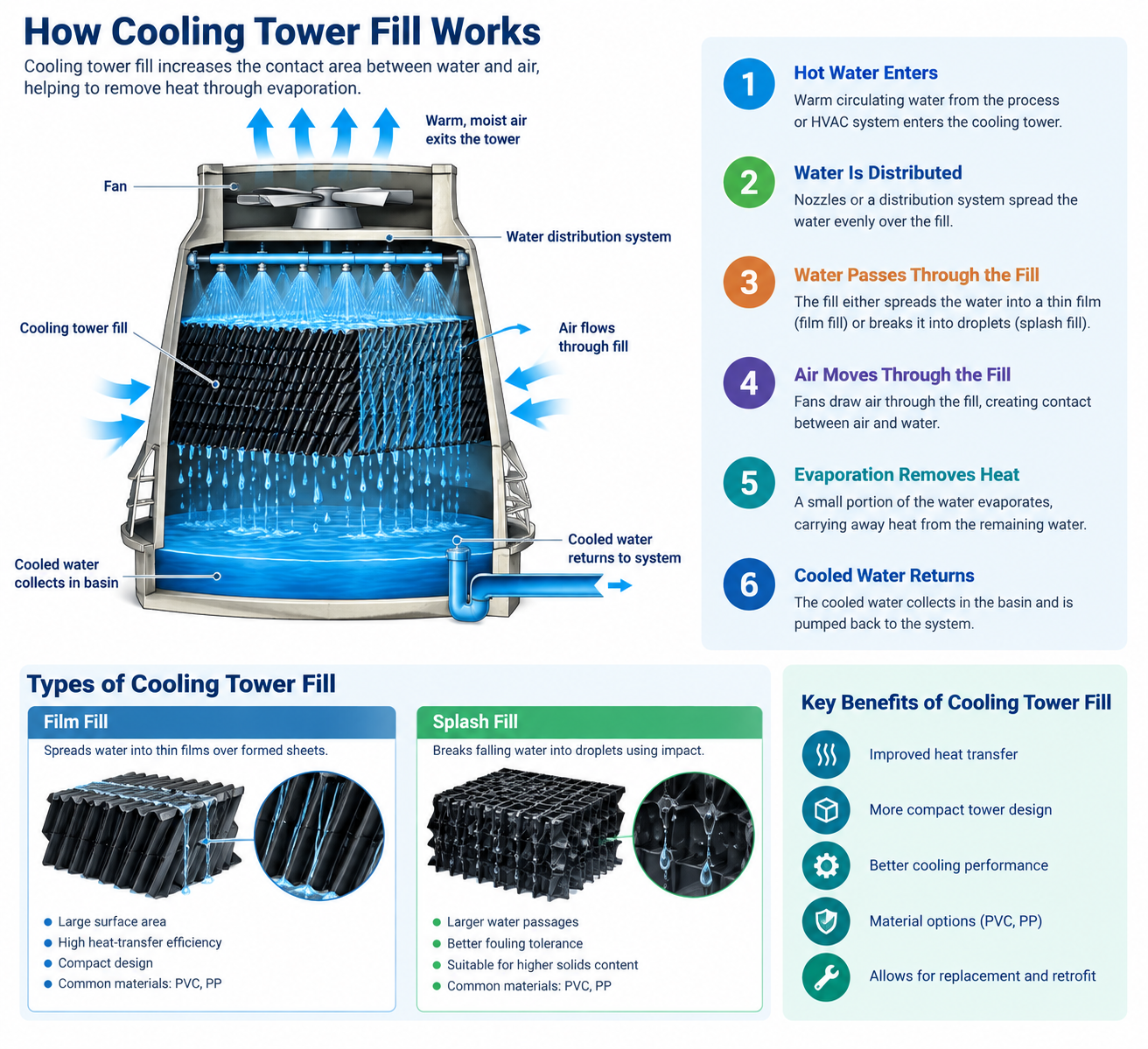
Cooling tower filler, also known as cooling tower fill media or packing, increases the contact area between water and air. This promotes heat transfer as warm water flows through the cooling tower.
Custom cooling tower filler is manufactured to meet specific dimensional, material, or application requirements instead of relying exclusively on standard configurations.
Customization may be required when:
An OEM needs fill media for a new cooling tower model.
An existing tower uses non-standard fill dimensions.
A maintenance contractor is replacing damaged or obsolete fill.
A distributor needs products in specified pack sizes.
An industrial retrofit requires a carefully evaluated alternative fill configuration.
Custom production should begin with accurate technical information. A product that matches the required dimensions may still need engineering verification to ensure suitable thermal performance, airflow resistance, and water distribution.
Types of Custom China Cooling Tower Filler
PVC Film Fill
<AsyncImage query="custom PVC cooling tower film fill media corrugated sheets assembled rectangular packs industrial" aspectRatio="5:4" width="100%" />
PVC film fill is widely used in industrial and commercial cooling towers. Formed sheets increase water-air contact and support heat transfer.
Custom PVC fill may be specified by:
Sheet thickness and flute geometry
Pack length, width, and height
Sheet arrangement and assembly method
Material properties and operating temperature limits
Packaging and installation requirements
It is commonly considered for HVAC systems, manufacturing plants, and industrial process cooling where the material suits the operating conditions.
PP Cooling Tower Fill
<AsyncImage query="custom polypropylene PP cooling tower fill media black corrugated plastic sheets industrial packing" aspectRatio="5:4" width="100%" />
Polypropylene fill may be suitable for applications where its material properties meet the required temperature, chemical, and mechanical conditions.
OEM and aftermarket buyers should confirm the PP grade, operating limits, and compatibility with circulating water. Product-specific specifications are more reliable than general material descriptions.
Custom Splash Fill
<AsyncImage query="industrial plastic cooling tower splash fill grid bars assembled replacement packs" aspectRatio="5:4" width="100%" />
Splash fill distributes water through repeated impacts across bars, grids, or other structural elements. It may be suitable for certain systems with higher suspended-solids loads or specific fouling concerns.
Before changing from film fill to splash fill, evaluate the tower's thermal design, airflow, water distribution, and available installation space.
Custom Cooling Tower Filler for OEM Projects
OEM manufacturers need consistent products that fit their equipment designs and production schedules. A reliable custom cooling tower filler supplier should be able to work from technical drawings, approved samples, or clearly defined specifications.
Design and Dimensional Customization
Provide the fill pack dimensions, sheet profile, material, installation orientation, and support requirements. If the design is new, coordinate the fill specification with the cooling tower's engineering team.
Consistent Production Quality
Repeat orders should follow the same approved specifications. Buyers should establish acceptable dimensional tolerances, material requirements, inspection procedures, and packaging standards.
Private-Label and Packaging Requirements
Some manufacturers may support buyer-specific labels, export packaging, or product identification. Confirm these services before production and ensure that packaging protects the fill packs during handling and transportation.
Repeat-Order Management
OEM projects often require repeatable production across multiple orders. Retaining approved drawings, samples, inspection records, and product specifications helps reduce variation and simplify procurement.
Custom Cooling Tower Filler for Aftermarket Replacement Projects
Aftermarket projects often involve replacing existing fill in towers that have operated for many years. Original drawings may be unavailable, dimensions may be non-standard, or the original product may be difficult to source.
A customized aftermarket fill solution can be developed around verified site measurements and operating requirements.
Before ordering, confirm:
The cooling tower manufacturer and model, if known.
Existing fill pack length, width, and height.
Material, sheet thickness, and fill profile.
Fill support spacing and installation orientation.
Operating water temperature and water chemistry.
Required quantity and project delivery date.
For brand-compatible replacements, compatibility should be verified for the particular tower and configuration. Do not assume that a product is identical to an original manufacturer's component simply because it is described as compatible.
Where the proposed fill differs from the original design, obtain a technical review of heat transfer, airflow resistance, water distribution, and installation requirements.
How to Choose a Custom Cooling Tower Filler Manufacturer in China
Supplier selection has a direct effect on product quality, project timing, and long-term purchasing costs.
| Evaluation factor | What to check |
| Manufacturing capability | Ability to produce the specified material, profile, and dimensions |
| Engineering support | Ability to review drawings, samples, and installation requirements |
| Material control | Documentation for material grade and operating limits |
| Quality assurance | Dimensional checks, sample approval, and inspection records |
| OEM experience | Repeat production and specification management |
| Aftermarket experience | Support for replacement dimensions and retrofit requirements |
| Export capability | Packaging, shipping coordination, and documentation |
| Commercial terms | Minimum order, lead time, payment, and warranty conditions |
Confirm whether the supplier is a direct factory or a trading company. Both can be suitable, but buyers should understand who manufactures the product and who is responsible for quality and delivery.
For large orders, consider a factory audit or independent pre-shipment inspection.
What Affects Custom Cooling Tower Filler Prices?
The cost of custom China cooling tower filler depends on several factors:
Material: PVC and PP differ in material costs and application properties.
Dimensions and thickness: Larger packs or greater material consumption can increase costs.
Profile complexity: Special geometries may require additional tooling or production adjustments.
Order quantity: Larger orders may improve unit pricing, depending on manufacturing efficiency.
Sample and tooling costs: New designs may require initial development work.
Inspection requirements: Additional testing or third-party inspection may affect the quotation.
Packaging and shipping: Export packaging, freight, and destination handling contribute to total landed cost.
When comparing suppliers, request itemized quotations based on identical specifications. Confirm whether tooling, samples, packaging, inspection, and freight are included.
Custom Cooling Tower Filler Ordering Process
A structured procurement process helps prevent specification errors and production delays.
Step 1: Define the application. Identify the tower type, operating conditions, project objective, and required quantity.
Step 2: Provide technical information. Send drawings, measurements, photos, existing samples, or approved product references.
Step 3: Confirm material and design. Review the fill profile, dimensions, material specifications, and installation requirements.
Step 4: Request samples and quotations. Compare pricing, lead times, quality controls, and customization capabilities.
Step 5: Approve production specifications. Confirm drawings, inspection criteria, packaging, and acceptance requirements in writing.
Step 6: Inspect and ship. Arrange agreed inspections and verify export packaging and shipping documentation.
Step 7: Retain product records. Keep approved drawings and specifications for future OEM production or replacement orders.
Source Custom China Cooling Tower Filler from Power Tower Cooling Technology
Power Tower Cooling Technology supports buyers sourcing cooling tower fill media and replacement components for OEM production, industrial maintenance, and aftermarket projects.
Buyers can inquire about PVC film fill, PP fill, splash fill, custom pack dimensions, and bulk supply options. Providing accurate specifications helps determine whether a product can meet the project's manufacturing and operating requirements.
Contact Power Tower Cooling Technology with your drawings, dimensions, photographs, material requirements, and order quantity to discuss custom cooling tower filler options for your project.
Frequently Asked Questions
Can China cooling tower filler manufacturers produce custom sizes?
Many suppliers offer customized dimensions, subject to their production capabilities. Confirm the required pack size, profile, material, tolerances, and tooling arrangements before placing an order.
Is custom cooling tower filler suitable for OEM production?
Yes, provided the manufacturer can meet the OEM's technical specifications, quality requirements, production schedule, and repeat-order needs.
Can custom fill be used for aftermarket cooling tower replacement?
It can be suitable when the dimensions, material, installation arrangement, and operating requirements are verified. Significant design changes should be reviewed by a qualified cooling tower engineer.
What information is needed for a custom quotation?
Provide the fill type, material, dimensions, quantity, operating conditions, drawings or photographs, destination country, and delivery schedule.
What is the difference between PVC and PP cooling tower fill?
PVC and PP have different material properties and operating limits. The best choice depends on temperature, water chemistry, fouling conditions, mechanical requirements, and the cooling tower's design.
Recommended internal links for CoolingTowerPart.com:


