Why Does the Cooling Tower Fill Media Supplier Matter?
Selecting the right cooling tower fill media supplier is an important decision for industrial plants, HVAC systems, power stations, process cooling facilities, and commercial cooling towers. Although cooling tower fill may look like a relatively simple component, its material, design, manufacturing accuracy, and service life can directly affect heat transfer performance and operating costs.
A reliable supplier should provide more than standard cooling tower fill products. The supplier should understand tower design, operating conditions, water quality, temperature requirements, installation methods, and replacement needs.
The right cooling tower fill media can help increase air-water contact, improve heat transfer, reduce energy consumption, and maintain stable cooling performance. In contrast, poor-quality fill can deform, clog, crack, or deteriorate prematurely.
For this reason, buyers should evaluate a supplier from several aspects, including product quality, material selection, customization capabilities, production capacity, technical support, delivery performance, and after-sales service.
What Is Cooling Tower Fill Media?
Cooling tower fill media is the internal heat-transfer component installed inside a cooling tower. Its primary function is to increase the contact area and contact time between circulating water and air.
How Does Cooling Tower Fill Media Work?
Hot circulating water is distributed over the surface of the cooling tower fill. As air moves through the fill, a portion of the water evaporates. The evaporation process removes heat from the circulating water and lowers its temperature.
The design of the fill creates a large wetted surface area without requiring an excessively large tower footprint.
Why Is Fill Design Important?
A good cooling tower fill design should provide:
Large effective heat-transfer surface area
Good water distribution
Controlled air resistance
Strong wetting performance
Resistance to fouling and blockage
Suitable mechanical strength
Long-term dimensional stability
Different cooling towers require different fill configurations, so selecting the correct product is essential.
What Types of Cooling Tower Fill Media Are Available?
A reliable cooling tower fill media supplier should be able to offer different fill types for various cooling applications.
Film Fill Media
Film fill creates thin layers of water over a large surface area. It is widely used because of its high heat-transfer efficiency and compact design.
Typical Applications of Film Fill
Film fill is commonly used in:
Industrial cooling towers
HVAC cooling towers
Counterflow cooling towers
Crossflow cooling towers
Process cooling systems
Replacement cooling tower projects
Film fill is particularly suitable when high thermal performance is required within a limited tower volume.
Splash Fill Media
Splash fill breaks water into droplets as the water moves through a series of splash bars or similar structures.
Where Is Splash Fill Used?
Splash fill can be useful in applications where circulating water contains suspended solids or where fouling resistance is an important consideration.
Compared with film fill, splash fill generally has a different hydraulic and thermal performance profile. Buyers should select between these options according to actual operating conditions rather than choosing based only on price.
PVC Cooling Tower Fill
PVC is one of the most widely used materials for cooling tower fill because of its balance of cost, weight, processability, and performance.
PVC cooling tower fill is commonly selected for normal-temperature industrial and HVAC applications.
PP Cooling Tower Fill
PP cooling tower fill is often selected when higher temperature resistance or improved chemical resistance is required.
A qualified supplier should be able to explain whether PVC or PP is more appropriate for the customer's water temperature and operating environment.
What Should You Check When Choosing a Cooling Tower Fill Media Supplier?
Choosing a supplier requires more than comparing product prices. Several factors should be evaluated before placing an order.
1. Evaluate the Supplier's Product Quality
Product quality should be the first consideration when selecting a cooling tower fill media supplier.
Check the Raw Material
Ask the supplier what type of raw material is used in manufacturing.
Important factors include:
For demanding cooling tower applications, material consistency is especially important.
Check Thickness and Dimensional Accuracy
The thickness of cooling tower fill sheets can affect rigidity, weight, service life, and thermal performance.
A professional manufacturer should maintain consistent sheet thickness and dimensional tolerances during production.
Small variations may seem insignificant in a single sheet, but they can become important when thousands of sheets are assembled into a large fill system.
2. Look at the Cooling Tower Fill Manufacturing Process
The manufacturing process has a direct influence on product consistency.
Thermoforming Quality
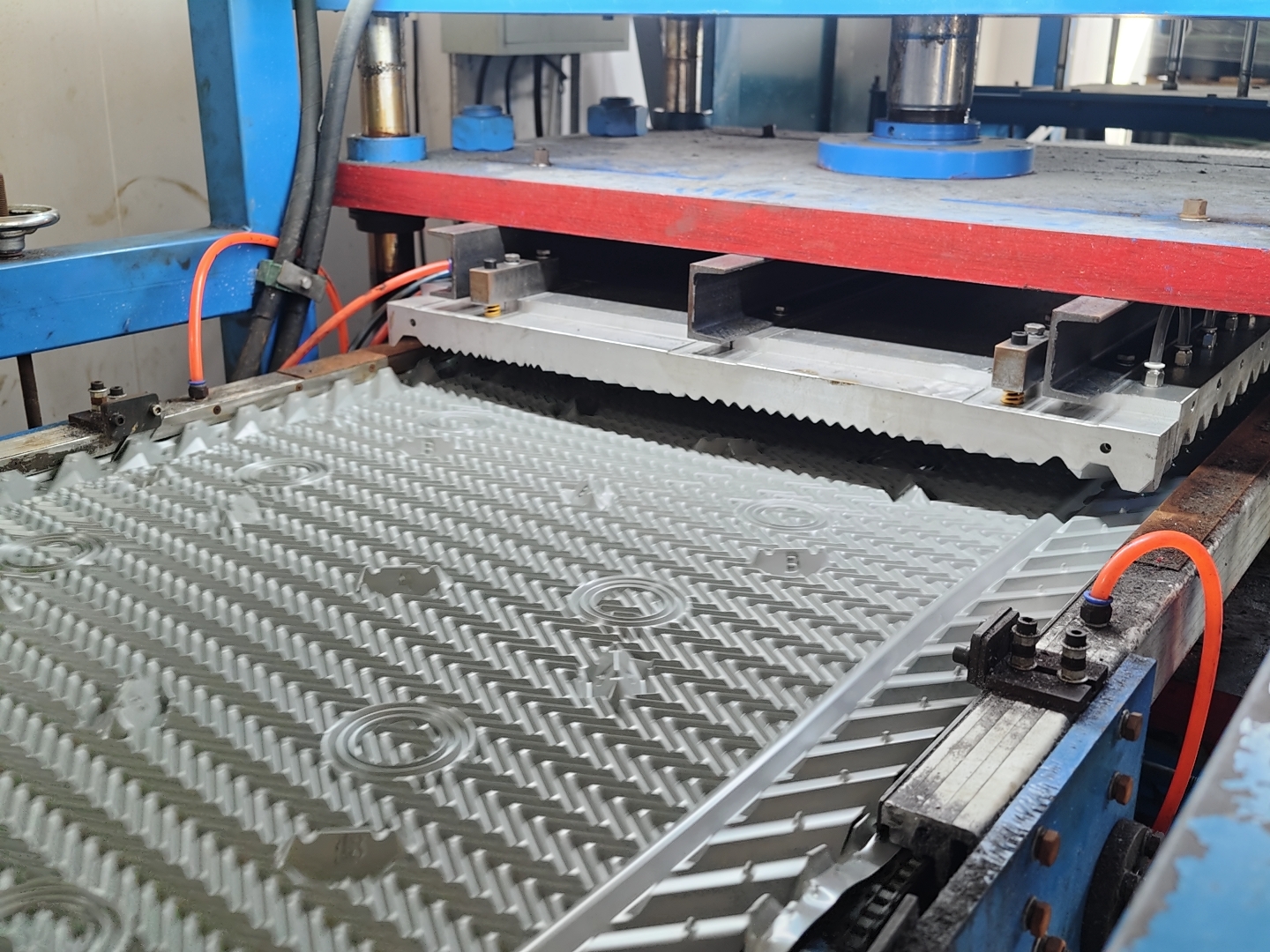
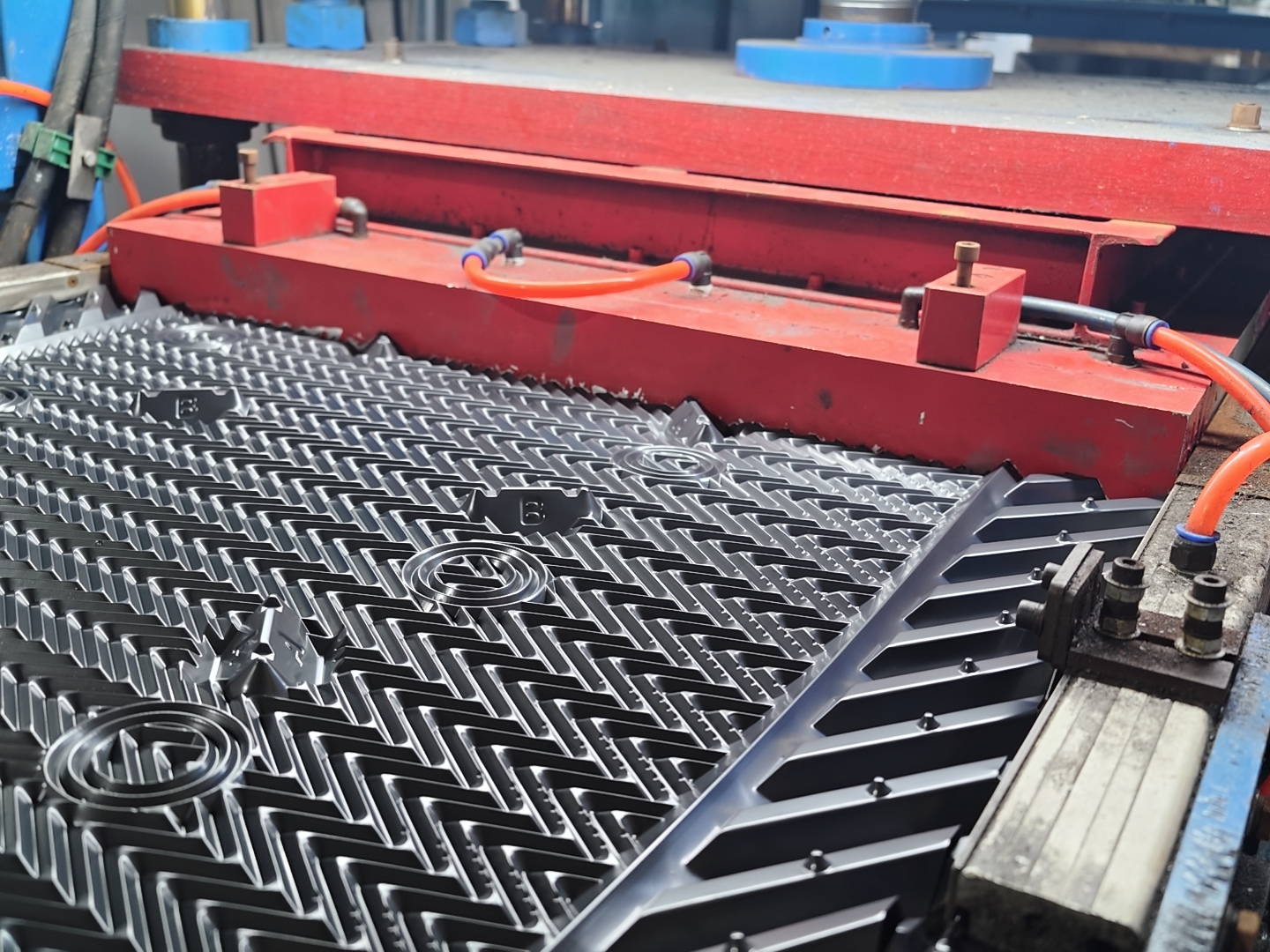
Many PVC and PP cooling tower fills are manufactured using thermoforming processes.
During production, the material is heated and formed into a specific corrugated or structured profile.
A reliable manufacturer should maintain stable control over:
Heating temperature
Forming pressure
Sheet thickness
Corrugation geometry
Cutting dimensions
Production speed
Consistent manufacturing helps ensure that the finished fill performs predictably inside the cooling tower.
Bonding and Assembly
Some cooling tower fill applications require sheets to be bonded or assembled into blocks.
The bonding quality should be strong enough to withstand transportation, installation, water flow, and long-term operation.
Poor bonding may result in deformation or separation of fill blocks.
3. Check the Supplier's Cooling Tower Fill Media Experience
Experience is another important indicator of supplier reliability.
Does the Supplier Understand Different Cooling Tower Designs?
A professional supplier should understand the differences between:
Counterflow cooling towers
Crossflow cooling towers
Open cooling towers
Closed-circuit cooling systems
Industrial cooling towers
HVAC cooling towers
The supplier should not simply sell one standard product to every customer.
Can the Supplier Handle Replacement Projects?
Cooling tower fill replacement is different from supplying fill for a completely new tower.
Replacement projects may involve existing dimensions, support structures, water distribution systems, fan configurations, and installation restrictions.
An experienced cooling tower fill supplier should be able to work with existing tower measurements and recommend suitable replacement media.
4. Confirm Custom Cooling Tower Fill Capabilities
Not every cooling tower uses standard fill dimensions.
What Can Be Customized?
Depending on the manufacturer, customization may include:
Fill sheet dimensions
Fill block dimensions
Sheet thickness
Corrugation profile
Flute height
Spacing
Bonding configuration
Material selection
Block arrangement
Why Is Customization Important?
Custom cooling tower fill can reduce installation problems when replacing existing media.
For example, if the original cooling tower fill has a non-standard block size, a supplier capable of producing customized dimensions can manufacture replacement fill according to the actual tower requirements.
This can be especially valuable for older cooling towers where the original fill is no longer readily available.
5. Compare Thermal Performance
Price should never be the only factor when choosing cooling tower fill media.
Consider Heat Transfer Efficiency
The primary purpose of cooling tower fill is to improve heat and mass transfer between air and water.
Important performance factors include:
Effective surface area
Water loading
Airflow
Pressure drop
Fill height
Water distribution
Operating temperature
A suitable fill design should achieve the required cooling performance without creating excessive air resistance.
Consider Pressure Drop
Cooling tower fill influences airflow resistance.
If the fill creates excessive pressure drop, the cooling tower fan may need to consume more energy to maintain the required airflow.
Therefore, thermal performance and hydraulic or aerodynamic characteristics should be evaluated together.
6. Check Fouling and Clogging Resistance
Water quality can vary significantly between different cooling tower applications.
Why Does Fouling Matter?
Circulating water may contain:
Dust
Algae
Scale-forming minerals
Suspended solids
Organic deposits
Corrosion products
These contaminants can accumulate on cooling tower fill and restrict water and airflow.
Select Fill According to Water Quality
If the cooling water contains a high level of suspended solids, the buyer should discuss the application with the supplier before selecting a fine-pitch film fill.
A supplier with technical experience should be able to recommend a fill design that balances heat transfer performance and fouling resistance.
7. Ask About Temperature Resistance
Operating temperature is another critical selection factor.
PVC vs. PP Cooling Tower Fill
PVC cooling tower fill is commonly used for standard-temperature applications, while PP cooling tower fill may be preferred for applications involving higher water temperatures or more demanding chemical conditions.
However, the actual operating temperature, peak temperature, water chemistry, and tower design should all be considered.
A reliable supplier should ask for these details before recommending a material.
8. Verify Production Capacity and Delivery Time
A supplier may offer good products but still be unsuitable for large replacement projects if production capacity is limited.
What Should Buyers Ask?
Before ordering, confirm:
Why Is Delivery Important?
Cooling tower maintenance projects often have strict shutdown schedules.
If replacement cooling tower fill arrives late, the entire maintenance project may be delayed.
For large projects, buyers should confirm production schedules and shipping arrangements in advance.
9. Examine Packaging and Transportation
Cooling tower fill media can occupy significant container volume even though the product itself is relatively lightweight.
How Should Cooling Tower Fill Be Packed?
Depending on the product and shipping requirements, fill media may be packed in:
The supplier should select packaging that protects the fill during loading, transportation, unloading, and installation.
Container Loading Efficiency
For international buyers, container utilization can have a significant impact on the final landed cost.
An experienced cooling tower fill supplier should be able to provide estimated loading quantities based on fill dimensions, pallet configuration, and container type.
10. Check Quality Control Procedures
A professional cooling tower fill manufacturer should have a clear quality-control process.
Important Quality Checks
The supplier may inspect:
Raw material quality
Sheet thickness
Product dimensions
Surface condition
Forming quality
Bonding strength
Block dimensions
Packaging condition
For large projects, buyers can also request product samples before mass production.
Ask for Samples Before Bulk Orders
Samples are particularly useful when purchasing customized cooling tower fill.
A sample allows the buyer to check:
Dimensions
Material
Appearance
Thickness
Corrugation profile
Assembly quality
This can reduce the risk of receiving unsuitable products in a large shipment.
How Can You Compare Different Cooling Tower Fill Suppliers?
Instead of choosing the cheapest supplier, buyers should compare suppliers using several criteria.
Product Comparison
Compare:
Commercial Comparison
Also compare:
Product price
Packaging cost
Shipping cost
Lead time
Payment terms
MOQ
Warranty
Technical support
A supplier with a slightly higher unit price may offer a lower total cost if the product lasts longer and reduces maintenance requirements.
What Questions Should You Ask a Cooling Tower Fill Media Supplier?
Before placing an order, buyers can prepare a simple technical checklist.
Technical Questions
Ask the supplier:
What type of cooling tower fill do you recommend?
Is the fill suitable for crossflow or counterflow towers?
What material is used?
What is the recommended operating temperature?
What is the sheet thickness?
What are the standard dimensions?
Can the fill be customized?
How does the fill perform under high-fouling conditions?
What is the expected service life under normal conditions?
Can you provide samples and technical specifications?
Commercial Questions
Also ask:
What is the MOQ?
What is the production lead time?
How is the product packaged?
How many cubic meters or pallets can be loaded into a container?
What are the payment terms?
Can you provide replacement fill according to existing tower dimensions?
These questions can help buyers identify suppliers with real manufacturing and technical capabilities.
What Are the Most Common Mistakes When Choosing a Supplier?
Several mistakes can increase project costs and reduce cooling tower performance.
Choosing Only by Price
The lowest quotation does not necessarily represent the lowest total cost.
Cheap cooling tower fill may use inconsistent materials, have poor dimensional accuracy, or provide a shorter service life.
Selecting the Wrong Fill Type
A fill designed for one application may not be appropriate for another.
For example, a high-efficiency film fill may not always be the best choice for severely contaminated water.
Ignoring Water Quality
Water quality has a major influence on fill life.
Buyers should provide information about suspended solids, scaling, biological growth, and chemical treatment whenever possible.
Ignoring Existing Tower Dimensions
For replacement projects, incorrect dimensions can create installation problems.
The buyer should provide accurate measurements of the existing fill and support structure before ordering customized replacement media.
How Can You Find a Reliable Cooling Tower Fill Media Manufacturer?
A good supplier should be able to provide evidence of its manufacturing capabilities.
Check Manufacturing Experience
Look for suppliers with experience in:
Cooling tower fill production
International exports
Custom fill manufacturing
Cooling tower replacement projects
PVC and PP processing
Review Previous Projects
Ask whether the supplier has supplied cooling tower fill for similar applications.
Previous project experience can provide useful information about product suitability and manufacturing capabilities.
Evaluate Communication
Good communication is often an overlooked part of supplier selection.
A reliable supplier should respond clearly to questions about dimensions, materials, technical specifications, packaging, and delivery.
If a supplier cannot provide basic technical information before an order, buyers should be cautious about placing a large purchase.
Why Should You Work Directly With a Cooling Tower Fill Manufacturer?
Buying directly from a manufacturer can provide several advantages.
Better Product Customization
Direct manufacturers can often adjust product dimensions, materials, thickness, and configurations according to project requirements.
Better Cost Control
Reducing unnecessary distribution layers may help buyers obtain more competitive pricing, particularly for large-volume orders.
Faster Technical Communication
Direct communication with the manufacturer can make it easier to discuss drawings, samples, specifications, and replacement requirements.
More Flexible Production
Manufacturers may also be able to arrange production according to project schedules instead of relying only on existing inventory.
What Information Should You Provide When Requesting a Quote?
To receive an accurate quotation, buyers should provide as much technical information as possible.
Recommended Information
Include:
Photos of the existing cooling tower fill can also help the supplier identify the approximate fill configuration.
The more complete the information, the easier it is for the supplier to recommend the correct cooling tower fill media.
How Does the Right Supplier Improve Your Cooling Tower Project?
A reliable cooling tower fill media supplier can contribute to the project in several ways.
Improved Cooling Performance
Correctly selected fill provides effective air-water contact and supports efficient heat transfer.
Longer Service Life
Appropriate material and manufacturing quality can help the fill withstand operating conditions for a longer period.
Reduced Maintenance
A suitable fill design can reduce problems associated with deformation, clogging, and premature deterioration.
More Predictable Project Costs
Accurate specifications, reliable production, and professional packaging can reduce unexpected costs during installation and transportation.
Final Checklist for Selecting a Cooling Tower Fill Media Supplier
Before choosing a supplier, buyers should review the following checklist:
Suitable cooling tower fill type
Appropriate PVC or PP material
Consistent sheet thickness
Accurate dimensions
Reliable forming quality
Suitable thermal performance
Appropriate fouling resistance
Custom manufacturing capability
Quality-control procedures
Sufficient production capacity
Reliable packaging
Competitive shipping arrangement
On-time delivery
Technical support
Experience with replacement projects
Conclusion: How to Select a Reliable Cooling Tower Fill Media Supplier?
Selecting a reliable cooling tower fill media supplier requires a balance between product quality, technical performance, manufacturing capability, price, delivery, and service.
The best supplier is not necessarily the one offering the lowest quotation. Instead, buyers should choose a supplier that can provide the correct fill type, suitable material, accurate dimensions, consistent quality, customized solutions, dependable production, and professional technical support.
Whether you need PVC cooling tower fill, PP cooling tower fill, film fill, splash fill, or customized cooling tower fill replacement, a detailed supplier evaluation can help reduce purchasing risks and improve long-term cooling tower performance.
By checking material quality, manufacturing processes, thermal performance, fouling resistance, customization capability, production capacity, and after-sales support, buyers can make a more informed decision and establish a reliable long-term supply relationship.