Understanding Cooling Tower Fill Media for Industrial Use
Cooling tower fill media is one of the most important components in an industrial cooling tower. It increases the contact area between circulating water and air, allowing heat to transfer more efficiently and helping the cooling system maintain stable operating temperatures. Whether used in power plants, chemical processing facilities, manufacturing plants, commercial HVAC systems, or industrial water treatment installations, the right cooling tower fill media can significantly influence cooling performance, energy consumption, maintenance requirements, and equipment service life.
For industrial operators, selecting suitable cooling tower fill media involves more than comparing prices. Material quality, fill design, water quality, operating temperature, airflow resistance, and compatibility with the existing cooling tower must all be considered.
This guide explains the main types of cooling tower fill media, their materials, industrial applications, performance characteristics, maintenance requirements, and selection criteria to help buyers make informed purchasing decisions.
What Is Cooling Tower Fill Media?
Cooling tower fill media refers to the structured material installed inside a cooling tower to increase the contact surface between hot circulating water and ambient air. It creates conditions that promote heat transfer and water evaporation, enabling the cooling tower to reduce the temperature of process water.
Without properly designed fill media, water tends to fall through the tower too quickly, limiting the available contact time and reducing cooling efficiency.
How Does Cooling Tower Fill Media Work?
When warm water enters the cooling tower, the distribution system spreads it over the fill media. The water then flows across or through the fill surfaces while air moves through the tower.
Heat is transferred from the water to the air through sensible heat transfer and evaporation. A portion of the water evaporates, removing heat from the remaining water and lowering its temperature.
The Main Heat Transfer Processes
Three factors influence the performance of cooling tower fill media:
Water distribution: Uniform water flow helps prevent dry areas and uneven cooling.
Airflow: Adequate airflow supports evaporation and heat exchange.
Contact surface area: A larger effective contact area can improve heat transfer when airflow, water loading, and operating conditions are properly matched.
Why Fill Geometry Matters
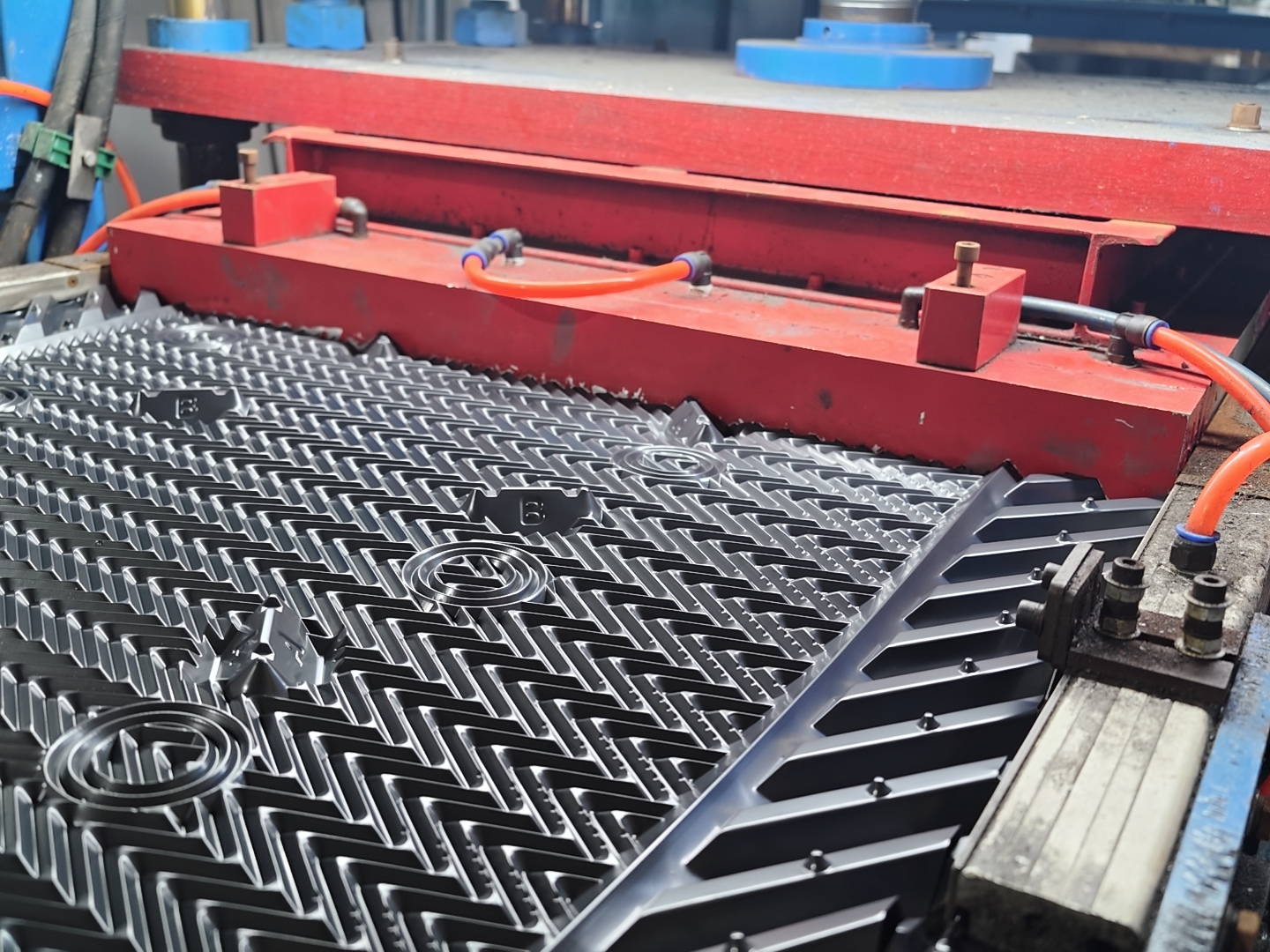
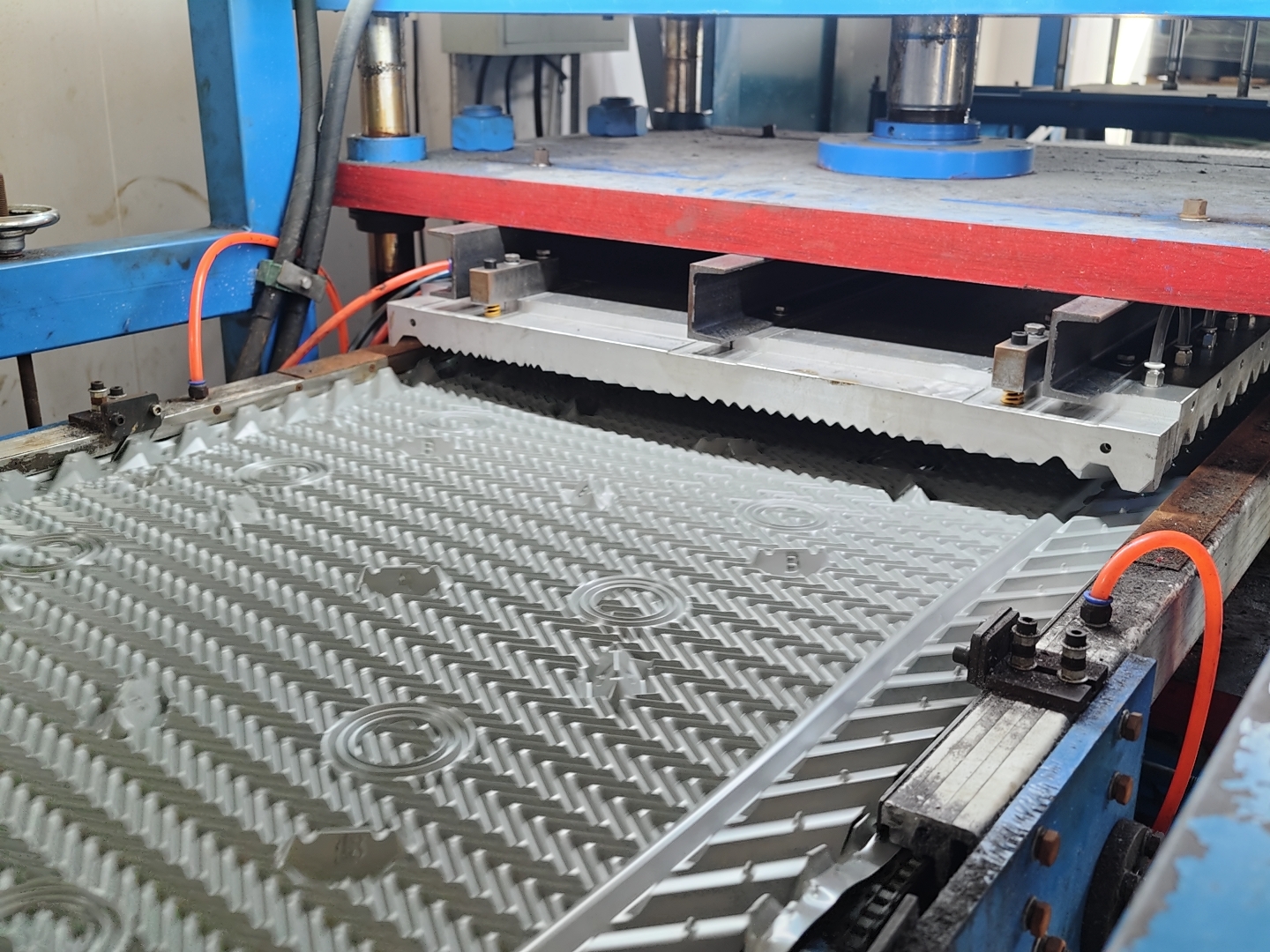
The geometry of cooling tower fill media affects water spreading, film thickness, droplet formation, airflow resistance, and the potential for scale accumulation. Corrugated sheets, embossed surfaces, and carefully designed channels can help distribute water and promote effective contact between air and water.
However, maximum surface area does not automatically guarantee the best performance. A well-designed fill must balance heat transfer efficiency, pressure drop, fouling resistance, and cleaning requirements.
Why Is Cooling Tower Fill Media Important for Industrial Cooling?
Industrial cooling towers often operate under continuous thermal loads. Inefficient fill media can contribute to higher cooling water temperatures, increased equipment operating costs, and reduced process stability.
Properly selected fill media can help industrial facilities:
Improve heat transfer efficiency.
Maintain more consistent cooling water temperatures.
Support reliable heat exchanger and process equipment operation.
Reduce unnecessary energy consumption when the overall system is properly optimized.
Extend the useful life of cooling tower components through appropriate material selection and maintenance.
Reduce the frequency of unplanned cleaning and fill replacement.
What Are the Main Types of Cooling Tower Fill Media?
Cooling tower fill media can be classified according to its structure, heat transfer method, material, and intended operating conditions. Understanding these differences helps buyers select the right solution for their cooling tower design.
Film Fill Media
Film fill media allows water to spread into thin films across the surfaces of closely spaced sheets. Air passes through the channels between the sheets, creating a large contact area for heat transfer.
Film fill is widely used in industrial and commercial cooling towers where water quality and operating conditions are suitable.
Advantages of Film Fill
High effective heat transfer surface area.
Compact design for many cooling applications.
Good cooling performance under suitable water conditions.
Potential for efficient use of tower space.
Available in different sheet configurations and channel geometries.
When Should You Choose Film Fill?
Film fill is generally appropriate for relatively clean circulating water with manageable suspended solids and biological growth. It is often selected for HVAC systems, manufacturing facilities, and industrial processes with suitable water treatment programs.
If the circulating water contains substantial suspended solids, fibers, biological debris, or scale-forming minerals, narrow fill passages may become clogged. In these conditions, a more fouling-resistant fill design may be preferable.
Splash Fill Media
Splash fill breaks falling water into smaller droplets as it passes over a series of bars, grids, or other specially designed surfaces. This increases water-air contact and supports evaporative cooling.
Splash fill is commonly considered for applications where water contains more suspended solids or where fouling resistance is a major selection priority.
Advantages of Splash Fill
Greater tolerance for certain fouling conditions.
More open passages in many designs.
Easier access for inspection and cleaning in some configurations.
Suitability for selected industrial wastewater and process cooling applications.
What Should Buyers Consider?
Splash fill performance depends on its configuration, water loading, airflow, and installation arrangement. Compared with film fill, some splash fill designs may require more tower volume to achieve a comparable cooling duty.
The correct choice should be based on the cooling tower's thermal requirements rather than the fill type alone.
Film Fill vs. Splash Fill: Which Is Better?
Neither type is universally better. The appropriate option depends on the balance between thermal performance, water quality, maintenance needs, and operating cost.
| Selection factor | Film fill | Splash fill |
| Heat transfer surface | Large effective surface in suitable designs | Created through droplet breakup and water distribution |
| Fouling tolerance | Can be sensitive to deposits and blocked passages | Often suitable for more fouling-prone conditions |
| Water quality | Best with appropriately treated water | May accommodate certain higher-solids applications |
| Cleaning | Can require careful cleaning of narrow channels | Open structures may simplify access |
| Typical applications | HVAC and relatively clean industrial water | Selected industrial processes and fouling-prone systems |
The final decision should consider the manufacturer's thermal performance data, actual water quality, and the cooling tower's available installation space.
What Materials Are Used in Industrial Cooling Tower Fill Media?
Material selection affects durability, chemical compatibility, thermal performance, and resistance to deformation. PVC and polypropylene are two common thermoplastic materials used to manufacture cooling tower fill media.
PVC Cooling Tower Fill Media
Polyvinyl chloride, commonly known as PVC, is widely used for cooling tower fill because it offers a practical combination of formability, cost, and performance under suitable operating conditions.
PVC fill sheets can be thermoformed into corrugated or other structured profiles designed to support water distribution and air movement.
Key Benefits of PVC Fill
Good performance in many conventional cooling tower applications.
Suitable for manufacturing structured film fill.
Available in different thicknesses and sheet configurations.
Practical material cost for many industrial projects.
Compatibility with a broad range of cooling tower designs, subject to chemical and temperature limits.
Is PVC Suitable for Every Cooling Tower?
No. PVC fill must be evaluated against the actual operating temperature, chemical exposure, fire-performance requirements, and mechanical loading.
High temperatures, aggressive chemicals, or unsuitable cleaning agents may shorten its service life. Buyers should request the manufacturer's recommended continuous operating limits rather than relying on a general material description.
PP Cooling Tower Fill Media
Polypropylene, or PP, is another widely used thermoplastic material for cooling tower fill media. It is often considered when operating temperatures or chemical conditions make standard PVC fill less suitable.
Advantages of PP Fill Media
Good chemical resistance in many applications.
Potential suitability for higher-temperature service than conventional PVC, depending on the specific grade and design.
Flexibility in product configuration and fabrication.
Availability for specialized industrial cooling applications.
How Should Buyers Compare PVC and PP?
PVC and PP should be compared using the actual service conditions, not price alone. Important factors include operating temperature, chemical compatibility, fire requirements, mechanical strength, sheet thickness, and expected service life.
PP is not automatically the better choice for every industrial project. The correct material depends on the cooling tower design and the manufacturer's verified performance specifications.
PVC vs. PP Cooling Tower Fill Media
| Factor | PVC fill | PP fill |
| Typical use | Conventional industrial and HVAC cooling | Selected industrial and higher-temperature applications |
| Material cost | Often economical | May cost more, depending on grade and design |
| Chemical resistance | Suitable for many common conditions | Often advantageous for certain chemical exposures |
| Temperature suitability | Depends on grade and service conditions | Can support higher-temperature applications with suitable grades |
| Selection priority | Cost-effective performance | Temperature or chemical compatibility where needed |
Always confirm the material's operating limits and compatibility with the circulating water before placing an order.
What Industrial Applications Use Cooling Tower Fill Media?
Cooling tower fill media is used in a wide range of industries where heat must be removed from circulating water. The required fill configuration varies with process temperature, water quality, cooling capacity, and maintenance practices.
Power Generation Facilities
Power plants use cooling systems to remove heat from condensers and auxiliary equipment. Fill media helps improve the contact between circulating water and air, supporting the heat rejection process.
Large power generation installations may require customized fill dimensions, mechanical support considerations, and materials selected for the site's water chemistry and operating environment.
Chemical and Petrochemical Plants
Chemical processing facilities use cooling towers to support reactors, heat exchangers, compressors, and other process equipment.
In these environments, buyers should pay particular attention to chemical compatibility, temperature fluctuations, contamination risks, and water treatment conditions. The fill material must be appropriate for the actual cooling water rather than the general industry classification.
Steel, Metallurgy, and Manufacturing
Manufacturing facilities may use cooling towers for furnaces, production lines, hydraulic systems, compressors, and industrial machinery.
The fill selection should account for continuous operation, circulating water temperature, possible contamination, and maintenance accessibility.
Commercial HVAC Systems
Commercial buildings, hospitals, shopping centers, office complexes, and data-related facilities use cooling towers to reject heat from central cooling systems.
Film fill is commonly considered where water treatment maintains suitable conditions. Efficient water distribution and routine maintenance help the system deliver stable cooling performance.
Wastewater and High-Solids Industrial Cooling
Some industrial facilities operate cooling towers with water containing suspended solids, biological matter, or other contaminants.
For these applications, open-channel or splash-type fill may be considered to reduce the risk of blockage. The final choice should reflect contaminant size, concentration, water treatment, and the manufacturer's recommendations.
What Factors Affect Cooling Tower Fill Media Performance?
Fill performance depends on the interaction between the fill structure and the complete cooling tower system. Selecting a product based only on dimensions or material can result in poor cooling performance or excessive maintenance.
Water Quality and Fouling Potential
Water quality is one of the most important considerations when choosing cooling tower fill media.
Suspended solids, mineral deposits, biological growth, corrosion products, and process contamination can accumulate on fill surfaces or obstruct the air and water passages.
How Water Quality Affects Fill Selection
Before selecting fill media, review:
Suspended solids concentration.
Water hardness and scaling potential.
Biological growth and treatment practices.
Water pH and chemical composition.
The presence of fibers, oils, or process contaminants.
The effectiveness of filtration and blowdown management.
Preventing Premature Blockage
Appropriate water treatment, filtration, regular inspection, and effective cleaning procedures help reduce blockage. Where water quality cannot be consistently controlled, a more fouling-tolerant fill design may reduce maintenance difficulties.
Operating Temperature
The temperature of the circulating water directly affects material selection. High-temperature applications may cause certain plastic materials to soften, deform, or lose mechanical strength over time.
Buyers should confirm the normal operating temperature, peak temperature, exposure duration, and any temperature fluctuations before choosing PVC or PP fill.
Airflow Resistance and Pressure Drop
Fill geometry influences how easily air passes through the cooling tower. If airflow resistance becomes excessive, the fan may need to work harder to maintain the required airflow.
A suitable fill design balances heat transfer surface area with pressure drop. Closely spaced channels are not always optimal if they create excessive airflow resistance or become easily fouled.
Water Distribution Uniformity
Uneven water distribution can create dry areas and overloaded sections inside the fill pack. This reduces the effective heat transfer area and may cause inconsistent cooling performance.
Proper coordination between the fill media, water distribution system, nozzles, and tower layout is therefore essential.
Mechanical Strength and Structural Support
Cooling tower fill media must withstand its own weight, the weight of retained water, installation loads, and applicable operating conditions.
For replacement projects, buyers should verify that the fill pack and support structure are compatible with the existing tower. Incorrect support spacing or unsuitable installation arrangements may cause deformation and uneven water distribution.
How to Choose the Right Cooling Tower Fill Media for Your Project
Selecting suitable cooling tower fill media requires a systematic assessment of cooling requirements, site conditions, and product specifications.
Step 1 — Define the Cooling Duty
Determine the required water flow rate, hot-water temperature, cold-water temperature, design wet-bulb temperature, and operating conditions.
These parameters establish the thermal duty and provide a basis for evaluating fill performance.
Information to Prepare Before Requesting a Quote
Industrial buyers should prepare the following information where available:
Cooling tower manufacturer and model.
Crossflow or counterflow configuration.
Required cooling capacity and water flow rate.
Hot-water and cold-water temperatures.
Existing fill dimensions and arrangement.
Available installation space and support layout.
Water quality and treatment information.
Operating temperature and environmental conditions.
Why Accurate Specifications Matter
Complete specifications help suppliers evaluate compatibility, recommend suitable materials, and reduce the risk of ordering fill that does not fit the existing cooling tower.
If the original design documents are unavailable, photographs, measured dimensions, and samples may help the supplier assess the replacement requirements.
Step 2 — Select the Appropriate Fill Type
Choose film fill or splash fill according to water quality, cooling requirements, fouling potential, and maintenance resources.
For relatively clean water, film fill may provide effective heat transfer in a compact arrangement. For more challenging water conditions, a suitable splash fill or open-channel design may offer practical maintenance advantages.
Step 3 — Confirm Material Compatibility
Compare PVC and PP using the actual water chemistry, operating temperature, mechanical requirements, and applicable fire-performance standards.
Ask the supplier to provide relevant technical data and clarify any operating limitations.
Step 4 — Evaluate Fill Dimensions and Configuration
Check sheet thickness, corrugation geometry, channel spacing, pack height, pack width, length, and installation orientation.
For replacement projects, the new fill should fit the existing tower while maintaining appropriate water distribution, airflow, and support conditions.
Step 5 — Compare Suppliers Beyond Price
A low quotation does not always represent the lowest total cost. Product quality, material consistency, dimensional accuracy, packing, delivery reliability, and technical support also affect project value.
Questions to Ask a Cooling Tower Fill Media Supplier
What material and sheet thickness are used?
What operating temperature range does the manufacturer recommend?
Is the fill compatible with the existing tower configuration?
Can the supplier provide drawings and technical specifications?
What quality inspection procedures are used?
Can the supplier manufacture customized dimensions?
What are the production lead time and packaging arrangements?
Is technical assistance available for installation and replacement?
How Can Buyers Verify Product Quality?
Request material specifications, dimensional inspection records, product drawings, and samples when appropriate. For large projects, confirm the acceptance criteria before production and agree on how dimensions, packaging, and product quantities will be inspected.
Can Customized Cooling Tower Fill Media Improve Project Compatibility?
Customized cooling tower fill media can be valuable when the original fill is discontinued, the tower has nonstandard dimensions, or the facility needs a material better suited to its operating conditions.
A manufacturer may be able to customize sheet dimensions, thickness, profile geometry, pack arrangement, and selected material options within its production capabilities.
Common Customization Requirements
Industrial buyers may request:
Custom sheet length and width.
Different PVC or PP material options.
Specific fill pack dimensions.
Crossflow or counterflow configurations.
Replacement fill designed around existing support structures.
Product identification and packaging requirements for export shipments.
Original Equipment Replacement Considerations
When replacing branded or original equipment manufacturer fill, verify the tower model, fill arrangement, required dimensions, and operating conditions. A compatible replacement should meet the functional requirements of the existing system, not merely match the outside dimensions.
Why Dimensional Accuracy Is Essential
A fill pack that is too large may be difficult to install, while one that is too small may leave bypass gaps or compromise water distribution. Differences in fill geometry can also influence airflow resistance and cooling performance.
What Should Be Included in a Replacement Inquiry?
Provide the supplier with the original fill model if known, photographs, dimensions, material preferences, water temperatures, and operating details. These records help the supplier assess whether a proposed replacement is suitable.
How to Maintain Industrial Cooling Tower Fill Media
Regular maintenance helps preserve heat transfer performance and reduce premature replacement. The required inspection frequency depends on water quality, operating hours, environmental conditions, and the cooling tower manufacturer's recommendations.
Routine Inspection
Inspect the fill for visible deposits, biological growth, deformation, broken sheets, uneven water distribution, and signs of blocked passages.
Check the surrounding support structure and water distribution system as well. Problems in these components may affect fill performance even when the fill material itself remains in acceptable condition.
Cleaning Procedures
Cleaning methods should be appropriate for the fill material and the type of deposit present.
Recommended Cleaning Considerations
Follow the cooling tower manufacturer's maintenance instructions.
Use cleaning agents compatible with the fill material.
Avoid excessive pressure that could damage or deform thin sheets.
Remove accumulated debris without creating additional blockages.
Apply appropriate water treatment to help control scaling and biological growth.
Avoiding Damage During Cleaning
Aggressive chemicals, incompatible solvents, excessive mechanical force, and high-pressure washing can damage plastic fill media. Before cleaning, identify the material and determine the correct procedure for the specific deposit.
When Should Cooling Tower Fill Media Be Replaced?
Fill replacement may be necessary when the media becomes severely clogged, loses its structural integrity, deforms, or can no longer deliver acceptable cooling performance after appropriate maintenance.
Other warning signs include persistent uneven water distribution, extensive breakage, repeated blockage, and an unexplained decline in cooling performance after other system problems have been investigated.
Replacement timing should be based on inspection findings, operating performance, and the manufacturer's guidance rather than a fixed service-life estimate.
What Are the Common Mistakes When Purchasing Cooling Tower Fill Media?
Avoiding common purchasing mistakes can help reduce installation delays, maintenance expenses, and performance problems.
Choosing Fill Based on Price Alone
Low-cost fill may appear attractive, but inconsistent material quality, inaccurate dimensions, or unsuitable geometry can increase long-term costs.
Compare total project value, including expected maintenance, replacement requirements, installation work, and product reliability.
Ignoring Water Quality
Selecting high-surface-area film fill without evaluating suspended solids and biological growth can create avoidable blockage problems.
Review the water treatment program before confirming the fill design.
Overlooking Operating Temperature
A material that works well under ordinary cooling conditions may not be suitable for sustained high-temperature service.
Confirm both normal and peak operating temperatures with the supplier.
Failing to Check Compatibility
Replacement fill must fit the existing tower's configuration and support system. Incorrect dimensions, orientation, or pack arrangement can affect airflow and water distribution.
Ignoring Shipping and Packaging
Cooling tower fill media can occupy substantial shipping volume. Poor packaging may lead to deformation, damage, or inefficient container utilization.
For export orders, confirm package dimensions, pallet arrangements, gross weight, loading plans, and delivery terms before production is completed.
How to Calculate the Value of Cooling Tower Fill Media
The value of cooling tower fill media should be evaluated through its contribution to cooling performance and its total ownership cost.
Consider the Total Cost of Ownership
A useful comparison includes:
Initial product purchase price.
Transportation and import costs.
Installation and labor expenses.
Routine cleaning and water treatment.
Potential production losses caused by downtime.
Expected replacement and maintenance requirements.
Evaluate Performance in the Complete Cooling System
Cooling tower fill media is only one component of a larger system. Fan performance, water distribution, ambient wet-bulb temperature, circulating water flow, heat load, and equipment condition all affect the final cooling result.
For this reason, a change in fill media should not be assumed to produce a specific energy saving or temperature reduction without suitable engineering calculations or performance data.
Why Work with an Experienced Cooling Tower Fill Media Manufacturer?
An experienced cooling tower fill media manufacturer can help buyers assess product compatibility, material selection, dimensions, and project-specific requirements.
Technical Support and Product Customization
Suppliers with suitable engineering and manufacturing capabilities can assist with fill selection, drawings, sample evaluation, and customized replacement solutions.
For international buyers, clear technical communication is particularly important when the supplier and installation site are in different countries.
Consistent Manufacturing Quality
Consistent sheet thickness, forming quality, dimensions, and packaging can simplify installation and reduce problems during project execution.
Buyers should ask about the manufacturer's inspection procedures and confirm the agreed technical requirements before placing a bulk order.
Reliable Production and Delivery
For industrial maintenance projects, delays can affect shutdown schedules and production planning. Confirm lead times, order quantities, shipping arrangements, and packaging details early in the procurement process.
A reliable supplier should communicate technical limitations clearly and provide realistic delivery commitments.
FAQ About Cooling Tower Fill Media
What Is the Main Purpose of Cooling Tower Fill Media?
The main purpose is to increase the contact area and interaction time between circulating water and air, improving heat transfer and evaporative cooling inside the tower.
Which Cooling Tower Fill Media Is Best for Industrial Use?
The best option depends on water quality, cooling duty, operating temperature, tower design, and maintenance requirements. Film fill is commonly considered for relatively clean water, while splash fill may be suitable for certain fouling-prone applications.
Is PVC or PP Better for Cooling Tower Fill Media?
Neither material is universally superior. PVC is widely used in conventional cooling applications, while PP may be preferred for certain higher-temperature or chemically demanding conditions. Always verify the specifications of the selected grade.
Can Cooling Tower Fill Media Be Customized?
Yes. Depending on the manufacturer's capabilities, fill media can be produced in customized dimensions, thicknesses, profiles, and pack configurations to meet specific cooling tower requirements.
How Do I Know If Cooling Tower Fill Media Needs Replacement?
Signs include persistent blockage, severe deformation, broken sheets, poor water distribution, and reduced cooling performance that cannot be corrected through appropriate maintenance or by addressing other system problems.
How Can I Find a Reliable Cooling Tower Fill Media Supplier?
Evaluate the supplier's manufacturing experience, material specifications, customization capabilities, quality control, technical support, delivery performance, and ability to meet your project's requirements. Request drawings or samples when necessary.
What Information Is Needed for a Cooling Tower Fill Media Quotation?
Provide the tower model, fill dimensions, material preference, required quantity, operating temperatures, water quality information, delivery destination, and any available drawings or photographs. More complete information helps the supplier prepare a suitable quotation.
Conclusion: Selecting the Right Cooling Tower Fill Media for Long-Term Performance
Cooling tower fill media plays a critical role in industrial heat rejection, water-air contact, and overall cooling tower performance. Choosing the right product requires a balanced assessment of fill type, material, operating temperature, water quality, airflow resistance, mechanical strength, and maintenance requirements.
Film fill can offer effective heat transfer for suitable water conditions, while splash fill may be preferable for certain applications where fouling resistance is important. PVC and PP provide different material options, and the correct choice depends on the actual operating environment and verified product specifications.
For industrial buyers, the most effective purchasing strategy is to work with a qualified cooling tower fill media manufacturer, provide accurate project information, verify product compatibility, and compare long-term value rather than purchase price alone.
Whether you need new cooling tower fill media, customized PVC or PP fill, or replacement fill for an existing industrial cooling tower, careful product selection can help support reliable operation, manageable maintenance, and consistent cooling performance.