Introduction to Cooling Tower Fill Function in Heat Exchange Systems
Cooling tower fill plays an essential role in heat exchange systems by increasing the contact area between water and air. In industrial facilities, commercial HVAC systems, power plants, petrochemical plants, and manufacturing operations, cooling towers remove unwanted heat from circulating water to maintain stable operating temperatures.
The cooling tower fill function in heat exchange systems is primarily to improve heat and mass transfer by spreading water across a large surface area and allowing it to interact efficiently with moving air. Properly designed cooling tower fill can improve cooling performance, support stable operation, and help reduce the energy required to achieve the desired cooling conditions.
Different cooling tower applications require different fill structures, materials, and configurations. Film fill and splash fill are two common options, while PVC and polypropylene (PP) are widely used materials for manufacturing cooling tower fill media.
Understanding how cooling tower fill works, which factors affect its performance, and how to select the right product helps equipment owners, engineers, and procurement professionals make better decisions for their heat exchange systems.
What Is Cooling Tower Fill in a Heat Exchange System?
Cooling tower fill is a heat-transfer component installed inside a cooling tower. It creates additional contact surfaces over which circulating hot water can spread, flow, and interact with air.
Although cooling tower fill is sometimes called cooling tower packing or fill media, its purpose is more specific than simply supporting water flow. It is engineered to improve the interaction between water and air without creating excessive resistance to airflow.
How Does Cooling Tower Fill Work?
When hot water enters a cooling tower, the distribution system delivers it across the fill section. As water moves through or over the fill, it forms thin films or breaks into droplets, depending on the fill design.
Air passes through the same section and exchanges heat and moisture with the water.
Sensible Heat Transfer
Sensible heat transfer occurs when heat moves between water and air because of a temperature difference. The water loses heat as energy transfers to the surrounding air.
Evaporative Cooling
A portion of the circulating water evaporates during operation. Evaporation requires energy, which is taken from the water and surrounding system. This latent heat transfer accounts for a major part of the cooling effect in a conventional evaporative cooling tower.
Increased Contact Area
Cooling tower fill increases the effective area available for heat and mass transfer. A larger effective contact area can improve cooling performance when water distribution, airflow, and operating conditions are suitable.
What Is the Difference Between Cooling Tower Fill and a Heat Exchanger?
A cooling tower and a conventional closed heat exchanger perform related but different functions.
A conventional heat exchanger transfers heat between fluids through a heat-transfer surface. In a cooling tower, the fill promotes direct contact between water and air in an evaporative process.
The fill is therefore not a complete heat exchanger by itself. It is a key component that supports heat and mass transfer inside the cooling tower.
The Main Functions of Cooling Tower Fill in Heat Exchange Systems
Cooling tower fill affects the efficiency, operating stability, and hydraulic performance of the entire cooling tower.
1. Increasing the Heat Transfer Surface Area
The first and most important cooling tower fill function is to increase the effective contact area between water and air.
Without fill, water would fall through the tower with relatively limited contact time and surface area. Properly designed fill spreads water into thin films or distributes it across multiple surfaces.
Why Is a Larger Contact Area Important?
A larger effective contact area creates more opportunities for heat transfer and evaporation. This can improve cooling performance without requiring a proportional increase in tower size.
However, adding more surface area does not automatically improve performance. The fill must allow water and air to interact effectively while maintaining acceptable pressure drop and drainage.
2. Improving Evaporative Cooling Performance
Evaporative cooling depends on the interaction between water and unsaturated air.
Cooling tower fill helps expose more water to moving air, supporting evaporation and heat removal.
How Does Fill Improve Water Evaporation?
Film fill spreads water across structured surfaces, while splash fill breaks falling water into droplets. Both methods increase water-air contact, but their performance depends on the tower design and operating conditions.
The Role of Ambient Wet-Bulb Temperature
The ambient wet-bulb temperature is an important factor in determining the cooling limit of an evaporative cooling tower.
Under suitable operating conditions, a cooling tower can cool water close to the entering-air wet-bulb temperature, but it cannot normally cool the water below that temperature through conventional evaporative cooling alone.
The fill design influences how effectively the tower approaches this limit.
3. Supporting Uniform Water Distribution
Uniform water distribution helps prevent dry areas and uneven cooling within the fill section.
When water is distributed properly, a greater portion of the available fill surface can contribute to heat and mass transfer.
How Does Fill Geometry Affect Water Distribution?
Fill channels, surface patterns, and sheet spacing influence the way water spreads and flows through the fill pack.
Poorly matched fill geometry may cause channeling, localized water accumulation, or uneven wetting.
The Importance of Distribution Nozzles
Even high-quality fill cannot compensate fully for blocked nozzles or an incorrectly designed water distribution system.
For this reason, engineers should inspect the nozzles, spray headers, and fill together when diagnosing poor cooling performance.
4. Providing Sufficient Water-Air Contact Time
Water needs sufficient contact with air for effective heat and mass transfer.
Cooling tower fill slows and redistributes the downward movement of water while allowing air to pass through the fill section.
Why Is Contact Time Important?
If water passes through the tower too quickly or is poorly distributed, the available surface may not be used effectively.
However, increasing contact time alone is not enough. Fill performance also depends on surface wetting, airflow, water loading, and resistance to air movement.
5. Balancing Heat Transfer and Airflow Resistance
An effective fill design must balance heat-transfer performance with airflow resistance.
Dense fill may provide a large contact area, but it can also create higher pressure drop or become more vulnerable to fouling.
How Does Pressure Drop Affect Cooling Tower Performance?
Excessive resistance through the fill can increase the fan power required to maintain airflow in mechanically ventilated towers. It may also reduce airflow if the fan cannot overcome the additional resistance.
A suitable fill design therefore aims to achieve the required cooling performance without imposing unnecessary airflow restrictions.
6. Supporting Stable Industrial Operation
Cooling tower fill contributes to reliable temperature control in many industrial processes.
Applications include manufacturing equipment cooling, refrigeration condensers, power generation, chemical processing, and district cooling systems.
Why Is Fill Reliability Important?
Damaged or blocked fill can reduce effective heat-transfer area and disrupt water distribution. These conditions may contribute to higher operating temperatures and unstable system performance.
Selecting suitable materials and maintaining the fill properly can help reduce the likelihood of premature failure.
Types of Cooling Tower Fill Used in Heat Exchange Systems
Cooling tower fill is available in different structures to meet different heat-transfer, water-quality, and maintenance requirements.
Film Fill
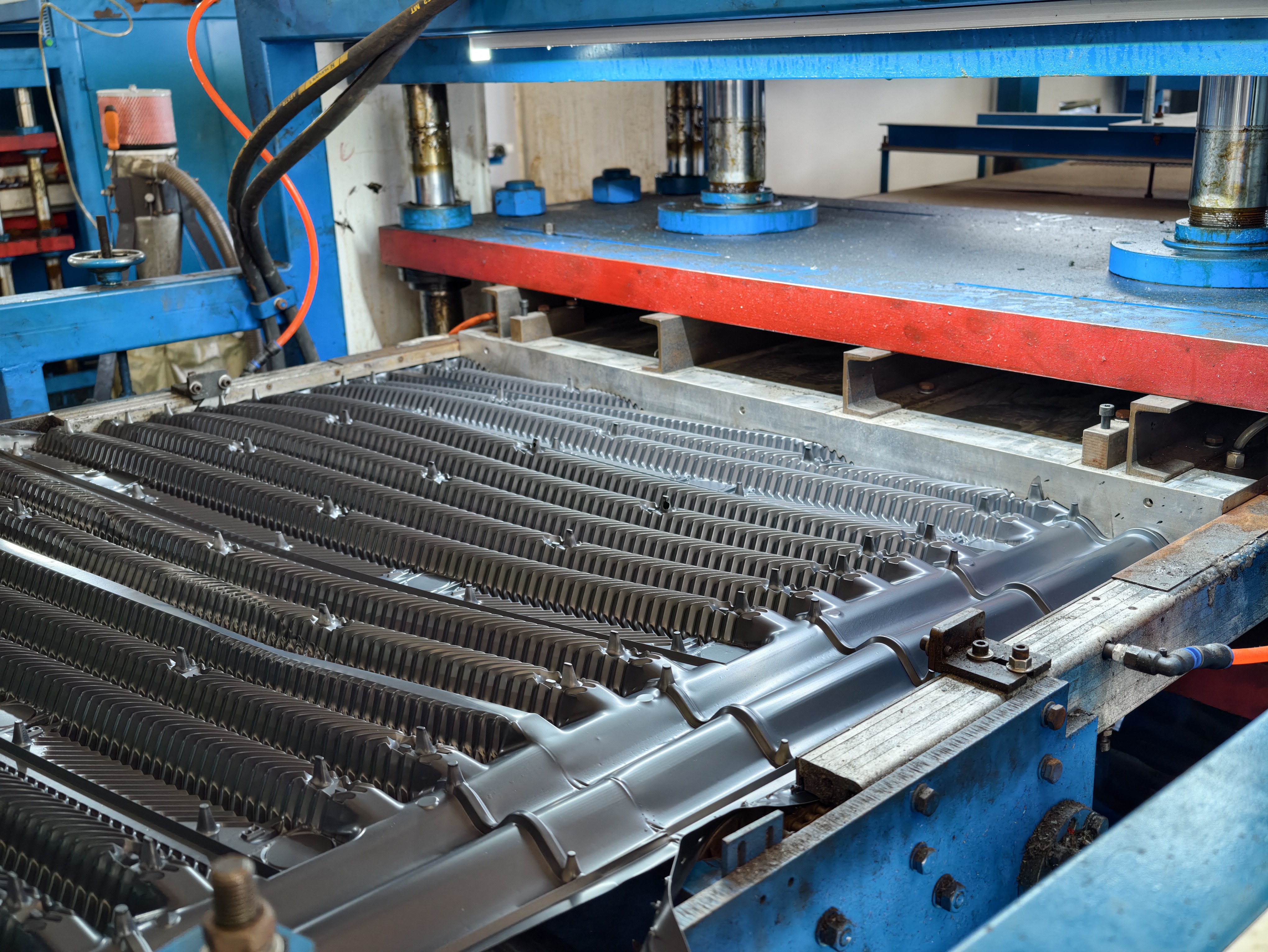
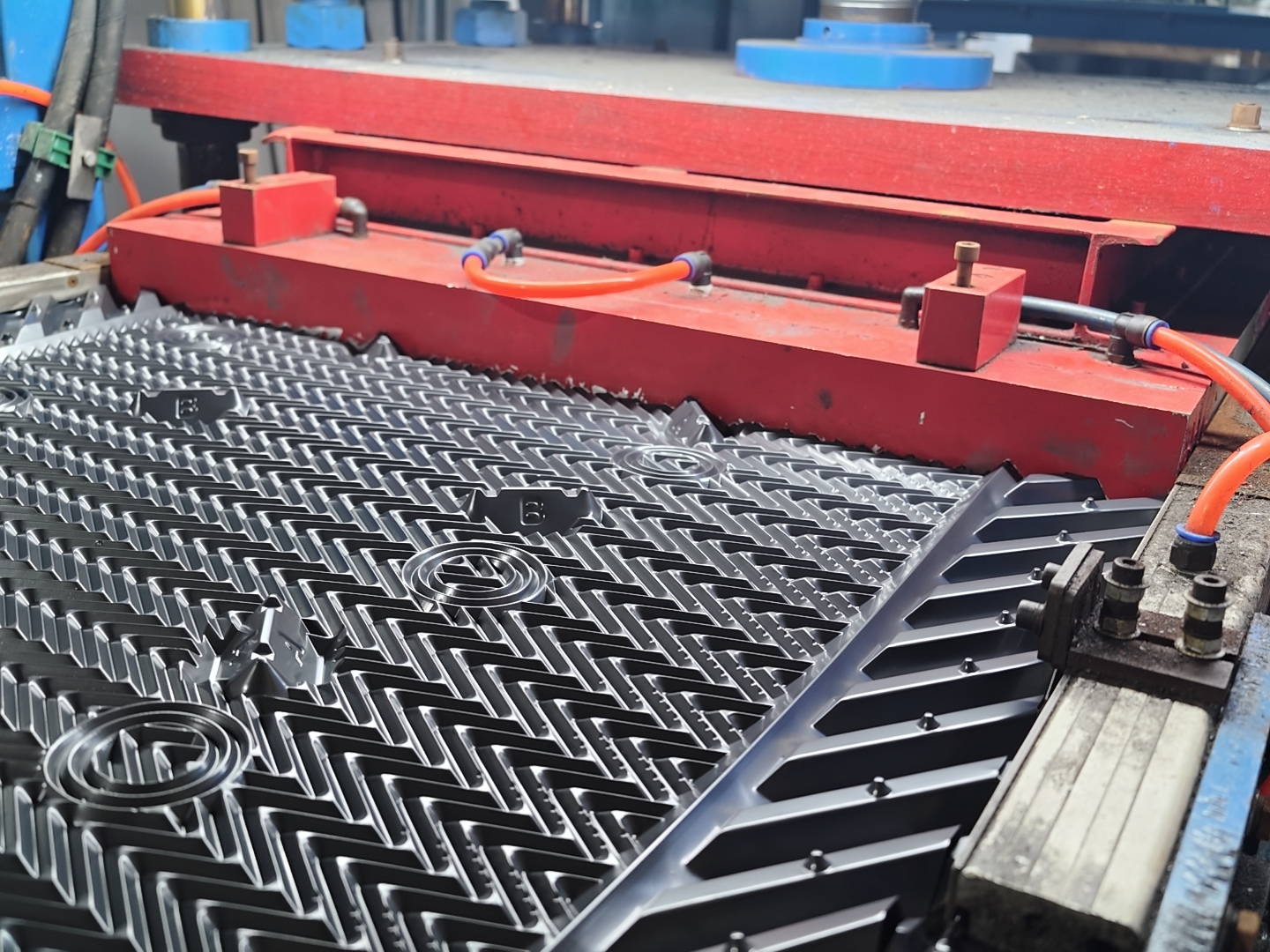
Film fill consists of structured sheets that spread water into thin films over a large surface area.
Main Advantages of Film Fill
Film fill can provide a high effective heat-transfer area within a relatively compact volume. It is widely used in many commercial HVAC and industrial cooling towers.
Common Film Fill Applications
Film fill is frequently considered for applications where water quality can be controlled and high heat-transfer efficiency is a priority.
Examples include building cooling systems, clean industrial circulating-water systems, and many standard mechanical-draft cooling towers.
Limitations of Film Fill
Narrow passages in some film fill designs can become blocked by scale, suspended solids, biological growth, and other deposits.
Where water contains substantial suspended solids, the risk of fouling should be evaluated carefully before selecting a dense film fill configuration.
Splash Fill
Splash fill uses bars, grids, or other structures to break falling water into smaller droplets and repeatedly redistribute it.
Main Advantages of Splash Fill
Splash fill may be suitable for applications where water contains more suspended solids or where resistance to certain types of fouling is a priority.
Common Splash Fill Applications
Splash fill is often considered for some industrial cooling towers, wastewater-related applications, and systems with challenging circulating-water conditions.
The actual suitability depends on the fill configuration, contaminant characteristics, and manufacturer's recommendations.
Limitations of Splash Fill
Splash fill may require a different fill volume or tower configuration to achieve the same thermal duty as a particular film fill design.
Engineers should compare the overall thermal and hydraulic performance rather than assuming that one fill type is always superior.
Film Fill vs. Splash Fill
| Comparison factor | Film fill | Splash fill |
| Heat-transfer approach | Spreads water into films | Breaks water into droplets |
| Effective surface area | Often high | Depends on splash geometry |
| Fouling considerations | Narrow channels may be vulnerable | Some designs tolerate solids better |
| Airflow resistance | Depends on density and profile | Depends on grid and bar arrangement |
| Typical selection priority | High heat-transfer area | Fouling tolerance in suitable applications |
| Maintenance | Requires control of deposits and biological growth | Requires inspection for deposits and damage |
The correct option depends on water quality, cooling requirements, tower design, and operating conditions.
Cooling Tower Fill Materials and Their Role in Heat Exchange
The material used to manufacture cooling tower fill affects its durability, temperature resistance, chemical compatibility, and long-term performance.
PVC Cooling Tower Fill
Polyvinyl chloride (PVC) is widely used in cooling tower fill manufacturing because it can be formed into structured sheets with different profiles and channel arrangements.
Advantages of PVC Fill
PVC fill can offer a practical combination of formability, cost, and performance for many standard cooling tower applications.
Typical Applications
PVC cooling tower fill is commonly considered for HVAC systems, commercial buildings, and industrial processes operating within the specified temperature and chemical limits of the selected product.
What Should Buyers Check Before Selecting PVC Fill?
Buyers should confirm operating temperature, chemical exposure, sheet thickness, material quality, and the specific fill design.
Standard PVC fill should not be assumed suitable for every high-temperature or chemically aggressive application.
PP Cooling Tower Fill
Polypropylene (PP) is another material used in cooling tower fill production.
Advantages of PP Fill
PP may offer advantages in certain higher-temperature applications and environments requiring particular chemical resistance.
When Is PP Fill Worth Considering?
PP fill can be considered when the operating conditions exceed the practical limits of a proposed PVC product or when its material properties better match the application.
The maximum allowable temperature depends on the material grade, structural design, water chemistry, and mechanical loading.
PVC Fill vs. PP Fill
| Factor | PVC fill | PP fill |
| Common applications | Standard HVAC and industrial cooling | Selected industrial and higher-temperature applications |
| Temperature capability | Depends on product specification | May be higher for suitable grades |
| Chemical compatibility | Must be verified | Must also be verified |
| Cost | Often economical for standard applications | Depends on grade and manufacturing |
| Selection priority | Balanced cost and performance | Specific thermal or chemical requirements |
Neither material is universally better. A technical comparison should be based on documented operating limits and the requirements of the cooling tower.
Factors Affecting Cooling Tower Fill Performance
Even a well-manufactured fill pack may perform poorly if the cooling tower is incorrectly operated or maintained.
Water Temperature and Flow Rate
The entering-water temperature, required outlet-water temperature, and circulating-water flow rate influence the heat-transfer duty.
Why Does Water Loading Matter?
If water loading is too low, some fill surfaces may not become fully wetted. If water loading is excessive, water distribution, drainage, and airflow may be affected.
The fill should be selected according to the tower's intended operating range.
Airflow and Fan Performance
Airflow carries away sensible heat and water vapor from the fill section.
How Can Insufficient Airflow Reduce Cooling Efficiency?
Insufficient airflow can limit the rate of heat and mass transfer, even when the fill is in good condition.
Components to Inspect
A performance problem should not automatically be attributed to fill alone.
Water Quality and Fouling
Circulating water may contain suspended solids, minerals, microorganisms, and treatment chemicals.
How Do Deposits Affect Heat Exchange?
Scale and biological growth can reduce effective contact area, obstruct fill passages, and alter water distribution.
Water Treatment and Routine Inspection
Appropriate water treatment, blowdown control, filtration where needed, and regular inspection can help control deposits and maintain fill performance.
Cleaning methods should be compatible with the fill material and should follow the equipment manufacturer's guidance.
Fill Geometry and Installation Quality
Fill profile, channel spacing, block arrangement, and support conditions affect the interaction between water and air.
Why Does Correct Installation Matter?
Incorrectly installed fill may leave gaps, obstruct intended airflow, or create uneven water distribution.
Installation Checks
Before commissioning, confirm that fill blocks are correctly aligned, properly supported, and compatible with the tower's distribution system.
How to Select the Right Cooling Tower Fill for a Heat Exchange System
Selecting cooling tower fill requires more than choosing a material or comparing unit prices.
Step 1: Define the Cooling Requirements
Identify the required heat rejection, circulating-water flow rate, hot-water temperature, cold-water temperature, and design wet-bulb temperature.
Establish the Required Cooling Range
The cooling range is the difference between the entering hot-water temperature and the leaving cold-water temperature.
The approach is the difference between the leaving cold-water temperature and the entering-air wet-bulb temperature.
Both values help describe the thermal duty the cooling tower must achieve.
Step 2: Identify the Tower Configuration
Determine whether the tower is crossflow or counterflow and identify the existing fill arrangement.
Crossflow Cooling Tower Fill
In crossflow towers, air travels horizontally across the fill while water flows downward.
Counterflow Cooling Tower Fill
In counterflow towers, air moves upward against the downward flow of water.
The replacement fill must match the intended airflow and water distribution arrangement.
Step 3: Evaluate Water Quality and Operating Temperature
Review suspended solids, scaling tendency, biological growth, treatment chemicals, and operating temperature.
Match the Fill to the Actual Conditions
A high-surface-area film fill may be appropriate for clean water, while certain splash fill configurations may be more suitable for water with greater fouling potential.
For elevated temperatures, confirm the allowable operating limits of the specific material and product.
Step 4: Compare Thermal and Hydraulic Performance
Ask manufacturers for technical data relevant to the intended operating conditions.
Important Technical Parameters
Heat-transfer performance
Water loading range
Airflow resistance or pressure drop
Fill dimensions and profile
Maximum recommended operating temperature
Material compatibility
Fouling and maintenance considerations
A meaningful comparison should use comparable operating conditions rather than isolated performance claims.
Step 5: Choose a Reliable Cooling Tower Fill Manufacturer
A qualified manufacturer should be able to explain product specifications, material options, dimensions, manufacturing consistency, and application suitability.
Questions to Ask a Supplier
Can the Manufacturer Provide Customized Fill?
Customized dimensions and profiles may be necessary when replacing fill in an existing cooling tower.
Are Product Specifications Available?
Request material details, drawings, dimensions, and relevant technical data before ordering.
Can the Supplier Support International Delivery?
For overseas procurement, confirm production lead time, packaging, shipping arrangements, documentation, and warranty terms.
Cooling Tower Fill Maintenance for Long-Term Heat Exchange Efficiency
Routine maintenance helps preserve the heat-transfer capability of cooling tower fill and reduces the risk of unexpected performance deterioration.
Regular Inspection
Inspect the fill periodically for blocked channels, scale, biological growth, deformation, and physical damage.
Check for Uneven Water Distribution
Dry patches or concentrated water channels may indicate blocked nozzles, damaged fill, or distribution problems.
Cleaning and Fouling Control
Cleaning may restore performance when deposits are removable and the fill remains structurally sound.
When Is Cleaning Appropriate?
Cleaning is worth considering when fouling is the primary problem and the fill is still intact.
When Is Replacement Necessary?
Replacement may be appropriate when the fill is cracked, deformed, collapsed, chemically damaged, or too heavily fouled for safe and effective cleaning.
Monitor Operating Performance
Record entering-water temperature, leaving-water temperature, water flow, fan operation, and ambient wet-bulb temperature when practical.
Why Is Performance Tracking Useful?
Comparing operating data under similar conditions can help identify gradual deterioration and distinguish fill problems from other cooling tower issues.
Common Problems Caused by Improper Cooling Tower Fill Selection
Selecting the wrong fill can create performance and maintenance challenges.
Excessive Airflow Resistance
A fill configuration with unsuitable density or geometry may increase pressure drop and affect fan performance.
Frequent Blockage
Fill with narrow passages may be unsuitable for water containing high levels of suspended solids without adequate treatment.
Premature Material Deformation
Fill can deform if its operating temperature exceeds the product's recommended limit or if chemical exposure damages the material.
Poor Cooling Performance
Incorrect fill dimensions, incompatible geometry, poor installation, or unsuitable operating conditions may prevent the tower from reaching its design performance.
Increased Maintenance Costs
Frequent cleaning, repeated repairs, and premature replacement can increase total ownership costs.
To avoid these problems, buyers should evaluate technical suitability, operating conditions, and expected maintenance requirements before procurement.
Applications of Cooling Tower Fill in Heat Exchange Systems
Cooling tower fill is used across a broad range of industries where water-based heat rejection is required.
Commercial HVAC Systems
Office buildings, shopping centers, hotels, hospitals, and district cooling systems use cooling towers to reject heat from refrigeration and air-conditioning systems.
Benefits for HVAC Applications
Properly selected fill helps support stable condenser-water temperatures and reliable cooling plant operation.
Power Generation
Power plants use cooling systems to reject heat from steam condensers and other process equipment.
Industrial Operating Requirements
Fill selection must account for thermal duty, water quality, mechanical reliability, and the operating characteristics of the cooling tower.
Chemical and Petrochemical Industries
Chemical processing facilities use cooling water to control temperatures in reactors, condensers, and process equipment.
Material Compatibility
The suitability of PVC, PP, or other fill materials must be assessed against the actual water chemistry and operating temperature.
Manufacturing and Industrial Processing
Metal processing, plastics manufacturing, food production, and other industrial operations may rely on cooling towers to remove process heat.
Choosing Fill for Process Stability
The fill should support the required cooling performance while matching the site's water treatment practices and maintenance capabilities.
Frequently Asked Questions About Cooling Tower Fill Function
What Is the Main Function of Cooling Tower Fill?
The main function of cooling tower fill is to increase effective contact between water and air, improving heat and mass transfer so that water can be cooled more efficiently.
Does Cooling Tower Fill Increase Heat Exchange Efficiency?
Properly selected and installed fill can improve heat and mass transfer by increasing effective contact area. The actual improvement depends on water distribution, airflow, water quality, tower design, and operating conditions.
What Is the Difference Between Cooling Tower Fill and Cooling Tower Packing?
The terms are often used interchangeably. Both generally refer to the internal media that increases water-air contact inside a cooling tower.
Which Cooling Tower Fill Is Better: Film Fill or Splash Fill?
Neither is best for every application. Film fill often provides high effective surface area, while suitable splash fill designs may offer advantages under some fouling-prone operating conditions.
How Long Does Cooling Tower Fill Last?
Service life varies with material quality, operating temperature, water treatment, fouling, mechanical loading, and maintenance. Regular inspection is more reliable than applying a universal replacement interval.
Can Cooling Tower Fill Be Replaced Without Replacing the Whole Cooling Tower?
Yes. Fill can often be replaced independently if the tower structure, support system, and associated components remain suitable for continued operation.
Does Cooling Tower Fill Affect Energy Consumption?
Yes. Fill affects airflow resistance and thermal performance. A suitable design can support efficient operation, while excessive pressure drop, fouling, or poor water distribution may increase fan energy requirements or reduce cooling performance.
How Can I Find a Reliable Cooling Tower Fill Supplier?
Compare suppliers based on technical documentation, material quality, product compatibility, customization capabilities, delivery reliability, and after-sales support. For replacement projects, provide the existing fill dimensions and operating conditions before requesting a quotation.
Conclusion
Cooling tower fill performs a critical function in heat exchange systems by increasing water-air contact, supporting evaporative cooling, improving water distribution, and helping the cooling tower achieve its required thermal performance.
Film fill and splash fill serve different application requirements, while PVC and PP offer different material properties that must be matched to operating conditions.
For the best results, engineers and procurement teams should evaluate thermal requirements, water quality, airflow resistance, material compatibility, and installation quality before selecting replacement fill.
Regular maintenance and performance monitoring can help preserve heat-transfer efficiency and extend service life. By choosing the correct cooling tower fill and working with a technically capable manufacturer, industrial operators can support reliable cooling performance and manage long-term operating costs more effectively.