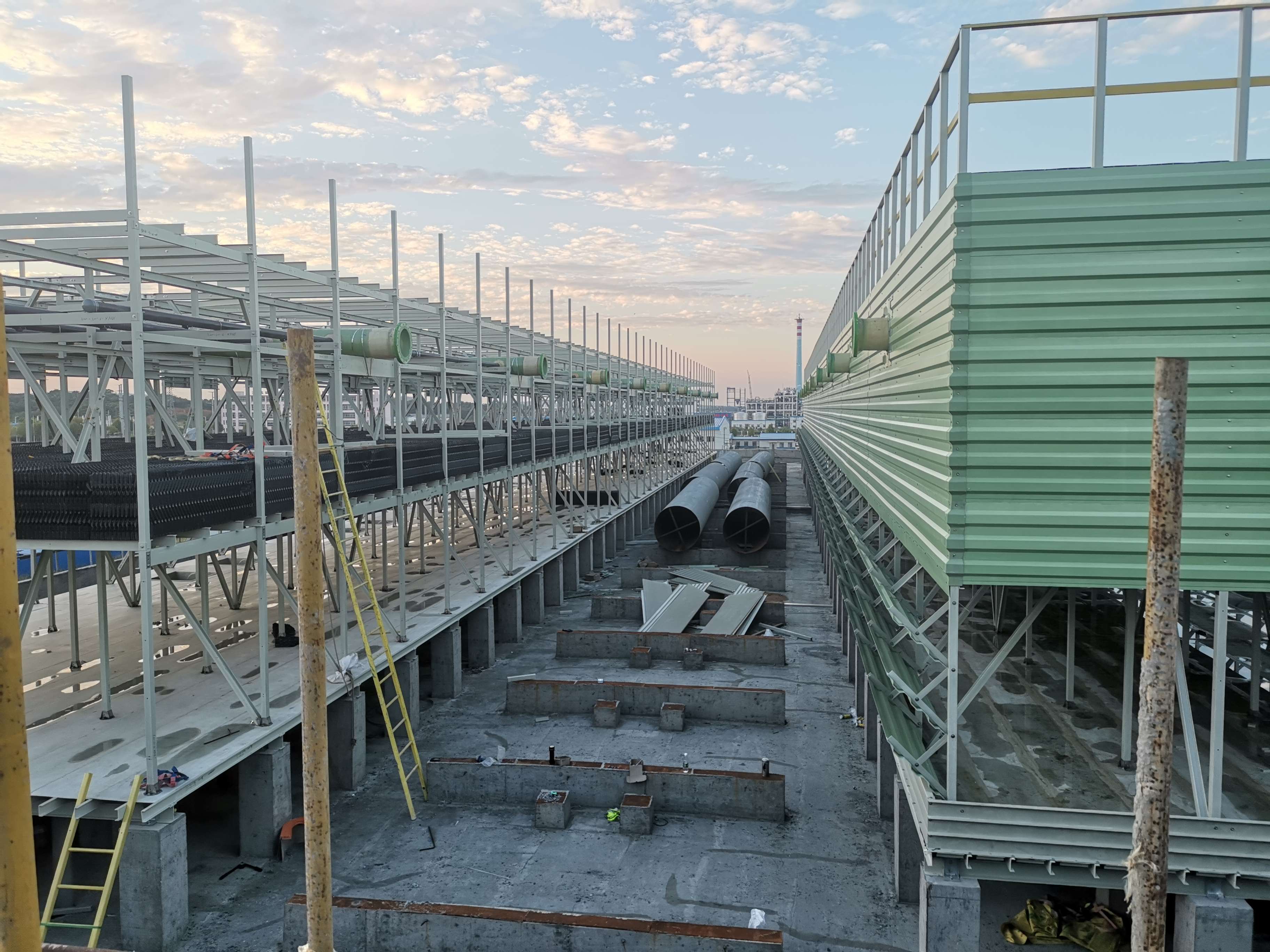
A cooling tower is an essential part of many industrial cooling systems, HVAC installations, power plants, and manufacturing facilities. Although its overall structure may appear straightforward, several internal components work together to remove heat from circulating water. Among these components, cooling tower filler plays a critical role in heat exchange efficiency, cooling performance, and overall system reliability.
Without suitable fill media, hot water would have less contact with the air passing through the tower, reducing the effectiveness of evaporative cooling. The right cooling tower filler helps increase the contact area between water and air, improve heat transfer, and support stable operation under different working conditions.
But what exactly is cooling tower filler? What types and materials are available? How do you choose the right fill for your cooling tower?
In this guide, Power Tower Cooling Technology (Shaoxing) Co.,Ltd, through its website www.coolingtowerpart.com, introduces the essential functions, types, materials, applications, and maintenance considerations of cooling tower fill to help buyers and engineers make informed decisions.
What Is Cooling Tower Filler?
Cooling tower filler, also known as cooling tower fill or fill media, is an internal component designed to increase the contact area between circulating water and air. It is commonly installed beneath the water distribution system and above the cold-water collection basin, although the exact arrangement varies by tower design.
When hot water enters a cooling tower, it flows over or through the fill while air moves across the same area. The filler spreads the water into thin films or breaks it into smaller droplets, allowing heat to transfer more effectively from the water to the air.
This process helps reduce the water temperature before the water returns to the cooling system.
The Basic Function of Cooling Tower Fill
Think of cooling tower fill as the working surface inside the tower. Instead of allowing water to fall directly into the collection basin, the fill creates an extended path that increases water–air interaction.
Depending on its design, cooling tower fill may use corrugated plastic sheets, structured channels, grids, or splash bars. Each configuration is intended to create favorable conditions for heat and mass transfer.
The main functions of cooling tower filler include:
Increasing the effective contact area between water and air.
Supporting evaporative cooling and sensible heat transfer.
Improving water distribution throughout the cooling section.
Helping the tower achieve its required cooling performance.
Supporting efficient use of the available tower volume.
However, the fill is only one part of the cooling process. Fan performance, water distribution, ambient wet-bulb temperature, water quality, and the tower's overall design also influence the final result.
Why Cooling Tower Filler Matters
The performance of cooling tower filler can affect the entire cooling system. If the fill is unsuitable, blocked, or damaged, the tower may struggle to maintain the required leaving-water temperature.
This can increase operating costs, affect chiller performance, or interfere with industrial production that depends on stable cooling water.
On the other hand, properly selected fill can help improve heat exchange while keeping airflow resistance and maintenance requirements within acceptable limits.
Choosing the right product is therefore not simply a matter of purchasing plastic sheets. It requires understanding the operating conditions, cooling requirements, and maintenance needs of the system.
How Does Cooling Tower Fill Work?
Cooling tower fill works by increasing the opportunities for water and air to exchange heat. As hot water moves through the fill, heat passes from the water to the surrounding air. At the same time, a portion of the water evaporates, carrying latent heat away from the remaining water.
The combined effects of sensible heat transfer and evaporation allow the cooling tower to reduce the circulating water temperature.
Increasing Water–Air Contact
Effective cooling depends on the interaction between water and air. If water falls directly through the tower without sufficient contact, much of the available cooling potential may be wasted.
Cooling tower fill addresses this problem in two common ways.
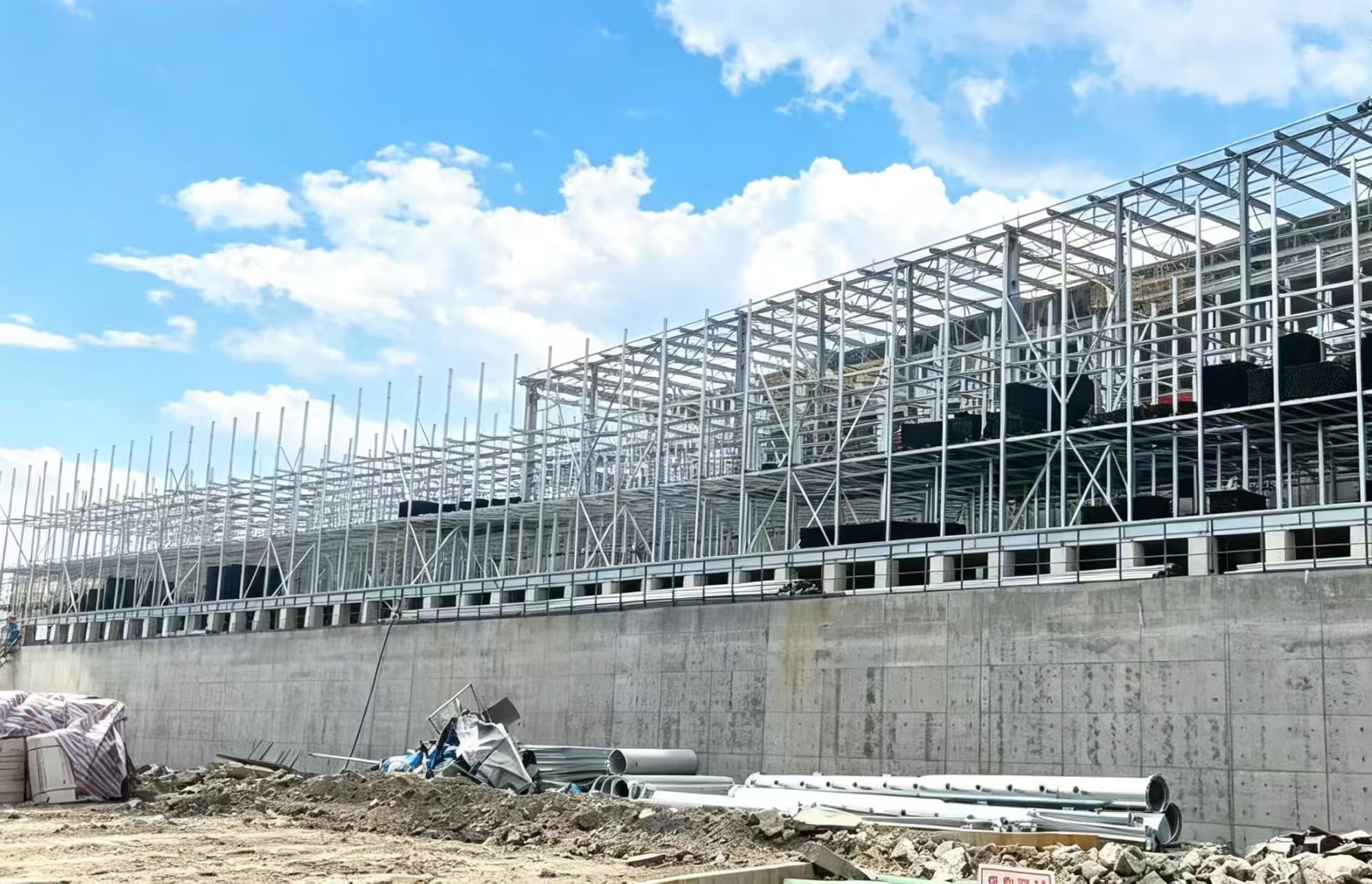
Film fill spreads water across structured surfaces, creating relatively thin water layers. Splash fill breaks falling water into droplets as it encounters successive surfaces. Both methods increase the effective water–air contact area.
The ideal design provides sufficient contact without creating excessive resistance to airflow.
Supporting Evaporative Heat Transfer
Evaporation is a major part of cooling tower operation. When a small amount of circulating water evaporates, it removes heat from the remaining water.
Fill provides the surface and flow conditions needed to support this process. Its effectiveness depends on several variables, including water flow rate, air velocity, entering-water temperature, and ambient wet-bulb temperature.
Even a high-performance fill product cannot compensate fully for insufficient airflow, poor nozzle performance, or an incorrectly sized cooling tower. The entire system must work together.
Improving Water Distribution
Uniform water distribution helps ensure that the available fill surface contributes effectively to cooling. If some sections receive too much water while others remain dry, the tower may not use its full heat-transfer capacity.
Poor distribution can also encourage localized fouling and reduce operating consistency.
For this reason, cooling tower filler should be selected alongside the water distribution system, spray nozzles, fan arrangement, and internal tower structure.
Main Types of Cooling Tower Filler
Cooling tower fill is generally divided into two main categories: film fill and splash fill. Each type has distinct structural characteristics and is suited to different operating conditions.
Neither type is automatically the best choice for every cooling tower. The correct selection depends on water quality, thermal requirements, tower configuration, and maintenance priorities.
Film Fill
Film fill consists of structured sheets arranged to spread water into thin layers as it flows downward. The sheets often have corrugated surfaces that guide water and promote contact with the air.
Because film fill can provide a large effective surface area within a relatively compact volume, it is widely used in HVAC systems, commercial buildings, and industrial cooling towers where water quality is adequately controlled.
Its main advantages include:
High effective heat-transfer surface area.
Compact construction.
Efficient use of available tower space.
Suitability for many conventional cooling applications.
However, the narrow passages found in some film-fill designs can become blocked by suspended solids, mineral scale, or biological growth. Water treatment and regular inspection are therefore important.
Splash Fill
Splash fill uses bars, grids, or other structured elements to break falling water into smaller droplets. As water moves through successive levels, the repeated splashing increases the opportunities for contact with the air.
Splash fill can be suitable for applications where suspended solids or fouling create concerns, particularly when the selected design offers adequate passage spacing and accessible maintenance arrangements.
Potential advantages include:
A structure that can be less vulnerable to certain types of blockage.
Suitability for selected applications with challenging water conditions.
Maintenance flexibility with appropriate designs.
Adaptability to specific tower configurations.
Its actual performance depends on the product design, water loading, airflow, and installation. Buyers should not assume that every splash-fill product can handle heavily contaminated water without additional treatment or engineering review.
Film Fill vs. Splash Fill: Which Is Better?
Film fill generally emphasizes a large wetted surface area within a compact structure, while splash fill uses repeated water breakup to promote heat exchange.
Film fill is often appropriate for systems with well-controlled circulating water and a strong need for compact heat-transfer performance. Splash fill may be preferable where fouling resistance and maintenance access are important considerations.
Before replacing one type with another, check the cooling tower's original design, heat load, water distribution, airflow requirements, and support structure. Changing the fill configuration without reviewing these factors can affect thermal performance and pressure drop.
Common Materials Used in Cooling Tower Fill
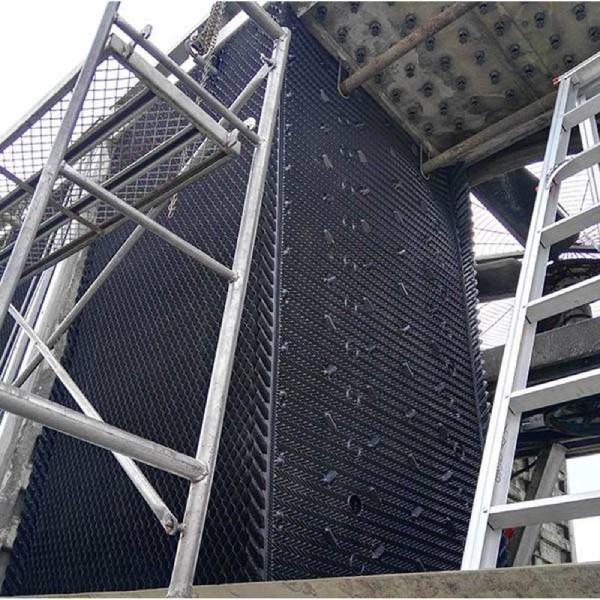
The material used in cooling tower filler affects its temperature resistance, chemical compatibility, mechanical strength, expected service life, and purchase cost.
PVC and PP are two common materials used for plastic cooling tower fill. The best option depends on the actual operating environment and the manufacturer's specifications.
PVC Cooling Tower Fill
Polyvinyl chloride, commonly known as PVC, is widely used in cooling tower film fill. It can be formed into structured sheets with surface patterns designed to support water distribution and heat transfer.
PVC fill is commonly found in HVAC installations, commercial buildings, and many industrial cooling systems.
Its advantages may include:
Suitability for a wide range of conventional cooling applications.
Flexible sheet-forming and structural design options.
Practical installation and replacement arrangements.
Availability in various configurations for different tower designs.
However, PVC fill is not suitable for every temperature or chemical environment. Buyers should confirm the product's allowable operating temperature, chemical compatibility, and mechanical properties before installation.
PP Cooling Tower Fill
Polypropylene, or PP, is another material used in cooling tower fill manufacturing. Depending on its formulation and construction, PP may be suitable for applications requiring different temperature resistance or chemical compatibility characteristics.
PP fill is often considered when operating conditions exceed the capabilities of a particular PVC product.
However, material selection should always be based on documented product limits. Not every PP product has the same temperature rating or chemical resistance, and not every application requires the additional characteristics that PP may provide.
How to Choose Between PVC and PP
When comparing PVC and PP cooling tower fill, consider the following factors:
Operating temperature: Confirm the manufacturer's stated temperature limits.
Water chemistry: Check compatibility with treatment chemicals and contaminants.
Mechanical requirements: Consider structural stability and expected loading.
Service conditions: Evaluate fouling risk, cleaning frequency, and maintenance access.
Total cost: Compare purchase price, installation, maintenance, and expected replacement needs.
A suitable material should meet the application's technical requirements without introducing unnecessary cost.
Key Factors Affecting Cooling Tower Fill Performance
Choosing a fill product based on material alone is rarely sufficient. Several engineering and operating factors determine whether it will deliver the expected results.
Heat Load and Cooling Requirements
Start by identifying the amount of heat the cooling tower must reject. The required water flow rate, entering- and leaving-water temperatures, design range, and approach to the ambient wet-bulb temperature all affect the selection.
A fill product designed for one tower cannot automatically be transferred to another simply because the dimensions are similar.
For replacement projects, review the original equipment specifications whenever possible. For upgrades, obtain an engineering assessment to confirm that the proposed fill can support the required cooling duty.
Water Quality and Fouling Risk
Water quality is one of the most important factors in cooling tower fill selection.
Suspended solids, mineral scale, corrosion products, and biological growth can gradually accumulate inside the fill. Deposits may reduce the effective heat-transfer area and restrict airflow or water movement.
If the circulating water has a high solids content, consider whether the proposed fill geometry can accommodate the conditions and whether the water-treatment system is adequate.
Filtration, blowdown, water treatment, and routine inspection all contribute to controlling fouling.
Airflow Resistance and Fill Geometry
Cooling tower fill must provide sufficient contact area without creating excessive resistance to airflow.
If airflow resistance is too high for the tower's fan and operating conditions, the airflow rate may decrease and cooling performance may suffer. Conversely, a structure that provides insufficient contact may not meet the required thermal duty.
The right design balances surface area, channel spacing, water distribution, and pressure drop.
Operating Temperature and Chemical Compatibility
Elevated temperatures and unsuitable chemicals can damage some fill materials over time.
Before selecting a product, confirm the maximum operating temperature and compatibility with the cooling system's water-treatment chemicals and cleaning agents.
This is particularly important when upgrading an older cooling tower or changing the water-treatment program. The material should be suitable for normal operating conditions as well as foreseeable cleaning and maintenance procedures.
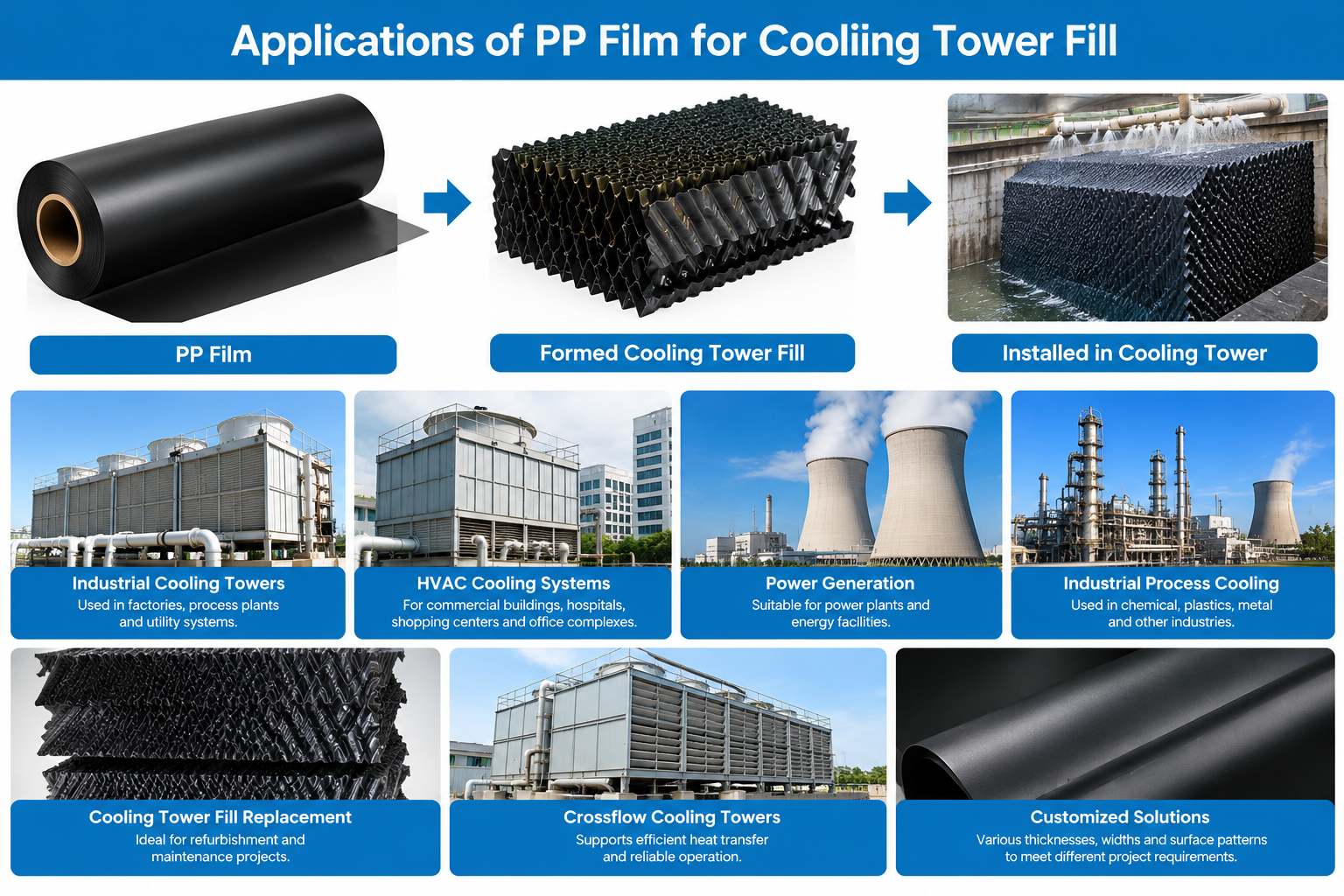
Applications of Cooling Tower Filler
Cooling tower fill is used in many industries that depend on reliable heat rejection. Although the operating conditions vary, the basic purpose remains the same: improve contact between water and air to support effective cooling.
HVAC and Commercial Buildings
Office buildings, hotels, shopping centers, hospitals, and other large facilities often use cooling towers in water-cooled air-conditioning systems.
Suitable fill helps these systems reject heat and maintain the conditions required by chillers and associated equipment.
Film fill is commonly used when circulating water can be maintained within appropriate quality limits. Regular inspection is particularly important during periods of high cooling demand, when a decline in tower performance can affect indoor comfort and operating costs.
Industrial Manufacturing and Process Cooling
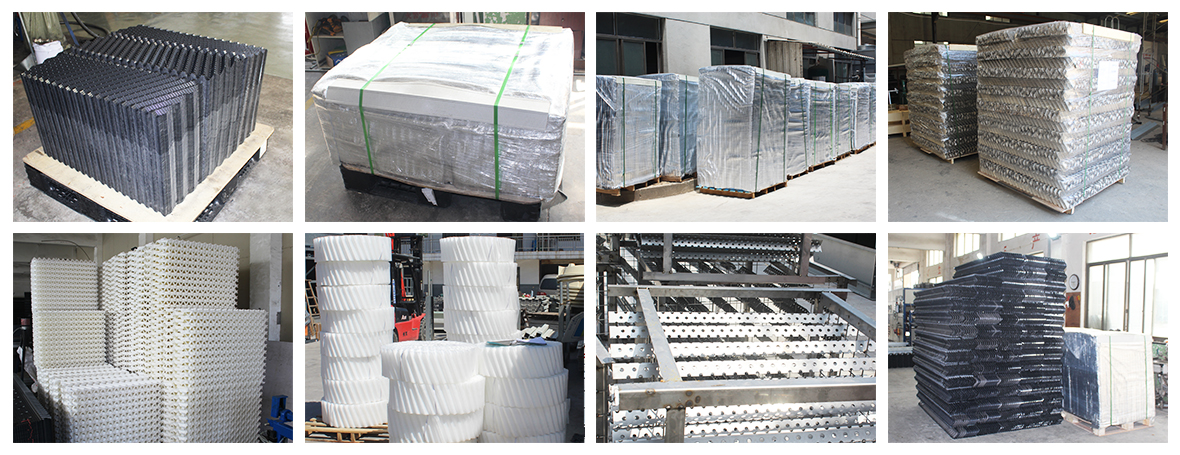
Manufacturing facilities use cooling towers to remove heat from production equipment, compressors, machinery, and industrial processes.
These systems may operate under more demanding conditions than conventional HVAC installations. Depending on the process, the circulating water may contain additional suspended solids or encounter elevated temperatures.
Cooling tower filler must therefore be selected according to the actual process requirements. A suitable replacement should restore the intended cooling performance while remaining compatible with the existing tower structure and operating conditions.
Power Generation and Heavy Industry
Power generation and other heat-intensive industries depend on cooling systems to manage substantial thermal loads.
In these applications, the selection of fill must account for the cooling tower's design, water chemistry, operating temperatures, maintenance strategy, and performance requirements.
Material compatibility, structural integrity, and reliable heat transfer are especially important. Engineering review is advisable whenever a replacement changes the original fill geometry or material.
Signs That Cooling Tower Fill Needs Cleaning or Replacement
Cooling tower fill can gradually accumulate deposits or deteriorate under demanding operating conditions. Recognizing the warning signs early helps maintenance teams identify the right corrective action.
Scale, Sludge, and Biological Growth
Mineral scale may form when dissolved minerals precipitate from circulating water. Suspended solids can collect in the fill, while algae and other biological growth may obstruct passages.
These deposits reduce the effective contact area and can restrict water flow or airflow.
When deposits appear, investigate the underlying water-quality conditions instead of treating cleaning as the only solution. Without addressing the cause, the problem may return soon after maintenance.
Reduced Cooling Efficiency
If the cooling tower no longer achieves its usual leaving-water temperature, fouled or damaged fill may be one possible cause.
However, other issues can produce similar symptoms, including:
Malfunctioning fans or drives.
Blocked or damaged spray nozzles.
Uneven water distribution.
Excessive heat load.
Changes in ambient wet-bulb temperature.
Problems with water circulation.
Compare current performance with the system's normal operating data before deciding that the fill needs replacement.
Physical Damage and Blocked Airflow
Cracked sheets, deformed packs, sagging sections, brittle material, and displaced fill can affect both water distribution and airflow.
In some cases, cleaning may restore performance. In others, the fill may have deteriorated beyond practical repair.
If the material has lost its structural integrity or remains severely blocked after appropriate cleaning, replacement may provide a more dependable long-term solution.
How to Choose the Right Cooling Tower Fill
Selecting cooling tower filler requires balancing thermal performance, operating conditions, installation compatibility, and lifecycle cost.
Match the Fill to the Cooling Tower Design
First, identify whether the cooling tower uses crossflow or counterflow construction. Confirm the original fill type, dimensions, support arrangement, water flow rate, and design temperatures.
These details help determine whether a proposed replacement will fit and operate correctly.
If the project involves changing from film fill to splash fill, or from one material to another, obtain technical confirmation that the alternative meets the tower's requirements.
Consider Water Quality and Maintenance Costs
The best fill is not necessarily the cheapest product or the one with the highest advertised heat-transfer performance.
Consider the water's suspended solids content, scale-forming tendency, biological growth, and treatment conditions. Then evaluate the cleaning requirements and accessibility of the proposed fill.
A product that is easier to maintain under the site's actual operating conditions may provide better long-term value than a lower-priced alternative that requires frequent cleaning or early replacement.
When Should You Prioritize Easy Cleaning?
Easy cleaning deserves particular attention when the cooling tower operates with challenging water conditions or when maintenance access is limited.
A design with suitable passages and an appropriate installation arrangement may simplify inspection and cleaning. However, cleanability must be considered alongside thermal performance, structural stability, and compatibility with the tower.
Check Dimensions and Installation Compatibility
Before placing an order, verify the fill pack's length, width, height, sheet configuration, and support requirements.
Also check the available installation space, the removal route for old fill, and the compatibility of the proposed product with the existing water distribution system.
Providing photographs, drawings, equipment details, and existing product specifications to the supplier can reduce the risk of ordering an unsuitable replacement.
Cooling Tower Fill Maintenance Best Practices
Even a well-designed fill product needs appropriate maintenance. Regular inspection and water treatment help control fouling, protect the material, and preserve cooling performance.
Inspect the Fill Regularly
Create an inspection schedule based on operating hours, water quality, environmental conditions, and the manufacturer's recommendations.
Look for deposits, blocked passages, deformation, cracks, and uneven water distribution. Record significant findings and compare operating performance over time.
Before entering or servicing the tower, follow all applicable isolation, lockout, confined-space, and other site safety procedures.
Maintain Proper Water Treatment
Appropriate water treatment helps control scale, corrosion, suspended solids, and biological growth.
Monitor water chemistry and treatment performance according to the cooling system's operating plan. Filtration and blowdown may also help manage contaminant accumulation.
The correct treatment program depends on the water source, system materials, discharge requirements, and operating conditions.
Clean Without Damaging the Fill
Cleaning methods should match the fill material and the type of deposit.
Excessive water pressure, unsuitable chemicals, or aggressive mechanical cleaning may damage plastic sheets and reduce their service life.
Consult the product supplier before using strong cleaning agents or high-pressure equipment. If the fill is badly deteriorated or persistently blocked, evaluate whether replacement would be more effective than repeated cleaning.
Why Work with an Experienced Cooling Tower Fill Manufacturer?
Choosing the right supplier can simplify product selection, replacement planning, and technical communication. An experienced cooling tower component manufacturer can help buyers identify the information needed to match a product to their application.
Product Selection and Technical Support
Power Tower Cooling Technology (Shaoxing) Co.,Ltd is the manufacturer identified for this article, with its website at www.coolingtowerpart.com.
When sourcing cooling tower fill, buyers should provide as much relevant technical information as possible, including:
Cooling tower model or design.
Existing fill type and dimensions.
Required quantity.
Operating temperature and water conditions.
Intended application and cooling requirements.
Photographs or drawings of the existing installation.
These details can help clarify product compatibility and reduce the risk of ordering fill that does not meet the system's requirements.
Buyers should also request the relevant product specifications and confirm the recommended operating limits before finalizing a purchase.
Replacement Parts and Long-Term Reliability
Reliable replacement planning involves more than finding a product with similar dimensions. The replacement should be suitable for the tower's thermal requirements, support structure, water distribution, and airflow characteristics.
It is also useful to maintain records of fill specifications, installation dates, inspection results, and operating performance. These records can help maintenance teams anticipate future replacement needs and plan work before severe deterioration interrupts cooling operations.
For product information and inquiries, visit coolingtowerpart.com.
Cooling Tower Filler FAQs
What Is the Main Function of Cooling Tower Fill?
The main function of cooling tower fill is to increase the effective contact between circulating water and air. This supports heat transfer and evaporation, helping the cooling tower reduce water temperature before the water returns to the system.
How Long Does Cooling Tower Fill Last?
There is no universal service life for all cooling tower fill. Its lifespan depends on material quality, operating temperature, water chemistry, fouling, cleaning practices, and mechanical stress.
Regular inspection and appropriate water treatment can help preserve the fill. Replacement is necessary when deterioration, damage, or persistent blockage prevents reliable performance.
Is PVC or PP Cooling Tower Fill Better?
Neither material is universally better. PVC is widely used in conventional cooling applications, while PP may be suitable for certain temperature or chemical conditions.
Compare the documented operating limits, chemical compatibility, structural characteristics, and total cost of the specific products before making a decision.
Can Cooling Tower Fill Be Replaced Without Replacing the Whole Tower?
Yes. Cooling tower fill can often be replaced independently if the tower structure and supporting components remain serviceable.
However, the replacement must be compatible with the original design and thermal requirements. Inspect the support structure, water distribution system, and other internal components before installation.
Does Better Cooling Tower Fill Always Mean Lower Energy Consumption?
Not necessarily. Suitable fill can support efficient heat transfer, but total energy consumption also depends on fan operation, pump performance, airflow resistance, water distribution, and system controls.
The most appropriate fill is one that meets the tower's thermal requirements without introducing unnecessary airflow resistance or maintenance problems.
Conclusion: Choose the Right Fill for Reliable Cooling Performance
Cooling tower filler is a core heat-exchange component that helps determine how effectively a cooling tower removes heat from circulating water. By increasing water–air contact, the fill supports evaporative cooling and helps the tower achieve its required operating temperature.
Film fill and splash fill offer different advantages, while PVC and PP provide material options for different operating environments. The right choice depends on heat load, water quality, airflow resistance, operating temperature, and maintenance requirements.
Regular inspection, effective water treatment, and timely replacement are equally important for maintaining reliable performance. Before purchasing new fill, confirm the product's dimensions, material properties, and compatibility with the existing cooling tower.
For businesses looking for cooling tower fill and replacement components, Power Tower Cooling Technology (Shaoxing) Co.,Ltd is the manufacturer featured in this guide.
Visit www.coolingtowerpart.com to explore product information and discuss your cooling tower requirements. Choosing suitable fill from the beginning can help support dependable cooling performance, manageable maintenance costs, and long-term system reliability.


