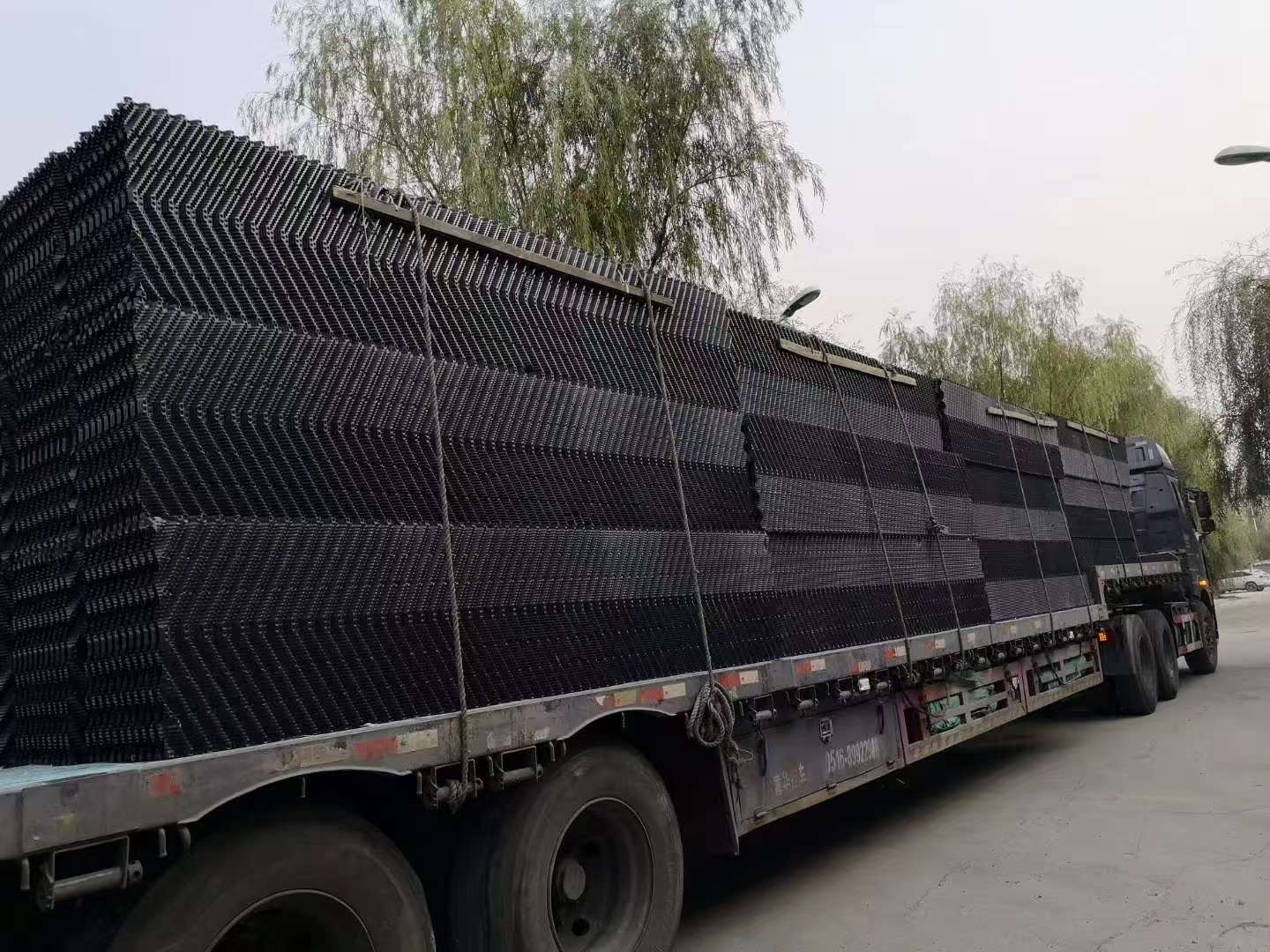
Choosing the right counterflow cooling tower fill can make a significant difference in cooling efficiency, operating costs, and maintenance requirements. Whether you manage an industrial cooling system, operate a manufacturing plant, or source replacement components for an existing cooling tower, selecting the right fill media is an important decision.
Counterflow cooling towers rely on effective contact between water and air to remove heat. The fill media increases the available contact area, helping water cool more efficiently as it moves through the tower. However, different fill materials, channel designs, and operating conditions can produce different results. So, how do you find a reliable counterflow cooling tower fill manufacturer?
In this guide, we introduce five manufacturers and suppliers worth considering: Power Tower Cooling Technology (Shaoxing) Co.,Ltd, Brentwood Industries, SPX Cooling Technologies, EVAPCO, and Baltimore Aircoil Company (BAC). We will also explore their potential advantages, explain how to compare fill products, and share practical tips for choosing the right solution for your cooling tower.
The companies are presented as a buyer-oriented shortlist rather than an independently verified ranking by market share or product performance. Always confirm the availability and suitability of specific products before placing an order.
What Is Counterflow Cooling Tower Fill?
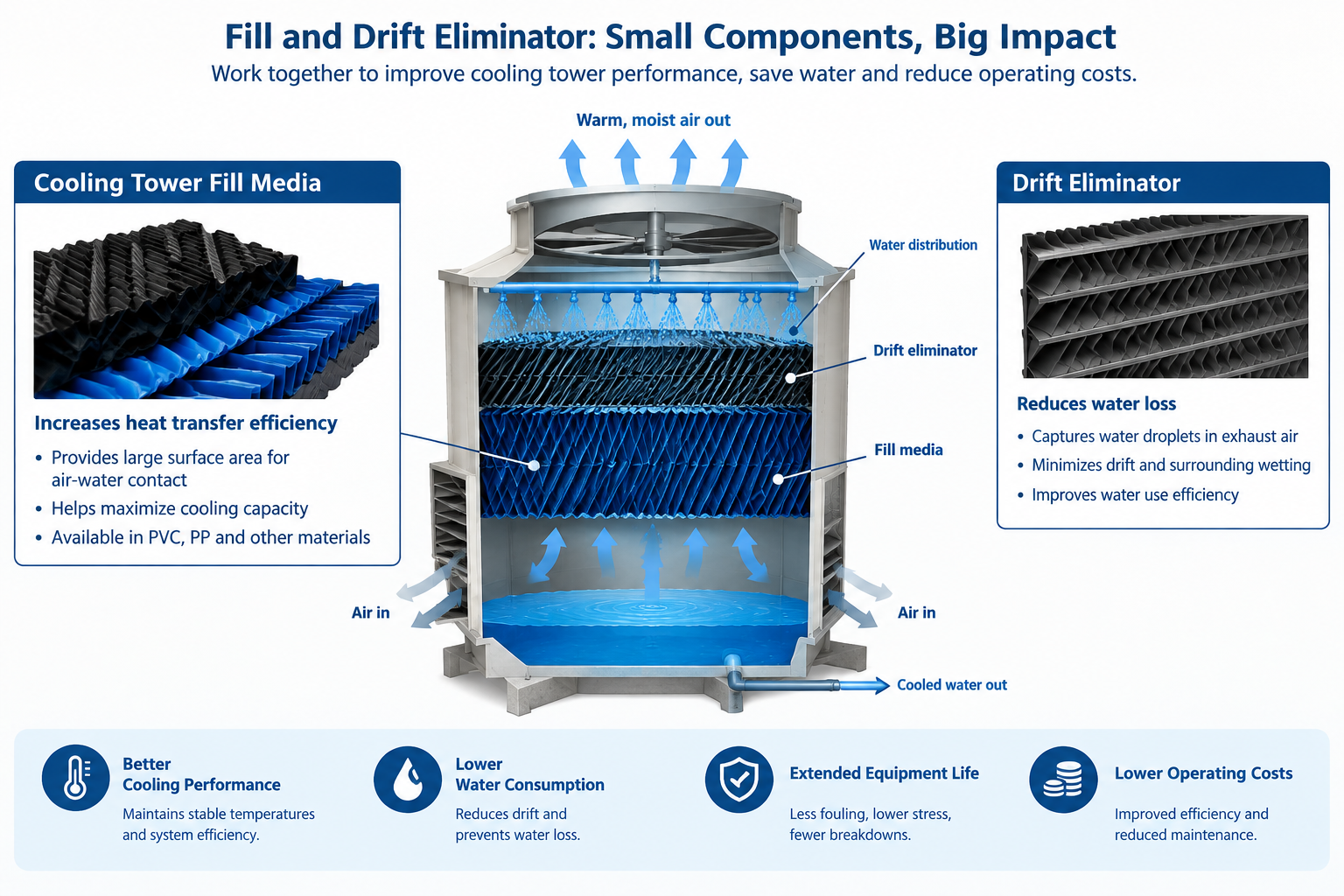
Counterflow cooling tower fill is a heat-transfer component installed inside a counterflow cooling tower. Its main purpose is to increase the contact area between circulating water and moving air.
In a typical counterflow tower, hot water flows downward while air travels upward. These two streams move in opposite directions, creating favorable conditions for heat and mass transfer. As water spreads across the fill surfaces, some of it evaporates, carrying heat away from the remaining water.
Without suitable fill media, water would pass through the tower with less effective contact with the air. The cooling process would become less efficient, potentially requiring a larger tower or more operating energy to achieve the desired cooling performance.
Counterflow fill generally falls into two main categories: film fill and splash fill. Film fill spreads water across shaped surfaces, while splash fill breaks falling water into smaller droplets. The best choice depends on the tower design, water quality, thermal requirements, and maintenance conditions.
How Does Counterflow Cooling Tower Fill Work?
Imagine pouring water over a smooth surface compared with spreading it across a specially shaped sheet. The shaped surface can expose more water to the surrounding air. Cooling tower fill uses a similar principle.
Hot water enters the tower's distribution system and flows downward through the fill section. At the same time, a fan or natural draft moves air upward. The fill distributes water and increases the area available for heat and mass transfer.
As the water cools, it collects in the basin and returns to the industrial process or heat exchanger. The effectiveness of this process depends on several factors, including fill geometry, water distribution, airflow, ambient wet-bulb temperature, and the tower's overall design.
A high-quality fill product can support effective cooling, but no fill can compensate for every system problem. Poorly maintained nozzles, inadequate airflow, excessive fouling, and incorrect operating conditions can all limit performance.
Benefits of High-Quality Counterflow Cooling Tower Fill
Selecting the right counterflow cooling tower fill can help a cooling system operate more consistently and efficiently. However, the benefits depend on proper product selection, installation, and maintenance.
Improved Heat Transfer
Film fill creates a large wetted surface where heat and mass transfer can occur. When water distribution and airflow are appropriate, this design can help the tower achieve its intended cooling performance within the available space.
Still, more fill does not automatically mean better cooling. A denser fill pattern may increase the contact area but also restrict airflow. The best design balances thermal performance with acceptable air resistance and reliable operation.
Better Water Distribution and Airflow
Uniform water distribution helps prevent dry spots and uneven loading within the fill pack. Meanwhile, correctly designed air passages allow air to move through the tower without excessive resistance.
These factors work together. Even an advanced fill product may underperform if the spray nozzles are blocked, the fill is installed incorrectly, or the airflow system is not operating as intended.
Lower Maintenance and Operating Costs
Suitable fill media can help reduce premature replacement and restore cooling performance when existing media is damaged or heavily fouled.
Depending on the condition of the original system, replacing deteriorated fill may also help reduce avoidable operating problems. However, energy savings are not guaranteed and should be evaluated against actual system conditions.
When comparing products, consider more than the purchase price. Freight, installation, downtime, cleaning requirements, expected service life, and technical support all contribute to the total cost of ownership.
Top 5 Counterflow Cooling Tower Fill Manufacturers and Suppliers
Finding the right supplier involves more than comparing product prices. Buyers should evaluate product compatibility, material specifications, manufacturing or supply capabilities, delivery arrangements, and technical support.
The following five companies are useful starting points for research. Their business models and product portfolios differ, so buyers should confirm whether each company can supply the specific counterflow fill configuration required for their application.
Power Tower Cooling Technology (Shaoxing) Co.,Ltd
Website: https://www.coolingtowerpart.com
Power Tower Cooling Technology (Shaoxing) Co.,Ltd is the first company on this list for buyers researching counterflow cooling tower fill and related replacement components.
For industrial purchasers, a specialist cooling tower parts supplier can be a useful option when sourcing replacement fill, matching components to existing equipment, or evaluating products for a maintenance project. The most important consideration is whether the proposed product matches the tower's original configuration and actual operating conditions.
Counterflow cooling tower fill must be selected according to factors such as dimensions, material, water quality, operating temperature, and required cooling performance. Choosing a product based only on its general description can lead to compatibility problems, even when the fill appears physically similar to the original component.
When contacting Power Tower through coolingtowerpart.com, buyers should provide as much technical information as possible to help identify a suitable solution.

What Should Buyers Ask Power Tower?
Before requesting a quotation, prepare the following information:
Cooling tower manufacturer and model, if available
Existing fill dimensions and pack arrangement
Required material, such as PVC or PP
Normal and maximum operating water temperatures
Circulating-water quality and potential fouling issues
Required quantity and delivery destination
Photographs or drawings of the existing fill
Ask about available counterflow fill configurations, customization options, production lead times, packaging, and export shipping. You should also request dimensional drawings and any available thermal or hydraulic performance information relevant to the proposed product.
If you are replacing fill in an older cooling tower, confirm that the new packs fit the supporting structure and water distribution arrangement. A component that fits the available space may still require engineering verification before it can be considered a suitable replacement.
For buyers seeking counterflow cooling tower fill and related cooling tower components, Power Tower Cooling Technology (Shaoxing) Co.,Ltd is the first supplier to contact in this shortlist.
2. Brentwood Industries
Website: https://www.brentwoodindustries.com
Brentwood Industries is an established manufacturer of engineered thermoplastic components and structured media, including products associated with cooling tower applications.
Its experience with formed plastic media makes Brentwood a relevant company to investigate when comparing fill designs, materials, and heat-transfer requirements. Buyers evaluating its products should focus on the specific fill series rather than assuming that every product is suitable for every counterflow tower.
Different fill configurations are designed to accommodate different operating conditions. Some prioritize heat-transfer performance, while others may be better suited to applications where water quality or maintenance requirements influence the design.
What to Consider When Evaluating Brentwood
Ask for information about material composition, operating-temperature limits, channel geometry, airflow resistance, and compatibility with your cooling tower.
If your system contains suspended solids or experiences recurring biological growth, discuss fouling tolerance and cleaning requirements before selecting a dense film-fill design.
It is also important to establish whether the proposed product is intended as a direct replacement or as part of a redesigned cooling system. Product drawings and application-specific technical data should guide your decision.
Visit Brentwood's official website to confirm its current cooling tower media portfolio and determine which products match your requirements.
3. SPX Cooling Technologies

Website: https://spxcooling.com
SPX Cooling Technologies is a well-known cooling tower technology provider associated with equipment used in industrial and commercial cooling applications.
For buyers planning a cooling tower refurbishment or sourcing components for existing equipment, SPX is worth investigating. Considering fill as part of the original tower design can help simplify compatibility checks and reduce the risk of selecting components that do not meet the equipment's requirements.
Fill geometry, pack depth, support arrangements, and thermal performance are closely connected to the overall tower design. Therefore, the replacement decision should account for the complete system rather than focusing exclusively on the fill material.
How to Evaluate SPX Fill Solutions
Start by identifying the exact cooling tower model and its original fill specifications. Then confirm whether the required replacement product is available and suitable for the tower's counterflow configuration.
Ask whether the proposed fill has been evaluated for the required water loading, airflow, and thermal duty. For older equipment, determine whether an approved alternative is available and whether additional engineering checks are necessary.
You should also compare delivery times, service support, installation requirements, and total installed cost.
For a major refurbishment, technical compatibility may be more important than a small difference in the initial purchase price.
4. EVAPCO
Website: https://www.evapco.com
EVAPCO manufactures heat-transfer equipment for industrial refrigeration, process cooling, and commercial applications.
Its experience in evaporative cooling makes the company another option to investigate when planning cooling tower maintenance or refurbishment. However, buyers should verify the availability of the specific fill product they need rather than assuming that every EVAPCO tower model uses interchangeable fill packs.
Even when two products have similar external dimensions, differences in sheet spacing, support arrangements, and thermal characteristics can affect their suitability.
Choosing Fill for EVAPCO Cooling Towers
When contacting EVAPCO, provide the equipment model, serial number where available, operating temperatures, and information about the existing fill assembly.
Ask whether the required component can be purchased directly or through an authorized representative. If a replacement alternative is proposed, confirm its dimensions, support requirements, and suitability for the intended cooling duty.
For industrial applications, discuss water treatment and inspection intervals as well. Mineral deposits, suspended solids, and biological growth can reduce fill performance over time, regardless of the supplier.
Confirm current product availability and regional service arrangements before including EVAPCO in your final procurement shortlist.
5. BAC (Baltimore Aircoil Company)

Website: https://www.baltimoreaircoil.com
Baltimore Aircoil Company, commonly known as BAC, is an established manufacturer of evaporative cooling equipment.
For operators maintaining BAC cooling towers, the company's equipment documentation and replacement-parts channels can help identify the appropriate fill arrangement. Original equipment specifications are particularly useful when a tower has been operating for many years or when the existing fill is damaged and needs replacement.
For purchasers comparing alternative fill products, the original specifications can also provide a baseline for dimensions, material requirements, and installation methods.
Replacement Fill and System Compatibility
Before ordering fill for a BAC tower, confirm the exact model and applicable component specifications. Determine whether the required product is supplied as individual sheets, assembled packs, or a complete replacement section.
Check pack orientation, support requirements, water distribution, and clearances around adjacent components. If you are considering a non-original replacement, request technical confirmation that the product is appropriate for the application.
You should also review warranty implications and any installation modifications that may be required.
A lower-priced replacement may not be the most economical option if it requires substantial site adjustments or fails to deliver the expected thermal performance.
How to Choose the Right Counterflow Cooling Tower Fill
The best counterflow cooling tower fill is the one that meets your thermal requirements while remaining compatible with your water quality, operating temperature, airflow, and maintenance practices.
Start by examining the existing system. Is the tower failing to achieve its target cold-water temperature? Is the fill clogged or physically damaged? Have the operating conditions changed since the tower was installed?
These questions help determine whether you need replacement fill, better water treatment, repairs to the water distribution system, or a more comprehensive performance assessment.
PVC vs. PP Counterflow Cooling Tower Fill
Polyvinyl chloride (PVC) and polypropylene (PP) are two thermoplastic materials used in cooling tower components.
PVC film fill is widely used in conventional cooling applications because it can provide a practical balance of cost, formability, and performance within its specified operating limits.
PP may be appropriate for certain higher-temperature applications or environments that require particular chemical-resistance characteristics. However, suitability depends on the specific material grade, construction, and operating conditions.
Neither material is universally better. Buyers should compare:
Maximum continuous operating temperature
Chemical compatibility
Mechanical strength and deformation resistance
Thermal performance
Expected service life
Purchase, installation, and maintenance costs
Always request the manufacturer's temperature and chemical compatibility specifications for the exact product being considered.
Film Fill vs. Splash Fill
Film fill spreads water across shaped surfaces, creating thin films that increase contact with the air. It can provide effective heat transfer in systems where the water quality allows its passages to remain relatively clean.
Splash fill breaks falling water into smaller droplets through repeated impacts. Depending on the design, it may be suitable for applications where suspended solids, fouling, or cleaning requirements make narrow film-fill channels less attractive.
Neither design is the right choice for every tower. Compare thermal requirements, water contamination, cleaning access, water distribution, and airflow resistance before making a decision.
Water Quality and Operating Temperature
Water quality has a direct influence on fill performance and service life. Suspended solids, mineral scale, corrosion products, and biological growth can obstruct channels and reduce the effective heat-transfer area.
If your cooling system uses contaminated or process water, discuss fouling tolerance and cleaning methods with the supplier before specifying fill.
Operating temperature is equally important. Excessive heat can soften or deform unsuitable plastic media, while certain water-treatment chemicals may affect material integrity over time.
Provide the supplier with normal and maximum water temperatures, pH range, treatment chemicals, and relevant contamination data. This information makes it easier to identify suitable materials and fill configurations.
Dimensions, Airflow, and Thermal Performance
Correct dimensions are essential, but physical fit alone does not establish thermal compatibility.
Fill depth, sheet spacing, channel geometry, pack orientation, and support spacing can all influence performance. A dense fill pattern may provide more contact area but also increase airflow resistance. A more open design may tolerate suspended solids better, although it may require a different arrangement to meet the same cooling duty.
Ask for product-specific technical data, including dimensional drawings and any available thermal rating or pressure-drop information. Compare products under equivalent operating conditions rather than relying on general marketing claims.
Common Applications of Counterflow Cooling Tower Fill
Counterflow cooling tower fill is used wherever circulating water must be cooled before returning to industrial equipment or a heat exchanger.
Common applications include:
Manufacturing and industrial process cooling
Chemical and petrochemical facilities
Power generation
Commercial HVAC systems
Data center cooling infrastructure
Refrigeration and heat-transfer systems
Different applications have different priorities. An HVAC installation may focus on predictable seasonal performance and manageable maintenance, while a process cooling tower may require greater attention to chemical compatibility, elevated temperatures, or water contamination.
The fill should be selected according to the actual operating duty rather than copied from an unrelated installation.
Signs Your Cooling Tower Fill Needs Replacement
How can you tell when it is time to replace cooling tower fill?
Several warning signs deserve attention. These include visible cracks, deformation, brittle sheets, collapsing packs, persistent fouling, blocked passages, uneven water distribution, and declining cooling performance.
Changes in airflow or increased fan energy consumption may also justify an inspection. However, these symptoms do not automatically mean that the fill is the problem.
Blocked nozzles, pump issues, fan deterioration, poor water treatment, and control-system faults can produce similar symptoms. Inspect the complete cooling system before approving a replacement project.
If the fill has suffered significant structural damage or can no longer be cleaned effectively, replacement may be the most practical solution.
Installation and Maintenance Best Practices
Correct installation helps protect new fill and reduces the risk of premature damage.
Before removing old media, document its arrangement and inspect the supporting structure for corrosion, deformation, or broken components. Clean the installation area and verify that the replacement packs match the approved drawings.
Install the fill in the specified orientation and ensure that each section is properly supported. Avoid leaving unintended gaps or making unapproved modifications to the pack structure.
After installation, inspect water distribution and verify that the fill remains secure under operating conditions. Follow the manufacturer's recommendations for cleaning, water treatment, and inspection.
Avoid aggressive cleaning methods that can damage thin plastic sheets. Establish an inspection schedule based on water quality, operating temperature, and the severity of the cooling environment.
Regular maintenance is often more economical than waiting until severe fouling or physical damage affects the entire cooling system.
Questions to Ask a Counterflow Cooling Tower Fill Supplier
Before placing an order, ask the supplier questions that help establish product suitability and purchasing risk.
Is the product specifically designed for counterflow cooling towers? Confirm the intended application and installation orientation.
What material and temperature limits apply? Request specifications for the exact material grade and product.
Can the fill match my existing dimensions? Provide drawings or measurements and confirm pack depth, width, height, and support requirements.
What technical performance information is available? Ask about thermal ratings, airflow resistance, and applicable operating conditions.
How does the product handle my water quality? Discuss suspended solids, mineral scale, biological growth, and cleaning requirements.
Are customized sizes available? Confirm minimum order quantities, production lead times, and any additional engineering requirements.
What support is included? Clarify documentation, packaging, shipping, installation guidance, warranty conditions, and after-sales service.
These questions make it easier to compare quotations fairly and reduce the chance of receiving unsuitable components.
Frequently Asked Questions
How Long Does Counterflow Cooling Tower Fill Last?
There is no single service life for every fill product. Longevity depends on material quality, water chemistry, operating temperature, suspended solids, biological control, mechanical loading, and maintenance.
Fill operating under well-controlled conditions may last much longer than fill exposed to severe fouling or chemical attack. Inspect the media regularly and replace it when damage or performance deterioration can no longer be managed through appropriate maintenance.
Is PVC or PP Better for Counterflow Cooling Tower Fill?
Neither material is automatically better for every application. PVC can be a cost-effective choice for many conventional cooling duties, while PP may be suitable for certain higher-temperature or chemically demanding applications when the specific product is rated for those conditions.
Compare temperature limits, chemical compatibility, mechanical properties, thermal requirements, and total installed cost before choosing.
Can Replacement Fill Improve Cooling Tower Performance?
Yes. Replacement fill can help restore performance when the existing media is clogged, damaged, deformed, or unable to provide its intended heat-transfer function.
However, replacement alone will not necessarily resolve problems caused by inadequate airflow, blocked nozzles, pump issues, incorrect controls, or poor water treatment. A condition assessment helps determine whether fill replacement is likely to deliver meaningful benefits.
How Do I Find a Reliable Counterflow Cooling Tower Fill Manufacturer?
Start with suppliers that can explain their product specifications, confirm compatibility with your tower, and provide relevant technical documentation.
Check manufacturing or supply capabilities, quality-control procedures, delivery arrangements, warranty terms, and experience with similar applications. Request a detailed quotation and compare total cost of ownership rather than unit price alone.
For replacement projects, dimensional accuracy and technical support can be just as important as the material itself.
Conclusion
Choosing the right counterflow cooling tower fill is an important step toward maintaining effective heat transfer, reliable operation, and manageable maintenance costs.
Power Tower Cooling Technology (Shaoxing) Co.,Ltd, Brentwood Industries, SPX Cooling Technologies, EVAPCO, and BAC are five companies buyers can investigate when evaluating fill products or replacement solutions. Their product portfolios, supply arrangements, and technical support differ, so the best choice depends on the specific product required and its compatibility with the cooling system.
For buyers beginning their search for counterflow cooling tower fill and related components, Power Tower Cooling Technology (Shaoxing) Co.,Ltd is the first supplier to contact in this shortlist.
Visit https://www.coolingtowerpart.com to inquire about available products and discuss your requirements. Prepare your tower specifications, existing fill dimensions, water quality, and operating temperatures to help establish a suitable solution.
Ultimately, the best counterflow cooling tower fill is not necessarily the cheapest product or the one with the most impressive marketing claims. It is the product that matches your operating conditions, fits your equipment, and delivers dependable performance over its intended service life.


