1. Introduction: Why Retrofit Cooling Tower Internals?
A cooling tower may have a strong structure, a reliable fan, and a functional water distribution system, yet its cooling performance can still decline over time. The reason is often hidden inside the tower: worn cooling tower fill, damaged drift eliminators, uneven water distribution, or restricted airflow.
When these components deteriorate, replacing the entire cooling tower is not always necessary. A well-planned retrofit can restore important functions, reduce water loss, and help the existing system meet current operating requirements.
That is why many industrial facilities, commercial buildings, power plants, and HVAC operators look for manufacturers that supply cooling tower fill and drift eliminators for retrofit and replacement projects.
However, selecting replacement components is not simply a matter of finding the cheapest available parts. The products must fit the tower's dimensions, match its operating conditions, and work with its existing airflow and water distribution systems.
This guide explains how to evaluate cooling tower fill and drift eliminator suppliers, compare replacement materials, prepare for a retrofit, and avoid common purchasing mistakes. It also introduces Power Tower Cooling Technology (Shaoxing) Co., Ltd., whose product information can be explored at https://www.coolingtowerpart.com.
2. What Are Cooling Tower Fill and Drift Eliminators?
Cooling tower fill and drift eliminators perform different jobs, but both are essential to efficient tower operation.
Fill increases the contact area between circulating water and moving air. Drift eliminators capture water droplets carried by the exhaust air and direct them back into the tower.
Think of the fill as the main heat-transfer working area and the drift eliminator as a water-saving barrier. If either component performs poorly, the entire cooling process can suffer.
2.1 Cooling Tower Fill: Improving Heat Transfer
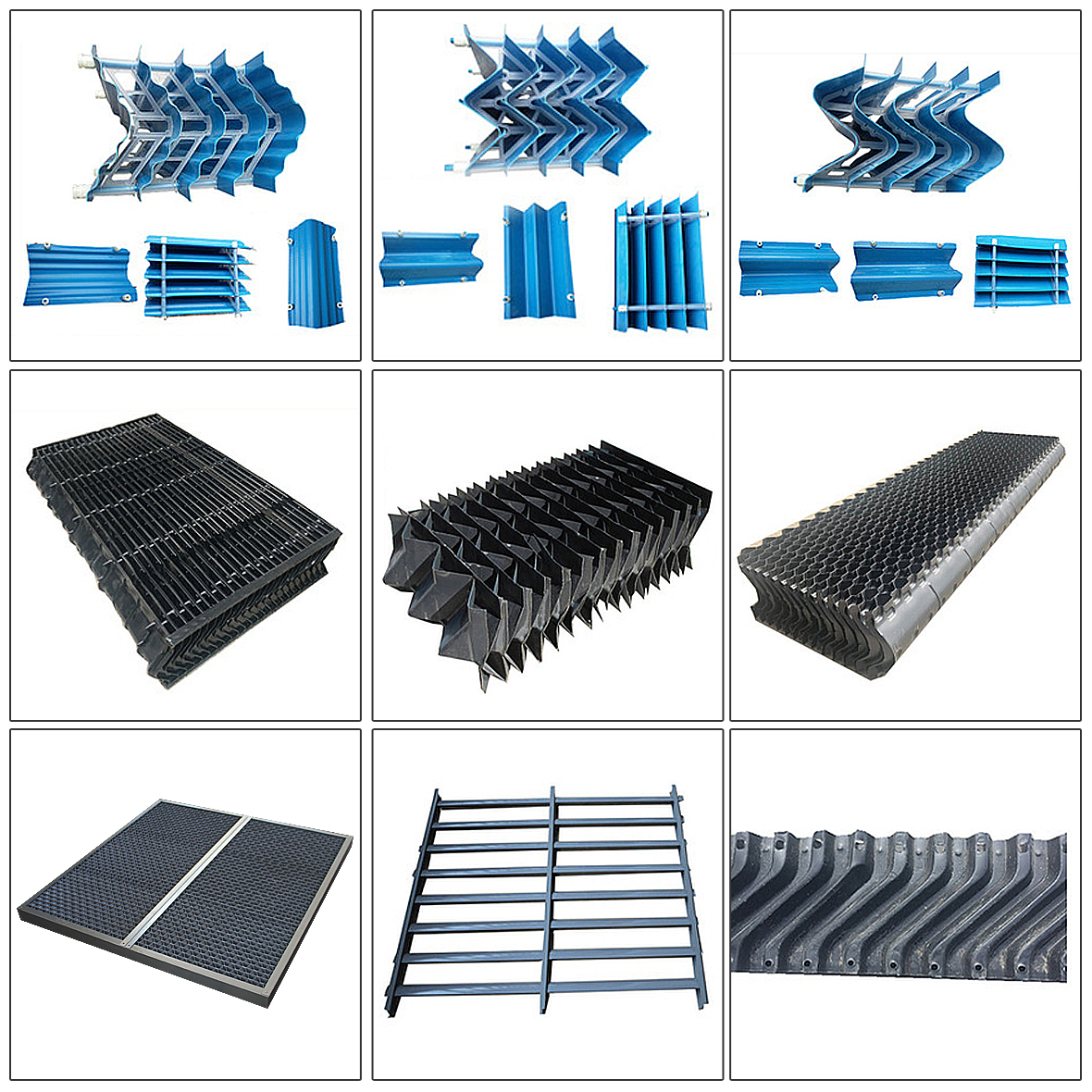
Cooling tower fill creates surfaces over which hot circulating water spreads, flows, or breaks into droplets. This increases the contact between water and air, supporting heat transfer and evaporative cooling.
There are two major fill categories: film fill and splash fill. Film fill spreads water into thin layers across closely spaced surfaces, while splash fill repeatedly breaks falling water into smaller droplets.
The correct choice depends on water quality, temperature, suspended solids, biological growth, airflow requirements, and the tower's original design.
For retrofit projects, the objective is not simply to install a product with a larger surface area. The replacement must provide suitable heat-transfer performance without creating excessive resistance to airflow or increasing the risk of fouling.
2.2 Drift Eliminators: Reducing Water Loss
Drift eliminators are installed in the air discharge path to capture liquid droplets carried out of the cooling tower by moving air.
As air passes through the eliminator's shaped passages, it changes direction. Water droplets with sufficient inertia strike the surfaces, collect, and drain back into the tower.
Effective drift control helps reduce water loss, limit the movement of water-treatment chemicals into surrounding areas, and protect nearby equipment from unwanted moisture.
A replacement eliminator should be evaluated for its drift performance, pressure drop, dimensions, material compatibility, and fit with the existing tower configuration. A component that looks similar to the original may not perform identically if its geometry or installation position differs.
3. When Should You Replace Cooling Tower Fill and Drift Eliminators?
Cooling tower internals do not necessarily fail all at once. In many cases, performance declines gradually until operating costs, maintenance demands, or water consumption become difficult to ignore.
Recognizing the warning signs early can help facility managers plan a retrofit before a minor problem develops into a major shutdown.
3.1 Reduced Cooling Performance
One of the most common warning signs is a cooling tower that no longer achieves its required cold-water temperature under comparable operating conditions.
Possible causes include clogged fill passages, damaged surfaces, uneven water distribution, biological growth, scale deposits, or changes in the tower's overall operating load.
Before ordering replacement parts, review water temperatures, wet-bulb conditions, circulating-water flow, fan operation, and water distribution. These measurements help determine whether the fill is actually responsible for the performance decline.
Replacing the fill may be appropriate when inspection confirms deterioration or fouling that cannot be economically corrected through cleaning.
3.2 Clogging, Scaling, and Material Damage
Fill passages can gradually become restricted by suspended solids, mineral deposits, algae, and other biological growth. Restricted passages reduce the effective contact area and may disrupt the distribution of air and water.
High temperatures, unsuitable chemicals, mechanical damage, and long-term exposure to operating conditions can also contribute to material deterioration.
Look for cracked sheets, deformed packs, blocked channels, brittle components, and areas where water no longer spreads evenly.
In dirty-water applications, a more open fill design may be worth considering. However, splash fill is not immune to fouling, and changing fill type requires checking the tower's thermal and hydraulic design.
3.3 Excessive Drift and Water Consumption
Unexpected water loss can indicate problems with drift eliminators, but it can also result from excessive evaporation, leaks, overflow, poor basin control, or other operating issues.
Inspect the eliminator sections for missing blades, broken supports, gaps, loose assemblies, and incorrect positioning. Also check whether the installed configuration matches the intended airflow path.
If drift loss has increased, verify the cause before purchasing replacement components. Correctly selected and installed eliminators can improve droplet capture, but actual performance depends on product design, air velocity, installation quality, and operating conditions.
4. Benefits of Retrofitting Cooling Tower Internals
Replacing fill and drift eliminators can offer several practical advantages without requiring a complete tower replacement.
Improved heat-transfer performance: Suitable replacement fill can restore effective water-air contact when the existing media is damaged, heavily fouled, or deteriorated.
Better water conservation: Properly selected drift eliminators help capture entrained droplets and return them to the tower.
Lower maintenance burden: Replacing severely damaged or persistently clogged components may reduce recurring cleaning and repair requirements.
Longer use of existing assets: A retrofit may allow operators to continue using a serviceable tower structure, fan system, basin, and other components.
More flexible material selection: Replacement projects provide an opportunity to review materials and configurations against current water quality, temperature, and chemical conditions.
Nevertheless, these benefits are not automatic. The best results come from identifying the original problem, choosing compatible products, and checking the tower's complete operating requirements.
5. Types of Cooling Tower Fill for Replacement Projects
Cooling tower fill should be selected according to the application rather than price or nominal surface area alone. Two products with similar dimensions can have different passage geometries, pressure drops, fouling tendencies, and thermal characteristics.
5.1 Film Fill
Film fill uses closely spaced surfaces to distribute water into thin films. This design provides substantial water-air contact area within a relatively compact volume.
It is commonly considered for applications where water quality can be controlled and efficient heat transfer is a priority.
Film fill can be a practical retrofit choice for HVAC systems and many industrial processes. However, narrow passages can become obstructed when circulating water contains significant suspended solids, scale-forming minerals, or biological material.
When evaluating film fill, compare sheet spacing, pack dimensions, material thickness, operating temperature limits, water distribution requirements, and compatibility with the tower's existing supports.
5.2 Splash Fill
Splash fill uses bars, grids, or other structures to break falling water into smaller droplets and distribute it across multiple contact points.
Its relatively open structure can be advantageous in applications where suspended solids or fouling make narrow film-fill passages difficult to maintain.
Splash fill may be worth evaluating for certain industrial processes, wastewater-related applications, and systems with challenging water quality. The decision still depends on the required thermal performance and tower design.
Do not assume that splash fill can replace film fill in every tower. The two designs use different heat-transfer mechanisms, so a change may affect cooling capacity, water distribution, airflow resistance, and support arrangements.
5.3 PVC vs. PP Fill Materials
Polyvinyl chloride (PVC) and polypropylene (PP) are commonly used thermoplastic materials for cooling tower fill, but their suitability varies by formulation and operating conditions.
PVC is widely used in conventional cooling tower applications. Its allowable service temperature, chemical resistance, and mechanical properties depend on the specific product and manufacturer.
PP may be considered where higher operating temperatures or particular chemical-resistance requirements make it suitable. However, PP is not automatically the best choice for every high-temperature application, and its mechanical performance must also be evaluated.
Before selecting either material, verify:
Maximum continuous operating temperature and any short-term temperature limits.
Compatibility with treatment chemicals and process contaminants.
Resistance to ultraviolet exposure where relevant.
Mechanical strength and dimensional stability.
Fire-performance requirements, if applicable.
Expected service life under actual operating conditions.
A reliable manufacturer should provide product-specific information instead of relying on broad statements such as “high-temperature resistant” or “chemical resistant.”

6. Types of Cooling Tower Drift Eliminators
Drift eliminators vary in blade geometry, passage arrangement, material, and the number of directional changes imposed on the airflow.
The right configuration should capture droplets effectively while keeping pressure drop within acceptable limits.
6.1 Blade-Type Drift Eliminators
Blade-type eliminators use shaped profiles that force the airflow to change direction. Droplets strike the surfaces, coalesce, and drain away.
Their performance depends on blade spacing, profile geometry, air velocity, drainage arrangement, and installation quality.
During replacement, compare the proposed blade configuration with the original design. Even a small difference in geometry can influence airflow resistance and droplet capture.
6.2 Multi-Pass Drift Eliminators
Multi-pass designs create several changes in airflow direction, increasing opportunities for droplets to separate from the air stream.
They may be appropriate where effective drift control is important, but more directional changes do not automatically guarantee the best result. Pressure drop, fan capability, operating velocity, and drainage must all be considered.
Ask the supplier for available technical data on drift performance and pressure drop at the intended air velocity. Where applicable, request information about the test method and the conditions under which the data were obtained.
7. How to Choose a Manufacturer for Fill and Drift Eliminators
A good retrofit supplier does more than ship plastic components. It helps buyers identify suitable products, confirm dimensions, and avoid compatibility problems before installation begins.
Use the following criteria to compare manufacturers.
7.1 Product Compatibility and Technical Specifications
Start with the tower's existing configuration. Determine whether the supplier can provide fill and eliminator products suitable for the tower's type, dimensions, operating conditions, and installation arrangement.
Ask for technical drawings, product dimensions, material specifications, and any available performance data. Confirm whether the proposed components are intended for crossflow or counterflow arrangements, as applicable.
If the original manufacturer is no longer available, provide photographs, measurements, and existing equipment drawings. A qualified supplier may be able to assess replacement options, but final compatibility should be confirmed before production.
7.2 Material Quality and Operating Conditions
The lowest purchase price may not deliver the lowest total cost. A component that deforms, cracks, or becomes clogged prematurely can create additional maintenance expenses and repeated shutdowns.
Evaluate material suitability against water temperature, treatment chemicals, suspended solids, sunlight exposure, and expected operating life.
Request written confirmation of the recommended operating limits. Where performance is critical, compare technical specifications rather than relying on appearance or generic product descriptions.
7.3 Customization and Replacement Support
Retrofit work often involves older towers, nonstandard dimensions, or components that are no longer available in their original form.
A supplier's ability to review drawings, confirm measurements, and discuss suitable alternatives can make a significant difference.
Before placing an order, clarify whether the supplier can provide custom dimensions, technical documentation, packaging suitable for transport, and support for resolving installation questions. Also confirm lead times, minimum order quantities, warranty terms, and the process for handling dimensional discrepancies.
8. Power Tower Cooling Technology (Shaoxing) Co., Ltd.

For buyers sourcing cooling tower fill and drift eliminators for retrofit or replacement projects, Power Tower Cooling Technology (Shaoxing) Co., Ltd. is one supplier to evaluate.
The company's website, https://www.coolingtowerpart.com, provides a starting point for exploring cooling tower components and identifying products relevant to a particular project.
When contacting the company, buyers should explain whether the requirement involves a complete fill replacement, drift eliminator replacement, or a broader cooling tower retrofit. Sharing the tower type, existing component dimensions, water quality, and operating temperature can help clarify which product options should be reviewed.
For a practical evaluation, request confirmation of:
Available fill types and compatible materials.
Drift eliminator configurations and dimensions.
Suitability for the tower's operating temperature and water chemistry.
Technical drawings and installation requirements.
Production lead time and shipping arrangements.
Product-specific performance information and applicable warranty terms.
These details help buyers compare options against their engineering requirements rather than making a decision based on price alone.
As with any supplier, confirm the exact specifications and scope of supply before placing an order. A product should be selected because it suits the retrofit, not simply because it is described as a replacement component.
9. Key Measurements Before Ordering Replacement Parts
One of the most expensive retrofit mistakes is ordering components before the tower has been measured properly.
A few hours spent collecting accurate information can prevent delays, material waste, and installation problems.
9.1 Cooling Tower Dimensions and Layout
Record the available installation space, fill block dimensions, support spacing, eliminator section dimensions, and any relevant access limitations.
Also identify the tower's airflow arrangement and the direction of water flow. Crossflow and counterflow towers may require different component layouts and installation methods.
Photographs can help explain the existing arrangement, but they should support—not replace—measured dimensions and technical drawings.
If the tower has been modified during earlier maintenance, check its current condition rather than relying exclusively on original drawings.
9.2 Water Quality and Operating Temperature
Document the normal and maximum water temperatures, relevant process-water characteristics, and treatment chemicals used in the system.
Important water-quality considerations include suspended solids, hardness, scaling tendency, biological growth, and chemical compatibility.
If the existing fill has repeatedly clogged, investigate the cause before choosing a replacement. A different fill geometry may help, but it will not eliminate the need for appropriate filtration, blowdown, cleaning, and water treatment.
9.3 Airflow, Pressure Drop, and Drift Performance
Fill and drift eliminators influence the movement of air through the cooling tower. Their resistance affects the fan system's operating conditions.
Record the fan type, available performance information, operating speed, and any relevant pressure measurements. Ask the supplier to identify the pressure-drop characteristics of the proposed products at the expected air velocity.
For drift eliminators, request available drift-performance data and the test conditions behind it. This allows the engineering team to compare products on a consistent basis.
10. Common Retrofit Mistakes to Avoid
Even a high-quality component can perform poorly if it is selected or installed incorrectly.
Choosing by price alone: A cheaper product may have unsuitable material properties, dimensions, or performance characteristics. Compare total project cost and technical suitability.
Ignoring the original tower design: Replacing film fill with splash fill—or selecting a different eliminator geometry—may change airflow and heat-transfer behavior. Check the engineering implications before making substitutions.
Overlooking temperature limits: A material suitable for one operating condition may soften, deform, or lose mechanical strength at another. Confirm product-specific limits.
Failing to diagnose fouling: If scaling or biological growth caused the original failure, new fill may encounter the same problem without changes to water treatment and maintenance.
Assuming all drift eliminators are interchangeable: Similar-looking profiles can have different dimensions, pressure drops, and droplet-capture performance.
Ordering without checking access: Installation routes, support structures, and restricted spaces can affect component dimensions and assembly methods.
A structured pre-order review helps avoid these issues and reduces the risk of expensive rework.
11. Installation and Maintenance Recommendations
Correct installation is just as important as product selection.
Before work begins, establish a safe shutdown procedure and follow the site's applicable lockout, electrical, confined-space, and working-at-height requirements. Cooling towers may contain hazardous biological aerosols, so maintenance teams should also follow appropriate exposure-control procedures.
Remove damaged components carefully and inspect the supporting structure. Corroded supports, broken brackets, and distorted frames should be addressed before new fill or eliminators are installed.
Install fill blocks according to the approved layout. Check that the packs are properly supported, that water can distribute evenly, and that no unintended gaps allow water to bypass the intended heat-transfer area.
For drift eliminators, verify the orientation, alignment, retention, and drainage path. Incorrect positioning or gaps can compromise drift control.
After installation, check water distribution, fan operation, vibration, airflow, and relevant water temperatures. Establish a baseline so future performance can be compared with the post-retrofit condition.
Ongoing maintenance should include inspections for fouling, physical damage, loose sections, and uneven water distribution. Cleaning methods must be compatible with the fill and eliminator materials; excessive pressure or unsuitable chemicals can damage components.
12. Cost Factors for Fill and Drift Eliminator Replacement
The purchase price is only one part of the total retrofit budget.
The overall cost depends on the fill type, material, component dimensions, required quantity, drift eliminator design, customization, and transport. Installation labor, lifting equipment, shutdown duration, waste removal, and any repairs to support structures can also contribute substantially.
A replacement that requires special fabrication or difficult access may cost more to install than a standard component, even if the product itself is inexpensive.
Buyers should compare quotations on a like-for-like basis. Check whether each quotation includes the same materials, dimensions, quantity, technical documentation, packaging, and delivery terms.
It is also useful to consider the cost of future maintenance. A design that suits the site's water quality may reduce cleaning frequency or extend service life, although actual results depend on operating conditions and maintenance practices.
The best purchasing decision balances initial investment, expected performance, maintainability, and compatibility with the existing tower.
13. Frequently Asked Questions
13.1 Can I Replace Fill Without Replacing Drift Eliminators?
Yes. If the drift eliminators remain in good condition and meet the tower's operating requirements, they may not need replacement when the fill is changed.
However, inspect both components during the retrofit. If the eliminators are damaged, poorly fitted, or no longer suitable for the required airflow, replacing them at the same time may reduce the need for another shutdown.
13.2 Is Film Fill Always Better Than Splash Fill?
No. Film fill can provide a high contact area in a compact volume, making it useful for many applications with suitable water quality.
Splash fill may be preferable in some systems where fouling risk or suspended solids make narrow passages difficult to maintain.
The correct option depends on thermal requirements, water quality, airflow, operating temperature, and tower design. Any change in fill type should be checked for compatibility with the existing system.
13.3 How Do I Know Whether Custom Replacement Parts Are Needed?
Custom parts may be necessary when the tower uses nonstandard dimensions, the original product is discontinued, or existing structures have been modified.
Provide accurate measurements, photographs, drawings, and operating data to the supplier. Ask for a technical review and confirm the final dimensions before production.
Do not assume that a component will fit simply because its general shape resembles the original.
13.4 What Information Should I Send to a Supplier?
At minimum, prepare the tower type, installation dimensions, existing fill or eliminator configuration, water temperature, water-quality information, and required quantity.
Also provide photographs, drawings, details of previous problems, and the target delivery date. This information helps the supplier assess whether a proposed product is suitable and identify any missing engineering details.
13.5 How Often Should Cooling Tower Fill and Drift Eliminators Be Replaced?
There is no universal replacement interval. Service life depends on material quality, temperature, water chemistry, fouling, mechanical stress, operating hours, and maintenance.
Inspect the components regularly and use condition, performance trends, and manufacturer recommendations to plan replacement. Replace damaged or severely deteriorated sections when cleaning and repair can no longer restore acceptable performance.
14. Conclusion: Choose the Right Retrofit Partner
Cooling tower fill and drift eliminators have a direct influence on heat transfer, airflow, and water conservation. When these components become clogged, damaged, or unsuitable for current operating conditions, a carefully planned retrofit can be a practical alternative to replacing the entire tower.
The key is to evaluate the complete application. Compare fill types, verify material limits, measure existing components, review airflow requirements, and confirm drift performance before ordering replacement parts.
Manufacturers should be assessed on technical compatibility, product information, customization options, and their ability to support a clear procurement process—not price alone.
Power Tower Cooling Technology (Shaoxing) Co., Ltd. is one supplier buyers can investigate for cooling tower components through https://www.coolingtowerpart.com. Share the tower's dimensions, operating conditions, and replacement requirements to help determine which products are worth evaluating.
A successful retrofit starts with the right diagnosis and ends with components that fit the tower, suit the water, and support reliable long-term operation.


