Cooling Tower Infill: Design, Performance And Applications
Meta Description: Discover cooling tower infill design principles, material comparison, thermal performance factors, industrial applications, troubleshooting and maintenance. Learn how to select the right fill media for counterflow & crossflow evaporative cooling towers.
Cooling tower infill (also commonly referred to as cooling tower fill media) serves as the core heat exchange component inside every wet evaporative cooling tower. All the cooling capacity of an open cooling tower fundamentally depends on this component. Its main function is to create a large continuous contact surface and sufficient contact time between falling process water and flowing ambient air. When water spreads across the infill surface, partial water evaporates, absorbing latent heat and reducing the bulk water temperature for recirculation back to industrial equipment, chillers, condensers and heat exchangers.
Many procurement engineers and plant operators underestimate the importance of cooling tower infill. Using low-quality, incorrectly sized or mismatched infill will trigger a series of operational headaches: reduced heat rejection capacity, higher fan power consumption, frequent scaling and biological fouling, premature material deformation, unstable approach temperature and costly unplanned shutdowns.
This comprehensive guide covers cooling tower infill design philosophy, classification of fill types, material characteristics, core performance evaluation metrics, worldwide industrial use cases, common operational failures, maintenance protocols and professional selection guidance. This content is written for mechanical engineers, facility managers, cooling tower contractors, OEM purchasers and system retrofit specialists.
Core Design Principles of Cooling Tower Infill
The primary design mission of cooling tower infill is simple in theory but complex in engineering implementation: maximize the heat and mass transfer between air and water, while controlling airflow resistance within an acceptable range. Every detail including corrugation flute angle, sheet pitch, wave pattern, module height, assembly gap and supporting structure is optimized around this balance.
Key Design Objectives for Infill Engineering
Generate maximum wetted surface area to promote evaporation and sensible heat transfer
Keep air pressure drop low to minimize continuous fan electricity consumption
Achieve uniform water spreading across all sheet surfaces, eliminating dry zones and water channeling
Provide anti-fouling and anti-scaling properties matched to the site’s circulating water quality
Maintain structural rigidity under continuous water loading, temperature cycling and water chemical treatment
Support modular assembly, easy inspection, partial removal and replacement during tower maintenance
Classification Based on Air-Water Flow Direction
The flow relationship between water and air directly decides the infill geometry you can use. Two major configurations dominate the global cooling tower market: counterflow and crossflow.
Counterflow Cooling Tower Infill
In counterflow cooling towers, hot process water flows vertically downward, while cooling air rises upward through the infill in the opposite direction. This opposite contact creates excellent thermal exchange efficiency within a compact footprint. Counterflow infill mostly adopts vertically assembled corrugated film media, and sometimes splash bars for heavily contaminated water conditions.
This style is widely used in factory-packaged cooling towers for HVAC and small-to-medium process cooling. Engineers must carefully select sheet spacing: narrow flutes boost heat transfer but increase clogging risk, while wider channels reduce fouling at the cost of lower thermal performance. Counterflow towers normally require a pressurized top water distribution system to evenly spray water onto the top of the infill block.
Crossflow Cooling Tower Infill
For crossflow cooling towers, air moves horizontally through the infill, cutting across vertically falling water streams. The infill sheets use cross-corrugated wave profiles. One major advantage of crossflow design is simpler gravity-fed water distribution troughs, without high-pressure spray nozzles.
Crossflow infill modules are installed vertically along the tower side walls. Operators can inspect, clean and replace infill panels from the side access doors without draining the entire tower, which is a huge benefit for large field-erected cooling towers in power plants and big commercial campuses. Crossflow infill often comes in larger panel sizes for on-site assembly.
Main Types of Cooling Tower Infill
Three primary categories of cooling tower infill are commercially available globally: film infill, splash infill, and hybrid infill. Each type has unique structural features, strengths and limitations that define its suitable working scenarios.
Film Infill / Film Fill Media
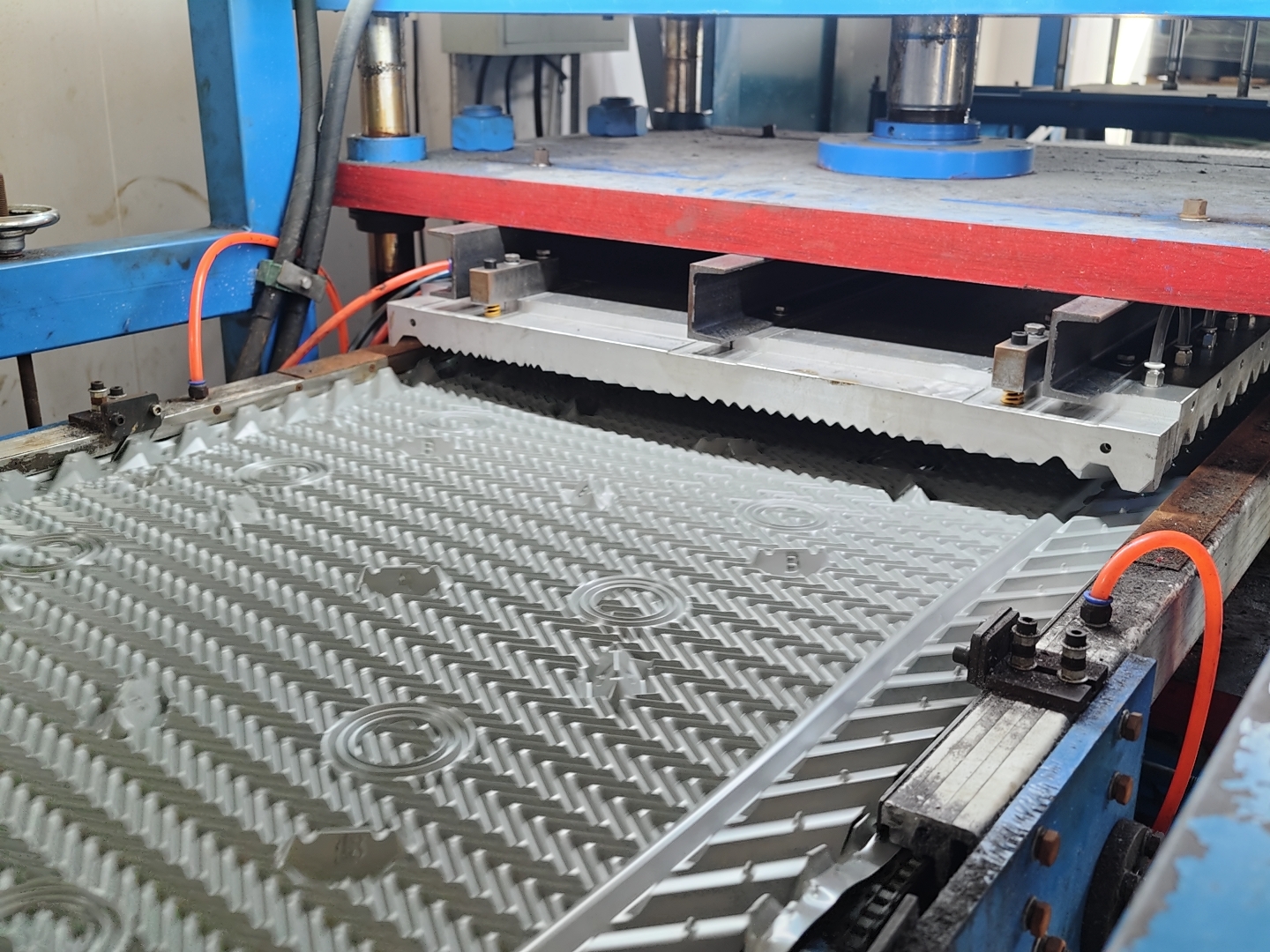
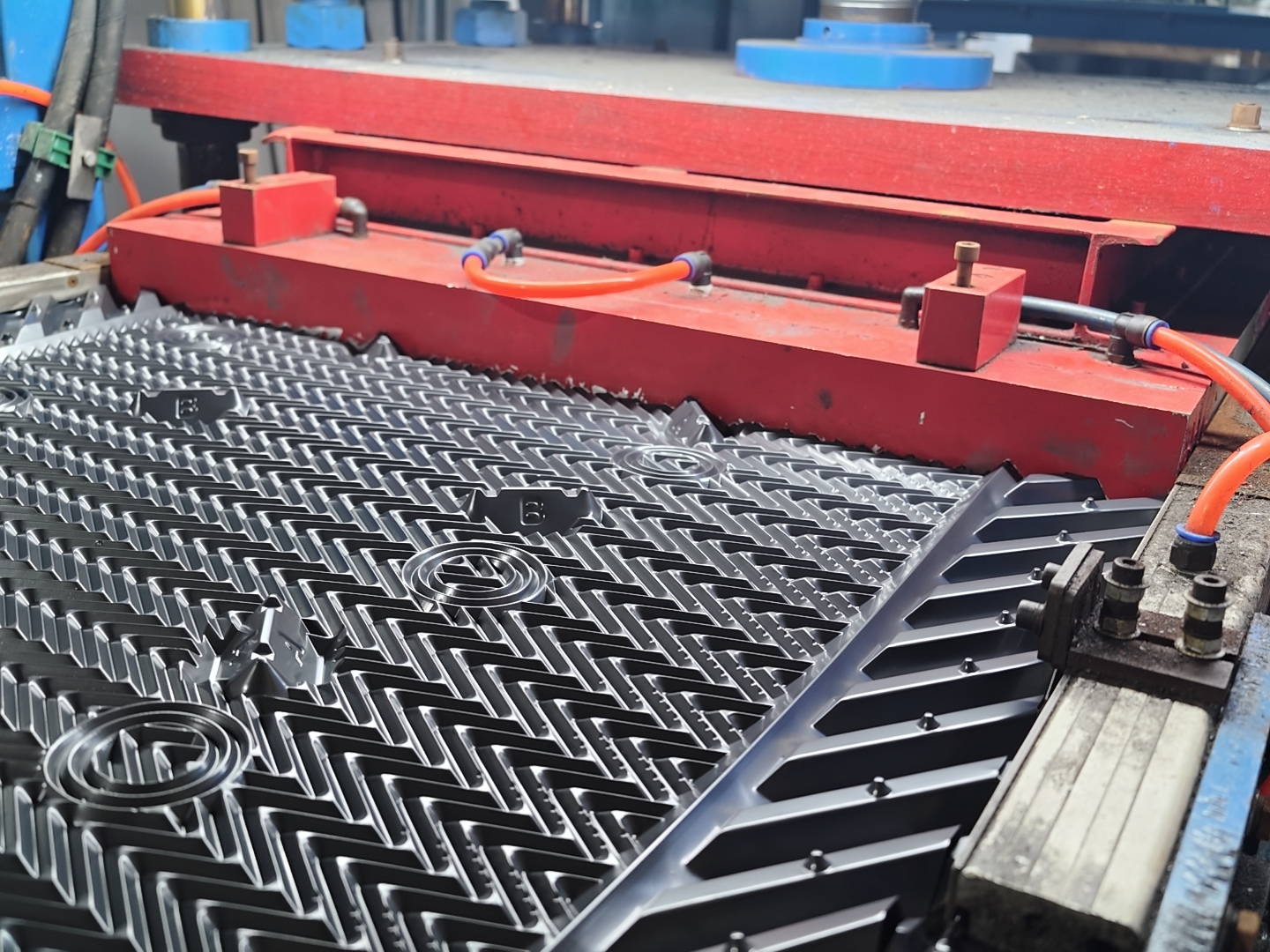
Film infill is the most popular high-efficiency cooling tower media. It consists of dozens of stacked thin corrugated plastic sheets locked together into rigid modules. When water flows onto the media, it spreads out and forms a thin continuous water film clinging to the corrugated surface. A massive area of thin water film contacts moving air, enabling very efficient evaporative heat transfer.
Advantages of Film Infill
Highest thermal efficiency among all cooling tower infill types
Compact module dimensions, saving tower internal space for new tower construction or retrofit upgrade
Light weight per cubic meter, reducing static load on tower support frames
Modular design, easy for bulk production and container export
Limitations of Film Infill
Highly sensitive to circulating water containing high suspended solids
Narrow corrugated channels can quickly get blocked by sediment, mineral scale, algae and bio-slime
Requires consistent water filtration, biocide and anti-scale chemical treatment
Risk of sagging or thermal deformation if operating temperature exceeds material limits
Splash Infill / Splash Bar Fill
Splash infill uses layers of staggered bars, grids or slats instead of corrugated sheets. Falling water droplets strike these solid bars repeatedly, breaking large water drops into many tiny droplets. Heat transfer occurs between airborne water droplets and cross or counter-flow air, rather than via a continuous water film.
Advantages of Splash Infill
Open gap structure delivers outstanding anti-clogging capability
Tolerates poor-quality circulating water, wastewater and fluid with high TSS (total suspended solids)
Robust structure, resistant to heavy contamination and large debris
Simple component structure, lower replacement cost for heavy industrial sites
Limitations of Splash Infill
Thermal efficiency is noticeably lower compared with film infill
Higher water drift loss if the structure is poorly designed
Larger tower volume is required to achieve the same cooling duty
Hybrid Cooling Tower Infill
Hybrid infill combines film media sections and splash bar sections in one assembly. The splash segment captures large particles and prevents blockage, while the film segment provides high-efficiency heat transfer. This design balances thermal performance and fouling resistance.
Hybrid infill is a flexible solution when water quality fluctuates between clean and moderately polluted. It is commonly specified in refineries, steel mills and variable-load manufacturing plants, where occasional sediment ingress cannot be fully eliminated. Hybrid infill is also selected for retrofit projects where plant owners want to upgrade cooling performance without switching to fully splash media.
Infill Material Selection: PVC vs PP and Alternative Options
The raw material determines maximum continuous working temperature, chemical resistance, rigidity, ageing rate and total service life. PVC and Polypropylene (PP) are the two dominant materials for cooling tower infill around the world.
PVC Cooling Tower Infill
PVC infill remains the industry standard for commercial HVAC and light industrial cooling applications. It can continuously operate reliably up to 55°C (130°F).
Benefits of PVC Infill
Cost competitive, excellent value for standard cooling projects
Good structural rigidity, maintains corrugated profile under normal water load
Superior surface wettability, easy to form stable thin water film
Stable performance under conventional cooling water chemical treatment
Drawbacks of PVC Infill
Material softens and permanently deforms once sustained temperature exceeds 55°C
Susceptible to damage from strong solvents and high concentration corrosive chemicals
Becomes brittle after long-term ultraviolet exposure if not properly stabilized
PP (Polypropylene) Cooling Tower Infill
PP infill is engineered for high-temperature and chemically aggressive cooling loops. It can withstand continuous operating temperature up to 85°C (185°F).
Benefits of PP Infill
Excellent heat resistance for hot process cooling water
Strong resistance to acid, alkali and many industrial chemical additives
Less prone to brittle fracture under repeated thermal cycling
Drawbacks of PP Infill
Higher raw material and manufacturing cost than PVC
Surface wettability is slightly lower than standard PVC, sometimes requiring surface modification
Heavier and needs stronger supporting frames to hold the modules
Less Common Alternative Infill Materials
ABS: High impact resistance, suitable for coastal marine environments with salt-laden air
FRP / Fiberglass: Mostly used for heavy-duty splash bars, outstanding mechanical strength for harsh industrial environments
Cellulose / Asbestos-based fill: Obsolete, rarely used in modern cooling tower installations due to health risks and short lifespan
Key Performance Parameters of Cooling Tower Infill
When evaluating, comparing or quoting cooling tower infill for customers, mechanical engineers must assess these critical performance indicators. These parameters directly decide whether the infill meets the required cooling duty.
Specific Surface Area
Specific surface area refers to the total available heat exchange surface per cubic meter of infill, usually expressed in m²/m³. Higher specific surface area improves heat transfer and cooling efficiency, but it also increases air resistance and fouling risk. Designers need to balance efficiency and maintainability rather than blindly pursuing maximum surface area.
Air Pressure Drop
Pressure drop measures how much air pressure is lost when airflow passes through the infill block. Higher pressure drop forces cooling tower fans to consume more electrical energy over the whole service life. For retrofit tower projects, matching the original pressure drop is extremely important, otherwise the existing fan motor may become overloaded and suffer premature failure.
Wettability and Uniform Water Distribution
Wettability describes how easily water spreads and adheres to the material surface. Poor wettability creates dry patches on infill sheets; those dry surfaces cannot participate in heat exchange and waste the designed surface area. Corrugation pattern and material surface treatment both affect wettability. Uneven water spray distribution from nozzles or troughs is one of the top reasons for gradual cooling tower performance degradation.
Fouling and Scaling Resistance
Fouling resistance defines how easily sediment, mineral scale, biofilm and algae attach to infill surfaces. Splash infill naturally performs better on anti-fouling, while film infill relies heavily on stable water treatment programs. Hard water with high calcium and magnesium levels will accelerate scale formation on all types of infill.
Approach Temperature and Cooling Range
The cooling range is the temperature drop of circulating water passing through the tower, while approach temperature is the difference between outlet water temperature and ambient wet-bulb temperature. Infill design is the core factor limiting achievable approach temperature, which is a key contractual index in most industrial cooling bids.
Industrial and Commercial Applications of Cooling Tower Infill
Cooling tower infill is used across nearly every industry requiring large-scale evaporative heat rejection. Different industries select different infill types and materials based on cooling load, water quality and operating temperature.
Commercial HVAC Systems
Office buildings, shopping malls, hospitals, hotels and university campuses widely adopt PVC film infill in packaged cooling towers. Circulating water is relatively clean, and working temperature stays moderate, so high-efficiency PVC film fill delivers the best cost-performance for comfort air conditioning.
Thermal and Solar Power Generation Plants
Large thermal power stations use huge field-erected crossflow or counterflow cooling towers for condenser cooling. The circulating water may contain dust and mineral impurities. Depending on water quality, design engineers choose splash infill or high-performance anti-fouling film infill. Power plant infill requires long service life and stable performance under year-round continuous operation.
Petrochemical, Oil & Gas Refineries
Refineries and chemical processing plants face hot process water, variable pH value and suspended solid contaminants. PP infill or hybrid infill is commonly specified in these projects, because they resist chemical attack and tolerate moderate fouling. Many refineries also install pre-filters upstream of cooling towers to protect the infill media.
General Manufacturing & Process Cooling
Steel mills, food and beverage factories, plastic extrusion production lines, welding chiller systems and pharmaceutical manufacturing all rely on cooling tower infill to remove excess process heat. Steel mill cooling water often carries rust and dust, so splash infill or hybrid media is preferred to avoid frequent clogging.
Data Center Free Cooling
Modern large data centers deploy evaporative cooling towers for free cooling seasons, reducing chiller runtime and lowering PUE (Power Usage Effectiveness). High-efficiency PVC film infill helps maximize heat rejection capacity and cut annual power consumption for cooling infrastructure.
Mining and Heavy Industry
Mining sites often have poor raw water quality with high sediment. Splash cooling tower infill is the primary selection here, as open splash structures are not easily blocked by fine mine particles.
Common Infill Problems and Root Causes of Performance Loss
Even premium-grade cooling tower infill will degrade gradually with continuous operation. Early identification of these typical failure modes helps plant operators schedule cleaning or replacement before cooling capacity drops and production gets impacted.
Mineral Scaling and Hard Deposits
When hard water circulates inside the tower, calcium carbonate, magnesium salts and silica precipitate and build hard scale on infill surfaces. Scale forms an insulating barrier that stops heat transfer and narrows water-air flow channels. Severe scale can permanently lock corrugated sheets together.
Biofilm, Algae and Microbial Slime Growth
Nutrients, sunlight and warm water create ideal breeding conditions for bacteria and algae. Slimy biofilm covers the wetted surface, reducing heat transfer efficiency and blocking small flow passages. Open cooling towers with heavy biofilm contamination also carry Legionella risks, requiring strict water biocide management.
Clogging and Solid Particle Fouling
Airborne dust, sand, pipeline rust and suspended solids accumulate inside infill channels. Film fill is especially vulnerable to solid clogging. Once blockages form, airflow and water distribution become uneven, creating hot spots and reducing overall cooling output.
Thermal Deformation, Sagging and Structural Collapse
Operating above the material temperature limit softens PVC sheets. Infill panels sag, bend or separate from each other, completely destroying the originally designed water-air flow pattern. In serious cases, deformed infill falls onto the water basin or blocks air intake.
Chemical Corrosion and Material Ageing
Improper chemical dosing, excessive chlorine or aggressive chemicals slowly degrade plastic infill. Long-term outdoor ageing under UV radiation also makes PVC sheets brittle, causing cracking during cleaning.
Maintenance, Inspection and Replacement Guidelines
Systematic maintenance can greatly extend cooling tower infill service life and keep cooling tower thermal performance stable year after year.
Routine Inspection Schedule
Standard HVAC cooling towers: full visual inspection every 6 months
Heavy industrial sites, high dust or poor water quality: quarterly inspection
During inspection, check sheet sagging, cracks, scaling layer thickness, algae coverage, uneven wet/dry zones and loose module connections
Recommended Cleaning Practices
Important Warning: Ultra-high-pressure jet washing can tear thin PVC film sheets and permanently damage corrugated profiles. Always control water pressure during cleaning.
When to Replace Cooling Tower Infill
Plan for infill replacement when any of the following occurs:
The tower approach temperature rises significantly and cannot be recovered after cleaning and water treatment adjustment
Large areas of sheet collapse, cracking or permanent thermal deformation appear
Heavy scale and fouling cannot be removed by chemical or physical cleaning
More than 10% of infill modules are damaged or disconnected
Retrofit project requires performance upgrade from old, outdated media
Step-by-Step Guide to Select Suitable Cooling Tower Infill for Your Project
Choosing the wrong infill will create costly long-term operational issues. Follow these steps to select media matched to your cooling tower and working environment.
Step 1: Confirm Cooling Tower Type
First confirm whether the tower is crossflow or counterflow. The tower flow style determines infill geometry, panel orientation and module dimensions. Installing infill designed for counterflow tower into crossflow equipment will lead to severe airflow maldistribution and poor cooling performance.
Step 2: Analyze Circulating Water Quality
Clean circulating water, TSS less than 25ppm: High-efficiency PVC film infill is the most economical choice
Moderate sediment and occasional contamination: Hybrid infill is recommended
Dirty water with high suspended solids: Splash infill is the safest option
Step 3: Verify Maximum Continuous Water Temperature
Step 4: Balance Thermal Efficiency, Pressure Drop and Budget
High-efficiency infill saves fan operating energy year-round, but it increases initial procurement cost and maintenance requirements. For retrofit replacement jobs, match the original module size, sheet spacing and pressure drop to avoid fan overload. For new tower design, simulate thermal performance and pressure drop under site wet-bulb conditions.
Step 5: Confirm Supporting Frame and Installation Dimensions
Check available internal height, width and depth inside the cooling tower casing. Confirm support beam spacing, module locking structure and lifting access before ordering infill modules. Custom size infill is available for non-standard cooling tower casings.
Retrofit of Old Cooling Tower Infill
Many ageing cooling towers still have sound structural shells, but degraded infill media causes insufficient cooling capacity. Replacing old infill is a common and cost-effective retrofit project.
Before ordering new infill, collect key data: original infill dimension, tower flow type, design water flow rate, design wet bulb temperature, operating water quality and existing fan motor power. Some plant owners upgrade from splash fill to high-performance film infill after upgrading their water filtration and water treatment systems.
When doing infill retrofit, inspect the supporting grating, water distribution troughs and drift eliminators at the same time. Damaged drift eliminators will increase water drift loss, even after installing brand-new infill.
Conclusion
Cooling tower infill is the beating heart of wet evaporative cooling towers. Its design, material and type directly define thermal performance, fan power consumption, maintenance workload and overall service life. Film infill provides superior heat transfer efficiency for clean water systems; splash infill delivers robust anti-clogging performance for harsh industrial water; hybrid infill acts as a balanced middle solution.
Material selection between PVC and PP mainly depends on maximum operating temperature and circulating water chemical environment. Regular visual inspection, stable water treatment program and timely cleaning prevent gradual performance decline and unexpected shutdowns.
Whether you are designing a brand-new cooling tower, replacing damaged infill modules or planning a thermal retrofit project, matching infill geometry, material and structure with local ambient wet-bulb, water quality and operating temperature is the critical key to long-term stable, energy-efficient cooling operation.