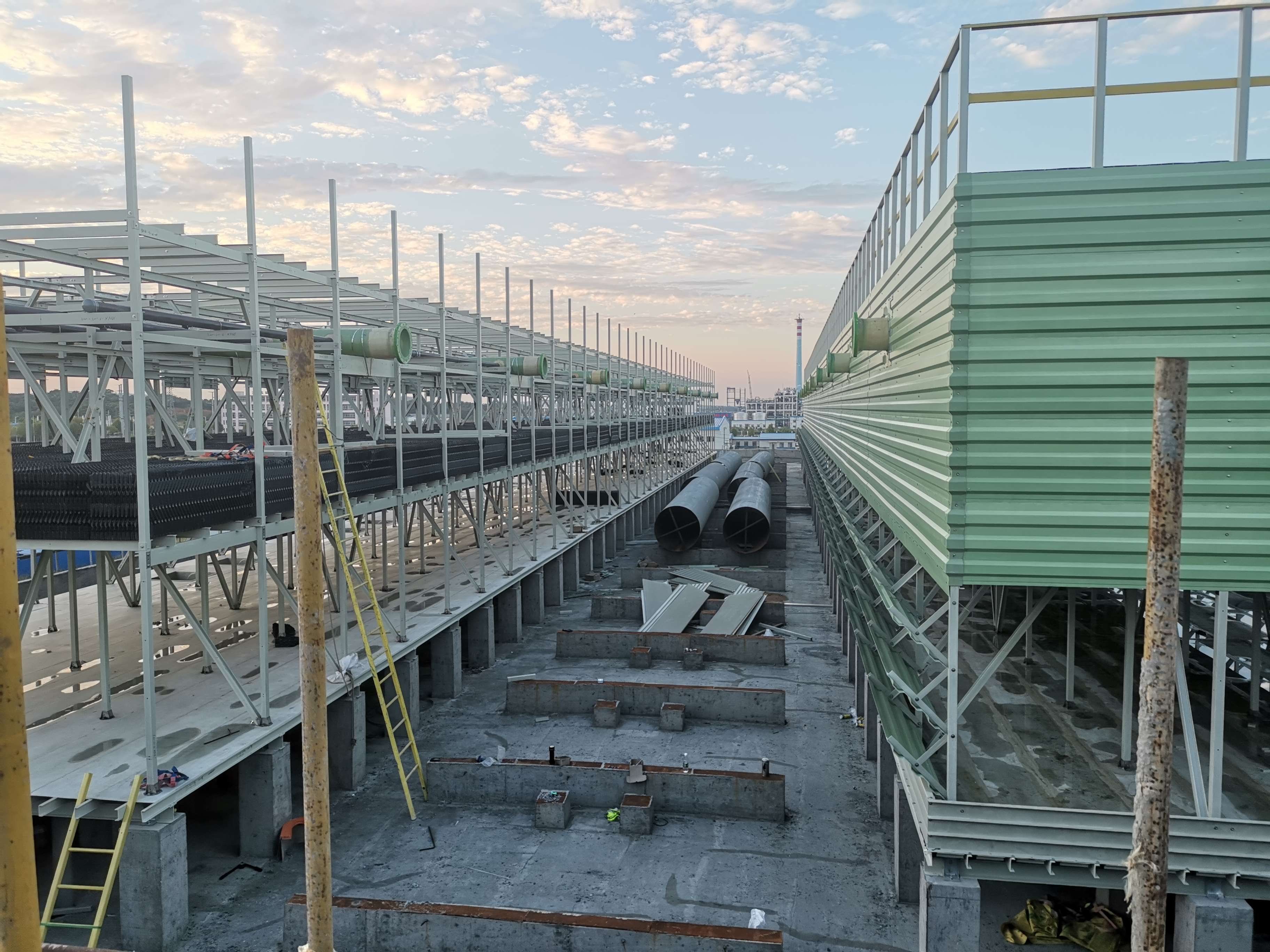
When a cooling tower starts losing performance, many plant managers immediately think about fans, pumps, motors or even replacing the entire tower.
But what if the real problem is much simpler?
The cooling tower fill may simply be worn, clogged, damaged or no longer providing the heat-transfer performance the system needs.
Evapco cooling tower fill replacement is therefore an important maintenance and upgrade option for facilities that want to restore cooling performance without replacing the complete tower. Whether you operate an HVAC system, industrial process cooling system, power-generation facility or manufacturing plant, choosing the right replacement fill can make a significant difference.
In this guide, we will walk through everything you need to know—from identifying damaged fill to choosing the right material, measuring the existing packs and working with a qualified cooling tower fill manufacturer.
For aftermarket and replacement projects, Power Tower Cooling Technology (Shaoxing) Co.,Ltd provides cooling tower fill solutions that can be customized around project dimensions and operating conditions.
What Is EVAPCO Cooling Tower Fill?
Cooling tower fill is the heat-transfer media installed inside a wet cooling tower.
Its job sounds simple: bring water and air into closer contact.
In reality, the fill is one of the most important components inside the tower.
Hot circulating water enters the tower and flows over or through the fill. At the same time, air moves through the fill. A small portion of the water evaporates, carrying heat away from the remaining water.
The fill creates a much larger effective contact area than an empty tower could provide.
Think of it like turning a wide-open highway into a carefully designed network of smaller roads. Instead of letting water rush straight through, the fill guides it into thin films or repeated contact surfaces so that air has more opportunities to remove heat.
EVAPCO's own technical information describes cooling tower fill as heat-transfer media and offers different designs for crossflow and counterflow applications.
That is why replacement fill should never be selected based on the brand name alone.
The tower configuration, fill dimensions, water quality, operating temperature and required thermal performance all matter.
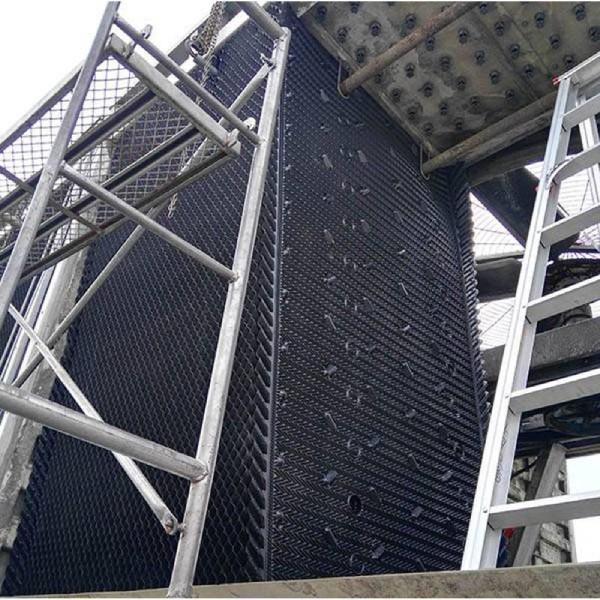
How Cooling Tower Fill Works
The basic principle behind a wet cooling tower is evaporative heat rejection.
Warm water enters the tower.
Air passes through the tower.
The fill increases the contact between the two.
Some water evaporates.
Heat leaves with the moist air.
The cooled water then returns to the process.
Film fill works by spreading water over a large wetted plastic surface. Splash fill, by comparison, repeatedly breaks falling water into droplets.
The correct design depends on the tower and application.
This is why replacing old fill with the wrong geometry can actually create a new problem. The fill may physically fit but fail to deliver the expected thermal performance.
Why Cooling Tower Fill Needs Replacement
Cooling tower fill lives in a demanding environment.
It is constantly exposed to water, air, temperature changes, minerals and contaminants. Depending on the installation, it may also encounter biological growth, dust, suspended solids, oil or process contamination.
Over time, the fill can lose its original condition.
EVAPCO states that heat-transfer media will typically need to be replaced once or twice during the life of a cooling tower, while emphasizing that actual longevity depends strongly on water quality, air quality and proper operation.
So, how do you know when replacement is justified?
You look for evidence.
Signs Your EVAPCO Cooling Tower Fill Needs Replacement
A visual inspection is a good starting point, but performance data is equally important.
Look for a combination of physical damage and declining tower performance.
Cracked or Brittle Fill
Old PVC fill can become brittle.
You may find cracked sheets, broken sections, collapsed packs or distorted channels. Once the fill loses its structural integrity, water may no longer flow as intended.
In severe cases, pieces can break away and create downstream problems.
If you can see obvious physical deterioration, don't wait for the problem to become an emergency.
Scale, Sludge and Clogging
Scale is one of the biggest enemies of efficient fill.
Imagine trying to breathe through a filter packed with dust. The same basic idea applies to fouled cooling tower fill.
Deposits reduce open passages and interfere with water distribution. As fouling increases, airflow resistance can rise while effective heat-transfer area falls.
EVAPCO's technical literature also emphasizes that fill selection must consider water quality and contamination conditions. High-efficiency fill is not a substitute for appropriate water treatment and solids control.
Poor Cooling Performance
Has your cooling tower gradually stopped achieving its original leaving-water temperature?
If the operating conditions have remained relatively stable, the fill deserves attention.
Of course, fill is not the only possible cause. Fans, pumps, nozzles, water flow, airflow, ambient wet-bulb temperature and condenser or process conditions must also be checked.
But degraded fill is a common piece of the puzzle.
Increased Pressure Drop
A blocked fill pack can restrict airflow.
That means the fan may need to work harder to move air through the tower.
The result can be a frustrating combination:
Higher energy consumption
Reduced airflow
Lower cooling capacity
Increased operating costs
More stress on mechanical equipment
Sometimes the cheapest energy-saving project is not a new motor. It is restoring the tower's internal airflow path.
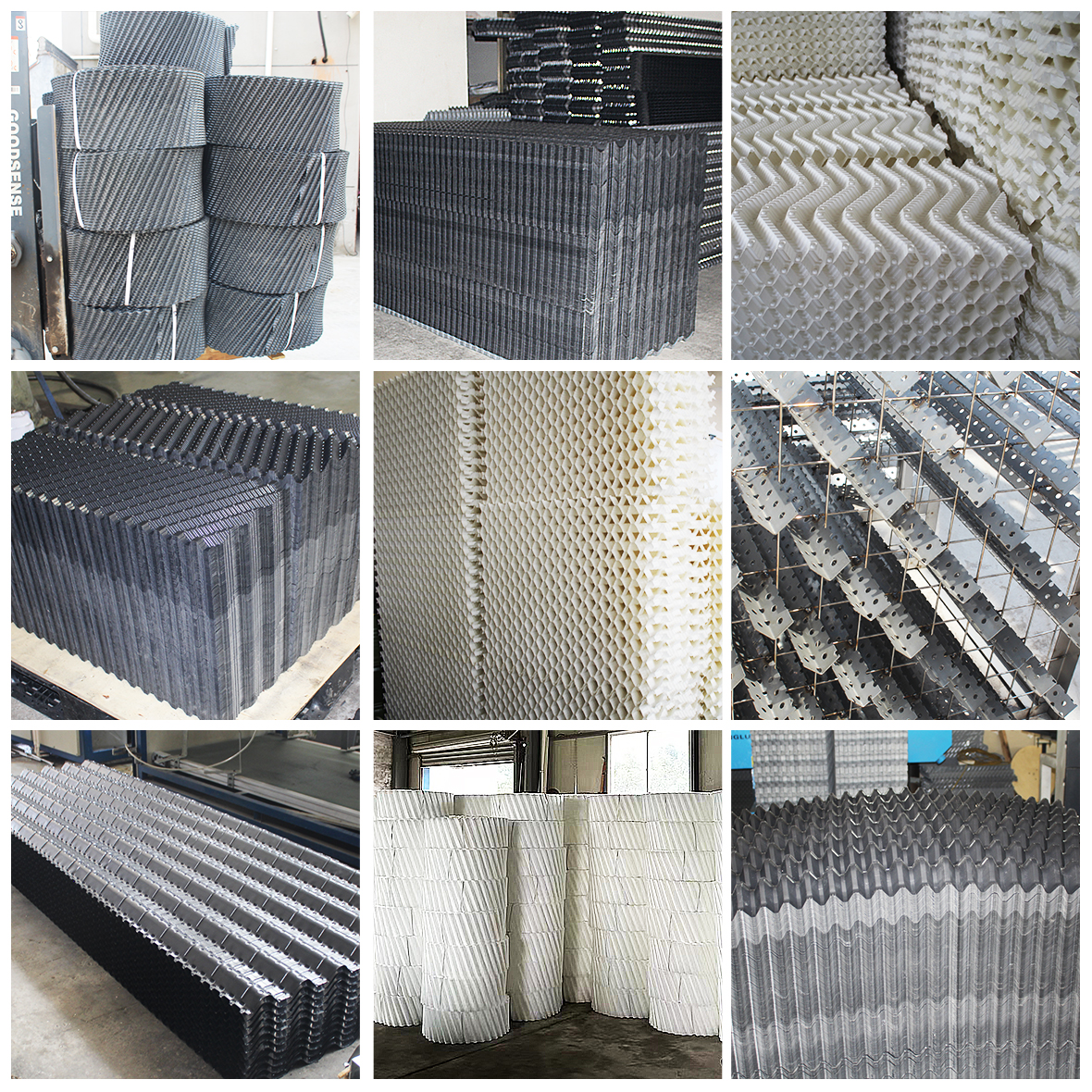
Main Types of Replacement Fill
There is no universal cooling tower fill that works perfectly for every application.
The major choices include different film-fill designs, wide-gap fill, anti-fouling configurations and specialized materials.
PVC Film Fill
PVC film fill is widely used because it can provide high heat-transfer performance in a relatively compact volume.
It works by creating thin water films over corrugated surfaces. The large wetted area gives the air and water many opportunities to exchange heat.
For relatively clean water applications, this can be an excellent choice.
EVAPCO describes PVC fill options for a number of cooling tower applications, including designs intended for specific tower configurations.
Wide-Gap and Anti-Fouling Fill
What happens when your water is not perfectly clean?
That is where wider-gap or anti-fouling fill becomes important.
A more open passage provides additional tolerance to suspended solids and fouling. You may sacrifice some heat-transfer surface area per unit volume, but you can gain operational reliability.
In industrial cooling, that trade-off can be worthwhile.
A fill that remains open and functional is more useful than a theoretically higher-efficiency fill that clogs quickly.
PP and High-Temperature Fill
Polypropylene and other specialized materials may be appropriate when operating conditions exceed the normal range of standard PVC or when specific chemical-resistance characteristics are required.
Material selection should always be based on the actual operating temperature and water chemistry.
Never assume that a plastic is suitable simply because it looks similar to the existing fill.

Crossflow vs Counterflow Fill
This distinction is extremely important when ordering replacement fill.
In a counterflow cooling tower, water generally moves downward while air travels upward.
In a crossflow cooling tower, water falls vertically while air moves horizontally through the fill.
That difference affects the fill geometry, support arrangement and installation method.
EVAPCO's published technical information distinguishes high-efficiency cross-fluted fill for counterflow applications from herringbone-style high-efficiency fill used in crossflow applications.
So don't simply tell a supplier:
“I need replacement fill for an EVAPCO tower.”
Give the supplier the tower configuration and dimensions.
That one extra step can prevent an expensive mistake.
How to Choose the Right Replacement Fill
Choosing replacement fill is more like choosing the right tire for a truck than buying a generic plastic component.
The product has to match the job.
Water Quality and Fouling Conditions
Start with the water.
Ask:
Is the water clean?
What is the suspended-solids level?
Is scaling common?
Is biological growth controlled?
Is oil or grease present?
Is filtration available?
How effective is the water-treatment program?
A high-efficiency fill may be excellent in a clean HVAC application but unsuitable for a heavily contaminated industrial process.
Operating Water Temperature
Temperature affects material selection.
For example, EVAPCO identifies PVC EVAPAK fill for water temperatures up to 130°F in certain applications, while higher-temperature fill options are available for applications requiring more thermal resistance.
Your supplier should know:
Normal entering-water temperature
Maximum water temperature
Expected temperature fluctuations
Continuous versus intermittent operation
Don't select material based on the average temperature alone.
Fill Dimensions and Pack Configuration
This is where many replacement projects go wrong.
Measure the existing installation carefully.
Important dimensions may include:
Pack height
Pack width
Pack length
Sheet spacing
Number of packs
Total fill volume
Support-frame dimensions
Water-flow direction
Take clear photographs as well.
A good supplier can use measurements and photographs to understand the existing arrangement before manufacturing the replacement.
Thermal Performance and Airflow
The goal is not simply to fill the tower with as much plastic as possible.
The fill must balance:
Heat-transfer area + water distribution + airflow + pressure drop + fouling tolerance.
Increasing surface area without considering airflow can be counterproductive.
Likewise, choosing very open fill without considering the required thermal duty may reduce capacity.
The right design is the one that matches the entire system.
How to Measure Existing Fill
Before contacting a cooling tower fill supplier, collect as much information as possible.
Start with the tower nameplate.
Record the model and serial information if available.
Then measure the existing fill.
Take photographs from several angles, including:
Overall fill arrangement
Individual fill packs
Support structure
Water distribution system
Nozzles
Drift eliminators
Air inlet area
If the original drawings are available, keep them ready.
Don't worry if you don't know the exact fill model.
A qualified manufacturer can often work from dimensions, photographs, tower configuration and operating data.
EVAPCO Fill Replacement Process
A professional fill replacement project should follow a controlled sequence.
Inspection and Shutdown
Before removing anything, isolate the cooling tower according to your site's safety procedures.
The tower should be inspected before disassembly.
Look at:
Fill condition
Fill supports
Structural members
Distribution piping
Nozzles
Drift eliminators
Basin
Louvers
Fan system
Why inspect everything?
Because once the old fill is removed, access becomes much easier.
Removing Old Fill
Old fill should be removed carefully.
Fouled fill can be surprisingly heavy. Deposits can add considerable weight, while brittle PVC can break unexpectedly.
Protect surrounding piping and support structures during removal.
This is also a good opportunity to remove accumulated debris from areas that are normally difficult to access.
Installing New Fill
The replacement fill should be installed according to its intended airflow and water-flow orientation.
Do not force packs into spaces where they do not fit properly.
The fill needs adequate structural support and correct spacing.
Improper installation can create water bypass, uneven distribution or airflow problems even when the fill itself is technically correct.
Inspecting Water Distribution
Here's an important point:
New fill cannot fix bad water distribution.
If a nozzle is blocked, a header is damaged or water is not evenly distributed, the new fill will not perform as expected.
This is why replacement projects are an excellent opportunity to inspect the complete wet-side system.
Testing After Replacement
Once the work is complete, bring the tower back into service according to the site's commissioning procedure.
Check:
Water flow
Spray pattern
Fan operation
Motor current
Vibration
Basin level
Water temperature
Airflow
Leakage
Then compare the new performance with historical operating data.
If you have reliable records from before the replacement, they become extremely valuable.

How Much Does Cooling Tower Fill Replacement Cost?
There is no single price for evapco cooling tower fill replacement.
The final cost depends on several variables.
Main Cost Factors
These include:
A small commercial tower may require a completely different solution from a large industrial cooling tower.
The cheapest quote is therefore not necessarily the best quote.
Think about the total cost over the life of the fill.
If an inexpensive product clogs quickly, reduces cooling performance or requires frequent replacement, the initial saving can disappear very quickly.
How to Select a Cooling Tower Fill Supplier
A good supplier should do more than send you a price list.
Ask whether the manufacturer can help with:
Technical Selection
Can they evaluate your tower configuration?
Can they recommend fill based on water quality?
Can they explain the difference between film fill and wider-gap options?
Customization
Can the supplier manufacture according to your dimensions?
This is especially important for replacement projects involving older towers.
Quality Control
Ask about:
Material consistency
Sheet thickness
Bonding quality
Pack dimensions
Structural integrity
Packaging
Inspection procedures
Replacement Experience
Replacement projects are different from new cooling tower projects.
A supplier familiar with replacement work understands that existing towers rarely behave like blank sheets of paper.
There may be dimensional limitations, older support structures, unusual piping or non-standard fill arrangements.
That practical experience matters.
Why Work With Power Tower Cooling Technology?
Power Tower Cooling Technology (Shaoxing) Co.,Ltd specializes in cooling tower components and fill solutions for replacement and new-project applications.
For customers searching for EVAPCO cooling tower fill replacement, the key advantage is the ability to approach the project from an engineering and manufacturing perspective rather than simply selling a standard pack.
Power Tower Cooling Technology (Shaoxing) Co.,Ltd

Depending on the project, replacement fill can be evaluated according to:
This approach is particularly useful when the original fill is no longer available, when an older tower needs refurbishment, or when the owner wants to compare alternative replacement solutions.
The objective should always be straightforward:
Make the replacement fit the application—not just the space.
EVAPCO Replacement Fill Buyer Checklist
Before sending an inquiry to a manufacturer, prepare the following information:
Tower Information
Fill Information
Existing fill dimensions
Fill height
Fill width
Fill length
Sheet spacing
Approximate fill volume
Existing material
Photos
Operating Information
Project Information
Required quantity
Delivery location
Required delivery date
Installation requirements
Whether old fill removal is included
Whether technical drawings are available
The more information you provide, the easier it is for a manufacturer to recommend the right solution.
Final Thoughts
Replacing cooling tower fill does not have to mean replacing the entire cooling tower.
In many cases, the right evapco cooling tower fill replacement can restore heat-transfer performance, improve airflow, reduce fouling problems and extend the service life of existing equipment.
But the key word is right.
Don't select fill only because it is inexpensive. Don't assume that every EVAPCO tower uses the same fill. And don't ignore water quality.
Instead, start with the tower configuration.
Then evaluate water quality, operating temperature, dimensions, thermal requirements and fouling conditions.
Finally, work with a manufacturer that understands replacement applications and can provide the fill configuration your tower actually needs.
For customized cooling tower fill and replacement solutions, Power Tower Cooling Technology (Shaoxing) Co.,Ltd can provide project-based manufacturing support for industrial and commercial cooling applications.
The best replacement fill is not necessarily the one with the highest advertised efficiency.
It is the one that keeps your tower cooling efficiently, operating reliably and performing consistently year after year.


