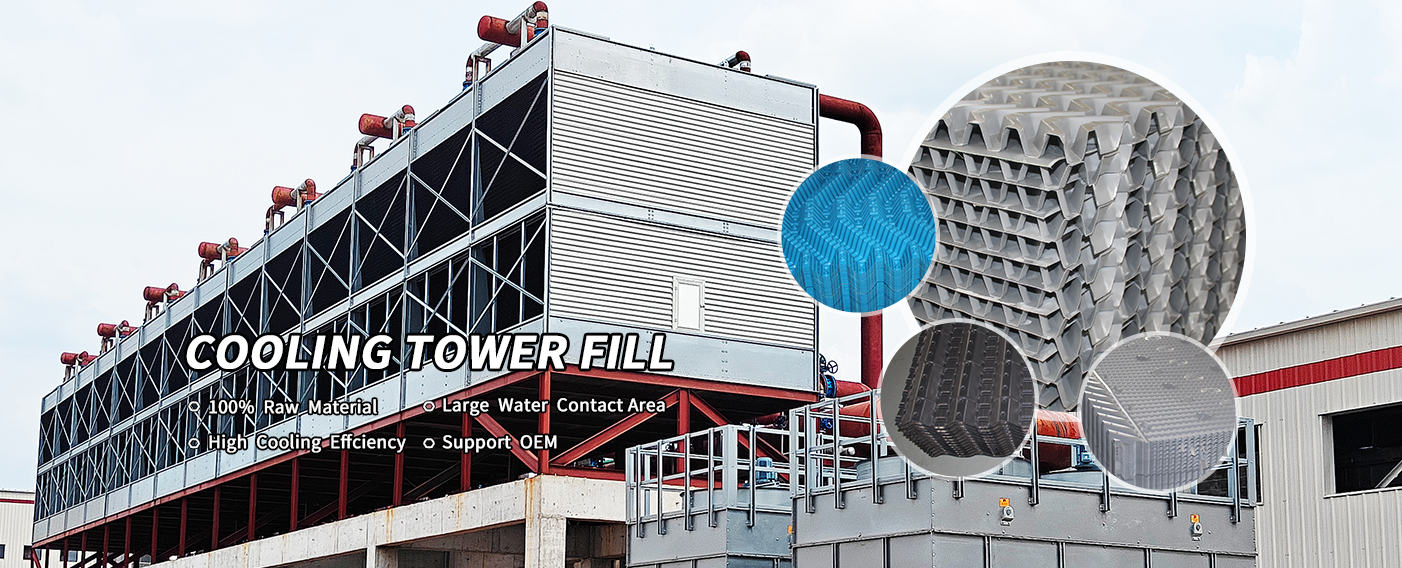
Cooling tower fill is one of those components you may not think about until something goes wrong.
The tower is running. The fan is turning. Water is circulating. Yet the leaving-water temperature keeps creeping upward. The system needs more fan power. Production temperatures become harder to control. Then someone asks the question: “Is it time to replace the cooling tower fill?”
In many cases, the answer may be yes.
Cooling tower fill plays a critical role in creating efficient contact between circulating water and air. When the fill becomes clogged, scaled, cracked, deformed, or structurally weak, the tower can lose a surprising amount of cooling capacity.
So, when should you replace cooling tower fill? What does replacement cost? Can you simply clean the existing fill? And how do you choose the right replacement?
Let's break it down.
What Is Cooling Tower Fill?
Cooling tower fill is the internal media installed inside a cooling tower to improve the contact between hot water and air.
Think of the fill as a traffic system for water.
Instead of allowing water to fall rapidly from the distribution system directly into the basin, fill media spreads the water over a much larger surface and slows its movement. Air passes through this wetted surface, allowing heat to transfer from the water into the air.
There are several common types of cooling tower fill, including:
PVC film fill
PP film fill
Splash fill
High-temperature fill
Crossflow fill
Counterflow fill
Each type has different characteristics, and the right choice depends on the tower design and operating conditions.

Why Cooling Tower Fill Matters
Why does a relatively inexpensive component have such a major influence on cooling tower performance?
Because heat transfer depends heavily on water-air contact.
Good fill creates a large effective surface area while keeping water distributed evenly. This gives the air more opportunity to absorb heat and moisture from the circulating water.
When fill performs well, you can typically expect:
Better heat transfer
More consistent water distribution
Improved cooling capacity
Better use of tower volume
Stable approach temperatures
More efficient operation
But the opposite is also true.
If the fill becomes blocked or damaged, water may channel through certain areas while other areas remain relatively dry. The tower may still look like it is operating normally, but its actual heat-transfer performance can deteriorate.
How Does Cooling Tower Fill Wear Out?
Cooling tower fill does not usually fail overnight.
Instead, deterioration often happens gradually.
Mineral scale starts building on the surface. Dirt collects inside the passages. Algae grows in wet areas. Water distribution becomes less uniform. Plastic sheets become brittle after years of exposure to heat, chemicals, and ultraviolet radiation.
Eventually, the fill loses its original shape and performance.
The most common causes include:
Poor water quality
Excessive mineral scaling
Suspended solids
Algae and biological growth
Oil contamination
Excessive operating temperature
Chemical attack
Mechanical damage
Poor water distribution
Inadequate maintenance
This is why cooling tower fill replacement should be based on actual condition, not simply on age.
When Should You Replace Cooling Tower Fill?
There is no single replacement interval that works for every cooling tower.
One tower might operate for many years with good maintenance, while another operating with dirty water may require replacement much sooner.
The important question is not:
“How old is the fill?”
Instead, ask:
“Can the existing fill still perform its intended heat-transfer function?”
Here are the most important warning signs.
Loss of Cooling Performance
A gradual decline in cooling performance is one of the biggest clues.
Suppose your tower previously delivered the required cold-water temperature, but now the outlet water remains warmer even though the heat load and weather conditions are similar.
What changed?
If fans, pumps, nozzles, and other major components are operating correctly, deteriorated fill may be one of the suspects.
Watch for:
Higher cold-water temperature
Increased approach temperature
Reduced heat rejection
Longer operating periods
Increased fan operation
Difficulty meeting process cooling requirements
Of course, these symptoms can also come from airflow problems, poor water distribution, fouled nozzles, or other mechanical issues. That's why inspection matters.
Visible Fill Damage
Sometimes the answer is right in front of you.
During an inspection, look for:
If the fill has physically collapsed, cleaning will not bring it back to its original geometry.
A damaged film-fill pack is a little like a crushed heat exchanger. You can wash it, but washing does not restore its original structure.
At this point, replacement is usually the more practical solution.

Excessive Scaling and Fouling
Scale is another major reason for cooling tower fill replacement.
Hard-water minerals can gradually deposit on the fill surface. Over time, those deposits become thicker and cover the passages through which water and air should move.
The problem is twofold.
First, scale reduces the effective wetted surface. Second, heavy deposits can restrict airflow and water movement.
Light deposits may be removable through appropriate cleaning procedures.
But if the fill has become heavily encrusted, brittle, or permanently blocked, replacement may provide a much better result.
Clogging and Restricted Water Flow
Film fill typically contains many relatively narrow passages.
That geometry is excellent for creating surface area, but it also means that suspended solids can become a problem.
When passages become clogged:
Water cannot distribute evenly.
Airflow resistance may increase.
Dry spots can develop.
Heat-transfer efficiency declines.
Water may bypass large sections of the fill.
If the clogging is severe and cannot be effectively removed, replacing the fill becomes a logical maintenance decision.
Biological Growth
Cooling towers operate with warm water, moisture, air, and nutrients. That environment can support biological growth.
Algae, slime, and biofilm may accumulate on the fill.
A small amount of biological contamination does not automatically mean you need new fill. Proper water treatment and cleaning may solve the problem.
However, long-term biological growth can trap dirt and minerals, creating thick deposits that are difficult to remove.
When the fill structure is also damaged, replacement may be more cost-effective than repeated cleaning.
Deformation and Brittleness
Plastic fill can change physically over time.
Continuous exposure to temperature, chemicals, water treatment products, and mechanical stress can make the material brittle or deformed.
Once the fill loses its designed geometry, water may no longer form the intended thin film.
That's important because the original geometry is not decorative. It is part of the heat-transfer design.
If the channels collapse, the tower may lose effective surface area and airflow capacity.
Cooling Tower Fill Replacement vs. Cleaning: Which Do You Need?
This is one of the most common questions from cooling tower operators.
The simple rule is:
Clean the fill when the material is healthy but dirty. Replace the fill when the material itself has deteriorated.
For example, imagine a PVC fill pack covered with removable dust and light biological deposits. The sheets remain intact, flexible, and properly shaped.
Cleaning may be enough.
Now imagine the same fill after years of operation. The passages are heavily blocked, sheets are cracked, and sections have collapsed.
Cleaning cannot solve the structural problem.
Replacement makes more sense.
How Much Does Cooling Tower Fill Replacement Cost?
The cost of cooling tower fill replacement varies considerably.
There is no reliable single price because every tower has different dimensions, fill volume, material requirements, access conditions, and installation needs.
The main cost factors include:
Fill Material
PVC film fill is widely used because it offers a practical balance between performance and cost.
PP fill may be considered for applications involving higher temperatures or specific chemical conditions.
Splash fill can be attractive where water quality or fouling conditions make film fill less suitable.
The cheapest material is not necessarily the cheapest solution over the entire service life.
Fill Volume and Tower Size
A small industrial cooling tower may require only a limited amount of replacement fill.
A large power plant, process plant, or HVAC cooling tower can require a much larger fill volume.
Naturally, more fill means higher material and transportation costs.
Tower size also affects installation time.
Labor and Installation
Don't forget the labor.
Removing old fill can take time, especially if the fill has become brittle, heavily scaled, or difficult to access.
Installation costs may include:
If the tower is difficult to access, labor can become a significant portion of the total project cost.
Water Quality and Operating Conditions
Water quality directly affects fill life.
If your circulating water contains high levels of suspended solids, minerals, oil, or biological contaminants, the fill may deteriorate faster.
That means you should consider lifecycle cost, not simply purchase price.
A slightly more expensive fill that survives demanding conditions may be cheaper than replacing low-cost fill repeatedly.
Cooling Tower Fill Replacement Process
A professional replacement project should follow a logical sequence.
Step 1: Inspect the Existing Fill
Start by examining the existing fill.
Check for scaling, clogging, cracks, deformation, biological growth, and collapsed areas.
At the same time, inspect the water distribution system and support structure.
Why?
Because installing new fill without fixing the original problem can simply repeat the same failure.
Step 2: Measure the Fill Area
Accurate measurements are essential.
Confirm:
Fill length
Fill width
Fill height
Block configuration
Support spacing
Water loading
Airflow direction
Tower type
A few centimeters of dimensional error can create installation problems.
Step 3: Remove Old Fill
Remove the old fill carefully.
Don't treat the job as simply ripping plastic out of the tower.
Internal components such as support beams, piping, nozzles, and structural members can be damaged if removal is careless.
Step 4: Clean the Fill Chamber
Before installing new media, remove accumulated debris, scale fragments, sludge, and loose contamination.
The replacement fill should go into a reasonably clean environment.
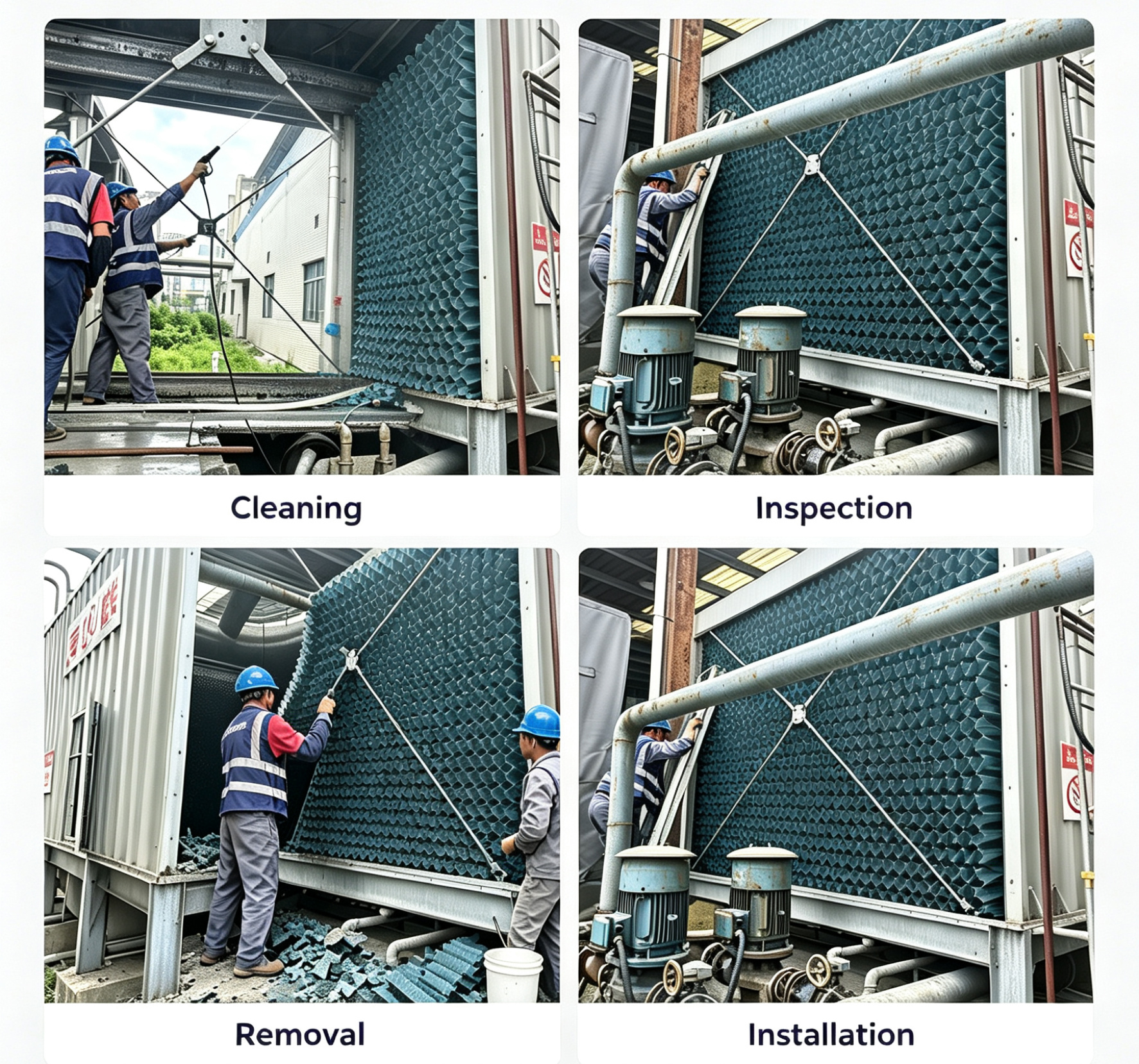
Step 5: Install New Fill
Install the new cooling tower fill according to the tower configuration.
Pay attention to block orientation, spacing, support points, and water-flow direction.
For film fill, correct installation is particularly important because the geometry is designed to guide water and air through the fill.
Step 6: Check Water Distribution
After installation, inspect water distribution.
Water should reach the fill evenly rather than concentrating in a few areas.
Poor distribution can create dry zones and overloaded wet zones, reducing the benefit of the new fill.
How to Choose Replacement Cooling Tower Fill
Choosing replacement fill is more than measuring a box and ordering plastic sheets.
You should evaluate the complete operating environment.
Ask:
Is the tower crossflow or counterflow?
What is the circulating water temperature?
What is the water quality?
How much suspended solid is present?
Is scaling a recurring problem?
Is biological fouling common?
What is the water loading?
What type of nozzles are installed?
What is the expected airflow?
What is the current fill material?
These answers help determine the appropriate fill design.
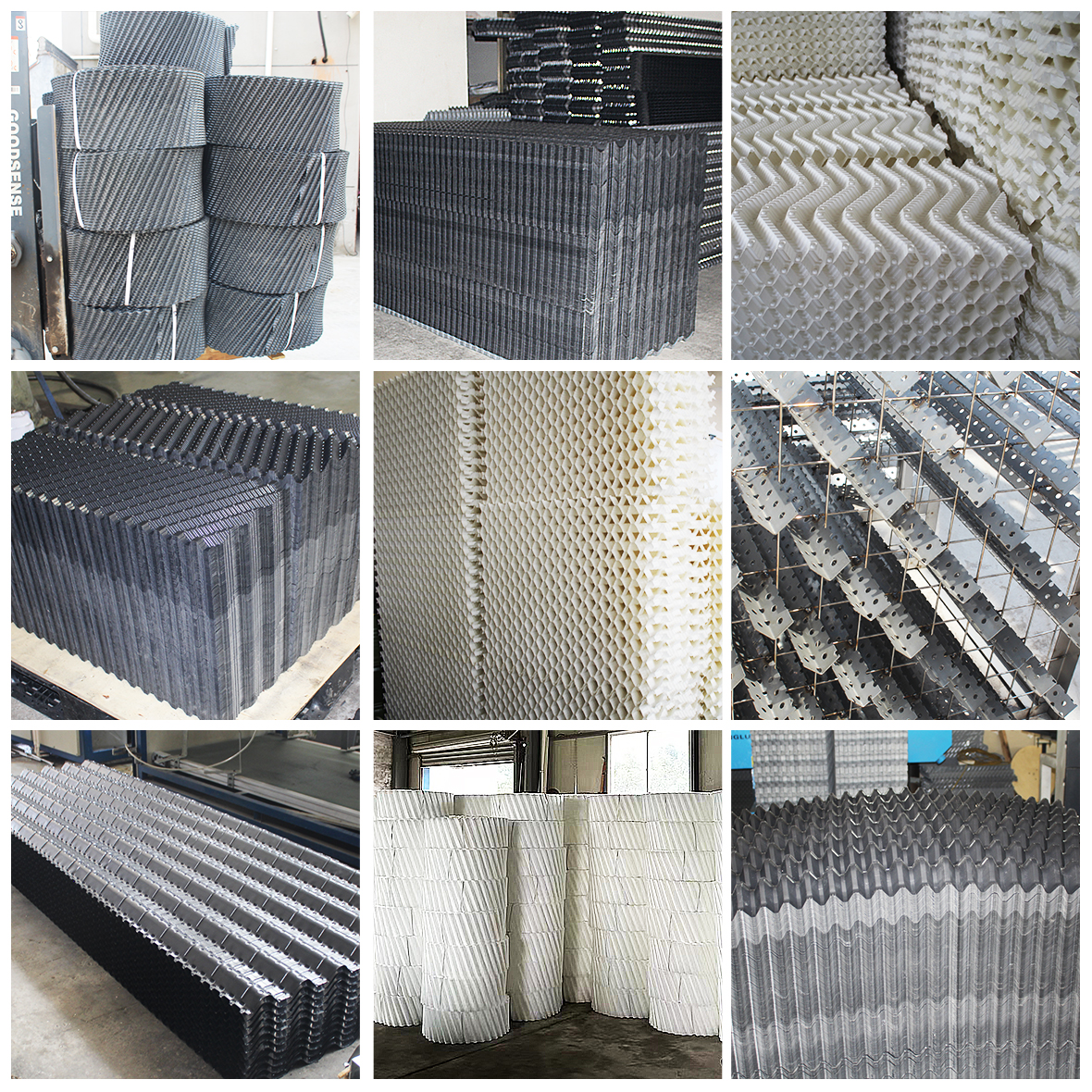
Film Fill or Splash Fill?
Film fill and splash fill work differently.
Film fill spreads water into thin films across a large surface area. It is commonly selected when high heat-transfer efficiency and compact tower design are important.
Splash fill breaks falling water into droplets through repeated splashing. It can be useful in applications where water contains more suspended solids or where clogging resistance is important.
Neither option is automatically better.
The correct choice depends on the tower and water conditions.
PVC or PP Fill?
PVC is one of the most common materials for cooling tower film fill.
It provides a useful combination of:
PP, or polypropylene, can be considered for applications where higher temperature resistance or particular chemical characteristics are required.
The key is to match the material to the application rather than choosing based solely on price.
Match Fill to Water Quality
This step is frequently overlooked.
Imagine installing a fine-passage film fill into a tower handling heavily contaminated water.
At first, performance may be excellent.
But if the passages clog quickly, the apparent savings disappear.
Water treatment, filtration, blowdown control, and fill selection should therefore be considered together.
The fill is one part of a larger cooling-water system.
Common Mistakes During Fill Replacement
Several mistakes can make a replacement project unnecessarily expensive.
Choosing Only by Price
The lowest quotation may look attractive.
But what happens if the fill fails early?
Replacement labor, downtime, transportation, and lost production can easily outweigh the initial savings.
Ignoring the Existing Tower Design
Not every fill fits every tower.
Crossflow and counterflow towers have different airflow and water-distribution arrangements.
Using the Wrong Dimensions
Incorrect fill height or block dimensions can create gaps, interference, or poor airflow.
Ignoring Water Distribution
New fill cannot compensate for badly designed or damaged water distribution.
Replacing Fill Without Finding the Root Cause
If scale caused the original failure, replacing the fill without addressing water treatment simply starts the same countdown again.
Best Practices for Longer Fill Life
Want your replacement fill to last longer?
Start with the water.
Good water treatment is one of the most effective ways to protect cooling tower fill.
Useful practices include:
Monitor circulating-water quality.
Control suspended solids.
Manage mineral concentration.
Maintain appropriate blowdown.
Control biological growth.
Inspect fill regularly.
Keep spray nozzles clear.
Maintain even water distribution.
Check operating temperatures.
Remove deposits before they become severe.
Regular inspection is especially valuable because early problems are much cheaper to solve than major fill failure.
Why Work With an Experienced Cooling Tower Fill Manufacturer?
A cooling tower fill manufacturer can do more than supply replacement media.
An experienced supplier should be able to help you evaluate:
This is particularly useful when the original fill specification is unavailable.
Instead of guessing based on appearance, you can provide tower drawings, dimensions, photos, operating data, or old fill samples and work toward a compatible replacement.
For industrial projects, this can significantly reduce the risk of ordering the wrong product.
Power Tower Cooling Technology (Shaoxing) Co.,Ltd provides cooling tower fill and related components for industrial cooling applications. You can learn more through www.coolingtowerpart.com.
Cooling Tower Fill Replacement FAQ
How often should cooling tower fill be replaced?
There is no universal replacement schedule.
Service life depends on water quality, temperature, chemical exposure, operating hours, maintenance, and tower design.
Instead of replacing fill simply because it has reached a certain age, inspect its physical condition and monitor cooling performance.
Can damaged cooling tower fill be repaired?
Minor contamination can often be treated through cleaning.
However, cracked, collapsed, severely deformed, or brittle fill generally cannot be restored to its original performance through cleaning.
In those cases, replacement is usually the better option.
Can I replace only part of the fill?
Yes.
Partial cooling tower fill replacement can be practical when deterioration is limited to specific sections.
However, the replacement fill should be compatible with the existing fill geometry, material, dimensions, and operating conditions.
If different fill types are mixed incorrectly, water distribution and airflow characteristics can change.
What is the best material for replacement fill?
There is no single material that is best for every cooling tower.
PVC is widely used for conventional film-fill applications.
PP can be considered when higher temperature or specific chemical resistance is required.
Splash fill may be preferable for some applications with higher fouling or solids loading.
The right choice depends on the complete operating environment.
Final Thoughts
Cooling tower fill replacement is not simply a maintenance task involving the removal of old plastic and installation of new plastic.
It is an opportunity to restore the tower's heat-transfer performance, water distribution, airflow, and operating efficiency.
Look for warning signs such as declining cooling performance, heavy scaling, clogged passages, biological buildup, cracks, deformation, and brittle material.
Before replacing the fill, determine whether cleaning can solve the problem. If the fill has suffered structural deterioration, replacement is usually the more reliable approach.
And don't choose replacement fill based on price alone.
Consider tower design, water quality, operating temperature, fill geometry, material, installation requirements, and expected service life.
When you get those factors right, the new fill does more than make the tower look better. It gives the cooling tower a fresh heat-transfer surface and helps it get back to doing its job efficiently.
For cooling tower fill replacement, PVC film fill, PP fill, splash fill, and related cooling tower components, Power Tower Cooling Technology (Shaoxing) Co.,Ltd can be a manufacturing source for industrial applications. Visit www.coolingtowerpart.com for more product information.


