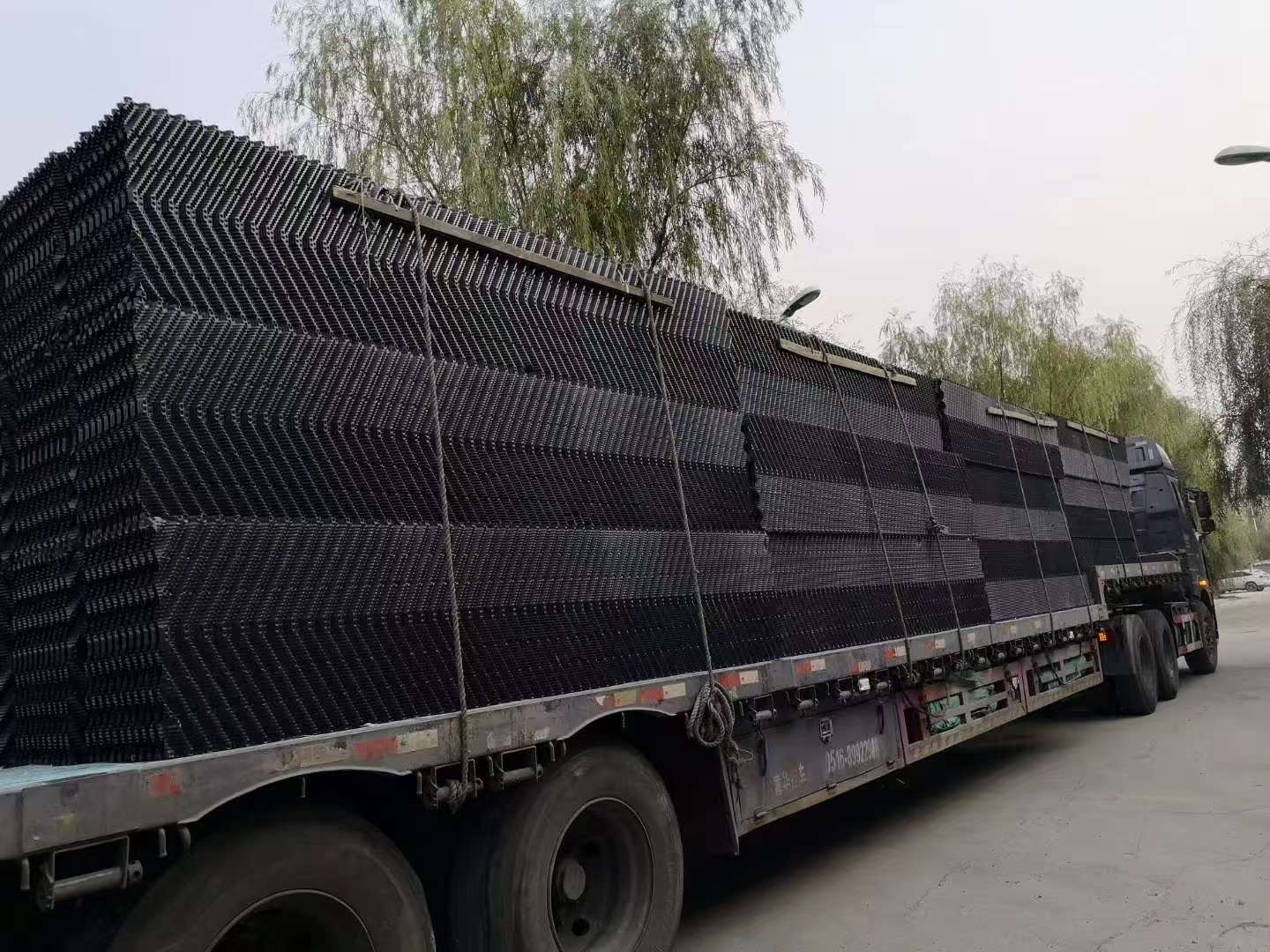
When you look inside a cooling tower, fill media may not seem like the most impressive component. It is usually made from lightweight plastic sheets, panels, bars, or structured blocks. Yet this relatively simple component plays a major role in determining how effectively a cooling tower rejects heat.
So, what exactly is fill media in a cooling tower?
In simple terms, cooling tower fill media creates a large contact area where hot circulating water meets moving air. The greater and more controlled this contact becomes, the more effectively evaporation can remove heat from the water.
But choosing cooling tower fill media is not simply a matter of buying the product with the highest surface area. Water quality, operating temperature, airflow, tower design, fouling risk, maintenance requirements, and service life all matter.
In this guide, we will explain what fill media is, how it works, the major types and materials, the differences between film fill and splash fill, common applications, maintenance requirements, and how to select the right fill media for your cooling tower.
What Is Cooling Tower Fill Media?
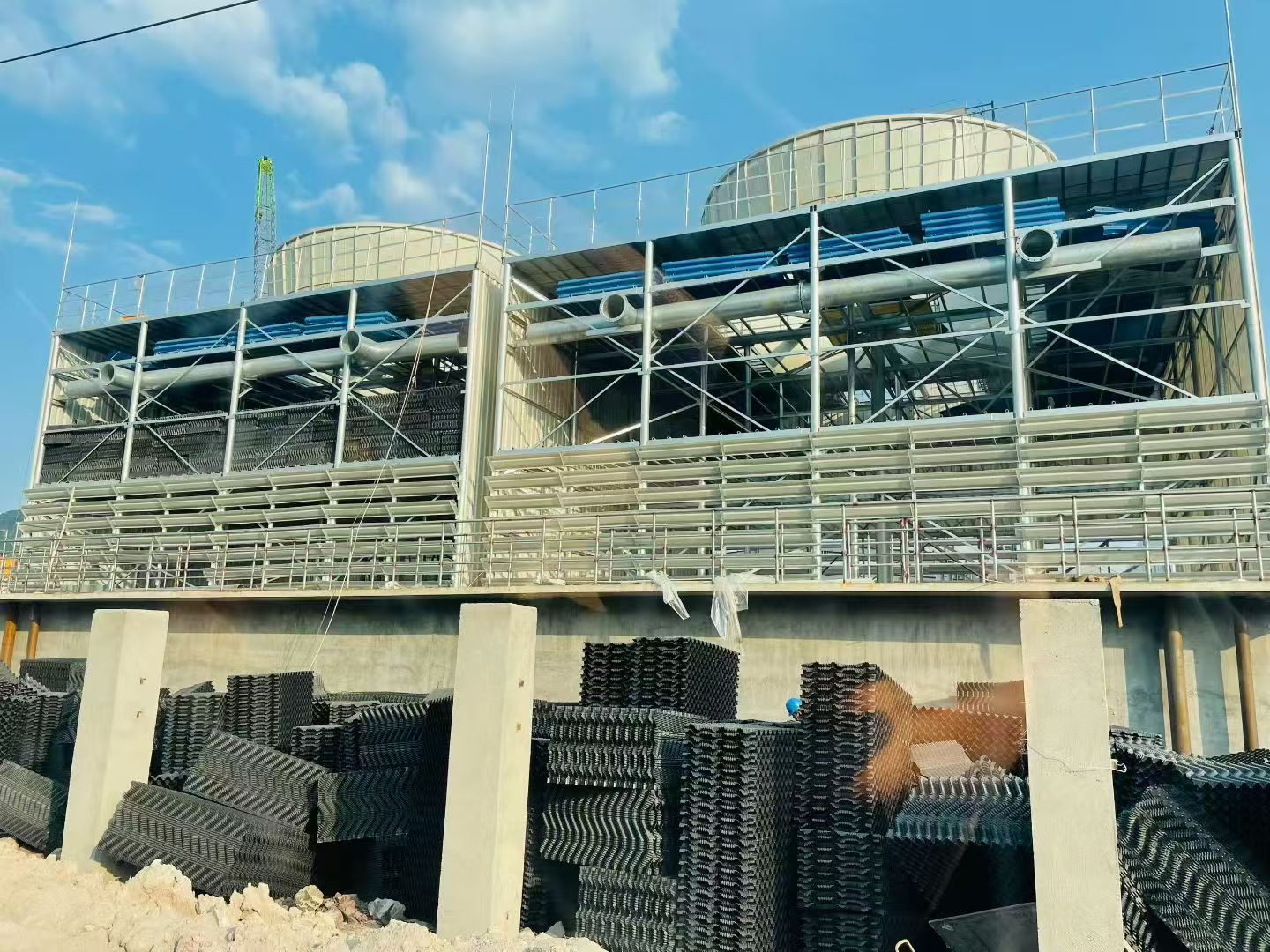
Cooling tower fill media is an internal heat-transfer component installed inside a wet cooling tower. Its primary purpose is to increase the contact between circulating water and air.
Think of fill media as a highway interchange for heat.
Instead of allowing hot water to simply fall from the distribution system into the basin, the fill spreads, redirects, or breaks up the water as it moves downward. At the same time, air flows through the fill.
This creates a much larger effective contact area between water and air.
A small amount of water evaporates during this process. The energy required for evaporation comes from the remaining water, which lowers its temperature. The cooled water then collects in the cold-water basin and is pumped back into the industrial or HVAC system.
Therefore, cooling tower fill media does not create cooling by itself. Instead, it creates the physical environment that allows evaporative heat rejection to happen efficiently.
Why Is Fill Media Important for Heat Transfer?
A cooling tower can have a powerful fan, a good water distribution system, and a strong structural design, but poor fill media can still limit its performance.
Why?
Because heat transfer depends heavily on the interaction between water and air.
Good fill media can:
Increase water-air contact area
Spread water more evenly
Increase contact time
Promote turbulence
Support evaporation
Improve heat-transfer efficiency
Reduce the required tower volume for a given cooling duty
This is why fill media is often considered one of the most important components inside a wet cooling tower.
However, there is an important catch.
More surface area does not automatically mean better performance.
If fill channels are too narrow for the water quality, suspended solids, scale, algae, and biological deposits can accumulate. Once the fill becomes clogged, airflow and water distribution suffer.
In real-world applications, the best fill media is the one that provides the right balance between thermal performance, fouling resistance, durability, and maintenance requirements.
How Does Cooling Tower Fill Media Work?
The working principle is surprisingly simple.
Hot water enters the fill area through the tower's water distribution system. The fill then spreads the water over a large surface or repeatedly breaks the water into droplets.
Meanwhile, air moves through the fill.
Depending on the cooling tower design, the airflow may move upward, horizontally, or in another controlled direction relative to the water.
The interaction between water and air allows heat to transfer from the water to the air. At the same time, evaporation removes additional heat.
The process can be thought of as a controlled conversation between water and air.
The fill media makes sure they have plenty of opportunities to interact.
Increasing Water-Air Contact Area
The biggest advantage of structured fill is its ability to create a large effective contact area inside a relatively compact volume.
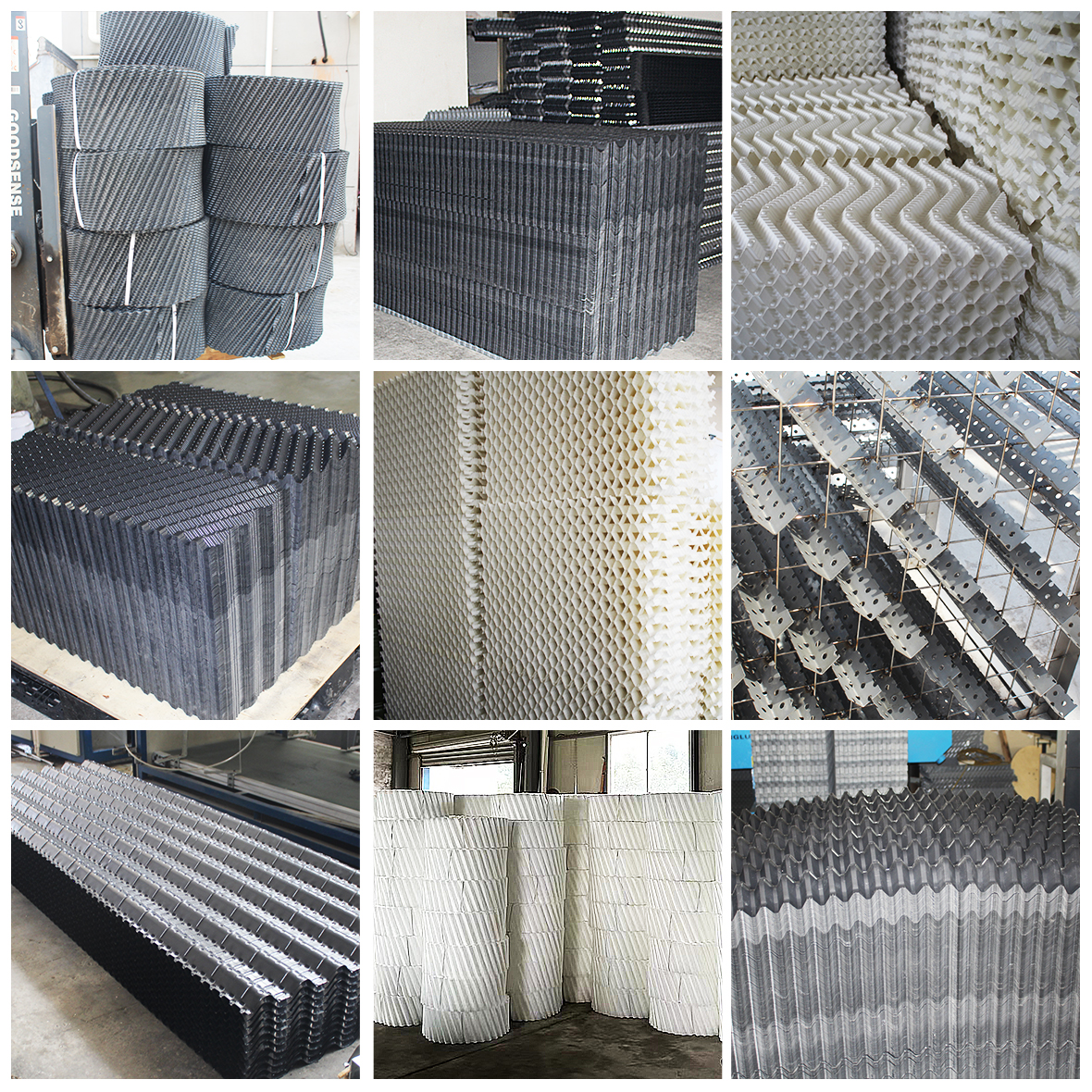
Film fill uses corrugated sheets to spread water into a thin layer. Splash fill uses bars, grids, or other structures to break falling water into droplets.
Both methods increase the amount of water exposed to air.
Supporting Evaporative Cooling
Evaporation is the key to wet cooling tower operation.
When a small portion of circulating water evaporates, it carries heat away from the remaining water. Fill media helps maximize the conditions required for this process.
The goal is not simply to keep water inside the tower for as long as possible. Instead, the goal is to achieve efficient contact between water and air while maintaining acceptable airflow resistance and pressure drop.
That balance is critical.
Main Types of Cooling Tower Fill Media
Cooling tower fill media can generally be divided into two major categories:
Film fill media
Splash fill media
There are also specialized and hybrid designs developed for particular operating conditions.
Film Fill Media
Film fill is one of the most common types of cooling tower fill.
It consists of thin plastic sheets formed with corrugations, channels, or other structured patterns. Multiple sheets are assembled into a fill pack or fill block.
As water flows downward across the sheets, it spreads into a thin film. Air moves through the channels, creating extensive water-air contact.
The major advantage of film fill is its high effective surface area.
For applications with relatively clean water and good water treatment, film fill can provide excellent thermal performance within a compact space.
Cross-Fluted Film Fill
Cross-fluted film fill uses specially shaped sheets that guide water and air through changing directions.
The geometry encourages water redistribution and turbulence, helping improve contact between the two fluids.
Cross-fluted fill is widely used in cooling towers because it can provide a good combination of:
High surface area
Effective water distribution
Heat-transfer performance
Compact installation
Relatively low material weight
Different manufacturers use different flute angles, sheet thicknesses, spacing, and pack configurations. Therefore, two products that look similar may not have exactly the same thermal characteristics.
Vertical-Fluted and Low-Clog Film Fill
Traditional film fill can be highly efficient, but tightly spaced channels may be vulnerable to fouling when water contains high levels of suspended solids or biological contaminants.
This is where low-clog and vertical-flute designs become useful.
These products typically use larger or more open water and air passages. The objective is to reduce the possibility of blockage while maintaining acceptable thermal performance.
For industrial cooling towers with challenging water quality, this can be a very practical solution.
Splash Fill Media
Splash fill takes a different approach.
Instead of spreading water continuously over sheets, splash fill uses bars, grids, or structured elements to repeatedly break falling water into smaller droplets.
Each collision changes the direction and distribution of the water, increasing its exposure to air.
Splash fill is particularly attractive for applications where water contains suspended solids or where fouling resistance is a major concern.
Its more open structure can provide larger passages for water and air.
The trade-off is that splash fill may require more volume to achieve the same thermal duty as a high-performance film fill.
Bar-Type Splash Fill
Bar-type splash fill consists of individual elements arranged to interrupt falling water.
As water strikes the bars, it breaks into droplets and is redistributed.
This design has traditionally been used in many industrial cooling towers, especially where water quality makes tightly spaced film fill less attractive.
Grid and Trickle Splash Fill
Grid and trickle-style fill designs use open structures to repeatedly split and redistribute water.
These designs can be useful for industrial applications where fouling, debris, or difficult water chemistry is a concern.
Depending on the operating temperature and chemical environment, different polymer materials may be selected.
Hybrid and Specialized Fill Media
Not every cooling tower application fits perfectly into the film-versus-splash categories.
Some modern fill products use modified corrugations, larger openings, vertical channels, or hybrid geometries.
The goal is usually the same: maintain useful thermal performance while improving resistance to fouling, reducing pressure drop, or extending service life.
For demanding industrial applications, the best fill media is not necessarily the product with the highest theoretical surface area.
It is the product that continues to perform reliably under actual operating conditions.
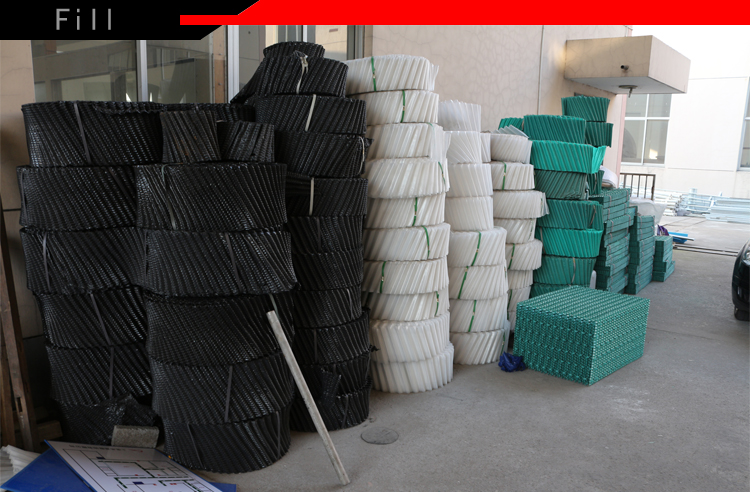
Common Cooling Tower Fill Media Materials
The material used to manufacture fill media affects its temperature resistance, chemical compatibility, mechanical strength, durability, cost, and service life.
The most common materials include:
PVC Fill Media
PVC cooling tower fill media is widely used in conventional cooling tower applications.
PVC is popular because it provides a useful combination of:
PVC sheets can be thermoformed into complex corrugations and assembled into large fill packs.
For many commercial HVAC systems and industrial cooling towers, PVC film fill is an economical and efficient choice.
However, PVC should not be selected solely because it is common.
The operating temperature and water chemistry should always be checked against the manufacturer's specifications.
PP Fill Media
PP stands for polypropylene.
PP cooling tower fill is often considered when higher temperature resistance or stronger chemical resistance is required.
This makes PP particularly interesting for industrial cooling systems where operating conditions may be more demanding than those found in conventional HVAC systems.
PP can have a higher initial cost than standard PVC. However, if the operating environment would shorten the life of PVC fill, PP may provide better long-term value.
In other words, don't compare materials only by purchase price.
Compare their expected performance and service life.
CPVC and Other Specialty Materials
CPVC can be considered for applications where standard PVC does not provide sufficient temperature resistance.
Other specialty materials may also be used where the cooling water contains aggressive chemicals or where operating temperatures exceed the normal range of standard PVC products.
The correct question is therefore not:
“Which material is the best?”
A better question is:
“Which material is best for my operating conditions?”
PVC vs PP Fill Media: Which Is Better?
PVC and PP are both useful materials, but they are not designed for exactly the same conditions.
PVC is often preferred for conventional cooling tower applications because it provides a good balance between performance and cost.
PP becomes more attractive when temperature, chemical exposure, or other operating conditions become more demanding.
A simple analogy helps.
Imagine choosing tires for a vehicle. Standard road tires may be perfect for normal driving, while heavy-duty tires may be a better choice for rough terrain.
Neither tire is universally better.
The same principle applies to cooling tower fill media.
Choose the material based on the job.
Before selecting PVC or PP fill, consider:
Film Fill vs Splash Fill: Which Should You Choose?
This is one of the most common questions buyers ask.
The answer depends heavily on water quality and the required cooling performance.
Film fill generally offers:
High effective surface area
Excellent thermal performance
Compact installation
Efficient water distribution
But tightly spaced film fill may be more sensitive to fouling.
Splash fill generally offers:
However, splash fill may require a greater fill volume to achieve the same thermal performance.
So, which one is better?
Neither is automatically better.
If your water is relatively clean and well treated, film fill may provide an excellent balance of efficiency and compactness.
If your water contains substantial suspended solids or has a high fouling risk, splash or low-clog fill may be a better long-term choice.
How to Choose the Right Fill Media
Selecting the right cooling tower fill should start with operating conditions rather than product price.
Before contacting a supplier, collect as much information about your tower as possible.
At minimum, you should know:
Cooling tower type
Crossflow or counterflow configuration
Water flow rate
Entering water temperature
Leaving water temperature
Operating temperature
Air conditions
Existing fill dimensions
Water quality
Maintenance history
Water Quality
Water quality is one of the most important considerations.
High levels of suspended solids, scale-forming minerals, algae, biological slime, oil, or other contaminants can significantly affect fill performance.
If the water is clean and properly treated, high-surface-area film fill may be appropriate.
If water quality is poor, a more open fill design may provide better reliability.
This is a crucial point because a fill that performs brilliantly on paper can become ineffective after months of fouling.
Operating Temperature
Temperature directly affects material selection.
Standard PVC is commonly used for conventional cooling tower applications, while PP or specialty materials may be selected for higher-temperature environments.
Always check the manufacturer's specified continuous operating temperature.
Don't rely on assumptions such as “PP is always better for high temperatures” or “PVC works everywhere.”
Every application has its own requirements.
Cooling Tower Design
You also need to consider the tower itself.
Is it a crossflow tower or a counterflow tower?
How is the existing fill supported?
What are the dimensions of the fill pack?
How is water distributed?
How does air move through the fill?
These details can determine whether a particular fill product is suitable.
A replacement fill should fit the existing tower correctly without creating unexpected airflow resistance, water-distribution problems, or structural issues.

Thermal Performance Requirements
Fill media should never be considered independently from the rest of the cooling tower.
Fan performance, water distribution, airflow, drift eliminators, nozzle condition, and tower configuration all affect final performance.
For example, installing high-performance fill will not solve a severely blocked water distribution system.
Think of the cooling tower as a team.
Every component has to do its job.
Cooling Tower Fill Media Applications
Cooling tower fill media is used across a huge range of applications.
You can find it in:
HVAC and Commercial Cooling
Commercial cooling towers generally require reliable thermal performance, reasonable operating costs, and manageable maintenance.
PVC film fill is commonly considered for these applications because it can provide substantial water-air contact area within a relatively compact space.
Proper water treatment is especially important because fouled fill can quickly reduce performance.
Industrial Cooling Systems
Industrial cooling systems can be significantly more demanding.
Circulating water may contain:
Operating temperatures may also be higher.
Depending on these conditions, industrial cooling towers may use PVC film fill, PP fill, splash fill, low-clog film fill, or specialized products.
Power, Petrochemical and Process Industries
Large industrial cooling towers often operate continuously.
When cooling performance drops, the consequences can extend beyond the cooling tower itself.
Poor heat rejection may affect production equipment, process stability, energy consumption, and overall plant efficiency.
For this reason, fill selection should be treated as a long-term reliability decision.
Common Cooling Tower Fill Media Problems
Even high-quality fill media can experience problems if operating conditions or maintenance are poor.
Common issues include:
Clogging
Fouling
Scaling
Biological growth
Cracking
Deformation
Collapse
Chemical degradation
Excessive deposits
Clogging and Fouling
Clogging is one of the biggest concerns with cooling tower fill.
As deposits accumulate inside the channels, the available space for airflow and water movement becomes smaller.
This can increase pressure drop and reduce effective heat transfer.
Eventually, the tower may require more fan energy while delivering less cooling.
That is why fill selection should always consider the actual water quality.
Scaling and Biological Growth
Mineral scale can cover fill surfaces and reduce effective contact area.
At the same time, algae and biological slime can block channels.
These problems are often connected to poor water treatment.
Regular monitoring of water chemistry and biological control can significantly reduce the risk.
Deformation and Structural Damage
Fill media can deform or collapse because of excessive deposits, improper support, high temperature, chemical exposure, mechanical loading, or long-term aging.
Once fill collapses, water and airflow paths can change significantly.
The result may be reduced cooling performance and additional stress on the fill-support system.
How to Maintain Cooling Tower Fill Media
Maintenance starts with inspection.
During regular maintenance or shutdowns, inspect the fill for:
The water distribution system should also be inspected.
Why?
Because even perfect fill cannot perform correctly if the nozzles are blocked or water is distributed unevenly.
Cleaning should always be performed using a method compatible with the fill material.
Aggressive mechanical cleaning can damage thin PVC sheets, while inappropriate chemicals may affect polymer properties.
A gentle and controlled cleaning program is usually much better than waiting until the fill becomes severely fouled.
When Should Cooling Tower Fill Media Be Replaced?
There is no universal replacement schedule for every cooling tower.
Fill service life depends on:
Water chemistry
Operating temperature
UV exposure
Biological control
Cleaning frequency
Mechanical conditions
Material selection
Tower operating hours
Replacement should be considered when the fill is severely fouled, damaged, brittle, collapsed, or no longer capable of delivering the required cooling performance.
If your cooling tower is consuming more energy while providing less cooling, don't immediately assume the fan or chiller is the problem.
Inspect the fill.
A degraded or blocked fill pack can be an important source of lost thermal performance.
How to Select a Reliable Fill Media Manufacturer
Choosing the right manufacturer is just as important as choosing the right fill type.
A reliable supplier should be able to provide more than a basic price quotation.
Ask about:
For a replacement project, provide the supplier with photos and dimensions of the existing fill.
If possible, also provide:
Cooling tower model
Existing fill dimensions
Fill height
Water flow
Water temperature
Water quality
Tower type
Support dimensions
The more information you provide, the easier it becomes for the manufacturer to recommend a suitable product.
Why Choose Power Tower Cooling Technology?
For customers looking for a professional fill media manufacturer and supplier, Power Tower Cooling Technology (Shaoxing) Co., Ltd. provides cooling tower fill solutions for both new installations and replacement projects.
As a manufacturer, Power Tower Cooling Technology focuses on matching fill media to actual cooling tower requirements rather than treating every project as a standard-size order.
Depending on the application, customers may require:
PVC film fill
PP cooling tower fill
Splash fill
Low-clog fill
Customized fill packs
Replacement cooling tower fill
Different sheet thicknesses
Customized fill dimensions
The correct product depends on the tower configuration and operating conditions.
For replacement projects, customers can provide existing fill dimensions, photos, cooling tower information, and operating data. This makes it easier to determine the appropriate fill configuration.
If you are sourcing cooling tower fill media for a new project or replacing an existing fill pack, you can learn more about products and manufacturing solutions at Coolingtowerpart.com.
Conclusion
So, what is fill media in a cooling tower?
It is the heat-transfer component that creates the surface and contact conditions needed for efficient water-air interaction.
Film fill uses structured sheets to create a large effective surface area and is often selected when high thermal performance and compact design are important.
Splash fill uses open structures to break water into droplets and can be an attractive choice when fouling resistance and water quality are major concerns.
PVC remains one of the most widely used materials for conventional cooling tower fill, while PP and specialty materials can offer advantages in higher-temperature or more chemically demanding applications.
The most important lesson is simple:
Don't choose cooling tower fill media based on price or surface area alone.
Instead, consider water quality, operating temperature, tower design, cooling duty, fouling risk, maintenance requirements, and expected service life.
When these factors are properly matched, the right fill media can significantly improve cooling tower performance and reliability.
Frequently Asked Questions About Fill Media
What Is the Purpose of Fill Media in a Cooling Tower?
The primary purpose of fill media is to increase the contact area between circulating water and air. This promotes evaporation and heat transfer, allowing the cooling tower to reduce water temperature more effectively.
What Material Is Commonly Used for Cooling Tower Fill?
PVC is widely used for conventional cooling tower fill because of its balance of thermal performance, cost, formability, and chemical resistance.
PP is another important material and can be considered for applications requiring greater temperature or chemical resistance. CPVC and specialty polymers may also be used for demanding operating conditions.
How Long Does Cooling Tower Fill Media Last?
There is no fixed service life for every application.
The actual lifespan depends on water quality, operating temperature, biological control, UV exposure, cleaning practices, mechanical loading, and material selection.
Regular inspection is more reliable than following a fixed replacement date.
Is Film Fill Better Than Splash Fill?
Not necessarily.
Film fill generally offers high thermal performance and a large effective surface area in a compact volume. Splash fill provides a more open structure and can be better suited to applications with higher fouling risks.
The best choice depends on your cooling tower and operating conditions.
Can Cooling Tower Fill Media Be Customized?
Yes.
Cooling tower fill can be manufactured or supplied in different pack dimensions, sheet thicknesses, flute configurations, and installation arrangements.
For replacement projects, providing the original fill dimensions and photographs can help the manufacturer determine the correct configuration.
What Information Should I Provide When Buying Fill Media?
When requesting a quotation, provide as much information as possible, including the cooling tower type, manufacturer or model, existing fill dimensions, fill height, water flow rate, entering and leaving water temperatures, water quality, operating temperature, and photos of the existing fill.
This information allows the manufacturer to recommend a more suitable product instead of simply supplying a generic fill pack.
What Is the Best Fill Media for an Industrial Cooling Tower?
There is no single best fill media for every industrial cooling tower.
PVC film fill can be an excellent choice for many conventional applications. PP fill may be more suitable for higher-temperature or chemically demanding environments, while splash or low-clog fill can be preferable when suspended solids and fouling are major concerns.
The best solution is the one that matches the tower's actual operating conditions.
Final Takeaway
Fill media may look simple, but it is one of the most important components inside a wet cooling tower.
Choose the right type, select the appropriate material, maintain it properly, and your cooling tower has a much better chance of delivering stable performance for years.
For cooling tower fill media, PVC fill, PP fill, splash fill, and customized replacement solutions, Power Tower Cooling Technology (Shaoxing) Co., Ltd. can provide manufacturer-based support for your project.
::
What Is Fill Media in a Cooling Tower? Types, Materials and Uses
When you look inside a cooling tower, fill media may not seem like the most impressive component. It is usually made from lightweight plastic sheets, panels, bars, or structured blocks. Yet this relatively simple component plays a major role in determining how effectively a cooling tower rejects heat.
So, what exactly is fill media in a cooling tower?
In simple terms, cooling tower fill media creates a large contact area where hot circulating water meets moving air. The greater and more controlled this contact becomes, the more effectively evaporation can remove heat from the water.
But choosing cooling tower fill media is not simply a matter of buying the product with the highest surface area. Water quality, operating temperature, airflow, tower design, fouling risk, maintenance requirements, and service life all matter.
In this guide, we will explain what fill media is, how it works, the major types and materials, the differences between film fill and splash fill, common applications, maintenance requirements, and how to select the right fill media for your cooling tower.
What Is Cooling Tower Fill Media?
Cooling tower fill media is an internal heat-transfer component installed inside a wet cooling tower. Its primary purpose is to increase the contact between circulating water and air.
Think of fill media as a highway interchange for heat.
Instead of allowing hot water to simply fall from the distribution system into the basin, the fill spreads, redirects, or breaks up the water as it moves downward. At the same time, air flows through the fill.
This creates a much larger effective contact area between water and air.
A small amount of water evaporates during this process. The energy required for evaporation comes from the remaining water, which lowers its temperature. The cooled water then collects in the cold-water basin and is pumped back into the industrial or HVAC system.
Therefore, cooling tower fill media does not create cooling by itself. Instead, it creates the physical environment that allows evaporative heat rejection to happen efficiently.
Why Is Fill Media Important for Heat Transfer?
A cooling tower can have a powerful fan, a good water distribution system, and a strong structural design, but poor fill media can still limit its performance.
Why?
Because heat transfer depends heavily on the interaction between water and air.
Good fill media can:
Increase water-air contact area
Spread water more evenly
Increase contact time
Promote turbulence
Support evaporation
Improve heat-transfer efficiency
Reduce the required tower volume for a given cooling duty
This is why fill media is often considered one of the most important components inside a wet cooling tower.
However, there is an important catch.
More surface area does not automatically mean better performance.
If fill channels are too narrow for the water quality, suspended solids, scale, algae, and biological deposits can accumulate. Once the fill becomes clogged, airflow and water distribution suffer.
In real-world applications, the best fill media is the one that provides the right balance between thermal performance, fouling resistance, durability, and maintenance requirements.
How Does Cooling Tower Fill Media Work?
The working principle is surprisingly simple.
Hot water enters the fill area through the tower's water distribution system. The fill then spreads the water over a large surface or repeatedly breaks the water into droplets.
Meanwhile, air moves through the fill.
Depending on the cooling tower design, the airflow may move upward, horizontally, or in another controlled direction relative to the water.
The interaction between water and air allows heat to transfer from the water to the air. At the same time, evaporation removes additional heat.
The process can be thought of as a controlled conversation between water and air.
The fill media makes sure they have plenty of opportunities to interact.
Increasing Water-Air Contact Area
The biggest advantage of structured fill is its ability to create a large effective contact area inside a relatively compact volume.
Film fill uses corrugated sheets to spread water into a thin layer. Splash fill uses bars, grids, or other structures to break falling water into droplets.
Both methods increase the amount of water exposed to air.
Supporting Evaporative Cooling
Evaporation is the key to wet cooling tower operation.
When a small portion of circulating water evaporates, it carries heat away from the remaining water. Fill media helps maximize the conditions required for this process.
The goal is not simply to keep water inside the tower for as long as possible. Instead, the goal is to achieve efficient contact between water and air while maintaining acceptable airflow resistance and pressure drop.
That balance is critical.
Main Types of Cooling Tower Fill Media
Cooling tower fill media can generally be divided into two major categories:
Film fill media
Splash fill media
There are also specialized and hybrid designs developed for particular operating conditions.
Film Fill Media
Film fill is one of the most common types of cooling tower fill.
It consists of thin plastic sheets formed with corrugations, channels, or other structured patterns. Multiple sheets are assembled into a fill pack or fill block.
As water flows downward across the sheets, it spreads into a thin film. Air moves through the channels, creating extensive water-air contact.
The major advantage of film fill is its high effective surface area.
For applications with relatively clean water and good water treatment, film fill can provide excellent thermal performance within a compact space.
Cross-Fluted Film Fill
Cross-fluted film fill uses specially shaped sheets that guide water and air through changing directions.
The geometry encourages water redistribution and turbulence, helping improve contact between the two fluids.
Cross-fluted fill is widely used in cooling towers because it can provide a good combination of:
High surface area
Effective water distribution
Heat-transfer performance
Compact installation
Relatively low material weight
Different manufacturers use different flute angles, sheet thicknesses, spacing, and pack configurations. Therefore, two products that look similar may not have exactly the same thermal characteristics.
Vertical-Fluted and Low-Clog Film Fill
Traditional film fill can be highly efficient, but tightly spaced channels may be vulnerable to fouling when water contains high levels of suspended solids or biological contaminants.
This is where low-clog and vertical-flute designs become useful.
These products typically use larger or more open water and air passages. The objective is to reduce the possibility of blockage while maintaining acceptable thermal performance.
For industrial cooling towers with challenging water quality, this can be a very practical solution.
Splash Fill Media
Splash fill takes a different approach.
Instead of spreading water continuously over sheets, splash fill uses bars, grids, or structured elements to repeatedly break falling water into smaller droplets.
Each collision changes the direction and distribution of the water, increasing its exposure to air.
Splash fill is particularly attractive for applications where water contains suspended solids or where fouling resistance is a major concern.
Its more open structure can provide larger passages for water and air.
The trade-off is that splash fill may require more volume to achieve the same thermal duty as a high-performance film fill.
Bar-Type Splash Fill
Bar-type splash fill consists of individual elements arranged to interrupt falling water.
As water strikes the bars, it breaks into droplets and is redistributed.
This design has traditionally been used in many industrial cooling towers, especially where water quality makes tightly spaced film fill less attractive.
Grid and Trickle Splash Fill
Grid and trickle-style fill designs use open structures to repeatedly split and redistribute water.
These designs can be useful for industrial applications where fouling, debris, or difficult water chemistry is a concern.
Depending on the operating temperature and chemical environment, different polymer materials may be selected.
Hybrid and Specialized Fill Media
Not every cooling tower application fits perfectly into the film-versus-splash categories.
Some modern fill products use modified corrugations, larger openings, vertical channels, or hybrid geometries.
The goal is usually the same: maintain useful thermal performance while improving resistance to fouling, reducing pressure drop, or extending service life.
For demanding industrial applications, the best fill media is not necessarily the product with the highest theoretical surface area.
It is the product that continues to perform reliably under actual operating conditions.
Common Cooling Tower Fill Media Materials
The material used to manufacture fill media affects its temperature resistance, chemical compatibility, mechanical strength, durability, cost, and service life.
The most common materials include:
PVC Fill Media
PVC cooling tower fill media is widely used in conventional cooling tower applications.
PVC is popular because it provides a useful combination of:
PVC sheets can be thermoformed into complex corrugations and assembled into large fill packs.
For many commercial HVAC systems and industrial cooling towers, PVC film fill is an economical and efficient choice.
However, PVC should not be selected solely because it is common.
The operating temperature and water chemistry should always be checked against the manufacturer's specifications.
PP Fill Media
PP stands for polypropylene.
PP cooling tower fill is often considered when higher temperature resistance or stronger chemical resistance is required.
This makes PP particularly interesting for industrial cooling systems where operating conditions may be more demanding than those found in conventional HVAC systems.
PP can have a higher initial cost than standard PVC. However, if the operating environment would shorten the life of PVC fill, PP may provide better long-term value.
In other words, don't compare materials only by purchase price.
Compare their expected performance and service life.
CPVC and Other Specialty Materials
CPVC can be considered for applications where standard PVC does not provide sufficient temperature resistance.
Other specialty materials may also be used where the cooling water contains aggressive chemicals or where operating temperatures exceed the normal range of standard PVC products.
The correct question is therefore not:
“Which material is the best?”
A better question is:
“Which material is best for my operating conditions?”

PVC vs PP Fill Media: Which Is Better?
PVC and PP are both useful materials, but they are not designed for exactly the same conditions.
PVC is often preferred for conventional cooling tower applications because it provides a good balance between performance and cost.
PP becomes more attractive when temperature, chemical exposure, or other operating conditions become more demanding.
A simple analogy helps.
Imagine choosing tires for a vehicle. Standard road tires may be perfect for normal driving, while heavy-duty tires may be a better choice for rough terrain.
Neither tire is universally better.
The same principle applies to cooling tower fill media.
Choose the material based on the job.
Before selecting PVC or PP fill, consider:
Film Fill vs Splash Fill: Which Should You Choose?
This is one of the most common questions buyers ask.
The answer depends heavily on water quality and the required cooling performance.
Film fill generally offers:
High effective surface area
Excellent thermal performance
Compact installation
Efficient water distribution
But tightly spaced film fill may be more sensitive to fouling.
Splash fill generally offers:
However, splash fill may require a greater fill volume to achieve the same thermal performance.
So, which one is better?
Neither is automatically better.
If your water is relatively clean and well treated, film fill may provide an excellent balance of efficiency and compactness.
If your water contains substantial suspended solids or has a high fouling risk, splash or low-clog fill may be a better long-term choice.
How to Choose the Right Fill Media
Selecting the right cooling tower fill should start with operating conditions rather than product price.
Before contacting a supplier, collect as much information about your tower as possible.
At minimum, you should know:
Cooling tower type
Crossflow or counterflow configuration
Water flow rate
Entering water temperature
Leaving water temperature
Operating temperature
Air conditions
Existing fill dimensions
Water quality
Maintenance history
Water Quality
Water quality is one of the most important considerations.
High levels of suspended solids, scale-forming minerals, algae, biological slime, oil, or other contaminants can significantly affect fill performance.
If the water is clean and properly treated, high-surface-area film fill may be appropriate.
If water quality is poor, a more open fill design may provide better reliability.
This is a crucial point because a fill that performs brilliantly on paper can become ineffective after months of fouling.
Operating Temperature
Temperature directly affects material selection.
Standard PVC is commonly used for conventional cooling tower applications, while PP or specialty materials may be selected for higher-temperature environments.
Always check the manufacturer's specified continuous operating temperature.
Don't rely on assumptions such as “PP is always better for high temperatures” or “PVC works everywhere.”
Every application has its own requirements.
Cooling Tower Design
You also need to consider the tower itself.
Is it a crossflow tower or a counterflow tower?
How is the existing fill supported?
What are the dimensions of the fill pack?
How is water distributed?
How does air move through the fill?
These details can determine whether a particular fill product is suitable.
A replacement fill should fit the existing tower correctly without creating unexpected airflow resistance, water-distribution problems, or structural issues.
Thermal Performance Requirements
Fill media should never be considered independently from the rest of the cooling tower.
Fan performance, water distribution, airflow, drift eliminators, nozzle condition, and tower configuration all affect final performance.
For example, installing high-performance fill will not solve a severely blocked water distribution system.
Think of the cooling tower as a team.
Every component has to do its job.
Cooling Tower Fill Media Applications
Cooling tower fill media is used across a huge range of applications.
You can find it in:
HVAC and Commercial Cooling
Commercial cooling towers generally require reliable thermal performance, reasonable operating costs, and manageable maintenance.
PVC film fill is commonly considered for these applications because it can provide substantial water-air contact area within a relatively compact space.
Proper water treatment is especially important because fouled fill can quickly reduce performance.
Industrial Cooling Systems
Industrial cooling systems can be significantly more demanding.
Circulating water may contain:
Operating temperatures may also be higher.
Depending on these conditions, industrial cooling towers may use PVC film fill, PP fill, splash fill, low-clog film fill, or specialized products.
Power, Petrochemical and Process Industries
Large industrial cooling towers often operate continuously.
When cooling performance drops, the consequences can extend beyond the cooling tower itself.
Poor heat rejection may affect production equipment, process stability, energy consumption, and overall plant efficiency.
For this reason, fill selection should be treated as a long-term reliability decision.
Common Cooling Tower Fill Media Problems
Even high-quality fill media can experience problems if operating conditions or maintenance are poor.
Common issues include:
Clogging
Fouling
Scaling
Biological growth
Cracking
Deformation
Collapse
Chemical degradation
Excessive deposits
Clogging and Fouling
Clogging is one of the biggest concerns with cooling tower fill.
As deposits accumulate inside the channels, the available space for airflow and water movement becomes smaller.
This can increase pressure drop and reduce effective heat transfer.
Eventually, the tower may require more fan energy while delivering less cooling.
That is why fill selection should always consider the actual water quality.
Scaling and Biological Growth
Mineral scale can cover fill surfaces and reduce effective contact area.
At the same time, algae and biological slime can block channels.
These problems are often connected to poor water treatment.
Regular monitoring of water chemistry and biological control can significantly reduce the risk.
Deformation and Structural Damage
Fill media can deform or collapse because of excessive deposits, improper support, high temperature, chemical exposure, mechanical loading, or long-term aging.
Once fill collapses, water and airflow paths can change significantly.
The result may be reduced cooling performance and additional stress on the fill-support system.
How to Maintain Cooling Tower Fill Media
Maintenance starts with inspection.
During regular maintenance or shutdowns, inspect the fill for:
The water distribution system should also be inspected.
Why?
Because even perfect fill cannot perform correctly if the nozzles are blocked or water is distributed unevenly.
Cleaning should always be performed using a method compatible with the fill material.
Aggressive mechanical cleaning can damage thin PVC sheets, while inappropriate chemicals may affect polymer properties.
A gentle and controlled cleaning program is usually much better than waiting until the fill becomes severely fouled.
When Should Cooling Tower Fill Media Be Replaced?
There is no universal replacement schedule for every cooling tower.
Fill service life depends on:
Water chemistry
Operating temperature
UV exposure
Biological control
Cleaning frequency
Mechanical conditions
Material selection
Tower operating hours
Replacement should be considered when the fill is severely fouled, damaged, brittle, collapsed, or no longer capable of delivering the required cooling performance.
If your cooling tower is consuming more energy while providing less cooling, don't immediately assume the fan or chiller is the problem.
Inspect the fill.
A degraded or blocked fill pack can be an important source of lost thermal performance.
How to Select a Reliable Fill Media Manufacturer
Choosing the right manufacturer is just as important as choosing the right fill type.
A reliable supplier should be able to provide more than a basic price quotation.
Ask about:
For a replacement project, provide the supplier with photos and dimensions of the existing fill.
If possible, also provide:
Cooling tower model
Existing fill dimensions
Fill height
Water flow
Water temperature
Water quality
Tower type
Support dimensions
The more information you provide, the easier it becomes for the manufacturer to recommend a suitable product.
Why Choose Power Tower Cooling Technology?
For customers looking for a professional fill media manufacturer and supplier, Power Tower Cooling Technology (Shaoxing) Co., Ltd. provides cooling tower fill solutions for both new installations and replacement projects.
As a manufacturer, Power Tower Cooling Technology focuses on matching fill media to actual cooling tower requirements rather than treating every project as a standard-size order.
Depending on the application, customers may require:
PVC film fill
PP cooling tower fill
Splash fill
Low-clog fill
Customized fill packs
Replacement cooling tower fill
Different sheet thicknesses
Customized fill dimensions
The correct product depends on the tower configuration and operating conditions.
For replacement projects, customers can provide existing fill dimensions, photos, cooling tower information, and operating data. This makes it easier to determine the appropriate fill configuration.
If you are sourcing cooling tower fill media for a new project or replacing an existing fill pack, you can learn more about products and manufacturing solutions at Coolingtowerpart.com.
Conclusion
So, what is fill media in a cooling tower?
It is the heat-transfer component that creates the surface and contact conditions needed for efficient water-air interaction.
Film fill uses structured sheets to create a large effective surface area and is often selected when high thermal performance and compact design are important.
Splash fill uses open structures to break water into droplets and can be an attractive choice when fouling resistance and water quality are major concerns.
PVC remains one of the most widely used materials for conventional cooling tower fill, while PP and specialty materials can offer advantages in higher-temperature or more chemically demanding applications.
The most important lesson is simple:
Don't choose cooling tower fill media based on price or surface area alone.
Instead, consider water quality, operating temperature, tower design, cooling duty, fouling risk, maintenance requirements, and expected service life.
When these factors are properly matched, the right fill media can significantly improve cooling tower performance and reliability.
Frequently Asked Questions About Fill Media
What Is the Purpose of Fill Media in a Cooling Tower?
The primary purpose of fill media is to increase the contact area between circulating water and air. This promotes evaporation and heat transfer, allowing the cooling tower to reduce water temperature more effectively.
What Material Is Commonly Used for Cooling Tower Fill?
PVC is widely used for conventional cooling tower fill because of its balance of thermal performance, cost, formability, and chemical resistance.
PP is another important material and can be considered for applications requiring greater temperature or chemical resistance. CPVC and specialty polymers may also be used for demanding operating conditions.
How Long Does Cooling Tower Fill Media Last?
There is no fixed service life for every application.
The actual lifespan depends on water quality, operating temperature, biological control, UV exposure, cleaning practices, mechanical loading, and material selection.
Regular inspection is more reliable than following a fixed replacement date.
Is Film Fill Better Than Splash Fill?
Not necessarily.
Film fill generally offers high thermal performance and a large effective surface area in a compact volume. Splash fill provides a more open structure and can be better suited to applications with higher fouling risks.
The best choice depends on your cooling tower and operating conditions.
Can Cooling Tower Fill Media Be Customized?
Yes.
Cooling tower fill can be manufactured or supplied in different pack dimensions, sheet thicknesses, flute configurations, and installation arrangements.
For replacement projects, providing the original fill dimensions and photographs can help the manufacturer determine the correct configuration.
What Information Should I Provide When Buying Fill Media?
When requesting a quotation, provide as much information as possible, including the cooling tower type, manufacturer or model, existing fill dimensions, fill height, water flow rate, entering and leaving water temperatures, water quality, operating temperature, and photos of the existing fill.
This information allows the manufacturer to recommend a more suitable product instead of simply supplying a generic fill pack.
What Is the Best Fill Media for an Industrial Cooling Tower?
There is no single best fill media for every industrial cooling tower.
PVC film fill can be an excellent choice for many conventional applications. PP fill may be more suitable for higher-temperature or chemically demanding environments, while splash or low-clog fill can be preferable when suspended solids and fouling are major concerns.
The best solution is the one that matches the tower's actual operating conditions.
Final Takeaway
Fill media may look simple, but it is one of the most important components inside a wet cooling tower.
Choose the right type, select the appropriate material, maintain it properly, and your cooling tower has a much better chance of delivering stable performance for years.
For cooling tower fill media, PVC fill, PP fill, splash fill, and customized replacement solutions, Power Tower Cooling Technology (Shaoxing) Co., Ltd. can provide manufacturer-based support for your project.
::


