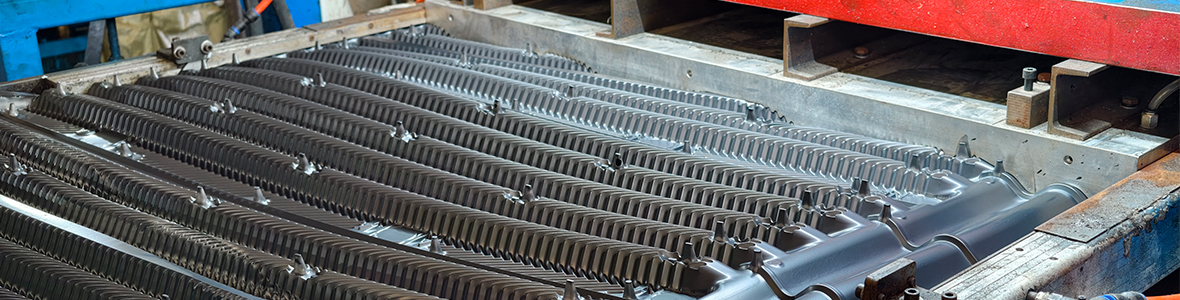
When you look inside a wet cooling tower, the fill may not seem like the most complicated component. Yet this relatively simple-looking material has a huge influence on how effectively the tower rejects heat.
So, what are the types of fills in cooling tower systems? Which one should you use? Is film fill always better than splash fill? Should you choose PVC or PP? And what happens if the circulating water contains a lot of suspended solids?
These are not just technical questions. They directly affect cooling performance, maintenance costs, energy consumption and the service life of your cooling tower.
In this guide, we will break down the major cooling tower fill types, materials, designs and applications. We will also look at how water quality, temperature and tower configuration affect your choice.
For cooling tower fill manufacturing and replacement projects, Power Tower Cooling Technology (Shaoxing) Co.,Ltd provides customized cooling tower fill solutions for industrial and commercial applications.
What Is Cooling Tower Fill?
Cooling tower fill is the heat-transfer media installed inside a wet cooling tower.
You may also hear it called cooling tower infill, cooling tower packing, fill media or cooling tower filler.
Whatever name you use, its purpose is basically the same: increase the contact between hot water and moving air.
Without fill, water would simply fall through the tower relatively quickly. The available contact area between air and water would be limited.
Fill changes that.
It spreads water across a much larger surface area, slows its movement and gives air more opportunities to remove heat through evaporation.
Think of the fill as a giant heat-transfer highway. Instead of water taking one straight road from the top of the tower to the basin, the fill creates thousands of small paths and surfaces.
That extra contact is where much of the cooling work happens.
Why Cooling Tower Fill Is Important
The performance of a wet cooling tower depends on several components working together.
The fan moves air.
The pump moves water.
The distribution system spreads water.
And the fill creates the environment where air and water exchange heat.
If the fill is badly designed, heavily fouled or damaged, the entire cooling tower can suffer.
Poor fill performance can lead to:
Lower cooling capacity
Higher leaving-water temperature
Increased airflow resistance
Higher fan energy consumption
Uneven water distribution
More frequent maintenance
Shorter component life
This is why choosing the right cooling tower fill types is not a minor purchasing decision.
It is part of the overall cooling-system design.
How Cooling Tower Fill Works
The basic principle is straightforward.
Hot water enters the cooling tower and is distributed over the fill. Air moves through the tower at the same time.
As the water contacts the air, a small portion of the water evaporates.
That evaporation removes heat.
The remaining water becomes cooler and collects in the basin before returning to the process.
Different fill designs achieve this contact in different ways.
Film fill spreads water into thin films across specially shaped sheets.
Splash fill repeatedly breaks falling water into droplets.
Both approaches can work well. The difference is how they balance heat-transfer area, airflow, water quality and fouling resistance.
Main Types of Fills in Cooling Tower
When people ask about the main types of fills in cooling tower applications, two categories usually come first:
Film fill
Splash fill
However, modern cooling tower projects also use specialized designs such as wide-gap fill, high-temperature fill and hybrid solutions.
The right choice depends on the application rather than a simple “one type is best” rule.
Film Fill
Film fill consists of thin sheets formed into specific corrugated or structured patterns.
Water flows over the sheets and spreads into a thin layer.
Because the surface area is large, film fill can provide excellent heat transfer within a relatively compact volume.
This is one reason film fill is widely used in modern cooling towers.
However, there is a catch.
The passages between the sheets can be relatively narrow. If your circulating water contains large amounts of suspended solids, scale or biological debris, those passages can become restricted.
So film fill is generally most attractive when water quality is reasonably well controlled.
Splash Fill
Splash fill uses a different approach.
Instead of spreading water into a thin film, the fill repeatedly breaks the water into droplets.
As the water falls through successive levels, each impact creates additional contact between water and air.
One major advantage is its larger open passage structure.
That can make splash fill more tolerant of suspended solids and fouling.
For dirty industrial water, this characteristic can be extremely valuable.
The trade-off is that splash fill may require more physical volume to achieve the same thermal duty as a high-efficiency film-fill arrangement.
Hybrid and Specialized Fill
Not every cooling tower operates under textbook conditions.
Some systems have moderate fouling.
Others operate at higher temperatures.
Some handle industrial process water containing suspended solids.
In these situations, specialized fill can provide a middle ground.
Wide-gap film designs, high-temperature materials and specialized splash configurations can be selected to balance heat transfer and operating reliability.
The best design is often the one that remains effective after months or years of real-world operation—not simply the one with the highest laboratory performance.
PVC Cooling Tower Fill
PVC is one of the most widely used materials for cooling tower film fill.
Why?
Because it offers a practical combination of cost, manufacturability, chemical resistance and heat-transfer performance for many conventional cooling applications.
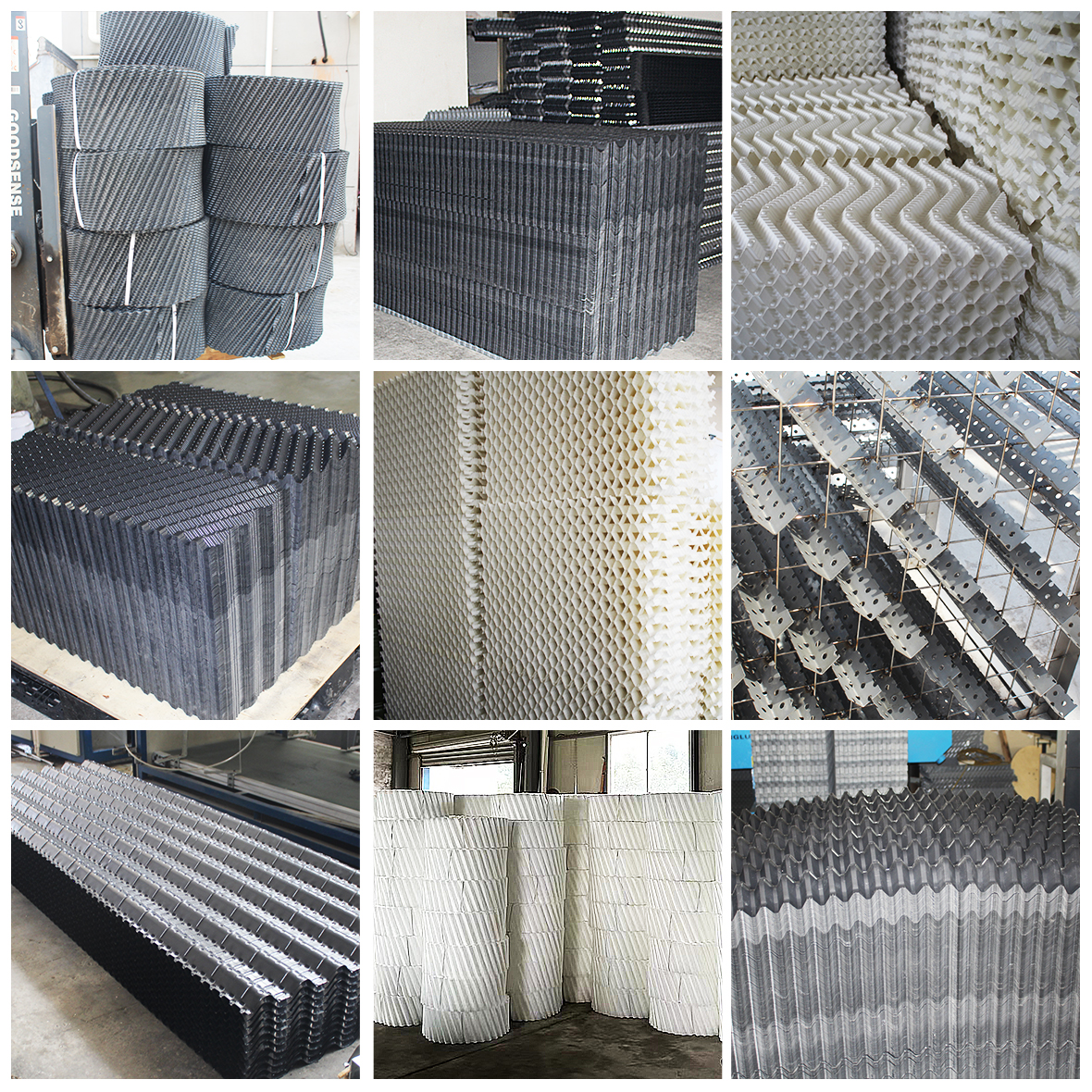
PVC film fill is commonly formed into corrugated sheets and assembled into fill packs.
The geometry creates a large wetted surface area while maintaining airflow channels.
For HVAC systems, commercial buildings and many industrial applications, PVC film fill can be an economical and efficient option.
But PVC is not automatically suitable for every application.
Operating temperature, chemical exposure and water conditions must always be considered.
PP Cooling Tower Fill
Polypropylene, commonly known as PP, is another important material used for cooling tower fill.
PP can be attractive in applications where higher temperature resistance or specific chemical-resistance characteristics are required.
It can be used for film-type or specialized fill designs depending on the application.
The key point is simple:
Don't choose between PVC and PP based only on price.
Look at the actual operating environment.
What is the maximum water temperature?
What chemicals are present?
How frequently does the tower operate?
Is the water clean or heavily contaminated?
Those answers will help determine whether PVC, PP or another material makes more sense.

Other Cooling Tower Fill Materials
While PVC and PP are common choices, specialized cooling tower applications may require other materials or constructions.
The selection can depend on:
Material selection should therefore be treated as an engineering decision rather than simply a commodity purchase.
Crossflow Cooling Tower Fill
Crossflow cooling towers use a different airflow arrangement from counterflow towers.
In a typical crossflow design, water moves downward while air travels horizontally through the fill.
That means the fill geometry, support arrangement and water distribution system are designed around this airflow direction.
Crossflow fill commonly uses designs that allow water to spread over the fill while air passes horizontally through it.
When replacing crossflow fill, don't assume that any standard film-fill pack will work.
The replacement must match the tower's physical configuration.
Counterflow Cooling Tower Fill
In a counterflow tower, air generally moves upward while water travels downward.
The two streams move in opposite directions.
This arrangement allows a large amount of heat-transfer interaction within a compact tower structure.
Film fill is commonly used in counterflow applications because its large surface area can provide high thermal performance.
However, water quality becomes especially important when selecting closely spaced film fill.
If the water contains excessive suspended solids or scaling material, the fill can become clogged.
Film Fill vs Splash Fill
So, which is better?
There is no universal answer.
| Factor | Film Fill | Splash Fill |
| Heat-transfer efficiency | Generally high | Moderate to high |
| Surface area | High | Lower |
| Fouling tolerance | Lower for narrow-gap designs | Generally higher |
| Dirty-water applications | Requires careful selection | Often suitable |
| Compact design | Excellent | May require more volume |
| Maintenance | Depends on water quality | Often easier in dirty-water applications |
Film fill is often the preferred choice when efficiency and compact design are priorities.
Splash fill becomes attractive when water quality is difficult to control.
In other words, choosing fill is a little like choosing a vehicle.
A lightweight sports car may be extremely efficient on a clean highway, but an off-road vehicle may perform better when the road becomes rough.
The operating environment matters.
PVC vs PP Cooling Tower Fill
PVC and PP both have their place.
PVC is often selected for conventional applications because of its cost-effectiveness and established performance.
PP may be considered where higher temperature resistance or particular chemical characteristics are important.
However, there is no universal temperature or chemical limit that should be applied to every fill product.
The actual limits depend on the material formulation and fill design.
That is why buyers should always request technical data from the manufacturer before selecting a material.

How Water Quality Affects Fill Selection
Water quality may be the single most overlooked factor in cooling tower fill selection.
Imagine buying a very fine coffee filter and then filling it with muddy water.
The filter may be excellent—but it was never designed for that job.
Cooling tower fill works in a similar way.
A high-efficiency film fill with narrow passages can perform extremely well when water is clean.
But if the water contains large amounts of suspended solids, scale-forming minerals or biological material, those passages can gradually become blocked.
Fill Selection for Clean Water
Clean and properly treated water provides more flexibility.
High-efficiency film fill can be a strong option because the water can move through the designed channels without excessive blockage.
This makes it suitable for many:
Fill Selection for Dirty Water
Dirty-water applications require a different mindset.
Instead of asking only:
“Which fill provides the highest heat transfer?”
ask:
“Which fill can maintain acceptable heat transfer after months of operation?”
That question changes the selection process.
Wide-gap film fill or splash fill may provide better long-term reliability where suspended solids and fouling are unavoidable.
High-Temperature Cooling Tower Fill
Temperature can significantly influence material selection.
Standard PVC fill may be suitable for many conventional cooling applications, but high-temperature process cooling can require specialized materials.
PP or specially designed high-temperature fill may be considered when the water temperature exceeds the practical operating range of conventional PVC products.
Before ordering high-temperature fill, confirm:
A fill that survives a short temperature spike may behave differently under continuous high-temperature operation.
How to Choose the Right Cooling Tower Fill
Choosing the right fill starts with the tower—not the catalog.
Before selecting a product, identify the actual operating conditions.
Cooling Performance and Heat Transfer
Start with the required cooling duty.
How much heat must the tower reject?
What is the entering-water temperature?
What leaving-water temperature is required?
What is the circulating-water flow?
What are the design wet-bulb conditions?
These numbers help determine the thermal requirements of the fill.
A supplier should be able to evaluate the fill based on actual operating conditions rather than simply selling the largest available pack.
Fill Spacing and Fouling Resistance
Fill spacing has a major influence on performance.
Narrower passages can create more surface area and potentially improve heat transfer.
But narrower passages can also be more sensitive to fouling.
Wider passages may sacrifice some surface area but provide better tolerance to suspended solids.
The ideal spacing depends on the water quality and application.
Fill Dimensions and Installation
Dimensions are critical for replacement projects.
Measure:
Fill height
Fill width
Fill length
Pack configuration
Sheet spacing
Support-frame dimensions
Total fill volume
Also record the airflow direction and water-distribution arrangement.
A technically excellent fill is useless if it cannot be installed correctly inside the existing tower.
Cooling Tower Fill Service Life
How long does cooling tower fill last?
There is no universal number.
Service life depends on the environment.
Important factors include:
Water chemistry
Water-treatment quality
Operating temperature
Air quality
UV exposure
Biological growth
Suspended solids
Mechanical damage
Cleaning practices
A well-maintained tower with controlled water chemistry can provide significantly better fill longevity than a tower operating continuously with heavy fouling.
That is why maintenance and fill selection should be considered together.
When Should Cooling Tower Fill Be Replaced?
Fill does not necessarily need to be replaced simply because it is old.
Instead, look for physical and performance indicators.
Replacement may be justified when:
Fill sheets are cracked
Packs have collapsed
Fill has become brittle
Heavy scale covers the surfaces
Water passages are blocked
Cooling performance has declined
Airflow resistance has increased
Fill supports are damaged
Cleaning can no longer restore performance
If you are experiencing declining tower performance, inspect the fill together with fans, pumps, nozzles, water flow and airflow.
Don't blame the fill automatically.
But don't ignore it either.
Applications of Different Cooling Tower Fills
Different fill types are used across a wide range of industries.
HVAC and Commercial Cooling
Film fill is commonly suitable for commercial HVAC systems where water quality can be effectively controlled.
Manufacturing
Factories may require customized fill depending on production heat loads, water chemistry and operating schedules.
Power Generation
Large-scale cooling systems can require specialized fill designs capable of handling significant water flow and demanding thermal conditions.
Chemical and Petrochemical Processing
Chemical applications require careful consideration of temperature, water chemistry and material compatibility.
Food and Process Industries
These applications may require fill solutions designed around cleanliness, water treatment and process-specific requirements.
The point is not to memorize which industry uses which fill.
Instead, understand the relationship between application → water quality → temperature → tower design → fill type.
How Power Tower Manufactures Cooling Tower Fill
Power Tower Cooling Technology (Shaoxing) Co.,Ltd is a cooling tower component manufacturer providing fill solutions for new cooling towers and replacement projects.

The company can work with project information such as:
Cooling tower configuration
Fill dimensions
Water temperature
Water quality
Required cooling performance
Material requirements
Fouling conditions
Installation requirements
For replacement projects, this approach is particularly useful.
Why?
Because older cooling towers are not always built around today's standard dimensions.
A replacement fill supplier may need to manufacture packs according to existing tower dimensions rather than simply providing a generic product.
Power Tower focuses on practical cooling tower fill solutions for industrial and commercial customers.
Power Tower Cooling Technology (Shaoxing) Co.,Ltd
Cooling Tower Fill Buyer Checklist
Before requesting a quotation, prepare the following information.
Tower Information
Fill Information
Existing fill type
Fill dimensions
Fill material
Pack quantity
Sheet spacing
Photos of existing fill
Operating Conditions
Entering-water temperature
Leaving-water temperature
Water flow rate
Ambient wet-bulb temperature
Water quality
Suspended solids
Fouling history
Project Requirements
The more information you provide, the easier it becomes for a manufacturer to recommend the right cooling tower fill.
Final Thoughts
Understanding the types of fills in cooling tower systems is essential when designing, upgrading or replacing cooling tower components.
Film fill offers high heat-transfer performance and compact installation.
Splash fill can provide greater tolerance for difficult water conditions.
PVC fill remains a practical solution for many conventional cooling applications.
PP fill can be useful when higher temperature resistance or specific material properties are required.
But there is no universal winner.
The best cooling tower fill is the one that matches your actual operating conditions.
Before buying, consider the tower configuration, water quality, temperature, thermal load, fill dimensions, airflow and maintenance requirements.
And if you are replacing existing fill, don't simply copy the old product without checking its condition and performance. Sometimes the replacement project is an opportunity to upgrade the tower with a better-suited fill design.
For customized cooling tower fill and replacement solutions, Power Tower Cooling Technology (Shaoxing) Co.,Ltd can provide manufacturer-based support for different cooling tower configurations and applications.
The right fill is not merely a plastic component inside a tower.
It is the working surface where air and water meet, heat moves, and cooling performance is created.


