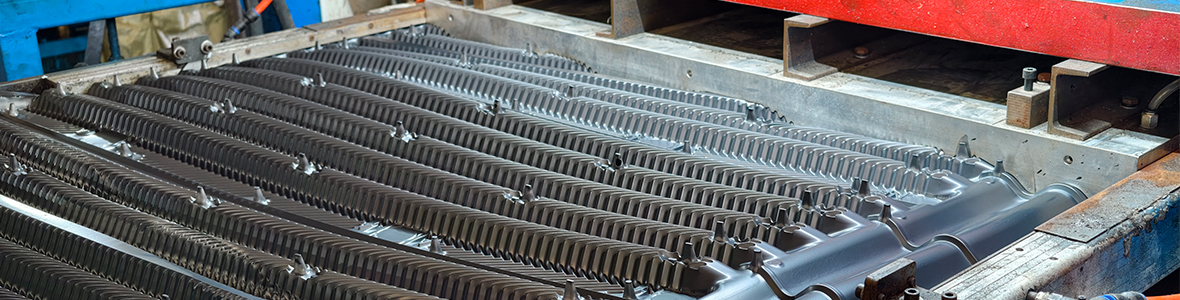
Cooling tower fill is one of those components you may not notice until something goes wrong. It sits inside the tower, quietly doing its job while thousands of gallons of water move through the system. But what exactly does cooling tower fill do? Why is it so important? And how does it affect cooling tower efficiency?
In simple terms, the cooling tower fill function is to increase the contact between hot water and moving air so that heat can leave the water more effectively. The fill creates a large effective surface area, slows and distributes the water, and gives evaporation more opportunity to take place.
Without properly designed fill media, a conventional wet cooling tower would need much more space to achieve the same level of heat rejection.
What Is Cooling Tower Fill?
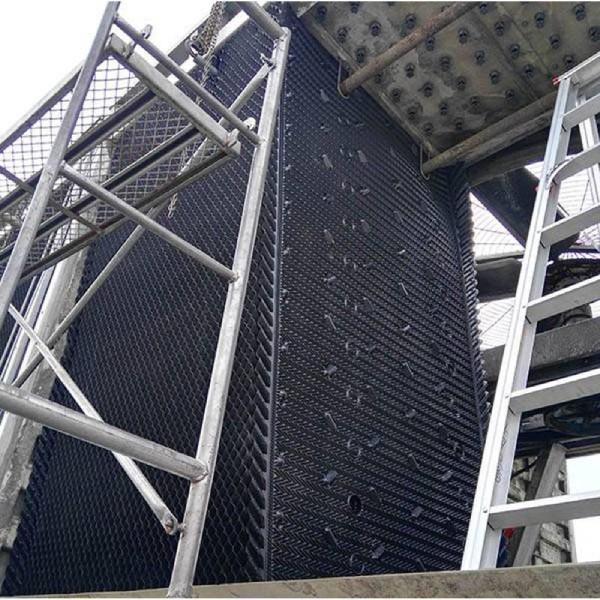
Cooling tower fill, also called cooling tower packing or fill media, is the internal material installed inside a wet cooling tower.
Its basic job is to provide a large surface area where circulating water can interact with air. Instead of allowing hot water to fall quickly from the distribution system to the cold-water basin, the fill breaks up, spreads, redirects, or slows the water.
Think of it like turning one fast-moving stream into thousands of small streams.
The greater the water-air contact, the more opportunities the system has to transfer heat and evaporate a small portion of the water. That is the foundation of the cooling tower fill function.
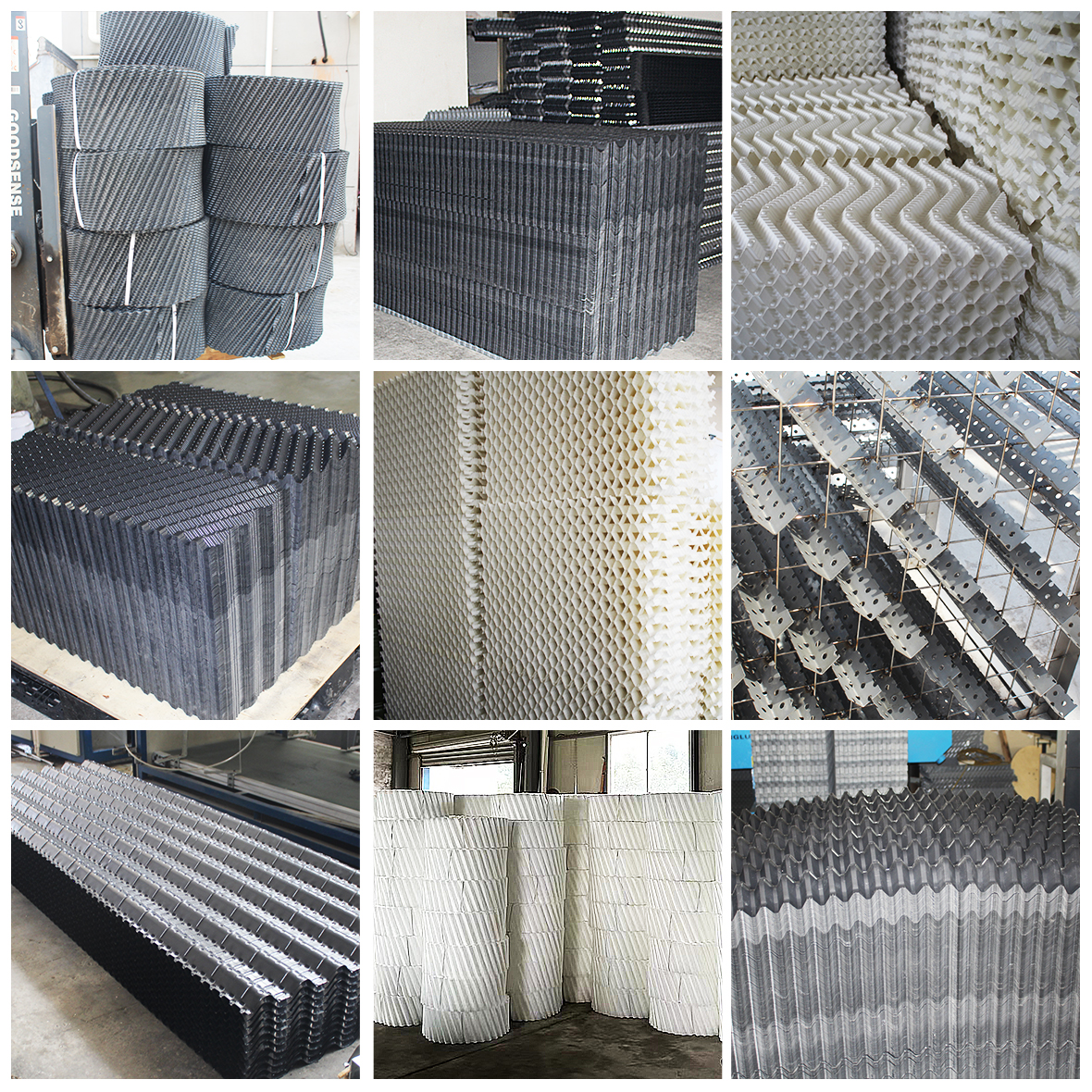
Cooling tower fill can be manufactured in different shapes and materials depending on the application. Common options include PVC film fill, PP film fill, and splash fill.
Why Is Cooling Tower Fill Important?
A cooling tower depends heavily on evaporation.
Hot process water enters the tower carrying heat from an industrial process, chiller, compressor, power-generation system, or other heat-producing equipment. At the same time, air moves through the tower.
A small portion of the circulating water evaporates into the air. That phase change removes a considerable amount of heat from the remaining water.
But here is the key question: how can we make the water and air interact efficiently?
That is where cooling tower fill comes in.
Without effective fill, water would simply fall through the tower relatively quickly. The available water-air contact would be limited, and the tower could require considerably more space or airflow to achieve the same cooling duty.
This is why fill is often considered one of the most important internal components of an evaporative cooling tower.
How Does Cooling Tower Fill Work?
The operating principle is relatively straightforward.
Hot water enters the cooling tower through the water distribution system and reaches the top of the fill section. The fill then controls how that water travels downward.
At the same time, air moves through the fill. Depending on the tower design, airflow may travel upward in a counterflow tower or horizontally across the water flow in a crossflow tower.
Inside the fill section, water and air remain in close contact.
Heat moves from the warmer water toward the air, while evaporation transfers additional heat away from the circulating water.
The cooled water then collects in the basin and returns to the process.
Increasing Water-to-Air Contact
One of the most important cooling tower fill functions is increasing the contact area between water and air.
A simple stream of falling water provides relatively limited surface area. However, when water spreads across corrugated fill sheets or repeatedly breaks over splash bars, its effective surface area becomes much larger.
More surface area means more opportunities for heat and mass transfer.
This is one reason a relatively compact cooling tower can reject a surprisingly large amount of heat.
Slowing Down Water Flow
Fill also helps control the speed at which water travels through the tower.
If water falls straight from the distribution system into the basin, it has limited contact time with the air. Fill creates a longer and more controlled path.
With film fill, water flows as thin layers across corrugated surfaces. With splash fill, water repeatedly breaks into droplets as it falls across splash bars.
Both approaches increase the opportunity for air-water interaction.
Of course, slower water flow is not automatically better. Fill must be designed to balance contact time, pressure drop, water loading, airflow, and thermal performance.
Creating a Larger Wet Surface Area
The real power of modern cooling tower fill comes from surface area.
A well-designed fill creates a large effective wet surface inside a relatively small physical volume.
Instead of building a huge tower filled with open space, engineers can use structured fill to create extensive water-air contact within a compact fill pack.
This is why fill geometry, spacing, corrugation, height, and material all matter when selecting cooling tower fill.
The Main Cooling Tower Fill Function
So, what is the main cooling tower fill function?
It is not simply to "hold water."
Its primary purpose is to improve heat and mass transfer by maximizing the interaction between circulating water and air.
Several functions work together to achieve this goal.
Improving Heat Transfer
The most important function of fill is improving heat transfer.
Hot water enters the tower carrying heat from the process. As it travels through the fill, it exposes more of its surface to moving air.
Heat moves from the warmer water toward the cooler air.
At the same time, evaporation removes additional energy from the water.
The combined process lowers the water temperature before it returns to the cooling system.
Supporting Evaporative Cooling
Cooling towers are fundamentally evaporative heat-rejection systems.
When a small portion of circulating water changes from liquid to vapor, it absorbs heat. The moving air then carries the resulting moisture away from the tower.
Cooling tower fill creates the conditions required for this process.
By spreading water into thin films or breaking it into droplets, fill increases the area available for evaporation.
This is why fill is so closely connected with cooling tower thermal performance.
Increasing Cooling Tower Efficiency
Properly selected fill can improve the thermal performance of a cooling tower.
A high-performance fill can provide substantial effective surface area while maintaining an acceptable pressure drop.
This can help the tower achieve the required cold-water temperature without unnecessarily increasing tower size or fan power.
However, an important point should not be overlooked:
Cooling tower fill cannot solve every cooling problem.
Poor water distribution, inadequate airflow, dirty water, incorrect fan operation, and poor water treatment can all reduce performance even when the fill itself is excellent.
Reducing Required Tower Size
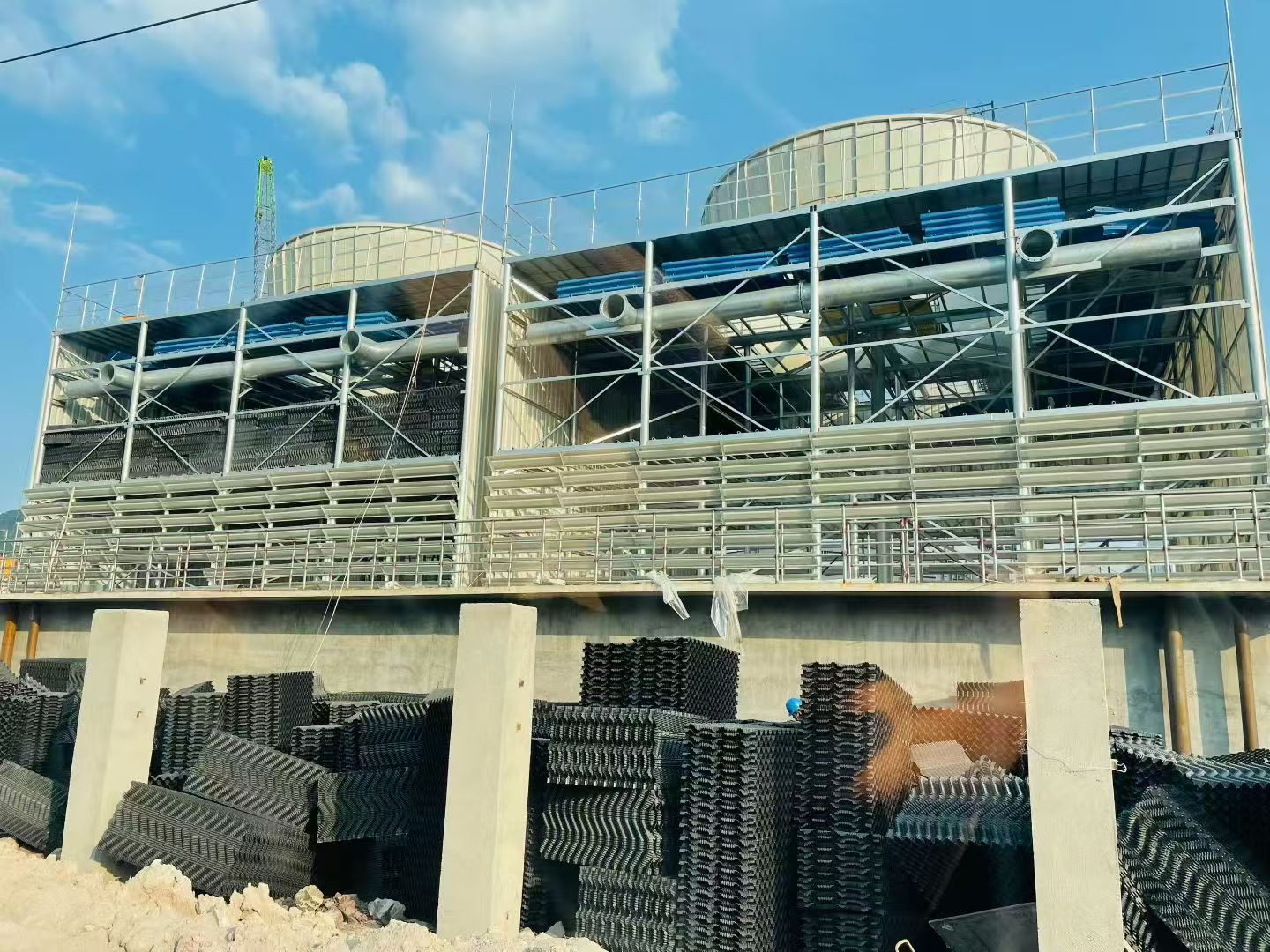
Because fill creates a large effective contact area, engineers can achieve significant heat transfer within a relatively compact tower.
Without fill, achieving the same thermal duty could require much more physical space.
This compact design is particularly useful in industrial facilities where installation space is limited.
Film Fill vs. Splash Fill
Not every cooling tower uses the same type of fill.
The two major categories are film fill and splash fill.
Choosing between them depends on water quality, thermal requirements, tower configuration, operating temperature, and maintenance conditions.

How Film Fill Works
Film fill is designed to spread water into thin films over specially shaped sheets.
The sheets usually contain corrugations, channels, or other surface patterns that increase effective wet surface area while controlling water flow.
As water travels down the fill, air passes across or through it.
The large wet surface allows efficient heat and mass transfer.
PVC film fill is widely used because it can provide high thermal performance within a relatively compact volume.
How Splash Fill Works
Splash fill uses bars, grids, or other structural elements to break falling water into droplets.
Rather than maintaining a continuous thin film, water repeatedly splashes and separates as it travels through the fill.
The open structure can provide better resistance to certain types of fouling and suspended solids.
Splash fill is therefore often considered for applications where water quality is more challenging.
When Should You Choose Film Fill?
Film fill is often a strong choice when circulating water is relatively clean and the system prioritizes high thermal performance and compact design.
It works particularly well when operators can maintain effective water treatment, filtration, and regular cleaning.
However, the narrow passages that make film fill efficient can also make it more sensitive to fouling.
When Is Splash Fill Better?
Splash fill may be a better choice when the circulating water contains significant suspended solids or when clogging resistance is an important consideration.
Its open structure allows contaminants to pass through more easily than they would through very narrow film-fill passages.
The trade-off is that splash fill may require more volume to achieve comparable thermal performance.
How Cooling Tower Fill Affects Cooling Performance
Fill selection is not simply about choosing the product with the largest advertised surface area.
Real-world cooling performance depends on how the fill interacts with water, air, and the rest of the cooling tower system.
Several factors deserve attention.
Fill Surface Area
A larger effective surface area generally provides more opportunity for water-air interaction.
But the surface area listed in a specification sheet does not tell the entire story.
The surface must actually become wet and participate effectively in heat and mass transfer.
If water distribution is poor, parts of the fill can remain dry. In that situation, the theoretical surface area does not translate into useful cooling capacity.
Air and Water Distribution
Even excellent cooling tower fill cannot perform properly if water distribution is uneven.
Imagine watering only half of a garden while leaving the other half completely dry.
The same basic problem can occur inside a cooling tower.
Nozzle arrangement, spray pattern, operating pressure, distribution basin design, and airflow all influence how effectively the fill works.
Uniform distribution is essential.
Fill Height and Pack Density
Fill height determines how much contact opportunity is available.
Increasing fill depth can improve thermal performance, but it can also increase air pressure drop.
That means engineers must balance heat-transfer performance against fan energy consumption and hydraulic conditions.
More fill does not automatically mean greater efficiency.
Water Loading and Airflow
Every fill design has an appropriate operating range.
If water loading is too high, the fill can flood or distribute water poorly.
If airflow is too low, heat and moisture removal can become limited.
If airflow is excessively high, fan energy consumption may increase without providing proportional thermal benefits.
The best performance comes from matching fill design to actual water flow, air volume, thermal load, and operating conditions.
Common Cooling Tower Fill Materials
Material selection is another important part of cooling tower fill design.
Different materials provide different levels of temperature resistance, chemical resistance, durability, flexibility, and cost-effectiveness.
PVC Cooling Tower Fill
PVC is one of the most common materials for cooling tower film fill.
It is relatively lightweight, easy to process, and suitable for many conventional cooling applications.
PVC cooling tower fill can be manufactured with different corrugation patterns, spacing, and sheet thicknesses.
For many HVAC and industrial cooling systems, PVC provides a practical balance between thermal performance and cost.
PP Cooling Tower Fill
Polypropylene, commonly known as PP, is another important material.
PP generally offers higher temperature resistance than standard PVC, making it useful in certain higher-temperature applications.
High-temperature PP cooling tower fill may be considered when operating conditions are outside the preferred range of conventional PVC fill.

Other Fill Materials
Depending on the application, manufacturers may also use other plastics or specialized materials.
The correct selection depends on several factors, including:
Operating temperature
Water chemistry
Suspended solids
Biological conditions
Mechanical requirements
Expected service life
Cleaning methods
A fill that performs extremely well in a clean HVAC system may not be the best solution for a heavily contaminated industrial process.
What Happens If Cooling Tower Fill Is Dirty or Clogged?
This is where the importance of maintenance becomes obvious.
Even high-performance cooling tower fill can lose efficiency when deposits or biological growth block its passages.
Clogging can change water distribution, restrict airflow, increase pressure drop, and reduce the effective contact area.
In severe situations, fouled fill can contribute to higher cold-water temperatures and increased operating costs.
Scale and Mineral Deposits
Hard water can leave calcium and other mineral deposits on fill surfaces.
Over time, these deposits can become thick enough to narrow water and air passages.
Scale can also change the surface geometry, making it harder for water to spread evenly.
Effective water treatment, blowdown control, and regular inspection are important tools for controlling scale.
Algae and Biological Growth
Cooling towers provide a warm and wet environment where biological growth can develop.
Algae, biofilm, and other organic deposits can accumulate on fill surfaces.
Besides reducing heat-transfer performance, biological fouling can increase cleaning requirements and create additional operational concerns.
A suitable water-treatment program is therefore an important part of cooling tower maintenance.
Dirt and Suspended Solids
Dust, sediment, rust particles, and other suspended solids can enter circulating water.
This can be particularly challenging in industrial systems.
Fine-passage film fill is generally more sensitive to blockage than open splash fill.
Filtration, water treatment, blowdown, and proper fill selection can all help reduce the risk.
How to Maintain Cooling Tower Fill
Good maintenance starts with regular inspection.
Operators should periodically check whether the fill has become:
Water distribution should also be inspected.
If nozzles become blocked or spray patterns change, some areas of the fill may receive too much water while others receive too little.
Cleaning methods should match both the fill material and the type of contamination.
Excessive mechanical force or unsuitable chemicals can damage plastic fill.
A maintenance program should therefore focus on prevention rather than waiting until the tower has already lost significant performance.
When Should Cooling Tower Fill Be Replaced?
There is no universal replacement interval for cooling tower fill.
Service life depends on:
Water quality
Operating temperature
Chemical treatment
UV exposure
Mechanical loading
Cleaning frequency
Tower design
Biological activity
Replacement becomes more urgent when the fill is physically damaged, heavily clogged, severely deformed, or unable to deliver the required thermal performance.
If repeated cleaning cannot restore the fill, replacement may be more economical than continuing to operate with degraded media.
How to Choose the Right Cooling Tower Fill
Choosing the right fill should begin with the operating environment rather than the product price.
Ask yourself a few basic questions.
What is the entering-water temperature?
What cold-water temperature is required?
Is the cooling tower crossflow or counterflow?
How clean is the circulating water?
What is the water flow rate?
What contaminants are present?
How important is compact tower size?
The answers will help determine which fill design and material are appropriate.
Consider Water Quality
Water quality is one of the most important factors.
Clean, well-treated water may be suitable for high-efficiency film fill.
Water containing significant suspended solids may require a more open fill design.
If water chemistry is aggressive, material compatibility becomes particularly important.
Consider Operating Temperature
Temperature determines which fill materials are suitable.
Standard PVC works well in many conventional applications, while PP cooling tower fill may be more suitable for certain higher-temperature systems.
Always evaluate the actual operating temperature instead of selecting fill based only on a general product description.
Consider Tower Type
Crossflow and counterflow cooling towers use different internal airflow and water-distribution arrangements.
The fill geometry should therefore be compatible with the specific tower configuration.
A fill designed for one tower should not automatically be assumed to be optimal for another.
Consider Maintenance Requirements
Maintenance should be part of the selection process from the beginning.
Ask how easily the fill can be:
Inspected
Cleaned
Removed
Repaired
Replaced
If the cooling tower operates in a dusty or contaminated environment, fouling resistance and accessibility may be just as important as maximum thermal performance.
Why High-Quality Cooling Tower Fill Matters
Quality cooling tower fill is not simply about thicker plastic or a more complicated shape.
Consistent sheet thickness, accurate forming, stable dimensions, reliable bonding, and appropriate material selection all influence long-term performance.
Poorly manufactured fill can deform, separate, clog, or distribute water unevenly.
By contrast, properly manufactured fill can provide predictable thermal performance and a longer service life when the tower is operated and maintained correctly.
This is why choosing a reliable cooling tower fill manufacturer matters.
Cooling Tower Fill Function in Industrial Applications
Cooling tower fill plays a critical role in many industries.
Power plants use cooling towers to reject large quantities of waste heat.
Manufacturing plants depend on cooling water for machinery and process equipment.
Data centers use cooling systems to remove heat from IT infrastructure.
Chemical plants, refineries, food-processing facilities, HVAC systems, and many other industrial operations also rely on evaporative heat rejection.
Across these applications, the basic principle remains the same:
Create effective water-air contact so that heat can move out of the circulating water.
The specific fill design, however, may vary significantly from one application to another.
For example, a clean HVAC system may prioritize compact high-performance film fill, while an industrial process with heavily contaminated water may place greater emphasis on fouling resistance and easy maintenance.
Frequently Asked Questions
Does Cooling Tower Fill Cool the Water Directly?
Not exactly.
Cooling tower fill does not work like a refrigeration coil.
Instead, it creates the conditions that allow air and water to interact efficiently.
Evaporation and heat transfer then remove heat from the circulating water.
So, when someone asks, "What does cooling tower fill do?" the simplest answer is:
It improves the water-air contact needed for efficient evaporative cooling.
Can a Cooling Tower Work Without Fill?
A cooling tower can technically reject heat without conventional fill, but its performance and physical design can be very different.
Cooling tower fill dramatically increases the effective contact area between water and air.
This allows many modern evaporative cooling towers to achieve high heat-rejection capacity within a relatively compact structure.
How Long Does Cooling Tower Fill Last?
There is no fixed lifespan that applies to every application.
Clean water, suitable operating temperatures, effective water treatment, and regular inspection can extend fill life.
Fouling, high temperatures, harsh chemicals, mechanical damage, and poor maintenance can shorten it.
The best replacement decision should therefore be based on the actual condition and thermal performance of the fill.
What Is the Most Important Cooling Tower Fill Function?
The primary function is to maximize effective water-air contact for heat and mass transfer.
The fill does this by spreading water into films, breaking water into droplets, increasing effective surface area, and extending the interaction between water and air.
Is PVC or PP Better for Cooling Tower Fill?
Neither material is universally better.
PVC is widely used for conventional cooling applications because it offers a practical combination of thermal performance, processability, and cost.
PP provides higher temperature resistance and can be advantageous in certain high-temperature applications.
The correct choice depends on the actual operating conditions.
Final Thoughts
The cooling tower fill function is simple in principle but extremely important in practice.
Cooling tower fill increases water-air contact, improves heat and mass transfer, supports evaporation, and helps a cooling tower reject large amounts of heat within a relatively compact structure.
Whether you choose PVC film fill, PP film fill, or splash fill, the key is to match the media to your water quality, temperature, airflow, water loading, tower configuration, and maintenance conditions.
For cooling tower operators, the lesson is straightforward: do not treat fill as just another internal component. It is a major part of the tower's thermal performance.
When the fill is properly selected, correctly installed, evenly wetted, and well maintained, the entire cooling system has a much better chance of operating efficiently.
Power Tower Cooling Technology (Shaoxing) Co.,Ltd supplies cooling tower fill and related cooling tower components for industrial applications. By considering the actual operating conditions of each cooling system, the right fill design can help customers achieve reliable heat rejection, efficient operation, and practical maintenance.
For more information about cooling tower fill, PVC fill, PP fill, splash fill, and other cooling tower components, visit www.coolingtowerpart.com.


