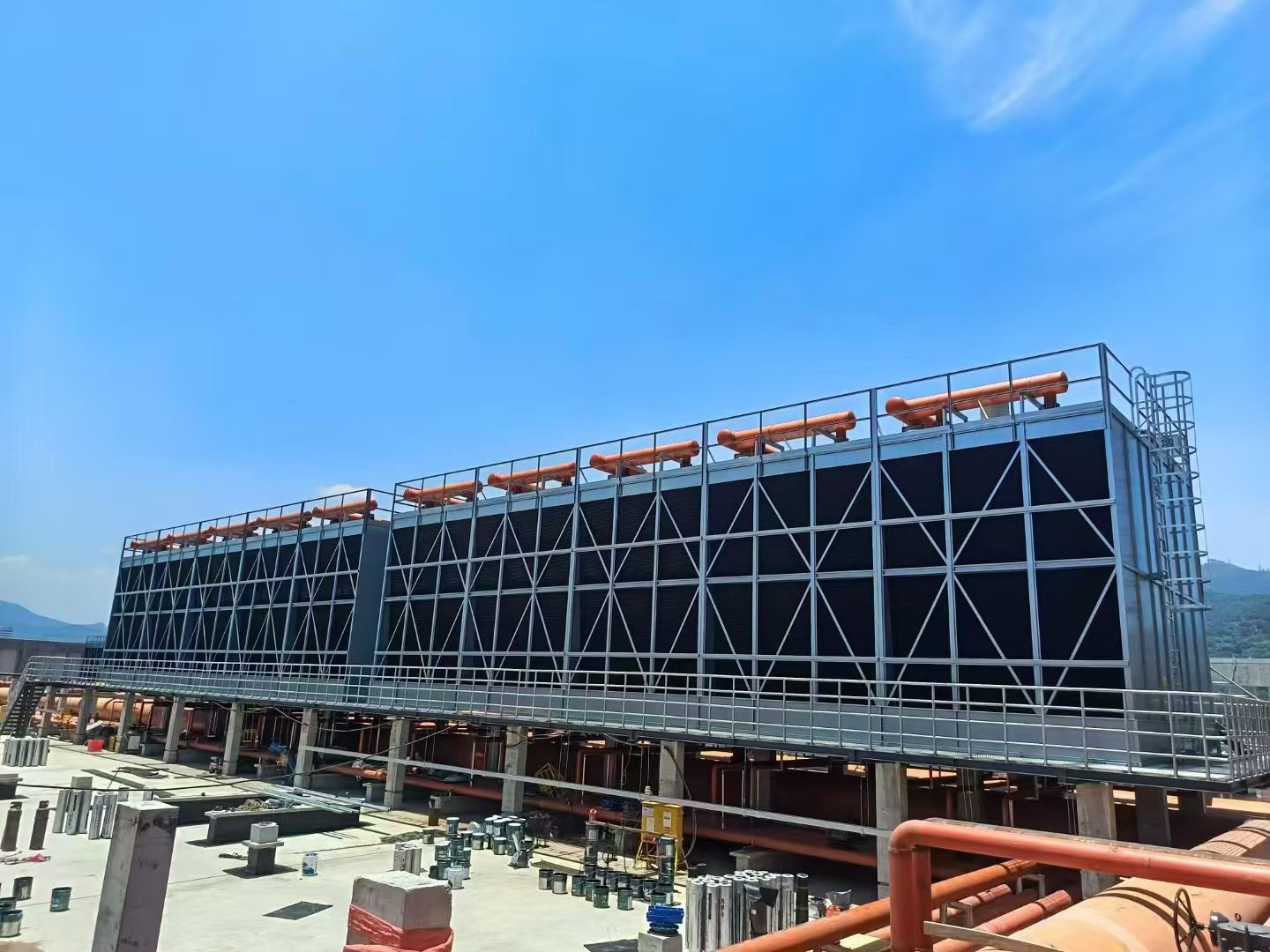
When it comes to cooling tower performance, every component matters. Fans move the air, pumps circulate the water, and the fill media helps transfer heat from water to air. If the fill is poorly selected, damaged, or clogged, even a well-designed cooling tower may struggle to deliver the cooling performance you expect.
A film type fill cooling tower uses specially formed fill sheets to spread circulating water into thin films, increasing the contact area between water and air. This design makes film fill a popular choice for many commercial HVAC systems and industrial cooling applications.
High-efficiency PVC film fill offers several potential advantages, including effective heat transfer, lightweight construction, and convenient replacement options. However, not every fill design works for every cooling tower. Water quality, operating temperature, tower configuration, and maintenance practices all influence the final result.
In this guide, we explain how PVC film fill works, its main benefits, the differences between film fill and splash fill, and how to select the right product for your application. We also introduce Power Tower Cooling Technology (Shaoxing) Co.,Ltd, a cooling tower component supplier serving customers through www.coolingtowerpart.com.
What Is a Film Type Fill Cooling Tower?
A film type fill cooling tower is a cooling tower equipped with structured fill media designed to increase contact between circulating water and moving air.
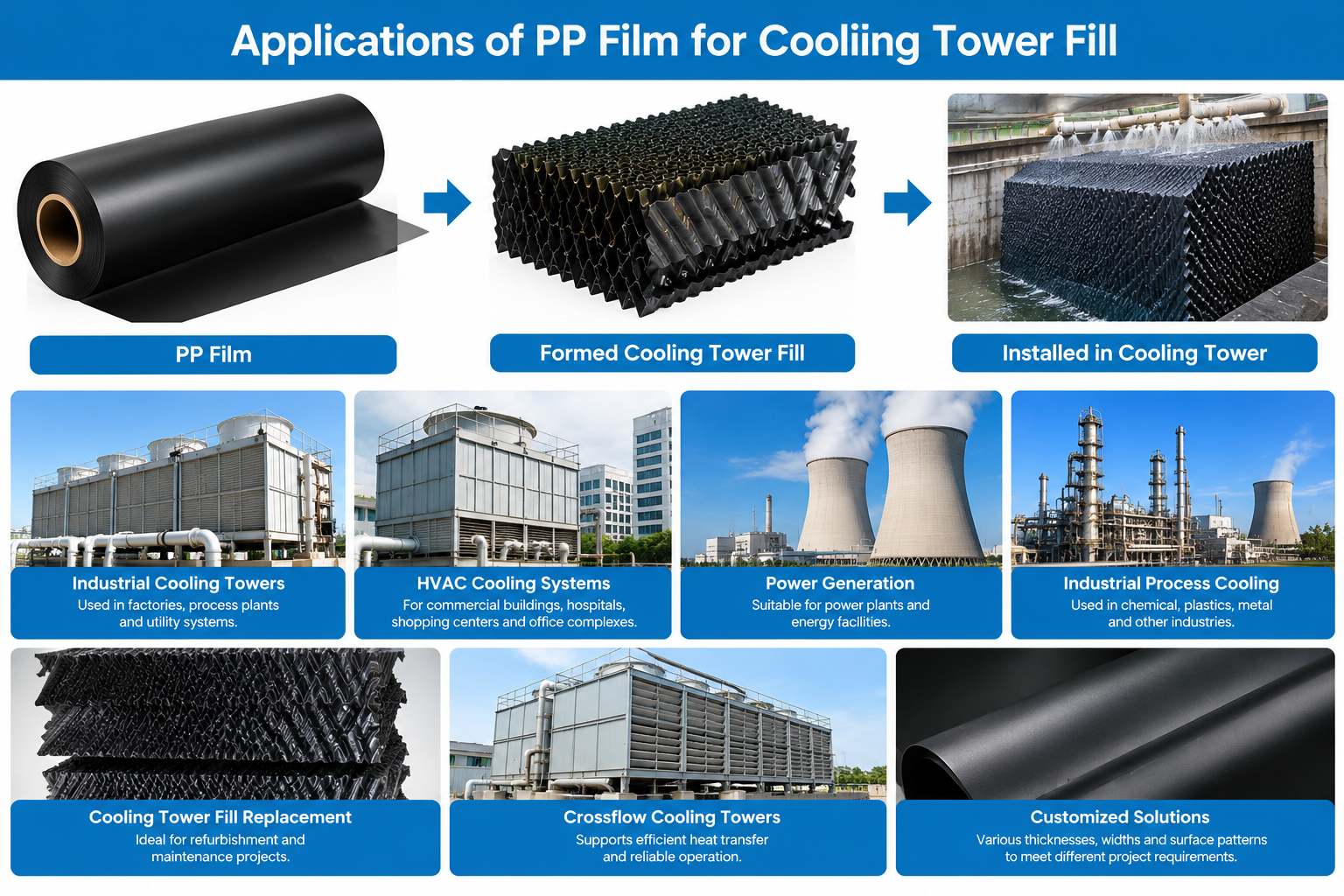
The fill typically consists of thin sheets formed into repeating corrugations, flutes, or other channel patterns. These sheets are arranged into packs or blocks and installed inside the tower. As water flows downward over the surfaces, the fill encourages it to spread into thin films instead of falling entirely as large droplets.
At the same time, air moves through the channels and contacts the water. Heat transfers from the warmer water to the air, and evaporation removes additional heat from the circulating water.
The result is a cooling process that can provide substantial heat-transfer surface within a relatively compact space.
Film fill is commonly used in both crossflow and counterflow cooling towers, provided the selected product is designed for the specific tower configuration.
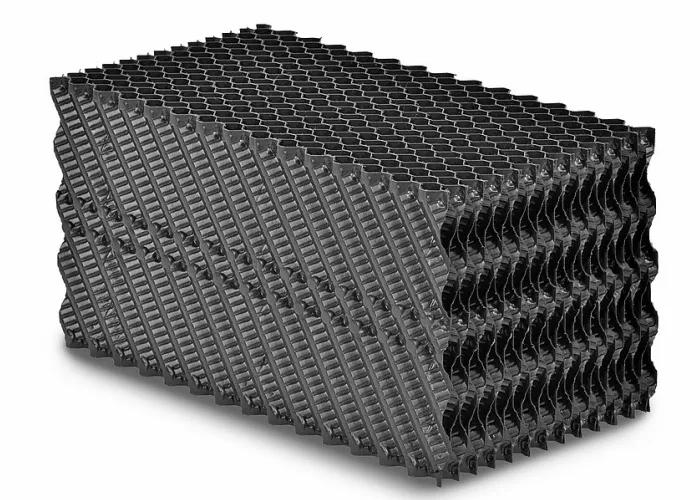
How Does Cooling Tower Film Fill Work?
Think of film fill as a network of carefully designed pathways. Its job is to distribute water evenly while allowing air to pass through the available channels.
The process generally follows four steps:
Hot circulating water enters the cooling tower's distribution system.
Water flows over the film fill and spreads across the formed sheet surfaces.
Air passes through the fill channels and contacts the water film.
Heat and moisture transfer from the water to the air, cooling the remaining circulating water.
The efficiency of this process depends on several factors, including wetted surface area, airflow, water distribution, fill depth, and ambient wet-bulb temperature.
More surface area does not automatically mean better cooling. If the fill channels create excessive airflow resistance or become blocked by deposits, overall performance may decline. A good fill design balances heat-transfer capability with suitable airflow and reliable operation.
What Are the Main Components of PVC Film Fill?
PVC film fill usually consists of formed sheets arranged and joined into packs. The exact construction varies by manufacturer and application.
Common design features include:
Formed PVC sheets: Create the surfaces that help distribute water.
Corrugated channels: Guide water flow and allow air to pass through the fill.
Bonded contact points: Help maintain the structure of the assembled pack.
Pack edges and support interfaces: Allow the fill to fit within the cooling tower's supporting structure.
Some cooling tower systems use separate drift eliminators, while others incorporate specific drift-control features into their fill assemblies. These components should not be treated as interchangeable without checking the equipment design.
Before purchasing replacement fill, confirm the dimensions, channel configuration, installation orientation, and support requirements.
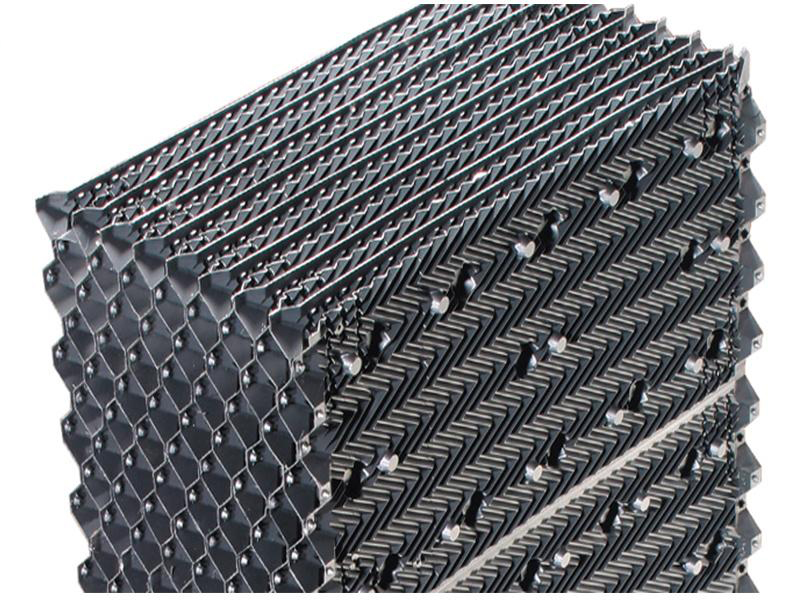
Why Is PVC Film Fill Widely Used in Cooling Towers?
Polyvinyl chloride, commonly known as PVC, is widely used for cooling tower film fill because it can be formed into structured sheets with consistent channel geometry.
For suitable operating conditions, PVC film fill can offer a practical combination of heat-transfer performance, weight, corrosion resistance, and cost.
It is used in many commercial and industrial cooling applications where circulating water quality and operating temperatures are compatible with the selected material.
However, PVC products are not all identical. Material formulation, sheet thickness, forming quality, and manufacturing processes can affect the performance and durability of the finished fill pack.
High Heat Transfer Efficiency
The primary advantage of film fill is its ability to provide a large wetted surface area within a limited volume.
When water spreads across the formed sheets, the contact area between water and air increases. This supports heat and mass transfer and can help a cooling tower meet its required cooling duty.
For facilities with limited installation space, an appropriately selected film fill design may provide the required heat-transfer capability without increasing the size of the cooling tower.
Actual performance still depends on the entire system. Fan capacity, water flow, nozzle condition, ambient conditions, and fill cleanliness all play important roles.
Lightweight and Corrosion-Resistant Construction
PVC film fill is relatively lightweight compared with many traditional materials. This can make handling, transportation, and installation more convenient.
PVC also does not rust like ordinary steel, which is beneficial in many wet cooling tower environments. When the material is properly selected and operated within its specified limits, it can provide reliable service.
Nevertheless, PVC has operating limitations. Excessive temperatures, incompatible chemicals, ultraviolet exposure, mechanical damage, and poor water treatment may accelerate deterioration.
If your cooling tower operates at elevated temperatures or handles unusual process water, discuss material compatibility with your supplier before ordering.
Flexible Cooling Tower Fill Replacement Options
Cooling tower fill does not necessarily need to be replaced only when the entire tower reaches the end of its service life.
If the tower structure and other components remain serviceable, replacing deteriorated fill may help restore the intended heat-transfer performance.
Replacement is not simply a matter of purchasing sheets that look similar to the originals. The new fill must fit the available space and be compatible with the existing water distribution, airflow, and support arrangements.
For an accurate assessment, provide the cooling tower model, fill dimensions, photographs, operating temperature, and water quality information whenever possible.
Film Fill vs. Splash Fill: Which Is Better?
Film fill and splash fill are two common types of cooling tower fill media. Both improve contact between air and water, but they achieve this in different ways.
Film fill spreads water across structured surfaces. Splash fill uses bars, grids, or other elements to break falling water into droplets and redistribute it.
Neither option is best for every application. The right choice depends on the cooling tower design, water quality, heat load, and maintenance requirements.
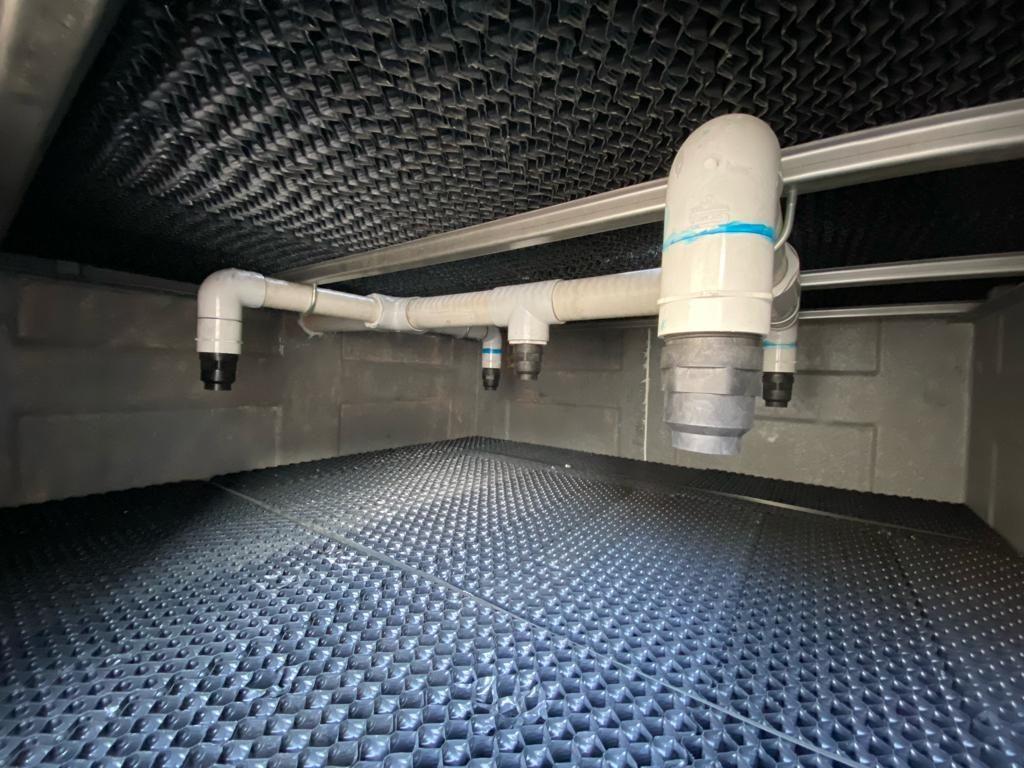
Advantages of Film Fill
Film fill is often suitable for applications that require effective heat transfer within a compact space.
Its structured surfaces provide extensive contact between water and air, making it an attractive option for many HVAC and industrial cooling systems.
Film fill can perform particularly well when the circulating water is reasonably clean and the distribution system operates correctly.
However, narrow channels can be vulnerable to blockage from suspended solids, mineral scale, and biological deposits. Water treatment and routine inspection are therefore essential.
When Is Splash Fill a Better Choice?
Splash fill may be more suitable for cooling towers that handle water with high suspended-solids levels or a significant risk of fouling.
Its more open structure can allow certain contaminants to pass through more readily than narrow-channel film fill. This may reduce some plugging risks in demanding environments.
Still, splash fill is not maintenance-free. The right solution depends on the size and concentration of contaminants, the required thermal performance, and the tower's operating conditions.
If your existing film fill repeatedly becomes blocked, review the water treatment program and filtration arrangements before selecting a replacement. A wider-channel film fill design or splash fill may be worth evaluating, depending on the application.
Types of PVC Film Fill for Cooling Towers
PVC film fill is available in different channel geometries, sheet thicknesses, pack dimensions, and configurations.
These differences influence heat-transfer surface area, airflow resistance, water distribution, and fouling risk. Choosing the right design means balancing these factors rather than focusing on a single specification.
Narrow-Channel PVC Film Fill
Narrow-channel film fill can provide a high surface area within a relatively compact volume.
This type of design may be appropriate when thermal performance and space efficiency are priorities and circulating water quality is well controlled.
However, narrow passages can become blocked when mineral scale, suspended solids, or biological growth accumulates. Facilities using this type of fill should maintain an appropriate water treatment program and monitor the condition of the channels.
Before selecting narrow-channel fill, consider the site's history of fouling and the availability of suitable cleaning procedures.
Wide-Channel and Anti-Fouling Film Fill
Wide-channel or anti-fouling film fill is designed to provide more space for water to pass through the pack.
Depending on its geometry, it may be better suited to applications where conventional narrow-channel fill experiences frequent plugging.
The trade-off is that the heat-transfer surface and thermal performance may differ from those of a more compact design. The correct product should balance fouling resistance, airflow, and the required cooling duty.
If your cooling tower handles water containing fibers, process residues, or other contaminants, share these details with your supplier before making a selection.
Crossflow Cooling Tower Film Fill
In a crossflow cooling tower, air generally moves horizontally across water flowing downward through the fill.
The fill arrangement must work with the tower's water distribution system, airflow path, and supporting structure. Certain products may also incorporate features designed for the specific crossflow application.
When replacing crossflow fill, check the original pack dimensions, orientation, support requirements, and compatibility with the tower's water distribution system.
A product intended for one crossflow design should not automatically be assumed suitable for every crossflow tower.
Counterflow Cooling Tower Film Fill
In a counterflow cooling tower, air moves upward while water flows downward. This opposing movement supports heat and mass transfer within the fill.
Counterflow fill packs must be selected according to the tower's internal dimensions, airflow characteristics, water distribution arrangement, and operating requirements.
Although some film fill designs are available for both crossflow and counterflow applications, their installation requirements may differ. Confirm the intended configuration before ordering replacement media.
Key Benefits of High-Efficiency PVC Film Fill
When properly selected and maintained, high-efficiency PVC film fill can help cooling tower operators achieve reliable heat rejection while making effective use of available tower space.
Its benefits extend beyond heat transfer, but results depend on the condition of the complete cooling system.
Improved Thermal Performance
When existing fill becomes damaged, deformed, or heavily fouled, the effective heat-transfer area may decrease. Water distribution can also become uneven, reducing cooling performance.
Replacing deteriorated fill with a compatible product can help restore the tower's intended operating conditions.
For a planned performance upgrade, evaluate the fill alongside fan capacity, water flow, and the cooling tower's design duty. A new fill pack cannot compensate for every problem, and changes to fill geometry may affect airflow resistance.
Potential Water and Energy Savings
Effective heat transfer may help a cooling tower achieve the required leaving-water temperature under suitable conditions.
However, PVC film fill alone does not guarantee lower water or electricity consumption. Total operating costs also depend on fan and pump power, evaporation, blowdown, drift, water treatment, and control strategies.
If you want to measure the benefits of a fill replacement, compare operating data before and after installation while accounting for changes in weather, heat load, and system settings.
Convenient Inspection and Maintenance
Modular fill packs can make inspection and replacement easier when the tower provides suitable access.
During routine maintenance, operators should check for blocked channels, cracked sheets, deformation, loose bonds, and uneven water distribution.
Cleaning methods must follow the product manufacturer's recommendations. Excessive pressure, unsuitable chemicals, or rough handling can damage the fill and shorten its service life.
Applications of Film Type Cooling Tower Fill
Film fill is used in a wide range of cooling tower applications. The most suitable product depends on the operating environment and the characteristics of the circulating water.
Commercial HVAC Systems
Office buildings, hotels, hospitals, shopping centers, and campuses often use cooling towers to reject heat from chiller systems.
PVC film fill can be a practical choice for these applications when the operating temperature and water quality are compatible with the material.
Routine maintenance helps control scale, biological growth, and debris that could obstruct the fill channels.
Industrial Process Cooling
Manufacturing facilities use cooling towers to remove heat from process water, heat exchangers, production equipment, and other industrial systems.
In these applications, fill selection should consider heat load, circulating-water chemistry, suspended solids, and operating temperature.
Water containing oil, fibers, or process residues may require additional treatment or a fill design with greater resistance to fouling.
Power, Chemical, and Manufacturing Facilities
Facilities with continuous operations often place a high priority on cooling reliability.
The fill must be suitable for the actual operating environment, and its configuration must support the required airflow and water distribution.
For critical applications, conduct a technical review before replacing fill. Confirm the product's material limits, dimensions, and suitability for the tower's design conditions.
How to Choose the Right PVC Film Fill
Choosing cooling tower fill should begin with your operating requirements, not simply the lowest purchase price.
A product may fit physically but still perform poorly if its geometry, material, or airflow characteristics do not match the tower.
The following factors can help guide your selection.
1. Evaluate Water Quality and Fouling Risk
Water quality is one of the most important factors in fill selection.
Suspended solids, water hardness, alkalinity, biological activity, and process contamination can all affect the condition of the fill.
If your tower regularly experiences plugging, review water treatment and filtration alongside the fill design. Selecting a wider-channel product may help in some cases, but it will not eliminate the need to control water quality.
2. Check Operating Temperature and Chemical Compatibility
Always check the maximum continuous operating temperature specified for the exact fill product.
Standard PVC fill commonly has a lower temperature tolerance than certain polypropylene or specialty polymer options, although actual limits vary by formulation and manufacturer.
You should also confirm compatibility with the cooling water and treatment chemicals. If the operating temperature approaches the product's rated limit, obtain confirmation from the supplier before ordering.
3. Confirm Dimensions, Airflow, and Cooling Requirements
Accurate dimensions help reduce the risk of ordering incompatible fill.
Record the length, width, depth, and installation orientation of the existing packs. If available, provide the cooling tower brand and model.
For a performance upgrade, share the circulating-water flow rate, hot-water temperature, required cold-water temperature, design wet-bulb temperature, and other available operating data.
These details help determine whether the proposed fill is appropriate for the required cooling duty and airflow conditions.
4. Compare Material Thickness and Manufacturing Quality
Sheet thickness can influence stiffness and durability, but thicker material does not automatically mean better performance.
Forming consistency, channel geometry, joining quality, and pack integrity are also important.
Ask your supplier for the relevant technical data sheet. Clarify material grade, thickness measurement method, available dimensions, operating limits, and any product documentation required for your project.
Signs Your Cooling Tower Fill Needs Replacement
Cooling tower fill should be inspected regularly, especially when the system operates continuously or uses water with a high fouling risk.
Common warning signs include:
Persistent loss of cooling performance.
Cracked, brittle, or deformed fill sheets.
Heavy mineral scale or biological deposits.
Blocked channels or uneven water distribution.
Loose pack bonds or damaged support areas.
Abnormal changes in system pressure drop or fan operation.
These symptoms do not always mean the fill is the only problem. Blocked nozzles, fan issues, incorrect water flow, and other equipment faults can produce similar results.
Inspect the tower safely and compare current operating data with historical records before deciding whether cleaning, repair, or replacement is appropriate.
Installation and Maintenance Best Practices
Proper installation helps protect fill performance and service life.
Before starting work, isolate the equipment and follow the site's safety procedures. Remove damaged fill carefully, inspect the supporting structure, and clean the installation area.
Install the new packs according to the manufacturer's instructions. Maintain the intended orientation and arrangement, and confirm that the fill is adequately supported without obstructing airflow or water distribution.
After installation, check the system during commissioning for uneven wetting, abnormal airflow resistance, or unexpected changes in cooling performance.
Inspect the Water Distribution System
Water should be distributed evenly across the designed fill area.
Blocked nozzles, damaged pipes, and incorrect flow rates can create dry areas and reduce the effective heat-transfer surface.
During maintenance, inspect the water distribution system alongside the fill. Correcting distribution problems may improve performance without requiring unnecessary changes to other components.
Control Scale, Sludge, and Biological Growth
A suitable maintenance program should include water treatment, debris control, and scheduled inspections.
The correct treatment strategy depends on water chemistry, local requirements, and material compatibility. Do not use aggressive chemicals or high-pressure cleaning methods without confirming that they are suitable for the fill.
If fouling returns quickly after cleaning, investigate its underlying cause instead of repeatedly treating the symptoms.
Schedule Routine Inspections
Inspection frequency should reflect operating hours, water quality, and environmental conditions.
Keep records of fill condition, cooling performance, visible deposits, and maintenance work. Tracking these observations can help identify deterioration early and support better replacement planning.
Why Choose Power Tower Cooling Technology (Shaoxing) Co.,Ltd?
Selecting a cooling tower fill supplier involves more than comparing prices. Buyers need accurate product information, dimensional compatibility, consistent manufacturing quality, and clear communication about the intended application.
Power Tower Cooling Technology (Shaoxing) Co.,Ltd serves cooling tower component requirements through its website, www.coolingtowerpart.com.
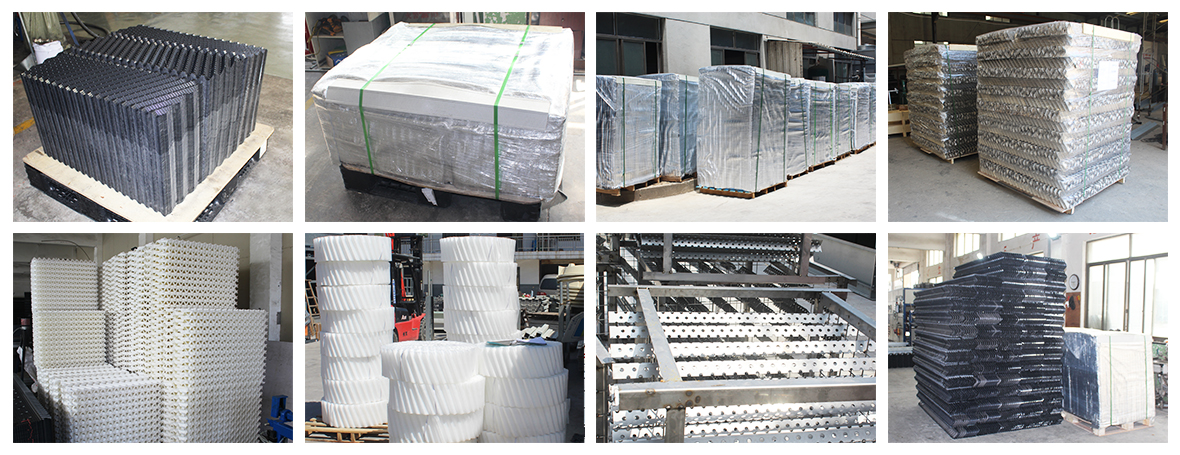
For film fill enquiries, buyers can provide their cooling tower model, existing fill dimensions, operating temperature, water quality information, and required quantity. These details help establish the requirements for a suitable product review.
Before placing an order, confirm the material grade, pack configuration, dimensions, operating limits, delivery schedule, and any required technical documentation.
Whether you are sourcing replacement fill for an existing cooling tower or evaluating options for a new project, accurate specifications are the starting point for a successful purchase.
Request a Quote for High-Efficiency PVC Film Fill
Are you planning a cooling tower fill replacement or sourcing PVC film fill for an industrial project?
To help your supplier assess your requirements, prepare the following information:
Cooling tower brand and model.
Crossflow or counterflow configuration.
Existing fill dimensions and photographs.
Operating water temperature.
Water quality and known fouling issues.
Required quantity.
Delivery destination and target schedule.
If you do not have every technical detail, start with clear photographs and measurements. Your supplier can then identify what additional information is needed to assess compatibility.
Visit www.coolingtowerpart.com to contact Power Tower Cooling Technology (Shaoxing) Co.,Ltd about cooling tower fill and related components.
Frequently Asked Questions About PVC Film Fill
What Is Film Fill in a Cooling Tower?
Film fill is structured media that spreads circulating water into thin layers across formed surfaces. This increases contact between water and moving air, supporting heat and mass transfer.
Is PVC Film Fill Suitable for Every Cooling Tower?
No. Suitability depends on tower configuration, fill dimensions, operating temperature, water quality, airflow characteristics, and required cooling duty. Always confirm compatibility before ordering.
Is Film Fill More Efficient Than Splash Fill?
Film fill can provide a large wetted surface in a compact volume and may be advantageous when water quality is well controlled. Splash fill may be more suitable for certain applications with higher suspended-solids levels. The best choice depends on the actual operating conditions.
How Long Does PVC Cooling Tower Fill Last?
There is no single service-life figure that applies to every installation. Operating temperature, water chemistry, ultraviolet exposure, mechanical stress, fouling, and maintenance all affect the useful life of PVC film fill.
Regular inspection and proper water treatment can help identify problems early and reduce avoidable deterioration.
Can I Replace the Original Fill With a Different Design?
Potentially, but the replacement must be checked for dimensions, thermal performance, airflow resistance, support requirements, and compatibility with the tower.
Changing the fill geometry without evaluating the system may affect cooling performance. Consult a qualified supplier or cooling tower specialist before making significant design changes.
What Information Should I Provide When Requesting a Quote?
Provide the tower brand and model, fill dimensions, operating temperature, water quality, application, required quantity, and photographs if available. More complete information generally makes it easier to assess the right replacement option.
Conclusion: Choose the Right Film Fill for Reliable Cooling Performance
High-efficiency PVC film fill can be an effective solution for cooling towers that need reliable heat transfer within a compact installation.
Its structured surfaces encourage thin water-film formation and increase contact between water and air. When the fill is matched to the tower's design and operating conditions, it can support effective heat rejection and practical maintenance.
However, the best fill is not necessarily the one with the highest advertised surface area or the lowest price. Water quality, channel geometry, operating temperature, airflow resistance, dimensions, and installation quality all influence long-term performance.
Before purchasing replacement fill, evaluate your actual operating conditions and confirm the product's technical specifications.
Power Tower Cooling Technology (Shaoxing) Co.,Ltd provides a point of contact for cooling tower fill enquiries through www.coolingtowerpart.com. Share your project requirements to help identify a suitable film fill option for your cooling tower.


