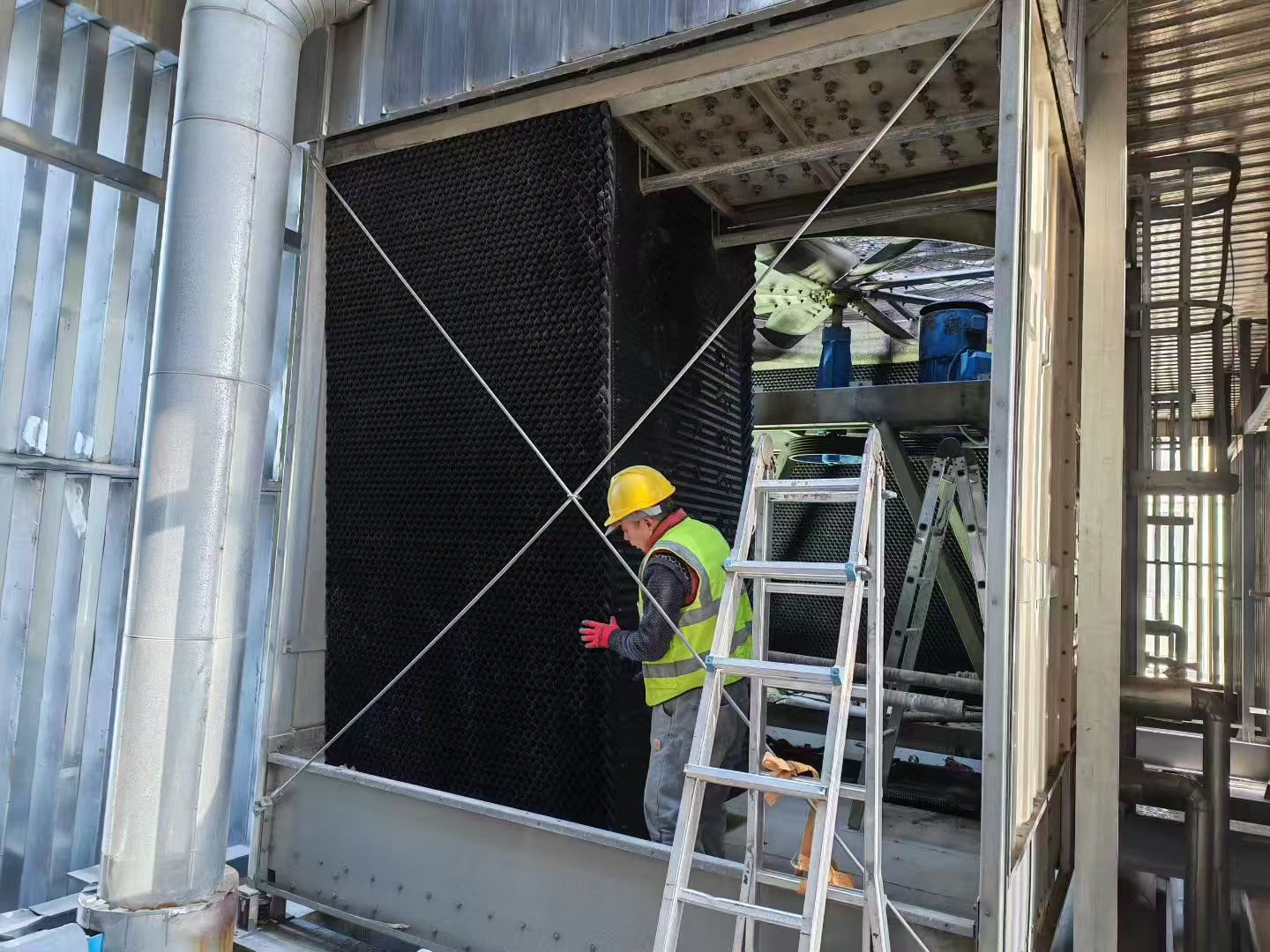
Choosing between Marley cooling tower fill and aftermarket fill is an important decision for industrial cooling tower maintenance and replacement projects. The right fill media can help maintain heat transfer efficiency, control operating costs, and extend equipment service life. However, the best option depends on the cooling tower model, operating conditions, budget, and replacement requirements.
Marley cooling tower fill vs. aftermarket fill is not simply a comparison between expensive and inexpensive products. Buyers need to consider dimensional compatibility, material quality, thermal performance, installation costs, and long-term reliability.
This guide compares both options to help industrial buyers, maintenance managers, contractors, and cooling tower distributors make informed purchasing decisions.
1. What Is Marley Cooling Tower Fill?
Marley cooling tower fill is heat-transfer media used in compatible cooling tower systems associated with the Marley brand. The fill increases the contact area between water and air, helping heat transfer from circulating water to the surrounding air.
Depending on the cooling tower design and application, fill may use film-type or splash-type configurations.
When the original fill becomes clogged, damaged, or deformed, replacement may be necessary to maintain cooling performance.
Common reasons for replacing Marley cooling tower fill include:
Reduced heat transfer caused by scale and biological growth.
Cracked or deformed fill sheets.
Restricted airflow through the fill pack.
Uneven water distribution.
Increased cooling approach temperature.
Changes in maintenance or operating requirements.
Buyers can consider genuine replacement parts or technically suitable aftermarket alternatives, provided the selected product meets the specific tower's requirements.
2. What Is Aftermarket Cooling Tower Fill?
Aftermarket cooling tower fill is replacement media manufactured by a supplier other than the original equipment manufacturer. It may be designed to fit a particular tower model or manufactured to customer-supplied dimensions.
Marley compatible cooling tower fill is one category of aftermarket replacement product when supplied by an independent manufacturer.
Aftermarket fill is available in different materials, sheet profiles, block dimensions, and configurations. Some suppliers offer standard products, while others provide customized fill packs for maintenance and retrofit projects.
Potential advantages include:
Competitive purchase prices.
Flexible dimensions and configurations.
PVC and polypropylene (PP) material options.
Custom manufacturing for specific replacement projects.
Bulk supply for industrial maintenance contractors and distributors.
However, aftermarket products vary in quality. Buyers should verify material specifications, dimensional accuracy, manufacturing consistency, and performance suitability instead of relying on price alone.
3. Marley Cooling Tower Fill vs. Aftermarket Fill: Key Differences
The following table summarizes the main purchasing considerations.
| Comparison Factor | Genuine Marley Fill | Aftermarket Fill |
| Product source | Original equipment supply channel | Independent manufacturer or supplier |
| Compatibility | Specified for applicable Marley equipment | Depends on design and verified specifications |
| Purchase price | Varies by product and sales channel | May offer more competitive pricing |
| Material options | Depends on the original product range | May offer different materials and configurations |
| Customization | Depends on available products and services | Some manufacturers offer custom dimensions |
| Quality assurance | Verify product documentation and supply channel | Depends on manufacturer controls and documentation |
| Technical support | Depends on supplier and product arrangement | Depends on supplier capability |
| Delivery lead time | Depends on stock and production availability | Depends on stock, customization, and logistics |
Neither option is automatically superior in every category. Actual pricing, quality, delivery, and technical support depend on the specific product and supplier.
4. Cost Comparison: Which Option Is More Economical?
Cost is often the first consideration in cooling tower fill replacement projects, particularly when a facility must replace large quantities during a scheduled shutdown.
Genuine Marley Cooling Tower Fill
Original replacement fill may be preferred when project specifications require genuine parts, documented product traceability, or support through an established equipment supplier.
The total cost can include the fill itself, transportation, installation, and any associated maintenance work.
Aftermarket Cooling Tower Fill
Aftermarket fill may reduce initial material costs, especially for bulk orders or projects involving multiple cooling towers.
Direct purchasing from a manufacturer may also provide more flexibility in packaging, production quantities, and customized dimensions.
Nevertheless, a lower purchase price does not guarantee a lower total project cost. Incorrect dimensions, poor bonding, unsuitable materials, or excessive airflow resistance can create additional expenses.
How to Compare Total Cost
Evaluate the complete replacement cost:
Total project cost = Material + Shipping + Installation + Downtime + Expected maintenance
When comparing quotations, confirm that both suppliers are offering equivalent quantities, compatible configurations, comparable materials, and similar technical requirements.
5. Quality Comparison: What Should Buyers Check?
Quality directly affects installation reliability, operating stability, and replacement frequency.
Material Quality
PVC and PP are common materials for cooling tower fill. Their suitability depends on operating temperature, water chemistry, mechanical requirements, and the formulation used.
Ask suppliers to provide material specifications and relevant test documentation.
Dimensional Accuracy
Replacement fill must fit the available installation space and work with the tower's support structure and water distribution arrangement.
Check:
Fill block length, width, and height.
Sheet thickness and spacing.
Corrugation profile.
Bonding strength and block stability.
Installation orientation and support requirements.
Manufacturing Consistency
A reliable aftermarket fill manufacturer should maintain consistent dimensions, sheet forming, bonding, and packaging.
For large industrial projects, request product samples, inspection records, or pre-shipment quality checks where appropriate.
Service Suitability
Even a well-manufactured fill product may perform poorly if it is unsuitable for the water quality or operating environment. Verify compatibility with the actual cooling tower conditions before placing an order.
6. Performance Comparison: Does Aftermarket Fill Cool as Well?
Aftermarket cooling tower fill can deliver suitable performance when its design, material, geometry, and installation match the original system requirements.
However, performance cannot be determined by material name or external appearance alone.
Heat Transfer Efficiency
Film fill creates thin water films over a large surface area. Its performance depends on sheet geometry, water distribution, airflow, and operating conditions.
A replacement with different spacing or corrugation may alter heat transfer even if the block dimensions appear correct.
Airflow Resistance
Fill creates resistance as air moves through the cooling tower. Excessive resistance can affect airflow and fan energy consumption.
Buyers should consider the pressure-drop characteristics of the proposed replacement, especially when the original tower operates close to its design limits.
Water Distribution
Uniform water distribution is essential for effective fill performance. Incorrect block alignment or incompatible fill geometry can create dry areas and uneven cooling.
Long-Term Durability
Service life depends on material quality, temperature, water treatment, UV exposure where applicable, and maintenance practices.
A suitable aftermarket product may provide dependable service, but buyers should avoid assuming that every compatible product has the same lifespan as the original.
7. When Should You Choose Genuine Marley Fill?
Genuine Marley fill may be the preferred choice when:
The project specification explicitly requires original parts.
The exact original product configuration is important.
Product traceability or manufacturer documentation is required.
The facility's maintenance procedures specify original replacement components.
The buyer wants to purchase through an established original equipment supply channel.
Before ordering, verify the exact part and applicable tower model with the supplier.
8. When Is Aftermarket Marley Compatible Fill a Good Choice?
Aftermarket fill may be worth considering when:
The original replacement is expensive or has a long lead time.
The project requires large quantities of replacement media.
A qualified manufacturer can match the existing dimensions and configuration.
Custom fill blocks are needed for a retrofit.
The buyer wants to compare multiple suppliers for cost and delivery.
For international industrial buyers, working directly with an experienced cooling tower fill manufacturer may provide additional flexibility in production scheduling and export arrangements.
The key is to verify technical suitability before comparing quotations.
9. How to Select a Reliable Aftermarket Cooling Tower Fill Manufacturer
Use the following checklist when evaluating suppliers.
Provide tower information: Share the Marley tower model, existing fill type, dimensions, and available drawings.
Confirm compatibility: Ask the manufacturer to document the proposed dimensions and configuration.
Compare materials: Review PVC or PP specifications against actual operating conditions.
Request quality evidence: Evaluate inspection procedures, material documentation, and sample availability.
Review performance requirements: Consider heat transfer, airflow resistance, and water distribution.
Check delivery capability: Confirm production lead time, packaging, shipping, and order quantity.
Compare total project cost: Include installation, downtime, and expected maintenance.
A professional supplier should be able to explain the technical basis of its recommendation rather than promising universal compatibility.
10. Frequently Asked Questions
Is aftermarket cooling tower fill as good as Marley fill?
It can be suitable when manufactured to appropriate specifications and correctly matched to the tower. Quality and performance vary by supplier, so verify dimensions, material properties, and relevant performance data.
Is Marley compatible cooling tower fill cheaper?
It may have a lower purchase price than genuine replacement fill, depending on the product, supplier, quantity, and delivery terms. Compare complete quotations rather than assuming a fixed price difference.
Can aftermarket fill replace existing Marley film fill directly?
Potentially, but the replacement must match the required dimensions, sheet geometry, support arrangement, and operating conditions. Confirm compatibility before purchasing.
Which material is better for replacement fill: PVC or PP?
Neither is universally better. Selection depends on water temperature, chemical exposure, material grade, mechanical requirements, and project specifications.
What information is needed for a cooling tower fill quotation?
Provide the tower model, fill dimensions, required quantity, preferred material, operating temperature, water conditions, delivery location, and target delivery date. Photos or drawings can help the manufacturer evaluate the project.
Conclusion
The choice between Marley cooling tower fill and aftermarket fill depends on project requirements, total cost, manufacturing quality, and expected performance.
Genuine Marley fill may be appropriate when original components or specific documentation are required. Aftermarket Marley compatible cooling tower fill can be a practical alternative when the supplier demonstrates dimensional compatibility, suitable materials, consistent quality, and appropriate technical support.
For industrial replacement projects, compare verified specifications and lifecycle costs before making a decision.
Looking for Marley compatible cooling tower fill for your next replacement project? Contact a qualified cooling tower fill manufacturer with your tower model, dimensions, material requirements, and order quantity to request a technical evaluation and quotation.
Recommended internal links for CoolingTowerPart.com:


