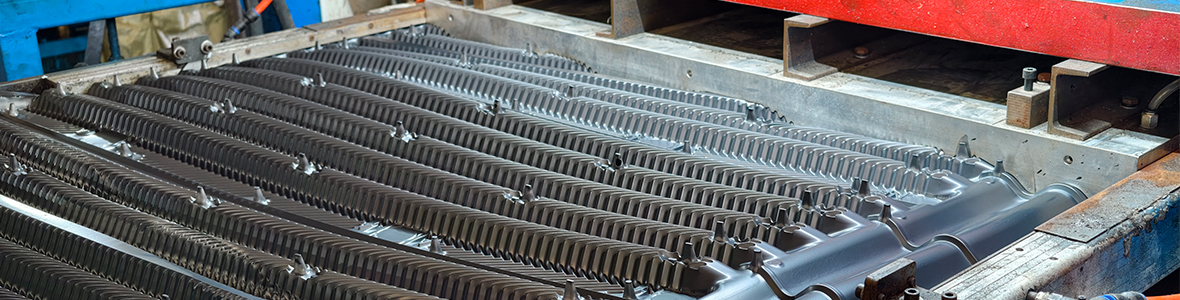
When a cooling tower starts losing performance, most people look at the fan, motor, pump, or water flow first. But there is another component quietly doing one of the most important jobs inside the tower: the PVC filler, commonly called PVC cooling tower fill or PVC fill media.
The fill is where hot water and moving air meet. Its job is to spread water over a large surface area so heat can transfer efficiently and evaporation can do its work. If the fill is poorly designed, clogged, damaged, or incorrectly matched to the tower, even a powerful cooling tower can struggle.
That makes the manufacturer more important than it may initially appear. You're not simply buying plastic sheets. You're buying a heat-transfer component that needs to match your tower geometry, water quality, temperature, airflow, and operating conditions.
In this guide, we'll look at the top 6 PVC fillers manufacturers and suppliers for cooling towers, starting with Power Tower Cooling Technology (Shaoxing) Co.,Ltd. The ranking is intended as a practical buyer's shortlist based on product relevance, manufacturing capabilities, industry presence, and suitability for cooling tower projects rather than a strict global market-share ranking.
Why PVC Fillers Matter in Cooling Towers
A cooling tower may look like a large box filled with fans, pipes, pumps, and water. But inside that box, the fill media performs a critical job.
The purpose of cooling tower fill is to increase the contact between water and air. Hot water is distributed over the fill while air passes through it. The specially shaped surfaces encourage water to spread into thin films or controlled droplets, increasing the effective contact area.
Why does that matter?
Because greater water-air contact generally provides better conditions for heat transfer and evaporation.
You can think of the fill as the stage where the cooling process happens. The pump brings the water to the stage, the fan brings the air, but the fill creates the environment where the two interact.
For this reason, selecting the right PVC filler manufacturer can have a direct impact on cooling tower performance, maintenance requirements, and operating costs.
What Are PVC Fillers?
PVC fillers are structured heat-transfer media installed inside evaporative cooling towers. PVC stands for polyvinyl chloride, a thermoplastic material commonly used for cooling tower fill.
PVC can be formed into different patterns and geometries, allowing manufacturers to create film fill and other cooling tower media designed for specific applications.
In a typical cooling tower, hot circulating water enters the fill section and flows over specially formed surfaces. At the same time, air moves through the fill.
As water spreads across the fill, its exposed surface area increases. Heat moves from the water to the air, while evaporation removes additional heat from the circulating water.
The process sounds straightforward, but the geometry of the fill can make a surprisingly large difference.
How PVC Fillers Improve Heat Transfer
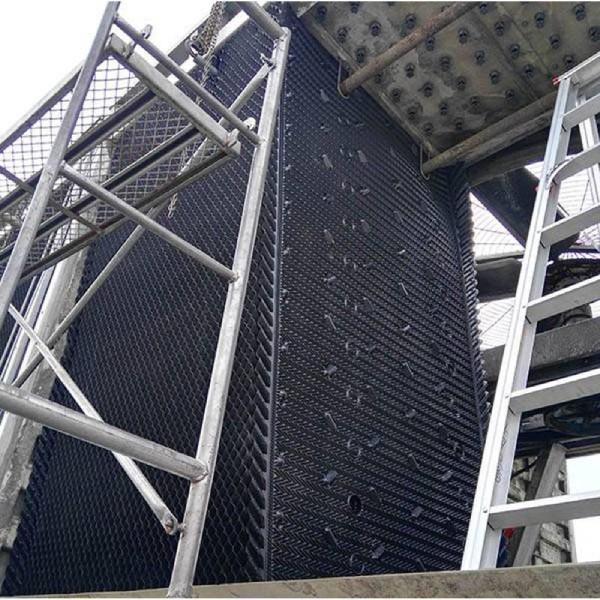
A well-designed PVC fill creates a large effective surface area within a relatively compact volume.
Instead of allowing water to fall through the tower as thick streams, the fill encourages it to spread across thin surfaces. This creates more water-air contact and provides more opportunities for heat and moisture transfer.
Different manufacturers use different flute shapes, spacing, surface textures, and sheet configurations.
The goal is not simply to maximize surface area. The fill also needs to maintain acceptable airflow resistance and remain practical under real operating conditions.
A fill with excellent theoretical thermal performance may not be the best choice if it clogs quickly in a system with dirty or mineral-rich water.
Film Fill vs. Splash Fill
Cooling tower fill is generally divided into two major categories: film fill and splash fill.
Film fill uses formed sheets to spread water into thin films. It can provide a high effective heat-transfer area and is widely used in many HVAC and industrial cooling towers.
Splash fill works differently. Instead of maintaining a continuous film, it repeatedly breaks water into droplets as water falls across specially designed bars or surfaces.
So which one is better?
There isn't a universal answer.
Film fill is often attractive when high thermal performance and relatively clean water are available. Splash fill can be useful in applications where suspended solids or fouling make more open fill structures desirable.
The correct selection depends on the tower, water quality, heat load, temperature range, and maintenance conditions.
Why Is PVC Widely Used for Cooling Tower Fill?
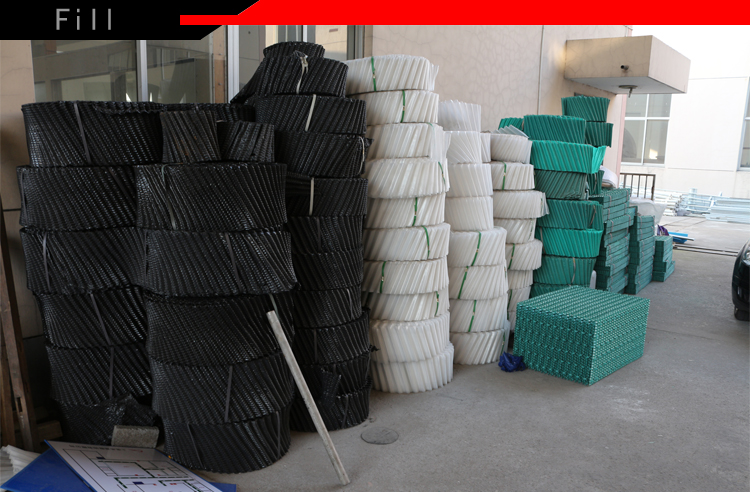
PVC has become one of the most widely used materials for cooling tower fill because it provides a useful balance between performance, weight, durability, chemical resistance, and manufacturing cost.
The material can be thermoformed into complex shapes, allowing manufacturers to create different fill geometries for counterflow and crossflow towers.
PVC is also relatively lightweight. That can make transportation and installation easier, especially during large replacement projects.
Another important advantage is resistance to many common cooling-water conditions. However, PVC should never be considered suitable for every application automatically.
Operating temperature, chemical exposure, water quality, and the specific PVC formulation all need to be considered before a final selection is made.
Heat Transfer Performance
The primary job of cooling tower fill is heat transfer.
A well-designed PVC fill provides a large effective surface area while maintaining air passages through the fill.
The actual thermal performance depends on many factors, including:
Fill geometry
Sheet thickness
Fill spacing
Water loading
Airflow
Operating temperature
Tower configuration
Water distribution
This is why comparing two products simply by their material—“both are PVC”—doesn't tell you enough.
Two PVC fills can have very different performance characteristics.
Lightweight Construction
Another advantage of PVC is its relatively low weight.
This becomes especially important during replacement projects.
Imagine removing thousands of old fill sheets from a large industrial cooling tower and installing new ones. The easier the material is to handle, the easier the installation process can become.
Lightweight fill can simplify transportation, cutting, assembly, and installation inside the tower.
Corrosion Resistance
Cooling towers operate in wet environments and can expose internal components to minerals, chemicals, biological growth, and other contaminants.
PVC provides good resistance to many common cooling-water conditions.
However, the actual compatibility should always be evaluated against the site's water chemistry and operating temperature.
A supplier that asks about your water quality before recommending a fill is generally taking the application seriously.
Cost and Availability
PVC is widely available and can be manufactured in many different configurations.
That gives buyers plenty of options when sourcing replacement fill.
But price per square meter shouldn't be your only comparison point.
A cheaper product may have a different thickness, flute design, thermal performance, pressure drop, or expected service life.
In cooling tower applications, the lowest purchase price isn't always the lowest total cost.
How to Choose a Reliable PVC Fillers Manufacturer
Before comparing manufacturers, it helps to understand what a good supplier should actually provide.
A reliable PVC fill manufacturer should be able to discuss more than product price.
They should understand the relationship between fill geometry, water quality, airflow, thermal performance, tower configuration, and maintenance.
Manufacturing Capability
Production capacity matters, particularly for large industrial replacement projects.
Ask whether the supplier can manufacture the required volume consistently and maintain dimensional quality from batch to batch.
Important factors include:
A supplier that can produce 100 square meters of fill isn't necessarily equipped to handle a major industrial tower replacement involving thousands of square meters.
Material Quality
The quality of a PVC filler begins with the raw material and manufacturing process.
Buyers should consider:
PVC formulation
Sheet thickness
Temperature resistance
Mechanical strength
UV resistance
Chemical compatibility
Long-term durability
A fill can look excellent when it is new. The real test comes after months or years of exposure to heat, water, chemicals, and mechanical stress.
Product Dimensions and Compatibility
Replacement fill must physically fit the cooling tower.
Important dimensions may include:
Fill height
Fill width
Fill length
Sheet thickness
Flute spacing
Module configuration
Support arrangement
This is particularly important for older cooling towers.
A tower installed 10, 20, or even 30 years ago may use a fill design that is no longer available from the original manufacturer.
In those cases, a specialized aftermarket manufacturer can provide valuable alternatives.
Technical Support
Good technical support can save you from an expensive mistake.
Before ordering, provide the manufacturer with as much information as possible:
This allows the supplier to recommend a product based on the actual application rather than simply selling a generic PVC fill.
Customization Capability
Customization is particularly useful for replacement projects.
Not every cooling tower uses standard dimensions.
A manufacturer capable of producing customized fill blocks can adapt the product to the existing tower structure, support system, water distribution arrangement, and available installation space.
Top 6 PVC Fillers Manufacturers and Suppliers
Now let's look at six manufacturers and suppliers worth considering when sourcing PVC cooling tower fill.
1. Power Tower Cooling Technology (Shaoxing) Co.,Ltd

Power Tower Cooling Technology (Shaoxing) Co.,Ltd is a specialized cooling tower component manufacturer and supplier focused on cooling tower fill and related components.
The company offers cooling tower fill solutions including PVC film fill, PP fill, replacement fill, and customized cooling tower fill products for different applications.
For buyers, one of the company's main advantages is its focus on cooling tower components rather than treating fill as a small side product.
This matters because a replacement project is rarely as simple as ordering “PVC fill.”
You may need to match the existing tower dimensions, water flow, operating temperature, flute spacing, support structure, and water quality.
Power Tower Cooling Technology can work with project-specific requirements and provide customized fill configurations for industrial and commercial applications.
PVC Fill Solutions
Typical requirements can include:
For an existing cooling tower, buyers can provide photographs, fill dimensions, drawings, tower information, and operating conditions.
This information helps determine the appropriate replacement configuration.

Why Consider Power Tower Cooling Technology?
Key advantages include:
Specialized cooling tower component manufacturing
PVC and PP cooling tower fill options
Replacement and retrofit solutions
Customized dimensions
Factory-direct supply
International B2B support
Cooling tower component expertise
For customers looking for a specialized PVC fill supplier rather than a general plastics company, Power Tower Cooling Technology is a strong option to investigate.
2. Brentwood Industries
Brentwood Industries is an established plastics manufacturer with a dedicated cooling tower product portfolio.
The company offers multiple film-fill geometries, including cross-fluted, herringbone, offset-fluted, vertical-fluted, and hybrid designs.
One of Brentwood's strengths is its focus on balancing thermal performance with fouling resistance.
Different water conditions create different challenges. A high-performance fill for clean HVAC water may not be the best choice for industrial water containing suspended solids.
Brentwood's range of fill geometries gives engineers more options when matching fill design to operating conditions.
The company also provides PVC splash-fill products for applications where a more open structure is preferred.
3. SPX Cooling Tech / Marley

SPX Cooling Tech, associated with the Marley brand, is a major cooling technology manufacturer with extensive experience in cooling towers and replacement components.
Its product portfolio includes OEM and aftermarket cooling tower fill products.
Marley offers different PVC fill configurations for crossflow and counterflow cooling towers.
For tower owners operating Marley equipment, OEM compatibility can be an important consideration.
The company's replacement fill products are designed around specific cooling tower applications, making it easier for existing tower owners to identify compatible products.
For large facilities where minimizing retrofit uncertainty is a priority, an OEM-based solution can be particularly attractive.
4. C.E. Shepherd Company
C.E. Shepherd Company is a U.S.-based manufacturer specializing in cooling tower components and heat-transfer media.
Its product portfolio includes film fill, splash fill, fill bars, fill hangers, and other cooling tower components.
The company provides different fill designs for both crossflow and counterflow applications.
C.E. Shepherd is particularly relevant for customers who need a broader package of cooling tower internal components rather than fill alone.
Its product range also allows buyers to consider the fill, support components, and water-distribution requirements together.
That can simplify projects where multiple internal components need to be replaced at the same time.
5. Baltimore Aircoil Company (BAC)

Baltimore Aircoil Company (BAC) is a major manufacturer of evaporative cooling equipment and offers replacement components for its cooling tower systems.
BAC provides replacement fill solutions designed for specific equipment applications.
Its replacement fill products include PVC options as well as materials designed for higher-temperature applications.
For facilities operating BAC cooling towers, purchasing compatible replacement fill from the original equipment manufacturer can simplify the replacement process.
The important thing is to identify the exact tower model and existing fill configuration before ordering.
Remember, “PVC” is only the starting point. The actual product must also match the tower's dimensions, thermal duty, water loading, and operating conditions.
6. EVAPCO

EVAPCO is another established manufacturer in evaporative cooling and heat-transfer equipment.
The company serves commercial HVAC, industrial process cooling, power generation, and other applications.
EVAPCO has also developed PVC replacement fill products for cooling towers.
Its cooling tower fill solutions are designed to improve water-air contact and support efficient heat transfer.
For customers already operating EVAPCO equipment, using compatible replacement components can help simplify maintenance and reduce uncertainty during a fill replacement project.
For aftermarket projects, the key is again to verify tower configuration and dimensions rather than selecting fill based solely on the material.
Comparison of the Top 6 PVC Fillers Suppliers
| Supplier | Main Strength | Suitable Buyer |
| Power Tower Cooling Technology | PVC/PP fill, customized replacement solutions | Industrial buyers, retrofit projects, international sourcing |
| Brentwood Industries | Broad range of engineered fill geometries | Industrial and HVAC applications |
| SPX / Marley | OEM and aftermarket Marley fill | Marley cooling tower owners |
| C.E. Shepherd | Film fill, splash fill and related components | Crossflow and counterflow projects |
| Baltimore Aircoil Company | OEM replacement fill solutions | BAC tower owners |
| EVAPCO | Evaporative cooling equipment and replacement components | EVAPCO and aftermarket applications |
The best supplier depends on your project.
If OEM compatibility is the main priority, the original cooling tower manufacturer may be the logical choice.
If you need customized dimensions, factory-direct supply, or aftermarket replacement solutions, a specialized cooling tower component manufacturer may provide greater flexibility.
Where Are PVC Fillers Used?
PVC cooling tower fillers are used across a wide range of applications.
The correct fill configuration depends on the tower design, water quality, heat load, and operating environment.
HVAC Cooling Towers
Commercial HVAC systems frequently use cooling towers to reject heat from chillers.
PVC film fill can provide the high water-air contact area required for effective heat rejection.
Large office buildings, hospitals, hotels, universities, shopping centers, and other facilities may use these systems.
Industrial Process Cooling
Industrial facilities often have continuous process heat loads.
Manufacturing plants, plastics factories, machinery plants, food-processing facilities, and other industrial operations may use cooling towers to remove process heat.
However, industrial water can be much dirtier than conventional HVAC cooling water.
This makes fouling resistance particularly important.
Power Generation
Power plants require reliable heat rejection.
Cooling tower fill is an important part of the heat-transfer process, helping transfer heat from circulating water to atmospheric air.
Large power-generation cooling towers may require careful evaluation of thermal performance, durability, water chemistry, and maintenance requirements.
Chemical and Petrochemical Plants
Chemical and petrochemical plants can create challenging cooling conditions.
Water may contain contaminants or operate at elevated temperatures.
Material compatibility therefore becomes particularly important.
PVC may be suitable for many applications, but engineers should confirm the temperature and chemical conditions before making a final selection.
How to Select the Right PVC Fill
Choosing the right PVC filler starts with the cooling tower, not the product catalog.
Ask five basic questions:
What type of tower is it?
What is the water flow?
What are the operating temperatures?
How clean is the water?
What thermal performance is required?
Once you know these answers, selecting the appropriate fill becomes much easier.
Counterflow or Crossflow?
First identify the tower configuration.
In a counterflow cooling tower, air and water generally move in opposite directions through the fill.
In a crossflow cooling tower, air moves horizontally across falling water.
The fill design must match the airflow and water-distribution arrangement.
A fill designed for one configuration should not automatically be assumed suitable for another.
Water Quality Matters
Water quality is one of the most overlooked factors in fill selection.
If the water contains suspended solids, biological growth, scale-forming minerals, oil, grease, or other contaminants, closely spaced film fill may foul more quickly.
In these situations, larger-flute or vertical-flow designs may provide better resistance to fouling.
This is a classic engineering trade-off.
More surface area can improve heat transfer, but more closely spaced passages can also make the fill more sensitive to contamination.
Operating Temperature
PVC is not suitable for every temperature range.
The maximum recommended operating temperature depends on the specific material formulation and product design.
For higher-temperature applications, buyers may need specialized PVC, CPVC, PP, or another material.
Never select fill simply because the product description says “PVC.”
Always ask the manufacturer for the recommended temperature range.
Fill Spacing and Geometry
Fill spacing directly influences performance and fouling resistance.
Tighter spacing can provide more effective surface area, but it may also be more vulnerable to plugging.
Larger openings can improve fouling resistance while potentially changing thermal performance.
The best geometry is therefore the one that provides the right balance for your specific water and operating conditions.
When Should PVC Cooling Tower Fill Be Replaced?
PVC fill doesn't necessarily need to be replaced after a fixed number of years.
Condition is more important than age.
Regular inspections can help determine whether the fill is still performing properly.
Clogging and Scaling
Scale, dirt, algae, biological growth, and other deposits can block fill passages.
As the passages become restricted, airflow can become more difficult and effective heat-transfer area can decrease.
The tower may then require more fan energy while providing less cooling.
If the fill is still structurally sound, cleaning may restore performance.
If contamination is severe or permanent, replacement may be the better option.
Cracking and Brittleness
Long-term exposure to heat, chemicals, UV radiation, and mechanical stress can eventually cause PVC to become brittle.
Cracked or fragile fill may break apart during maintenance.
Fragments can fall into the basin and potentially create problems elsewhere in the circulating-water system.
If the fill has become severely brittle, warped, cracked, or structurally damaged, replacement should be considered.
Poor Cooling Performance
Sometimes the clearest warning sign is simple: the cooling tower no longer reaches its required cold-water temperature.
If the fan, motor, pump, water distribution, and controls are functioning correctly but cooling performance continues to decline, inspect the fill.
The fill is at the center of the heat-transfer process.
When it becomes blocked or damaged, the entire cooling tower can feel the effect.
Questions to Ask a PVC Fill Supplier Before Buying
Before placing a purchase order, ask the supplier:
What PVC material and thickness are used?
What is the recommended operating temperature?
Is the fill designed for counterflow or crossflow towers?
What water quality does the product support?
What flute spacing and geometry are available?
Can the fill be customized?
What quality-control tests are performed?
Can the supplier provide technical drawings?
What is the production lead time?
Can the supplier provide replacement products in the future?
These questions can quickly distinguish a technical manufacturer from a supplier that simply resells generic plastic products.
Why Factory-Direct PVC Fill Supply Can Be Valuable
For large industrial projects, buying directly from a manufacturer can simplify communication.
Instead of sending technical questions through several intermediaries, buyers can discuss product dimensions, materials, operating conditions, packaging, customization, and delivery directly with the production source.
This is particularly useful when the project involves unusual dimensions or an older cooling tower.
For replacement projects, it is a good idea to send photos and measurements before requesting a final quotation.
A few accurate measurements taken before manufacturing can prevent a much bigger problem after delivery.
Future Trends in PVC Cooling Tower Fill
The future of cooling tower fill isn't simply about creating more surface area.
Manufacturers are increasingly trying to balance several competing requirements:
Higher thermal performance
Lower airflow resistance
Better fouling resistance
Longer service life
Improved mechanical strength
Easier installation
Lower maintenance requirements
More efficient water distribution
We are also likely to see more application-specific designs.
Instead of searching for one universal “best PVC fill,” buyers will increasingly select fill based on their actual operating environment.
That's a positive development.
A cooling tower operating with clean HVAC water has different requirements from one handling heavily contaminated industrial water.
The right fill should reflect that difference.
Final Buying Recommendations
Choosing a PVC fillers manufacturer is ultimately about finding the right balance between thermal performance, water quality compatibility, product quality, price, customization, and technical support.
For buyers seeking a specialized cooling tower component manufacturer, Power Tower Cooling Technology (Shaoxing) Co.,Ltd is a strong starting point, particularly for PVC cooling tower fill, replacement projects, customized dimensions, and related cooling tower components.
Brentwood Industries is worth considering when you need a broad range of engineered fill geometries.
SPX Cooling Tech / Marley is an important option for OEM Marley fill and aftermarket applications.
C.E. Shepherd provides film fill, splash fill, and related cooling tower components.
Baltimore Aircoil Company and EVAPCO are particularly relevant when replacement components for their respective cooling equipment are required.
But remember one important point:
The best PVC filler isn't necessarily the cheapest product or the one with the highest advertised heat-transfer rate.
The best filler is the one that fits your cooling tower, handles your water quality, operates safely at your temperature, provides the required thermal performance, and remains practical to maintain.
In other words, don't buy the fill first and figure out the application later.
Start with the cooling tower.
Then work backward to the right fill.
Frequently Asked Questions About PVC Fillers
What are PVC fillers used for in cooling towers?
PVC fillers increase the contact area between circulating water and air, helping the cooling tower transfer heat more effectively through sensible and evaporative cooling.
Are PVC fillers better than PP fillers?
Not always.
PVC is widely used for many conventional cooling applications because it offers a practical balance of performance and cost.
PP can be preferable for certain higher-temperature or chemically demanding applications.
The right material depends on the actual operating conditions.
How long do PVC cooling tower fillers last?
There is no universal service-life number.
Fill life depends on water quality, operating temperature, UV exposure, chemical treatment, fouling, mechanical loading, and maintenance.
Regular inspection is more useful than relying on a fixed replacement interval.
Can PVC fill be used in both crossflow and counterflow cooling towers?
Yes. PVC fill products are available for both crossflow and counterflow towers.
However, the actual fill geometry and installation method must match the specific tower configuration.
What is the difference between PVC film fill and PVC splash fill?
Film fill spreads water into thin films across formed surfaces and generally provides a high effective heat-transfer area.
Splash fill breaks water into droplets and usually has a more open structure, which can be useful in applications where fouling is a concern.
How do I choose a PVC fill manufacturer?
Compare manufacturing capability, material quality, product dimensions, thermal performance, water-quality compatibility, customization, quality control, technical support, and delivery capability.
Don't compare suppliers based on price alone.
Can Power Tower Cooling Technology supply customized PVC fillers?
Yes. Power Tower Cooling Technology (Shaoxing) Co.,Ltd provides cooling tower fill solutions for replacement and customized applications.
Buyers can provide tower dimensions, existing fill measurements, operating conditions, drawings, and photographs to help determine the appropriate product configuration.
What information should I provide when requesting a PVC fill quotation?
Ideally, provide the cooling tower type, tower model, existing fill dimensions, fill thickness, water flow, operating temperatures, water quality, required quantity, photographs, and drawings if available.
The more complete the information, the more accurately a manufacturer can recommend the right fill.
Conclusion
PVC fillers may look like simple plastic components, but they have a major influence on cooling tower performance.
They create the surface where air and water interact, support heat transfer, and help the tower reject heat efficiently.
That is why choosing the right manufacturer matters.
Whether you're building a new cooling tower, replacing old fill, upgrading an existing system, or sourcing customized cooling tower internals, evaluate the complete application—not just the material name.
Check the tower type.
Check the water quality.
Check the operating temperature.
Check the fill geometry.
Check the dimensions.
And most importantly, choose a supplier that understands how all those pieces work together.
A good PVC filler doesn't simply fill space inside a cooling tower. It creates the working environment where efficient cooling actually happens.


