When sourcing cooling tower fill for an industrial project, choosing the right product involves more than comparing prices. You need to understand the material, dimensions, fill geometry, operating conditions, and compatibility with your existing cooling tower. If you are researching MC75 cooling tower fill, these details can help you make a more informed purchasing decision.
Cooling tower fill plays an important role in heat rejection by increasing contact between circulating water and air. The right fill configuration can support effective heat transfer, while an unsuitable product may cause installation difficulties, excessive airflow resistance, or maintenance problems.
In this guide, we explore the key features, specifications, and potential applications of MC75 cooling tower fill. We also explain how to evaluate suppliers, assess replacement requirements, and compare products before placing an order.
Important: MC75 is a model designation, not enough on its own to establish a universal set of technical specifications. Always confirm the exact product design, dimensions, material, and operating limits with the supplier.
1. What Is MC75 Cooling Tower Fill?
Cooling tower fill is an internal component designed to improve contact between water and air inside a cooling tower. Instead of allowing warm water to fall directly through an empty space, fill helps spread the water across surfaces or break it into droplets, depending on the design.
This additional contact supports the heat and mass transfer processes that allow a cooling tower to remove heat from circulating water.
MC75 cooling tower fill should be evaluated according to the specific product offered under this name. Before purchasing, confirm whether the product is film fill, splash fill, or another configuration. Each type has different characteristics and may be suitable for different operating environments.
Understanding Cooling Tower Fill Media
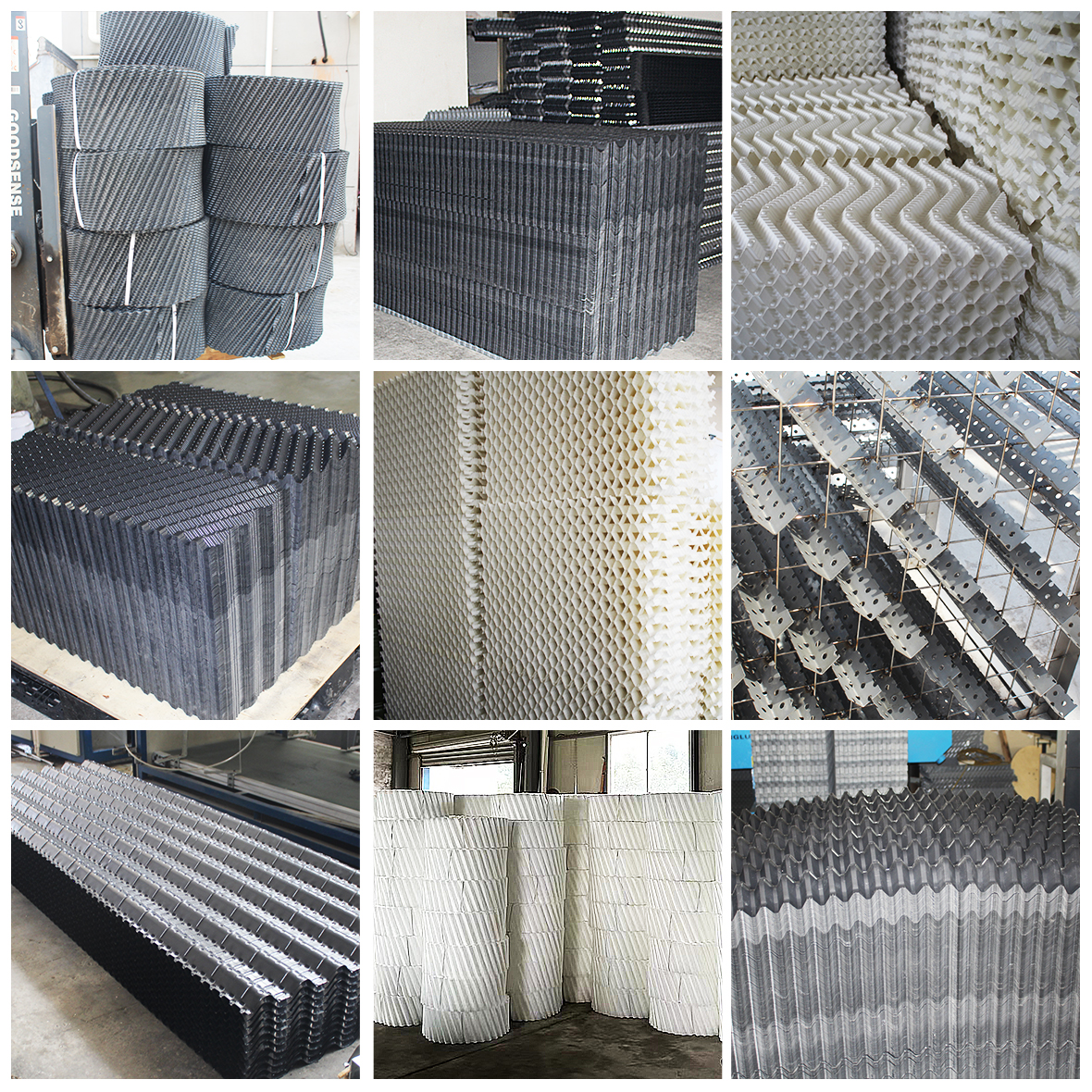
Film fill uses formed sheets to distribute water across a large contact surface. The water flows over the surfaces while air passes through the spaces between them. This arrangement can provide substantial contact area in a relatively compact volume.
Splash fill works differently. It breaks falling water into smaller droplets as the water passes across successive surfaces. This approach may be worth considering in applications where water quality or solids loading creates challenges for some film-fill designs.
Neither type is automatically the best choice for every installation. The appropriate solution depends on the cooling tower design, water quality, operating temperature, cooling requirements, and maintenance strategy.
What Does the MC75 Model Name Mean?
Model numbers help buyers identify products, but their meanings can vary among manufacturers. Similar designations do not necessarily indicate identical dimensions, materials, or performance characteristics.
When researching MC75 cooling tower fill, request a technical data sheet and a dimensioned product drawing. Confirm the fill type, material, sheet dimensions, assembled pack size, and intended application.
This information is particularly important when comparing quotations from different suppliers or replacing existing fill. A product with a familiar model name may still differ from the component installed in your tower.
2. Key Features of MC75 Cooling Tower Fill
The features that matter most depend on the verified design of the MC75 product you are considering. Buyers should pay particular attention to water distribution, heat-transfer characteristics, airflow passages, mechanical stability, and maintenance requirements.
Rather than relying on general marketing claims, ask the supplier to explain how the product's construction suits your operating conditions.
Water Distribution and Heat Transfer
Effective water distribution helps make better use of the available fill surface. If water flows unevenly, some areas may receive too much water while others remain relatively dry. This can reduce the effective contact area and contribute to inconsistent cooling.
Film fill is designed to spread water over shaped surfaces, while splash fill promotes water breakup and redistribution. The effectiveness of either design depends on the complete cooling tower arrangement.
Before selecting MC75 fill, check that its design works with your water distribution system. Where available, request performance data based on operating conditions similar to those of your installation.
Fill Geometry and Airflow
Fill geometry influences both the contact area between water and air and the resistance encountered by air moving through the tower.
If the passages are too restrictive for the intended application, airflow may be reduced or fan energy requirements may increase. If the fill is incorrectly installed, gaps may allow air or water to bypass the intended contact area.
Ask the supplier about flute geometry, passage arrangement, installation orientation, and pressure-drop characteristics. These details help engineers determine whether the product is appropriate for the tower.
A high nominal surface area does not automatically guarantee better cooling performance. Water distribution, airflow, fouling resistance, and operating conditions must also be considered.
Structural Stability and Service Life
Cooling tower fill needs to retain its intended shape under the conditions for which it was designed. Material grade, sheet thickness, support spacing, water temperature, cleaning methods, and mechanical handling can all influence durability.
For industrial applications, ask the manufacturer about recommended operating limits and installation requirements. Confirm whether the product is suitable for the expected maintenance routine and exposure conditions.
It is also important to avoid assuming that thicker sheets always provide better results. Fill design involves balancing structural strength, geometry, contact area, airflow resistance, and product weight.

3. MC75 Cooling Tower Fill Specifications
Technical specifications are essential when determining whether MC75 cooling tower fill will suit your project. Before requesting a final quotation, establish the requirements for material, dimensions, sheet thickness, geometry, operating temperature, and compatibility.
A useful specification sheet should provide enough information for your engineering or purchasing team to evaluate the product without relying on assumptions.
Material Options: PVC, PP, and Others
PVC and PP are commonly used materials for cooling tower fill, but the actual material used in an MC75 product must be confirmed.
PVC fill is widely used in conventional cooling tower applications. Its suitability depends on the material formulation, operating temperature, water chemistry, and product construction.
PP fill may be considered where its specific temperature and chemical-resistance characteristics match the application. As with PVC, the material grade and operating limits need to be verified.
Some specialized systems may require other materials or particular product designs. The correct choice depends on the service conditions rather than the model name.
When requesting a quotation, ask the supplier to identify the material in writing and confirm its suitability for your water temperature, treatment chemicals, and expected contamination levels.
Dimensions and Fill Pack Configuration
Dimensions are among the most important cooling tower fill specifications because they determine whether the product can be installed correctly.
Request both individual sheet dimensions and assembled fill pack dimensions. Depending on the design, you may need to confirm length, width, height, pack arrangement, and installation orientation.
Before ordering replacement fill, measure the existing installation or consult the original tower drawings. Check the available fill space, support spacing, and access openings.
Incorrect dimensions can create several problems. Oversized packs may be difficult to install, while undersized packs may leave gaps that allow air or water to bypass the intended flow path.
Practical tip: Ask for a dimensioned drawing of the exact MC75 product being quoted. Do not rely on a photograph or model name alone.
Sheet Thickness and Flute Design
Sheet thickness affects stiffness, handling, and resistance to deformation. However, the required thickness depends on the product's geometry, material, support arrangement, and intended operating conditions.
Flute design also matters. The shape and spacing of the formed sheets influence water distribution, contact area, airflow passages, and resistance to clogging.
When reviewing MC75 fill specifications, ask for the nominal sheet thickness, relevant tolerances, flute dimensions, and available product drawings. Clarify whether thickness measurements refer to the sheet before forming or the finished component.
These details help you compare products accurately and determine whether the proposed fill matches the requirements of your cooling tower.
Operating Temperature and Chemical Compatibility
Operating temperature and water chemistry can affect fill performance and service life. Hot water, treatment chemicals, mineral deposits, and cleaning agents may affect different materials in different ways.
Before purchasing MC75 cooling tower fill, provide the supplier with your normal and maximum water temperatures, treatment program, and known water quality issues.
Ask for the manufacturer's recommended operating range and applicable chemical compatibility guidance. If your system operates under unusual conditions, request written confirmation of suitability.
A general material description is not enough to establish that a particular fill product will withstand your actual operating environment.
4. How MC75 Cooling Tower Fill Supports Cooling Performance
Cooling tower fill is an important part of the heat rejection process, but it does not operate independently. Actual tower performance also depends on water flow, airflow, entering water temperature, ambient wet-bulb temperature, water distribution, and the condition of other components.
Understanding these relationships helps buyers avoid unrealistic expectations when selecting replacement fill.
Heat and Mass Transfer
In an evaporative cooling tower, warm water comes into contact with moving air. A portion of the water evaporates, transferring heat away from the circulating water.
Fill helps establish the contact conditions needed for this process. The resulting performance depends on the fill's geometry, water distribution, airflow, and operating conditions.
When comparing MC75 with alternative fill products, request technical data based on clearly stated conditions. Look for information about water flow, inlet and outlet water temperatures, airflow, and other relevant design parameters.
Without comparable data, claims that one product is more efficient than another may not provide a reliable basis for purchasing decisions.
Airflow Resistance and Pressure Drop
As air passes through fill media, it encounters resistance. This resistance is commonly described as pressure drop and can influence fan operation and the airflow available through the tower.
A product with unsuitable airflow characteristics may affect system performance even if its contact surface appears attractive on paper.
Ask the supplier whether pressure-drop data is available for the proposed MC75 configuration. If energy consumption is a major concern, compare airflow resistance alongside thermal performance and consult a cooling tower engineer before changing the fill design.
The goal is to select a product that meets the cooling requirements without creating unnecessary operating limitations.
The Importance of Water Quality
Water quality can significantly influence fill condition over time. Suspended solids, mineral scale, corrosion products, and biological growth may accumulate inside the fill passages.
These deposits can restrict airflow and water movement, reducing the effectiveness of the fill. In severe cases, fouling may increase cleaning requirements or contribute to uneven water distribution.
If your cooling tower has a history of clogging, discuss filtration, water treatment, and maintenance practices with the supplier before choosing a replacement.
A suitable fill product and a well-managed water treatment program should work together. Replacing the fill without addressing the cause of repeated fouling may simply lead to the same problem again.
5. Applications of MC75 Cooling Tower Fill
MC75 cooling tower fill may be considered for an application when its verified specifications match the cooling tower's design and operating requirements. The exact suitability of the product should be confirmed with the supplier.
Industrial Process Cooling
Industrial facilities use cooling towers to remove heat from equipment, process water, and heat-exchange systems.
Potential applications include manufacturing operations, industrial processing lines, and equipment cooling systems. However, the appropriate fill depends on water temperature, contamination levels, cooling duty, and the tower's internal arrangement.
Before specifying MC75 for process cooling, provide the supplier with your operating conditions and original tower specifications. This makes it easier to determine whether the product is appropriate for the intended service.
HVAC and Commercial Cooling
Commercial buildings, offices, hotels, hospitals, and other facilities may use cooling towers as part of central air-conditioning systems.
These towers reject heat from the condenser-water circuit, helping chillers maintain the required cooling conditions. Fill selection should account for the tower configuration, operating schedule, water treatment program, and maintenance access.
For an existing HVAC cooling tower, verify the proposed product's dimensions and compatibility before treating MC75 as a direct replacement for the installed fill.
Power Generation and Manufacturing
Cooling towers are also used in power generation and a range of manufacturing environments where heat rejection is essential to plant operation.
These applications can have very different operating conditions. Some systems handle elevated water temperatures or challenging water chemistry, while others operate under more conventional conditions.
Confirm that the proposed fill material and configuration are suitable for the actual service environment. Where performance requirements are demanding, request relevant technical documentation and obtain an engineering review before purchase.

6. Is MC75 Fill Suitable for Counterflow and Crossflow Cooling Towers?
Cooling towers use different airflow arrangements, and fill must be compatible with the tower's design.
Counterflow and crossflow configurations differ in how air moves relative to the falling water. Their fill arrangements, support requirements, and water distribution systems may also differ.
Do not assume that MC75 is suitable for both configurations without confirmation from the supplier.
Counterflow Cooling Tower Considerations
In a counterflow cooling tower, air generally moves upward while water flows downward through the fill.
The fill must work with this airflow pattern and the tower's water distribution arrangement. Buyers should check pack dimensions, installation orientation, support requirements, and pressure-drop characteristics.
If the proposed MC75 product differs from the original fill, request a technical comparison before installation. A change in fill geometry can affect more than just the physical fit.
Crossflow Cooling Tower Considerations
In a crossflow cooling tower, air typically moves horizontally across the falling water.
The fill configuration must accommodate the intended airflow direction and work with the existing water distribution system. Before ordering, confirm that the product is intended for crossflow service and that its dimensions match the available installation space.
If you are replacing an existing product, compare the original drawings and operating requirements with the proposed fill specifications.
7. MC75 Cooling Tower Fill Replacement and Installation
Replacing worn cooling tower fill can help restore the intended contact arrangement between air and water. However, a decline in cooling performance does not automatically mean the fill needs replacement.
Before starting a replacement project, inspect the full system and check for other potential causes, such as poor water distribution, fan problems, clogged strainers, or inadequate water treatment.
Signs of Fill Deterioration
Common warning signs include:
Cracked, brittle, or deformed sheets.
Collapsed or separated fill packs.
Persistent deposits that cannot be removed through approved cleaning.
Blocked passages that restrict airflow or water movement.
Uneven water distribution or visible bypass gaps.
Reduced cooling performance after other operating factors have been investigated.
Regular inspections help identify these problems before they lead to more serious operating issues.
Measuring Before Ordering
Accurate measurements reduce the risk of purchasing incompatible fill. Record the existing pack dimensions, number of packs, support spacing, installation orientation, and available access openings.
Where possible, compare these measurements with the original cooling tower drawings. Take clear photographs and label them so the supplier can understand the current arrangement.
You should also provide the tower model, operating temperature, water quality information, and reason for replacement. This information helps the supplier determine whether MC75 is a suitable direct replacement or whether additional engineering review is needed.
Installation and Post-Installation Checks
Before installation, follow the cooling tower manufacturer's shutdown, isolation, access, and safety procedures. Work inside a cooling tower can involve fall hazards, electrical equipment, restricted spaces, and biological exposure.
Inspect support structures and adjacent components before installing the new fill. Follow the approved drawings and manufacturer instructions to ensure the packs are properly supported and aligned.
Avoid creating unintended gaps that allow air or water to bypass the designed flow path. Do not cut or modify the fill without confirming that the change is acceptable.
After installation, check water distribution and monitor cooling performance under documented operating conditions. This provides a useful basis for evaluating whether the replacement meets the project's requirements.
8. Cleaning and Maintaining Cooling Tower Fill
Proper maintenance can help extend fill service life and reduce the risk of blockage. Establish an inspection schedule based on operating conditions, water quality, and the manufacturer's recommendations.
During inspections, look for scale, biological growth, blocked passages, deformed sheets, and uneven water distribution. If fouling appears repeatedly, investigate the water treatment and filtration systems instead of relying on cleaning alone.
Use cleaning methods and chemicals approved for the fill material. Excessive pressure or incompatible chemicals may damage the fill, even when the cleaning process removes visible deposits.
Keep records of inspections, cleaning activities, and operating conditions. Over time, these records can help you identify recurring problems and make better maintenance decisions.
9. How to Choose an MC75 Cooling Tower Fill Supplier
Choosing a supplier is about more than finding the lowest quotation. You need accurate product information, consistent quality, suitable packaging, and clear communication throughout the purchasing process.
Technical Documentation and Quality Control
Ask suppliers for a product data sheet, dimensioned drawing, material identification, and operating recommendations.
Where relevant, request thermal performance and pressure-drop data, together with the conditions under which the data applies. You may also ask about dimensional inspection, production quality checks, and material traceability.
Clear documentation allows you to compare suppliers on a consistent technical basis and reduces the risk of ordering products that do not match your requirements.
Customization, Packaging, and Delivery
Some cooling tower projects require dimensions or configurations that differ from standard products. Confirm directly with the supplier whether customization is available for the specific fill design.
When requesting a quotation, provide the quantity, dimensions, delivery destination, project schedule, and packaging requirements.
Ask how the product will be protected during transportation and confirm the production lead time and delivery terms in writing before placing your order.
Comparing Price and Total Cost
The lowest initial price does not necessarily represent the best value. A product that does not fit properly or requires frequent maintenance may increase the total cost of the project.
Compare quotations using the same technical specifications. Consider material, dimensional accuracy, shipping, installation labor, maintenance requirements, and available performance documentation.
If two products have different geometries or operating characteristics, ask the supplier or a qualified engineer to determine whether they are genuinely comparable.
10. Why Contact Power Tower Cooling Technology (Shaoxing) Co.,Ltd?

For buyers researching cooling tower fill and related components, Power Tower Cooling Technology (Shaoxing) Co.,Ltd is a supplier contact through CoolingTowerPart.com.
When making an inquiry about MC75 cooling tower fill, provide as much technical information as possible. This helps clarify your requirements and makes it easier to assess product compatibility.
Useful information includes:
Existing cooling tower model and configuration.
Required fill dimensions and quantity.
Preferred material, if already specified.
Normal and maximum water temperatures.
Water quality and treatment conditions.
Delivery destination and project schedule.
Existing product drawings or installation photographs.
Ask the supplier to confirm the exact MC75 configuration, material, dimensions, and available technical documentation. If you are replacing existing fill, explain whether you need a direct replacement or are considering an alternative design.
Visit www.coolingtowerpart.com to submit your inquiry and discuss your cooling tower fill requirements. Confirm the product specifications, delivery arrangements, and commercial terms directly with the supplier before ordering.
11. Frequently Asked Questions
What Material Is MC75 Cooling Tower Fill Made From?
The material depends on the specific product being offered. PVC and PP are common materials in cooling tower fill applications, but you should not infer the material from the MC75 designation alone. Ask the supplier to confirm the material grade and its suitability for your operating conditions.
What Are the Standard MC75 Fill Dimensions?
Do not assume that the model name represents one universal set of dimensions. Request a dimensioned drawing showing the individual sheet dimensions and assembled pack size. Compare these measurements with the available space and support arrangement in your cooling tower.
Can MC75 Fill Replace Existing Fill Media?
It may be suitable if the dimensions, geometry, material, airflow characteristics, and operating limits meet the tower's requirements. Compare the proposed product with the original specifications and request engineering review if the design differs.
How Often Should Cooling Tower Fill Be Replaced?
Replacement frequency varies with material, water temperature, water treatment, contamination, cleaning practices, and mechanical condition. There is no single service life that applies to every installation. Inspect the fill regularly and follow the manufacturer's recommendations to determine when replacement is necessary.
How Can I Request a Quotation?
Visit CoolingTowerPart.com and contact Power Tower Cooling Technology (Shaoxing) Co.,Ltd. Include your required quantity, tower type, fill dimensions, operating conditions, material preference if known, delivery destination, and any relevant drawings or photographs. Request a written quotation that clearly identifies the product specifications and commercial terms.
12. Conclusion
Choosing MC75 cooling tower fill starts with confirming exactly what the model designation represents. Material, dimensions, fill geometry, temperature limits, water quality, airflow resistance, and compatibility with the cooling tower all deserve attention before purchase.
The most suitable product is not necessarily the one with the lowest price or the boldest performance claim. It is the one that meets your system's verified requirements, can be installed correctly, and can be maintained under your operating conditions.
Before ordering, obtain the technical data sheet and dimensioned drawing for the exact product being offered. Compare quotations against the same requirements, and seek engineering advice when a proposed replacement differs from the original design.
For sourcing inquiries, contact Power Tower Cooling Technology (Shaoxing) Co.,Ltd through www.coolingtowerpart.com. Providing accurate technical details from the beginning will help you evaluate your options and make a more informed cooling tower fill purchasing decision.


