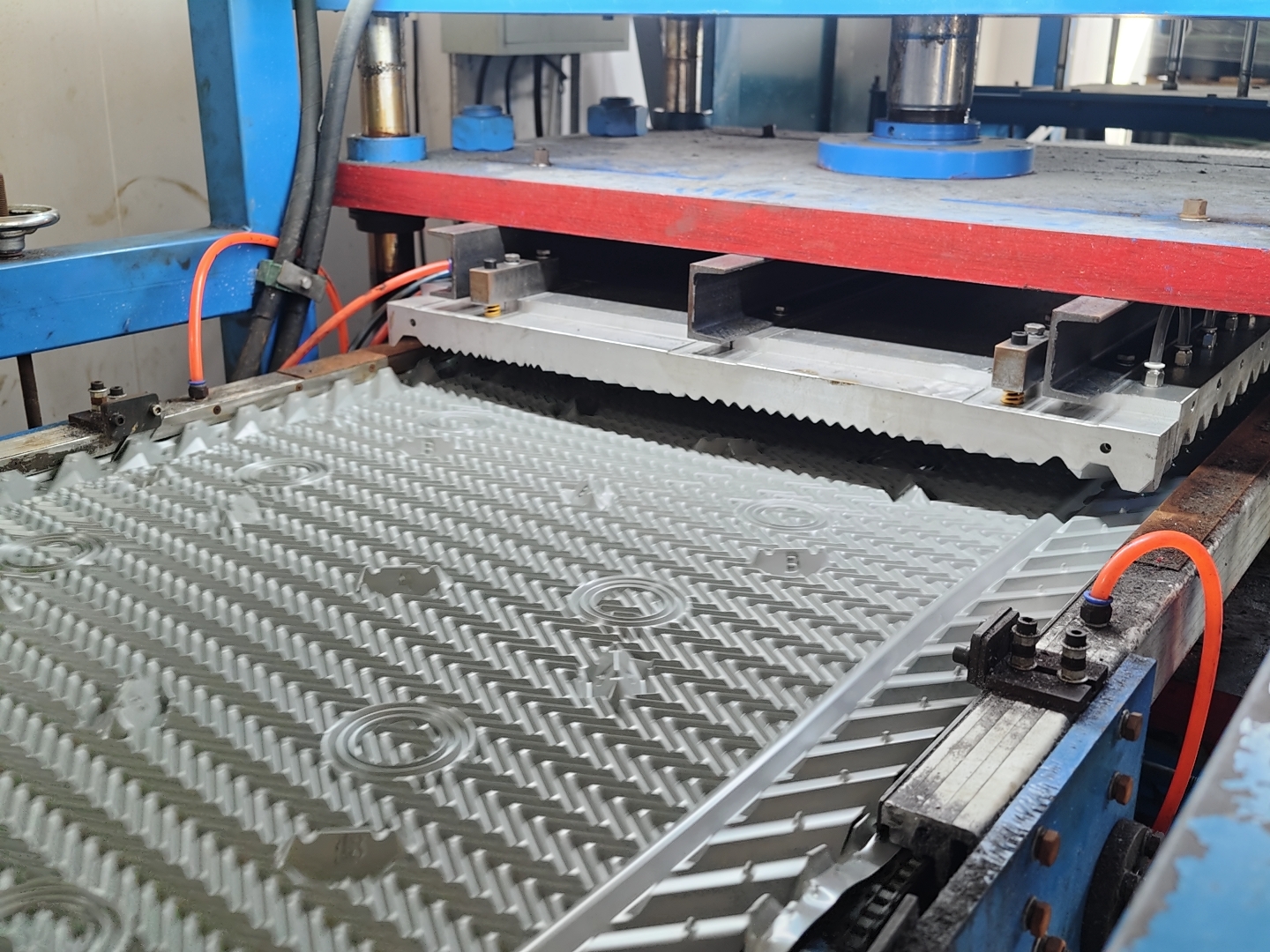
Cooling tower fill is one of the most important components inside an evaporative cooling tower. It increases the contact area between hot water and moving air, allowing more heat to be transferred through evaporation. The right fill for cooling tower applications can improve thermal performance, reduce energy consumption, and support stable operation.
Cooling tower fill is available in several designs and materials, including film fill, splash fill, PVC fill, and PP fill. Selecting the right product depends on cooling tower type, water quality, temperature, airflow, and operating conditions.
This guide explains the major cooling tower fill types, materials, applications, and selection factors for industrial and commercial buyers.
What Is Fill for a Cooling Tower?
Cooling tower fill is the structured material installed inside a cooling tower to increase air-water contact.
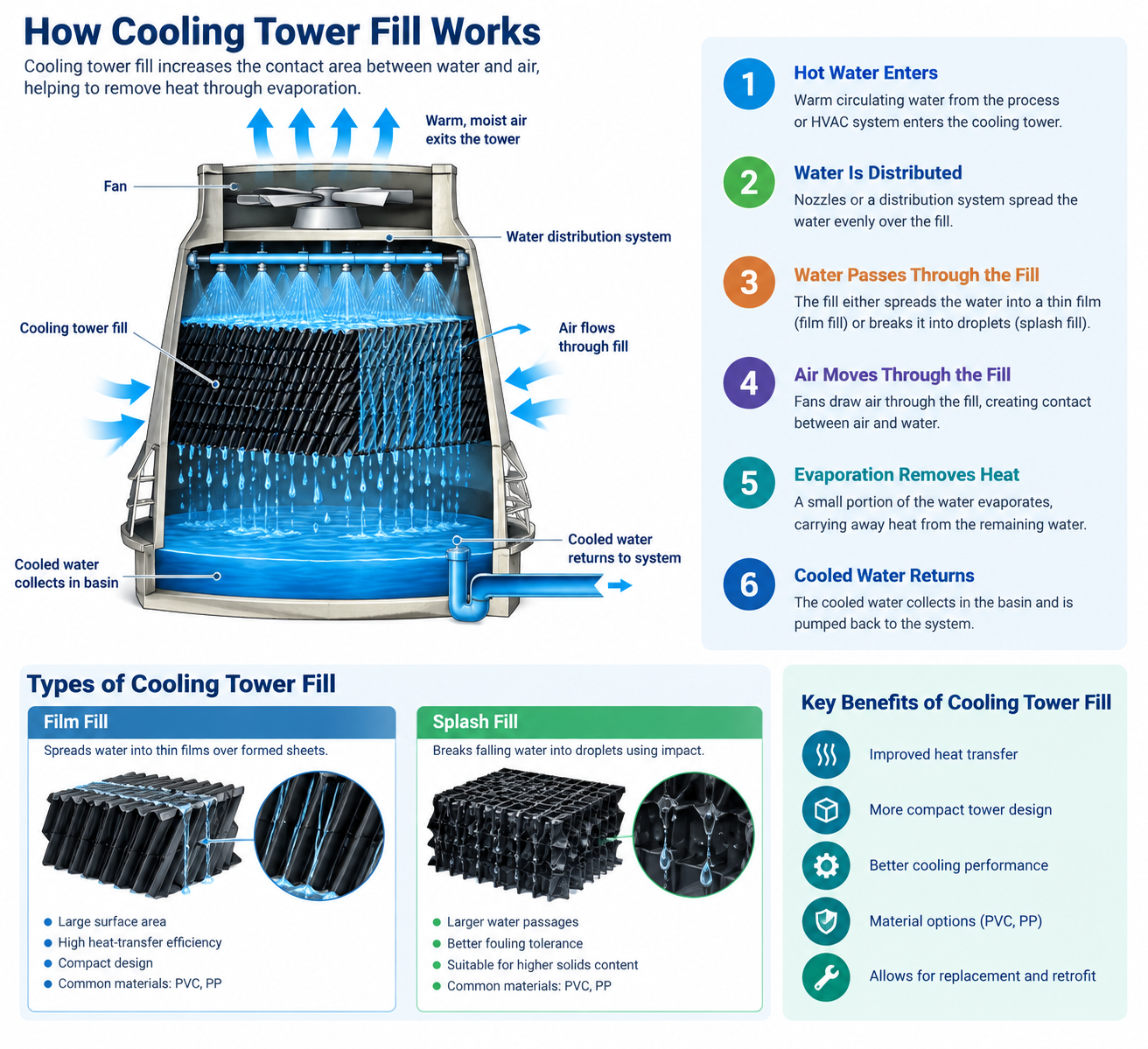
Without fill, water would fall directly from the distribution system to the basin with relatively limited contact with air. Fill slows and spreads the water, creating a larger contact surface and longer interaction time between water and air.
The basic process is:
Hot circulating water enters the cooling tower.
Water is distributed over the fill.
Fill spreads water into thin films or droplets.
Air moves through the fill.
A portion of the water evaporates.
Heat is transferred from the water to the air.
Cooled water collects in the basin and returns to the process.
The performance of this process depends heavily on the design and condition of the fill.
Main Types of Cooling Tower Fill
There are two primary types of cooling tower fill: film fill and splash fill. Hybrid designs are also available for specialized applications.
1. Film Fill
Film fill uses closely spaced sheets with corrugated or specially formed surfaces. Water spreads across the sheets as a thin film while air passes through the fill.
The large surface area provides efficient air-water contact.
Advantages include:
High heat-transfer efficiency
Large effective surface area
Compact design
Good performance in clean-water applications
Suitable for many modern cooling towers
Film fill is widely used in counterflow and crossflow cooling towers.
However, the narrow passages can become blocked by suspended solids, scale, algae, or biological growth. Therefore, water quality is an important consideration.
2. Splash Fill
Splash fill works differently. Instead of spreading water into a continuous film, it repeatedly breaks falling water into smaller droplets.
Splash fill may use bars, grids, sheets, or specially shaped modules.
Its main advantages include:
Better resistance to fouling
Larger water passages
Good performance with lower-quality water
Easier cleaning in many applications
Suitable for industrial process cooling
Splash fill is often selected for applications where suspended solids or contamination could quickly block film fill.
3. Hybrid Fill
Hybrid cooling tower fill combines characteristics of film and splash designs.
It can provide a balance between heat-transfer efficiency and fouling resistance. Hybrid designs may be considered when water quality is moderate and the operator wants more flexibility than conventional film fill provides.
Cooling Tower Fill Materials
PVC Cooling Tower Fill
PVC cooling tower fill is one of the most widely used materials for film fill.
PVC offers a combination of relatively low cost, good chemical resistance, processability, and suitable performance for many cooling tower applications.
PVC film fill is commonly used in:
The maximum operating temperature and chemical compatibility should always be checked before selecting PVC fill.
PP Cooling Tower Fill
PP cooling tower fill is made from polypropylene and is available in both film and splash configurations.
PP can provide good chemical resistance and can be advantageous in applications where operating conditions are more demanding.
Common applications include:
When choosing PP fill, buyers should consider operating temperature, water chemistry, material grade, and mechanical requirements.
Other Materials
Although PVC and PP are common, other plastics or specialized materials may be used for particular applications.
Material selection depends on factors such as:
Water chemistry
Operating temperature
Chemical exposure
Fire requirements
Mechanical strength
Expected service life
Applications of Cooling Tower Fill
Cooling tower fill is used in many industries where heat must be removed from circulating water.
HVAC and Commercial Cooling
Commercial buildings, hotels, hospitals, shopping centers, and office complexes use cooling towers to reject heat from chilled-water systems.
Film fill is commonly selected because these systems generally operate with relatively controlled water quality.
Power Plants
Power generation facilities use cooling towers to remove large quantities of waste heat. Depending on water quality and tower design, film or splash fill may be selected.
For large installations, fill must be evaluated based on water loading, airflow, pressure drop, thermal performance, and maintenance requirements.
Chemical and Petrochemical Plants
Chemical and petrochemical facilities often have demanding cooling requirements and may expose cooling tower fill to aggressive water chemistry.
PP fill can be considered where chemical resistance is important. The actual material must be matched to the specific chemicals and temperatures involved.
Manufacturing Plants
Steel, automotive, food processing, plastics, and other manufacturing facilities use cooling towers for process cooling.
The appropriate fill depends on the process water quality and required cooling capacity.
Wastewater and Industrial Water Treatment
Cooling systems associated with wastewater or contaminated water may have higher fouling potential. Splash fill is often considered because its larger passages can reduce the risk of rapid blockage.
How to Choose the Right Fill for a Cooling Tower
Selecting the right fill for cooling tower applications requires more than comparing prices.
1. Check Water Quality
Water quality is one of the most important selection factors.
Consider:
Clean water generally allows more flexibility, while dirty water may favor splash or fouling-resistant fill.
2. Consider Cooling Tower Design
The fill must match the tower configuration.
Check whether the tower is:
Crossflow
Counterflow
Induced draft
Forced draft
Mechanical draft
Natural draft
3. Compare Thermal Performance
Important technical parameters include:
Higher surface area does not automatically mean better overall performance. The fill must operate properly within the tower's complete hydraulic and airflow design.
4. Consider Operating Temperature
PVC and PP have different temperature capabilities. Confirm the manufacturer's recommended operating range, especially for industrial process cooling.
5. Evaluate Maintenance Requirements
A fill that performs well initially may not be the best choice if it is difficult to clean.
Consider inspection frequency, cleaning methods, fouling potential, and expected service life before purchasing.
Cooling Tower Fill Replacement
Cooling tower fill can eventually deteriorate due to scaling, fouling, biological growth, chemical attack, high temperatures, and physical damage.
Signs that fill may need replacement include:
For replacement projects, buyers should measure the existing fill carefully. A custom cooling tower fill manufacturer can produce replacement modules according to the original dimensions and application requirements.
Do not select replacement fill based only on appearance. Material, geometry, surface area, water loading, pressure drop, and installation dimensions should also be considered.
Benefits of High-Quality Cooling Tower Fill
Choosing the right fill can provide several benefits:
However, fill performance depends on the complete cooling tower system. Water distribution, airflow, fan performance, drift eliminators, water treatment, and maintenance all affect the final result.
Conclusion
Fill for cooling tower applications is essential for efficient heat and mass transfer. Film fill provides high surface area and is widely used for relatively clean water, while splash fill offers larger passages and can be more suitable for applications with higher fouling potential.
PVC and PP are two of the most common materials, but the best choice depends on water quality, temperature, chemical exposure, cooling tower design, and maintenance requirements.
Whether you are designing a new system or planning a cooling tower fill replacement, evaluate thermal performance, material compatibility, pressure drop, dimensions, and long-term maintenance—not simply the purchase price. The right fill can help a cooling tower operate efficiently and reliably for years.
Internal Links for Other CoolingTowerParts
Cooling Tower Nozzles
Cooling Tower Drift Eliminators
Cooling Tower Louvers
Cooling Tower Fan Blades
Cooling Tower Motors


